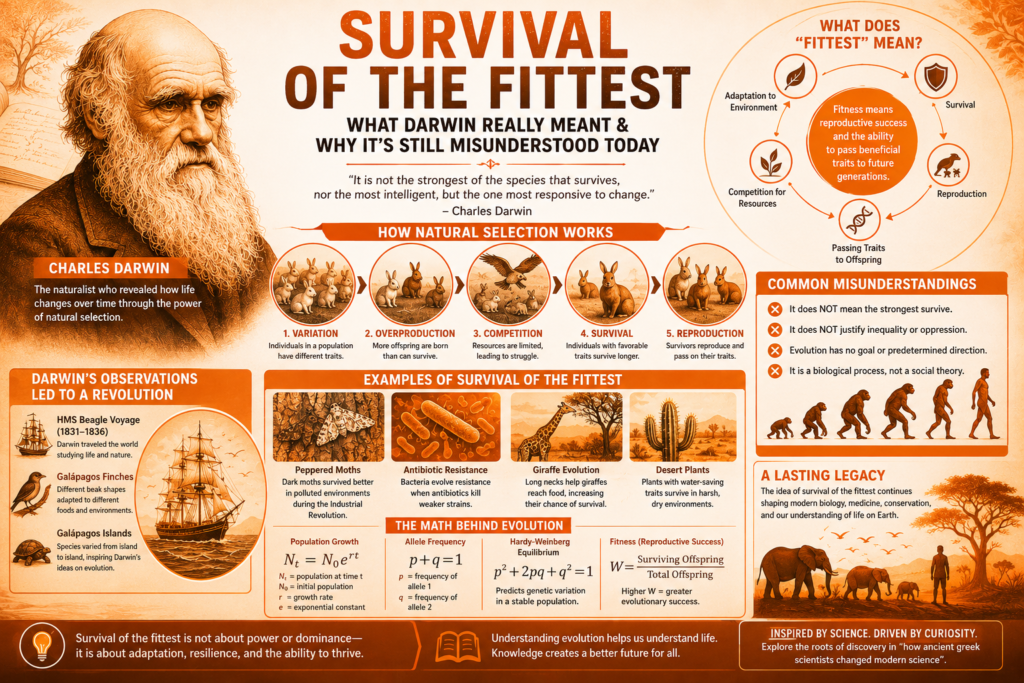
Survival of the fittest is one of the most famous phrases in science history, yet it is also one of the most misunderstood. Many people believe the phrase means only the strongest survive, but that is not what Darwinian evolution actually teaches.
In biology, survival of the fittest refers to organisms best adapted to their environment. Fitness in science means reproductive success and the ability to pass beneficial traits to future generations. Sometimes the fastest organism survives, while in other situations intelligence, camouflage, cooperation, or disease resistance matter more.
The misunderstanding surrounding survival of the fittest has created confusion about evolution, society, and human behavior for more than a century. Some people wrongly connected the phrase to social superiority or political ideology, even though Darwin’s biological theory focused on adaptation and natural selection in nature.
Today, modern evolutionary biology continues using the concept of survival of the fittest to explain adaptation, environmental pressure, and biological evolution. This article explores what the phrase truly means, where it came from, how Darwin used it, why it became controversial, and why it remains important in modern science.
The Origin of Survival of the Fittest (1850 – 1870)
The phrase survival of the fittest did not originally come from Charles Darwin himself. It was first introduced by philosopher Herbert Spencer after reading Darwin’s evolutionary ideas.
Spencer used the phrase to summarize the process of adaptation in nature. Later, Darwin accepted the expression because he believed it explained natural selection in simpler language.
Darwin included the phrase in later editions of on the origin of species, but he clarified that “fittest” did not mean physically strongest. Instead, it referred to organisms most suited to their environment.
For example:
- Desert plants survive because they conserve water
- Polar animals survive because they resist cold temperatures
- Camouflaged insects survive because predators cannot easily see them
Fitness depends entirely on environmental conditions.
This misunderstanding remains one of the biggest Darwinism misconceptions today.
Charles Darwin and Evolutionary Thinking
The scientific ideas behind survival of the fittest emerged from the work of Charles Darwin during the nineteenth century.
Darwin’s observations during the HMS beagle voyage changed his understanding of nature forever. While traveling around the world, he noticed that species differed from place to place and showed unique adaptations to local conditions.
The Galápagos Islands became especially important. Darwin studied birds, reptiles, and plants that appeared related yet adapted differently depending on their habitat.
These observations helped inspire Darwin’s revolutionary theory of natural selection.
According to Darwin, organisms with helpful inherited traits survive and reproduce more successfully over generations. Gradually, these beneficial adaptations become common within populations.
This process forms the foundation of biological evolution.
What Fitness Really Means in Science
One major misconception about survival of the fittest involves the scientific meaning of “fitness.”
In evolutionary biology, fitness refers to reproductive success rather than physical power.
An organism is considered “fit” if it:
- Survives long enough to reproduce
- Produces healthy offspring
- Passes beneficial genetic traits to future generations
Sometimes cooperation improves fitness more than aggression.
For example:
- Bees survive through colony cooperation
- Wolves hunt more effectively in groups
- Humans succeed through communication and social behavior
Fitness changes depending on the environment.
A trait helpful in one ecosystem may become harmful in another.
Mathematical Understanding of Evolutionary Fitness
Modern biology explains evolutionary adaptation using mathematical equations.
One important equation measures reproductive fitness:
Where:
- W = biological fitness
- Higher values indicate greater reproductive success
Population growth can also be represented mathematically:
Where:
- = population at time t
- = original population
- = growth rate
Natural selection changes allele frequencies in populations over generations:
Where:
- = frequency of one allele
- = frequency of another allele
Another important equation in population genetics is:
This Hardy-Weinberg equation helps scientists study evolutionary changes in populations.
These mathematical principles support modern evolutionary biology and adaptation theory.
Survival of the Fittest in Nature
Examples of survival of the fittest appear throughout the natural world.
Camouflage and Adaptation
Many insects evolved colors helping them blend into their surroundings. Camouflage improves survival by reducing predation.
Antibiotic Resistance
Bacteria resistant to antibiotics survive treatment while weaker bacteria die. Resistant strains reproduce and spread.
Arctic Animal Adaptation
Polar bears survive freezing climates because of thick fur and fat insulation.
Bird Beak Evolution
Darwin’s finches developed different beak shapes suited for specific food sources.
These examples demonstrate that adaptation matters more than brute force.
Misunderstanding Survival of the Fittest
Over time, many people distorted Darwin’s ideas.
Some social theorists incorrectly applied survival of the fittest to economics, politics, and human society. This became associated with Social Darwinism.
However, biological evolution does not justify social inequality or cruelty.
Darwin’s theory explained natural processes in ecosystems rather than moral or political systems.
Modern scientists strongly reject many historical distortions connected to Social Darwinism.
This confusion remains one of the biggest evolutionary biology myths in public discussion.
Survival of the Fittest and Environmental Pressure
Natural selection depends heavily on environmental conditions.
Environmental pressure may include:
- Climate change
- Predators
- Disease
- Food shortages
- Competition for mates
Organisms with favorable adaptations survive more successfully under these pressures.
For example:
- Long necks help giraffes reach food
- Thick fur protects animals from cold climates
- Sharp eyesight helps predators hunt effectively
The environment determines which traits become beneficial.
Adaptation Versus Strength
Many people mistakenly assume stronger organisms always survive. In reality, adaptation matters far more.
Small organisms often outperform larger ones under changing conditions.
For example:
- Cockroaches survive harsh environments
- Tiny bacteria adapt rapidly through mutation
- Plants evolve chemical defenses against insects
Evolution rewards flexibility and reproductive success rather than physical dominance alone.
This scientific reality explains why survival of the fittest should never be interpreted as “survival of the strongest.”
Darwin and Wallace: Shared Evolutionary Ideas
Another important figure connected to evolutionary thinking was Alfred Russel Wallace.
The partnership between darwin and wallace helped shape modern biology.
Wallace independently developed ideas similar to Darwin’s theory of natural selection. His work encouraged Darwin to publish his own findings after years of hesitation.
Together, Darwin and Wallace helped establish evolutionary science as a major scientific discipline.
Their discoveries transformed biology forever.
Survival of the Fittest and Genetics
Darwin did not fully understand genetics because DNA had not yet been discovered during his lifetime.
Modern science later connected evolution with genetics through mutation and inheritance.
Research linking darwin to DNA evolution revealed how genetic variation drives adaptation.
Mutations create new traits, while natural selection determines which traits spread through populations.
Modern evolutionary biology studies:
- Genetic lineage
- Mutation rates
- Reproductive success
- Population genetics
- Environmental adaptation
- Selective pressure
DNA evidence strongly confirms Darwinian evolution.
Why the Phrase Remains Controversial Today
Even today, survival of the fittest remains controversial because people often misunderstand its scientific meaning.
Common misconceptions include:
- Believing evolution favors only violence
- Thinking humans are “more evolved” than animals
- Assuming evolution has a final goal
- Confusing biological adaptation with moral superiority
In reality, evolution has no predetermined direction.
Natural selection simply favors traits improving survival and reproduction within specific environments.
Scientific understanding requires separating biology from political or ideological distortions.
Survival of the Fittest in Human Evolution
Humans also evolved through natural selection.
Important human adaptations include:
- Larger brains
- Language development
- Social cooperation
- Endurance walking
- Tool use
Interestingly, cooperation became one of humanity’s greatest survival strategies.
Groups sharing food, knowledge, and protection often survived more successfully than isolated individuals.
This reveals another major misunderstanding about survival of the fittest. Evolution frequently rewards teamwork rather than selfish aggression.
Modern Importance of Survival of the Fittest
The concept remains essential in many scientific fields today.
Scientists use evolutionary principles to study:
- Emerging diseases
- Vaccine development
- Climate adaptation
- Animal conservation
- Agricultural breeding
- Artificial intelligence systems
Understanding adaptation helps researchers predict how populations respond to environmental changes.
Without Darwinian evolution, modern biology would lack a unifying explanation for biodiversity and genetic change.
FAQs About Survival of the Fittest
What does survival of the fittest really mean?
It means organisms best adapted to their environment survive and reproduce more successfully.
Did Charles Darwin invent the phrase?
No. Herbert Spencer first introduced the phrase, although Darwin later adopted it.
Does survival of the fittest mean strongest survive?
No. Fitness refers to reproductive success and adaptation rather than physical strength alone.
Why is survival of the fittest misunderstood?
Many people incorrectly connected the phrase to social or political ideas instead of biological evolution.
How does natural selection relate to survival of the fittest?
Natural selection favors inherited traits improving survival and reproduction.
Is survival of the fittest still accepted today?
Yes. Modern evolutionary biology strongly supports natural selection and adaptation through genetics and fossil evidence.
Conclusion
Survival of the fittest remains one of the most important yet misunderstood concepts in science history. Darwin’s evolutionary ideas never claimed that only the strongest survive. Instead, the phrase explains how organisms best adapted to their environment pass successful traits to future generations.
Modern biology, genetics, and evolutionary science continue confirming the power of adaptation and natural selection. From bacteria resisting antibiotics to animals adapting to climate change, survival of the fittest remains visible throughout nature today.
The revolutionary scientific thinking behind evolution stands alongside the discoveries of many great thinkers whose ideas transformed civilization, including those explored in how ancient greek scientists changed modern science.