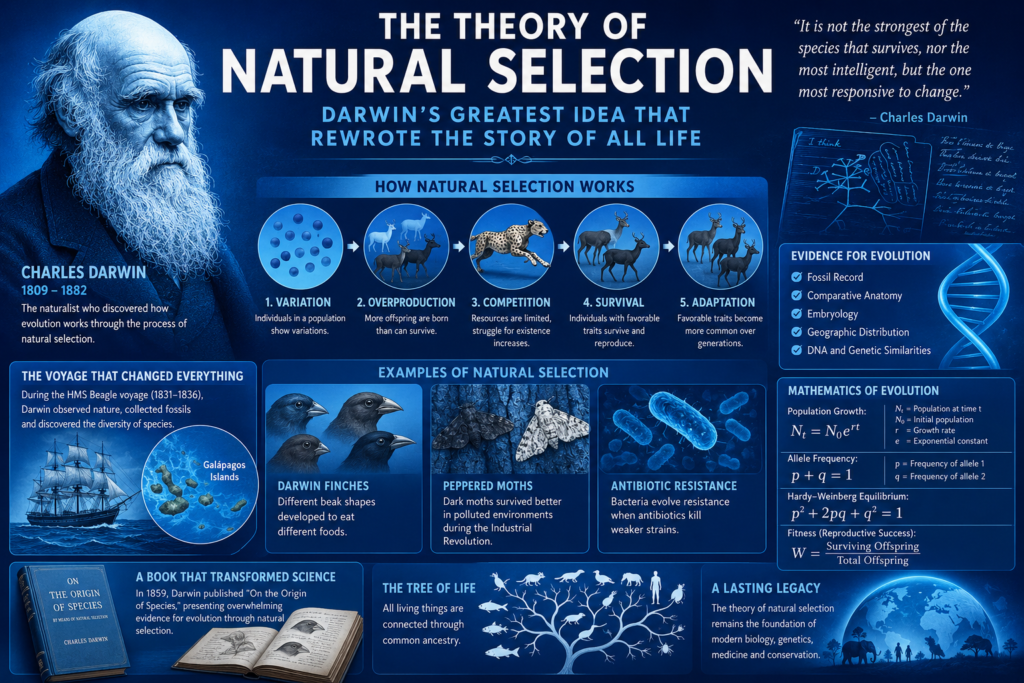
Theory of natural selection is one of the most important scientific ideas ever discovered. It completely transformed humanity’s understanding of life, evolution, and the natural world. Before this theory, many people believed every species had remained unchanged since creation. Charles Darwin introduced a radically different explanation supported by observation, evidence, and logic.
The theory of natural selection explains how living organisms gradually change over generations. Species adapt to their environment through inherited traits that improve survival and reproduction. Over millions of years, this process creates entirely new species and shapes the diversity of life on Earth.
Today, natural selection forms the foundation of modern biology, genetics, ecology, and medicine. Scientists use Darwinian selection to study antibiotic resistance, animal behavior, genetic adaptation, and environmental change.
This article explores the origin, mechanism, evidence, mathematical principles, and scientific impact of the theory of natural selection.
Early Scientific Ideas Before Darwin (1700 – 1830)
Before Darwin, scientists struggled to explain why living organisms looked so perfectly adapted to their environments. Most naturalists believed species were fixed and unchanging.
However, several thinkers began questioning these traditional beliefs. Fossils suggested ancient species had disappeared, while geological discoveries revealed Earth was far older than previously believed.
The work of geologist Charles Lyell strongly influenced Darwin. Lyell argued Earth changed slowly through gradual natural processes over immense periods of time.
Darwin also studied the writings of Thomas Malthus, who explained how populations grow faster than resources. This idea became essential to understanding competition in nature.
These scientific influences eventually helped Darwin develop the revolutionary theory of natural selection.
Charles Darwin and the Birth of Natural Selection (1831 – 1859)
The journey that shaped Darwin’s thinking began during the famous HMS beagle voyage. Between 1831 and 1836, Darwin traveled around the world studying plants, animals, fossils, and geological formations.
During the voyage, Darwin observed important patterns:
- Similar species varied across regions
- Fossils resembled living organisms
- Isolated islands contained unique species
- Animals showed adaptations suited to local environments
The Galápagos Islands became especially important. Darwin noticed that finches on different islands had different beak shapes adapted to specific food sources.
These observations inspired the ideas later associated with darwin finches and evolutionary adaptation.
After years of study and analysis, Darwin realized species were not fixed. Instead, they slowly evolved through environmental pressures and inherited variation.
How Natural Selection Works
The mechanism of evolution through natural selection depends on several important principles.
Variation Within Species
No two organisms are completely identical. Individuals within a population show differences in size, color, speed, intelligence, and resistance to disease.
Some variations are inherited genetically from parents.
Overproduction of Offspring
Most organisms produce more offspring than can survive. For example:
- Fish may lay thousands of eggs
- Plants produce hundreds of seeds
- Insects reproduce rapidly
Because resources are limited, competition naturally occurs.
Struggle for Survival
Organisms compete for:
- Food
- Shelter
- Water
- Mates
- Territory
This competition creates selective pressure within ecosystems.
Survival and Reproduction
Individuals with beneficial traits are more likely to survive and reproduce successfully. These helpful genetic traits become more common over generations.
This process became closely linked with the phrase survival of the fittest.
In evolutionary biology, “fitness” means reproductive success rather than physical strength alone.
Mathematical Understanding of Natural Selection
Modern evolutionary biology uses mathematics to explain population genetics and evolutionary adaptation.
One important equation is exponential population growth:
Where:
- Nt = population size at time t
- N0 = initial population
- r = growth rate
- e = exponential constant
This equation shows how populations grow rapidly under favorable conditions.
Another important principle in genetics is allele frequency:
Where:
- = frequency of one allele
- = frequency of another allele
Natural selection changes allele frequencies over time.
The Hardy-Weinberg equilibrium equation is also essential:
This equation predicts genetic variation in populations when evolution is absent.
Fitness in Darwinian selection can also be represented mathematically:
Organisms with higher fitness contribute more genes to future generations.
Natural Selection in the Galápagos Islands
One of the most famous examples of evolution involves galapagos islands and darwin.
The islands contained closely related species adapted to different environments. Darwin realized geographic isolation encouraged evolutionary change.
For example:
- Finches developed specialized beaks
- Tortoises evolved different shell shapes
- Marine iguanas adapted to ocean feeding
These adaptations improved survival under local environmental conditions.
The Galápagos observations provided strong evidence supporting biological evolution principles.
On the Origin of Species and Scientific Revolution (1859)
Darwin published his revolutionary book on the origin of species in 1859.
The book explained how natural selection drives evolutionary change over long periods of time.
Darwin supported his ideas using evidence from:
- Fossils
- Comparative anatomy
- Animal breeding
- Geographic distribution
- Embryology
- Artificial selection
The book shocked Victorian society but transformed biology forever.
Many scientists quickly recognized the power of Darwin’s explanation because it unified enormous amounts of biological evidence into one coherent scientific theory.
Descent With Modification and Common Ancestry
Darwin described evolution using the concept of descent with modification.
This idea means species gradually change while inheriting traits from ancestors.
According to Darwin:
- All living organisms share common ancestry
- Evolution creates branching relationships
- Species diverge over time
- Adaptation occurs through natural selection
Modern genetics strongly confirms this theory.
DNA analysis reveals remarkable similarities between species. Humans and chimpanzees share approximately 98.8% of their DNA, supporting common ancestry.
The idea also connects closely with the tree of life theory, which visualizes evolution as branching relationships between organisms.
Natural Selection Examples in Modern Science
Natural selection can still be observed today.
Antibiotic Resistance
Bacteria evolve resistance when antibiotics kill weaker individuals while resistant bacteria survive and reproduce.
Peppered Moths
During the Industrial Revolution, darker moths survived better in polluted forests because they blended into soot covered trees.
Animal Camouflage
Many organisms evolved camouflage to avoid predators or capture prey more effectively.
Climate Adaptation
Species today continue adapting to changing temperatures, habitats, and ecosystems.
These examples show that evolutionary adaptation remains an active process.
Darwin and Wallace: Shared Discovery (1858)
Before Darwin published his theory, Alfred Russel Wallace independently developed similar ideas about evolution.
The relationship between darwin and wallace became an important chapter in scientific history.
Wallace’s letter encouraged Darwin to publish his own work after decades of hesitation.
Both scientists presented their ideas together in 1858, although Darwin later became more famous because of the extensive evidence contained in his book.
Their collaboration helped launch the modern scientific revolution in biology.
Genetic Traits and Modern Evolutionary Biology
Darwin did not fully understand genetics because DNA had not yet been discovered.
Later scientists combined genetics with evolution to create the modern evolutionary synthesis.
Today, scientists understand that mutations create genetic variation. Natural selection then acts upon these variations.
Modern evolutionary biology studies:
- Mutation rates
- Population genetics
- Environmental pressure evolution
- Phenotype variation
- Genotype inheritance
- Ecosystem adaptation
This modern understanding connects Darwin’s ideas with genetics and molecular biology.
Natural Selection and Human Evolution
Natural selection also shaped human evolution.
Scientists believe humans evolved through gradual changes over millions of years.
Important adaptations include:
- Larger brains
- Upright walking
- Language abilities
- Complex social behavior
Fossils and DNA evidence strongly support human evolution through Darwinian selection.
Research linking darwin to DNA evolution has revealed how genetic mutations shaped human history and adaptation.
Why Natural Selection Matters Today
The theory of natural selection remains essential for understanding life on Earth.
It helps scientists study:
- Emerging diseases
- Vaccine development
- Conservation biology
- Artificial intelligence models
- Agricultural breeding
- Climate change adaptation
Without natural selection, modern biology would not exist.
The theory also explains biodiversity and the interconnected relationships between organisms within ecosystems.
Even fields such as psychology and computer science have borrowed evolutionary concepts from Darwinian selection.
FAQs About the Theory of Natural Selection
What is the theory of natural selection?
The theory of natural selection explains how organisms with beneficial inherited traits survive and reproduce more successfully over time.
Who created the theory of natural selection?
Charles Darwin developed the theory, although Alfred Russel Wallace independently proposed similar ideas.
Why is natural selection important?
Natural selection explains biological evolution, adaptation, and the diversity of life on Earth.
What is survival of the fittest?
It means organisms best adapted to their environment are more likely to survive and reproduce.
Does natural selection still happen today?
Yes. Natural selection continues affecting species through environmental changes, diseases, and genetic variation.
How does mutation affect evolution?
Mutations create genetic variation, providing new traits upon which natural selection can act.
Conclusion
The theory of natural selection completely transformed humanity’s understanding of life and evolution. Charles Darwin’s revolutionary idea explained how species adapt, survive, and evolve across millions of years through environmental pressure and inherited variation.
Today, natural selection remains one of the strongest scientific theories ever developed. It connects genetics, ecology, medicine, and evolutionary biology into a unified explanation of life on Earth. From fossils to DNA analysis, modern science continues confirming Darwin’s extraordinary insight into nature.
The scientific revolution created by Darwin stands beside the achievements of many other great thinkers whose discoveries shaped civilization, including those discussed in how ancient greek scientists changed modern science.