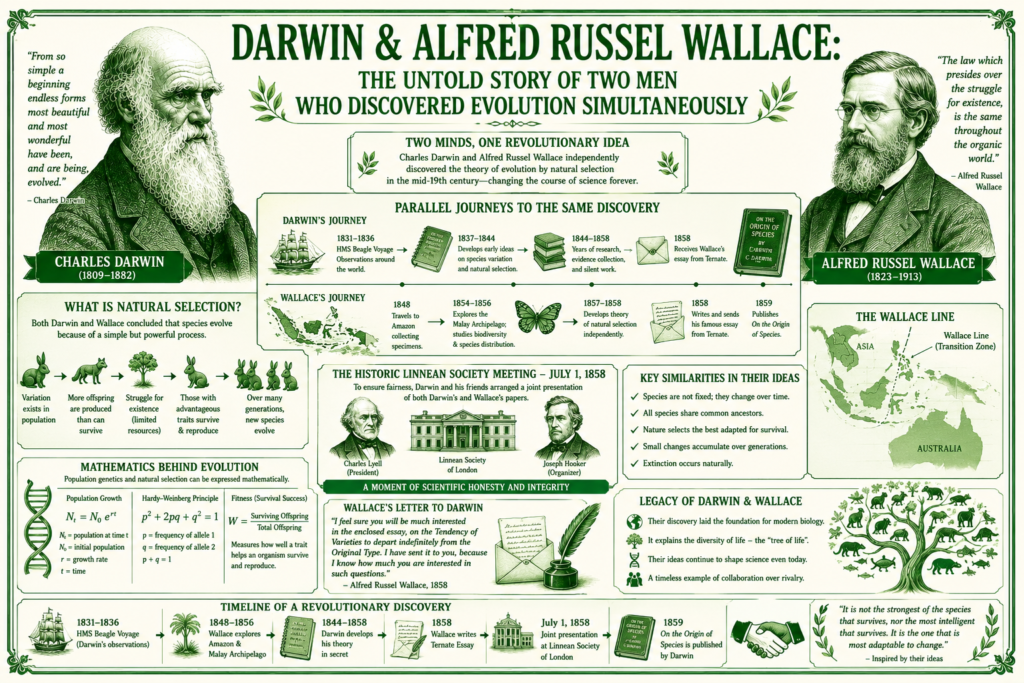
Darwin and wallace represent one of the most extraordinary stories in scientific history. Charles Darwin and Alfred Russel Wallace independently discovered the theory of evolution through natural selection, even though they worked thousands of miles apart under completely different circumstances. Their simultaneous discovery transformed biology forever and changed humanity’s understanding of life on Earth.
For many years, Charles Darwin received most of the public recognition for evolution. However, Alfred Russel Wallace played a critical role in developing evolutionary theory. Wallace independently reached conclusions remarkably similar to Darwin’s after studying plants, animals, geography, and biodiversity across South America and Southeast Asia.
The story of darwin and wallace is not merely about scientific discovery. It is also a story about intellectual honesty, friendship, competition, fear, and scientific cooperation. Rather than becoming bitter rivals, Darwin and Wallace handled one of science’s greatest priority disputes with unusual professionalism and respect.
Today, darwin and wallace remain central figures in evolutionary biology, natural history, and the history of science. Their discoveries laid the foundation for modern genetics, ecology, and evolutionary theory.
This article explores the journeys of Darwin and Wallace, the mathematics behind evolution, the famous Ternate essay, the Linnean Society meeting, and how two naturalists changed science simultaneously.
Two Naturalists From Different Backgrounds (1820 – 1840)
The story of darwin and wallace began with two very different men.
Charles Darwin
Charles Darwin came from a wealthy English family and studied at Cambridge University. He gained scientific experience during the famous HMS beagle voyage, where he collected fossils, animals, and geological observations.
Alfred Russel Wallace
Alfred Russel Wallace came from a much poorer background. He received limited formal education and worked as a surveyor and teacher before becoming a naturalist.
Despite their different lives, both men became fascinated by:
- Biodiversity
- Species variation
- Geography
- Natural history
- Adaptation
Their separate journeys eventually led toward the same revolutionary conclusion.
Darwin’s Early Evolutionary Ideas (1837 – 1844)
After returning from the HMS Beagle voyage, Darwin secretly began developing evolutionary ideas.
He studied:
- Fossils
- Animal breeding
- Geological change
- Island species
- Population growth
Darwin gradually developed the theory of natural selection.
He realized:
- Organisms produce more offspring than survive
- Individuals vary naturally
- Useful traits improve survival
- Advantageous traits spread through reproduction
Although Darwin understood the revolutionary importance of his theory, he delayed publication for decades.
The reasons behind why darwin delayed publication included fear of controversy, religious backlash, and scientific caution.
Wallace’s Journey Through the Amazon and Malay Archipelago
While Darwin privately refined his theory, Wallace traveled across dangerous tropical regions collecting specimens.
Wallace explored:
- The Amazon rainforest
- Southeast Asia
- Indonesia
- The Malay Archipelago
He studied insects, birds, mammals, and island biodiversity.
Wallace noticed species changed geographically across different environments.
His observations strongly supported evolution and adaptation.
Wallace also discovered the famous “Wallace Line,” a biogeographical boundary separating Asian and Australian species.
The Influence of Population Pressure
Both Darwin and Wallace were influenced by economist Thomas Malthus.
Malthus argued populations grow faster than available resources.
This idea became central to natural selection.
Population growth can be modeled mathematically:
Where:
- = population size at time t
- = initial population
- = growth rate
Because resources remain limited, organisms compete for survival.
This competition drives adaptation and evolutionary change.
Darwin and Wallace independently recognized this principle.
Wallace Discovers Natural Selection (1858)
The most dramatic moment in the story of darwin and wallace occurred in 1858.
While sick with malaria in Ternate, Indonesia, Wallace suddenly realized how evolution might work.
He wrote an essay explaining natural selection and mailed it to Darwin for feedback.
Darwin was shocked.
Wallace’s ideas closely matched Darwin’s unpublished theory developed over twenty years.
Darwin feared losing scientific priority after decades of research.
This became one of the greatest moments in scientific history.
The Ternate Essay
Wallace’s essay became known as the Ternate essay.
The paper described:
- Variation within species
- Competition for resources
- Environmental adaptation
- Survival advantages
- Evolutionary change
Wallace independently reached conclusions nearly identical to Darwin’s.
The coincidence astonished the scientific community.
Today, the Ternate essay remains one of the most famous scientific manuscripts ever written.
The Linnean Society Meeting (1858)
Rather than competing aggressively, Darwin and Wallace handled the situation cooperatively.
Friends of Darwin arranged a joint presentation at the Linnean Society of London in 1858.
The meeting included papers from both Darwin and Wallace.
This event officially introduced natural selection to the scientific world.
The collaboration between darwin and wallace became one of science’s greatest examples of professional integrity.
Mathematical Foundations of Evolution
Modern biology uses mathematics to study evolutionary principles first developed by darwin and wallace.
Allele frequencies follow:
Where:
- = frequency of one allele
- = frequency of another allele
The Hardy-Weinberg equilibrium equation models inheritance:
Evolutionary fitness can be represented mathematically:
Selection pressure can also be studied statistically through population genetics.
These equations later strengthened Darwinian evolution with quantitative scientific evidence.
On the Origin of Species (1859)
One year after the Linnean Society presentation, Darwin published on the origin of species.
The book provided overwhelming evidence supporting evolution.
Darwin discussed:
- Fossils
- Comparative anatomy
- Geographic variation
- Artificial selection
- Natural selection
The publication transformed biology permanently.
Although Wallace played a major role in discovering evolution, Darwin’s book became more influential because it contained decades of evidence and detailed explanation.
Darwin and Wallace Relationship
The relationship between darwin and wallace remained surprisingly respectful.
Wallace admired Darwin deeply and never attempted to attack Darwin’s reputation.
Darwin also treated Wallace generously and acknowledged his contributions publicly.
Unlike many scientific rivalries, darwin and wallace avoided bitterness and hostility.
Their cooperation remains unusual in scientific history.
Survival of the Fittest and Public Debate
The concept of survival of the fittest later became strongly associated with Darwinian evolution.
However, both Darwin and Wallace understood evolutionary fitness meant reproductive success rather than physical strength alone.
Public misunderstandings often distorted evolutionary theory.
Critics accused evolution of promoting atheism, immorality, or social inequality.
The later conflict involving darwin vs church intensified these controversies.
Wallace and Spiritualism
Although Darwin and Wallace agreed about evolution, they later disagreed on some philosophical issues.
Wallace became interested in spiritualism and believed certain human mental abilities could not be fully explained by natural selection.
Darwin remained more scientifically skeptical.
Despite these disagreements, Wallace continued supporting evolution throughout his life.
Darwin to DNA Evolution
Modern genetics strongly confirmed ideas first proposed by darwin and wallace.
Research involving darwin to DNA evolution revealed the molecular basis of heredity and adaptation.
DNA evidence now confirms:
- Common ancestry
- Mutation
- Evolutionary divergence
- Population variation
Modern evolutionary biology combines genetics, fossils, ecology, and molecular biology into a unified scientific framework.
Wallace’s Contributions Beyond Evolution
Wallace made many important scientific contributions beyond natural selection.
He studied:
- Biogeography
- Animal distribution
- Ecology
- Island biodiversity
- Environmental science
Many scientists now believe Wallace deserves greater recognition in biology history.
The story of darwin and wallace continues inspiring historians and scientists today.
Why Darwin and Wallace Still Matter Today
Darwin and wallace remain historically important because they transformed humanity’s understanding of life itself.
Their discoveries influenced:
- Biology
- Genetics
- Medicine
- Ecology
- Anthropology
- Psychology
Modern evolutionary science continues building upon ideas first developed independently by Darwin and Wallace.
Their work remains among the greatest scientific achievements in history.
FAQs About Darwin and Wallace
Who were Darwin and Wallace?
Charles Darwin and Alfred Russel Wallace independently discovered evolution through natural selection.
What was the Ternate essay?
It was Wallace’s 1858 paper explaining natural selection while he was in Indonesia.
Did Wallace copy Darwin?
No. Wallace independently developed similar evolutionary ideas.
Why is Darwin more famous than Wallace?
Darwin published a much larger and more detailed scientific book explaining evolution.
What was the Linnean Society meeting?
It was the 1858 presentation introducing natural selection publicly through papers by Darwin and Wallace.
Did Darwin and Wallace become enemies?
No. They maintained a respectful and cooperative scientific relationship.
Conclusion
Darwin and wallace created one of the most extraordinary scientific stories ever recorded. Working independently across different continents, both men discovered the principles of evolution and natural selection almost simultaneously. Their discoveries permanently transformed biology, science, and humanity’s understanding of life on Earth.
Although Charles Darwin became more famous through On the Origin of Species, Alfred Russel Wallace played an equally remarkable role in revealing evolution’s fundamental mechanisms. Together, Darwin and Wallace demonstrated how scientific truth can emerge independently through careful observation, curiosity, and evidence.
The historical importance of darwin and wallace stands beside the achievements of many great thinkers whose discoveries reshaped civilization, including those explored in how ancient greek scientists changed modern science.