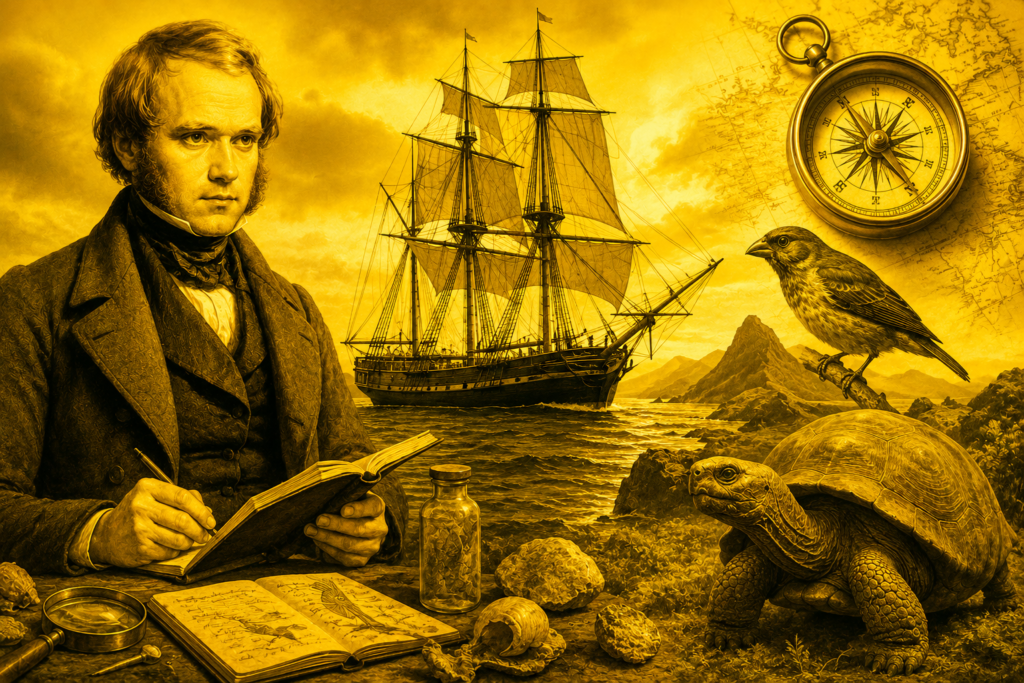
HMS beagle voyage was one of the most important scientific expeditions in human history. The five year journey completely transformed the thinking of Charles Darwin and eventually changed biology forever. Before the voyage, Darwin was a young naturalist with curiosity about nature. After the voyage, he possessed the observations and evidence that would later inspire the theory of evolution through natural selection.
The HMS beagle voyage lasted from 1831 to 1836 and traveled across South America, the Pacific Islands, Australia, and many other regions. During the expedition, Darwin studied fossils, plants, animals, rocks, ecosystems, and geological formations. He filled journals with observations that later became the foundation of evolutionary biology.
Today, the HMS beagle voyage remains one of the greatest scientific expeditions of the nineteenth century. It shaped modern science, transformed natural history, and forever changed humanity’s understanding of life on Earth.
This article explores the history of the HMS Beagle, Darwin’s discoveries, the scientific importance of the journey, and how the voyage helped launch evolutionary theory.
The World Before the HMS Beagle Voyage (1800 – 1831)
Before the HMS beagle voyage, most scientists believed species were fixed and unchanging. Many naturalists studied organisms, but there was no accepted scientific explanation for biodiversity and adaptation.
During the early nineteenth century:
- Fossils were being discovered worldwide
- Geologists debated Earth’s age
- Natural history collections expanded rapidly
- European exploration increased scientific knowledge
Young Charles Darwin initially planned to become a clergyman. He studied theology at Cambridge University but became fascinated with geology, insects, and natural history.
Darwin’s professor John Stevens Henslow recognized his scientific talent and recommended him for a position aboard the HMS Beagle.
That decision changed science forever.
The HMS Beagle and Captain Robert FitzRoy
The HMS Beagle was a British Royal Navy surveying ship designed for mapping coastlines and improving maritime navigation.
The expedition was commanded by Captain Robert FitzRoy, an intelligent and disciplined naval officer interested in science, navigation, and mapping.
The voyage had several goals:
- Improve South American maps
- Study coastlines and harbors
- Collect scientific data
- Observe natural environments
- Measure longitude using chronometers
Darwin joined the expedition as a naturalist and companion to FitzRoy.
Although Darwin lacked official naval duties, he spent the voyage collecting specimens, recording observations, and studying nature.
Departure and Early Challenges (1831)
The HMS beagle voyage officially began on December 27, 1831, departing from Plymouth, England.
Darwin struggled terribly with seasickness during the early months. Despite this discomfort, his excitement about exploration remained strong.
The ship crossed the Atlantic Ocean and arrived in South America, where Darwin began extensive scientific investigations.
The expedition used advanced maritime navigation methods involving:
- Chronometers
- Astronomical observations
- Mapping calculations
- Coastal surveying
Longitude calculations depended on time measurement:
Because Earth rotates 15 degrees every hour, accurate chronometers were essential for navigation.
These mathematical methods helped the Beagle create highly accurate maps.
Exploring South America (1832 – 1834)
South America became one of the most important regions during the HMS beagle voyage.
Darwin explored:
- Brazil
- Argentina
- Chile
- Uruguay
- Patagonia
- Tierra del Fuego
The biodiversity amazed him.
In Brazil, Darwin observed tropical rainforests filled with extraordinary plants and animals. He described the rainforest experience as one of the most beautiful moments of his life.
In Patagonia, Darwin discovered giant fossil bones belonging to extinct mammals.
These fossils strongly resembled modern animals, raising important questions about species relationships.
The discoveries connected closely with darwin fossil discoveries, which later became evidence supporting evolution.
Geological Discoveries and Earthquakes
Darwin also became deeply interested in geology during the voyage.
In Chile, he witnessed a powerful earthquake that lifted sections of coastline above sea level.
This event helped confirm geological ideas proposed by Charles Lyell, who argued Earth changes gradually over immense periods of time.
Darwin realized that slow geological processes could dramatically reshape the planet over millions of years.
This understanding later influenced his thinking about biological evolution and gradual species change.
Tierra del Fuego and Human Diversity
The expedition also explored Tierra del Fuego at the southern tip of South America.
Darwin encountered Indigenous peoples living in harsh environmental conditions. These experiences deeply influenced his thinking about human adaptation and cultural diversity.
Captain FitzRoy had previously brought several Fuegians to England before returning them during this voyage.
Darwin carefully documented these interactions in his journals and logbooks.
The experiences helped broaden his understanding of humanity and environmental adaptation.
The Galápagos Islands and Scientific Revolution (1835)
The most famous stage of the HMS beagle voyage occurred in the Galápagos Islands.
The islands contained unusual animals found nowhere else on Earth.
Darwin observed:
- Giant tortoises
- Marine iguanas
- Mockingbirds
- Unique plant species
- Different finch populations
The observations involving galapagos islands and darwin became central to evolutionary science.
Darwin noticed that species differed slightly from island to island while remaining clearly related.
The finches became especially important.
The discoveries involving darwin finches revealed birds with specialized beak shapes adapted to different food sources.
These observations strongly suggested species could gradually change through adaptation.
Natural Selection Begins to Form
Although Darwin did not fully develop evolution during the voyage itself, the journey planted the foundations for his future ideas.
He noticed several important patterns:
- Species varied geographically
- Fossils resembled living animals
- Organisms adapted to environments
- Islands contained related but distinct species
These observations eventually inspired the theory of natural selection.
Darwin later realized that natural selection could explain how species evolve gradually over generations.
Mathematical Principles Behind Population Growth
Modern evolutionary biology uses mathematics connected to ideas first inspired during the HMS beagle voyage.
Population growth can be represented mathematically as:
Where:
- = population size at time t
- = original population
- = growth rate
This equation demonstrates how populations expand rapidly under favorable conditions.
Population genetics also studies allele frequencies:
Where:
- p = frequency of one allele
- = frequency of another allele
Fitness in evolution can also be represented mathematically:
These principles later became central to evolutionary biology.
The Return to England (1836)
The HMS beagle voyage ended in October 1836 after nearly five years at sea.
Darwin returned to England with:
- Thousands of specimens
- Fossils and rocks
- Scientific journals
- Animal collections
- Plant samples
- Geological observations
Scientists quickly recognized the importance of his discoveries.
Darwin spent the following decades analyzing evidence and refining his evolutionary ideas.
From Voyage to On the Origin of Species
The HMS beagle voyage directly inspired Darwin’s later masterpiece, on the origin of species.
The observations collected during the expedition eventually helped Darwin explain:
- Adaptation
- Common ancestry
- Natural selection
- Evolutionary change
- Biodiversity
Without the voyage, Darwin likely would never have developed his revolutionary evolutionary theory.
The expedition became one of the greatest scientific journeys in history.
Darwin and Wallace: Shared Evolutionary Thinking
Another scientist connected to evolutionary theory was Alfred Russel Wallace.
The relationship between darwin and wallace became historically important because Wallace independently developed ideas similar to Darwin’s natural selection theory.
Wallace’s work encouraged Darwin to finally publish his ideas after many years of hesitation.
Together, they transformed biology forever.
Why the HMS Beagle Voyage Still Matters Today
The HMS beagle voyage remains important because it helped launch modern evolutionary science.
Darwin’s discoveries continue influencing:
- Genetics
- Ecology
- Medicine
- Conservation biology
- Anthropology
- Evolutionary theory
The voyage demonstrated the importance of observation, evidence collection, and scientific exploration.
Modern researchers still study Darwin’s journals, specimens, and route maps today.
The expedition also inspired future scientific voyages and natural history research worldwide.
Darwin’s Legacy After the Voyage
The scientific impact of the HMS beagle voyage extended far beyond Darwin’s lifetime.
Modern DNA analysis, fossil discoveries, and evolutionary biology continue supporting ideas that began forming during the expedition.
Research connecting darwin to DNA evolution later revealed how genetics supports common ancestry and adaptation.
The voyage remains one of humanity’s greatest examples of scientific curiosity and exploration.
FAQs About the HMS Beagle Voyage
What was the HMS Beagle voyage?
It was a five year scientific expedition that carried Charles Darwin around the world from 1831 to 1836.
Why was the HMS Beagle voyage important?
The voyage inspired Darwin’s ideas about evolution and natural selection.
Who commanded the HMS Beagle?
Captain Robert FitzRoy commanded the expedition.
What did Darwin discover during the voyage?
Darwin observed fossils, unique species, adaptation patterns, and biodiversity across many regions.
Why were the Galápagos Islands important?
The islands showed how species adapt differently to environments, helping inspire evolutionary theory.
Did Darwin create evolution during the voyage?
No. The voyage provided observations and evidence that later helped Darwin develop evolutionary theory.
Conclusion
The HMS beagle voyage completely transformed science and changed humanity’s understanding of life on Earth. Charles Darwin’s five year journey across oceans, islands, forests, and mountains provided the observations that later inspired evolutionary theory and natural selection.
From fossils in Patagonia to finches in the Galápagos Islands, every stage of the voyage helped reveal the extraordinary diversity and interconnectedness of life. Modern biology, genetics, and evolutionary science still depend on discoveries that began during this historic expedition.
The scientific legacy of the HMS beagle voyage stands beside the achievements of many great thinkers whose ideas reshaped civilization, including those explored in how ancient greek scientists changed modern science.