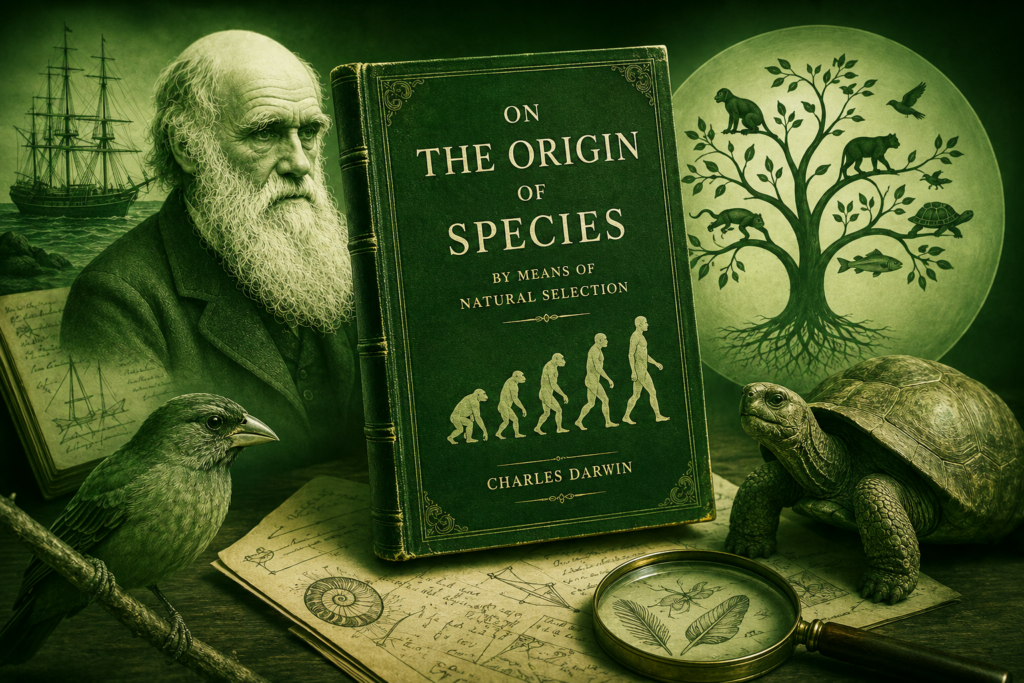
On the origin of species is one of the most important and controversial books ever written in human history. Published in 1859 by Charles Darwin, the book completely transformed humanity’s understanding of life, evolution, and nature itself. Before Darwin’s revolutionary work, most people believed species had remained unchanged since creation. Darwin challenged that belief with overwhelming scientific evidence and a powerful explanation of biological evolution.
The publication of on the origin of species shocked Victorian society, triggered intense scientific debates, and forever changed biology. Darwin introduced the theory of evolution through natural selection, explaining how species gradually adapt and evolve over millions of years.
Today, on the origin of species remains one of the foundations of modern science. Genetics, medicine, ecology, and evolutionary biology all trace their roots back to Darwin’s groundbreaking ideas.
This article explores the history, controversy, scientific arguments, mathematical principles, and lasting importance of Darwin’s most famous book.
The Scientific World Before Darwin (1700 – 1850)
Before Darwin published on the origin of species, many scientists believed species were fixed and independently created.
Although fossils suggested ancient organisms had existed and disappeared, there was no widely accepted scientific explanation for biological change.
Naturalists struggled to explain:
- Why organisms resembled one another
- Why fossils resembled living species
- Why isolated islands contained unique animals
- Why species adapted to specific environments
Geologists like Charles Lyell argued Earth was far older than previously believed. These discoveries opened the door for evolutionary thinking.
Darwin eventually combined geology, biology, observation, and natural history into a revolutionary scientific theory.
The HMS Beagle Voyage That Inspired Darwin (1831 – 1836)
Darwin’s scientific transformation began during the HMS beagle voyage.
Between 1831 and 1836, Darwin traveled around the world aboard the HMS Beagle. During the expedition, he studied fossils, plants, animals, and geological formations.
The journey exposed Darwin to extraordinary biodiversity and environmental adaptation.
One of the most important locations was the Galápagos Islands. There, Darwin observed closely related species showing important differences depending on local environments.
The observations involving darwin finches became especially significant. Different finch species possessed different beak shapes suited for different food sources.
These discoveries helped Darwin understand adaptation and common ancestry.
Darwin’s Revolutionary Theory
After returning to England, Darwin spent more than twenty years analyzing evidence and refining his ideas.
Eventually, he developed the theory of natural selection.
According to Darwin:
- Organisms produce more offspring than can survive
- Individuals vary within populations
- Some traits improve survival and reproduction
- Beneficial traits become more common over generations
This gradual process drives evolution.
Darwin described evolution as descent with modification, meaning species evolve from shared ancestors while slowly changing through inherited variation.
This idea directly challenged traditional beliefs about fixed species.
Why Darwin Delayed Publication (1837 – 1858)
One reason on the origin of species became so controversial was that Darwin understood how radical his ideas were.
The issue of why darwin delayed publication remains fascinating to historians today.
Darwin feared:
- Religious criticism
- Public controversy
- Scientific rejection
- Damage to his reputation
Victorian society strongly connected biological creation with religious belief. Darwin knew his theory could be viewed as heresy.
For more than two decades, Darwin quietly collected evidence before publishing his ideas.
However, in 1858, Alfred Russel Wallace independently developed a similar theory of evolution. This pushed Darwin to finally publish his work.
Publication of On the Origin of Species (1859)
Darwin’s book was officially published on November 24, 1859, by publisher John Murray.
The full title was:
On the Origin of Species by Means of Natural Selection
The first edition sold out immediately.
The book presented enormous evidence supporting evolution through natural selection. Darwin used examples from:
- Animal breeding
- Fossils
- Geography
- Comparative anatomy
- Embryology
- Variation within species
The publication marked a turning point in science history.
Mathematical Principles Supporting Evolution
Modern evolutionary biology uses mathematics to explain natural selection and population genetics.
Population growth can be represented mathematically as:
Where:
- = population size at time t
- = original population
- = growth rate
This equation demonstrates how populations expand under favorable conditions.
Allele frequencies within populations are represented as:
Where:
- = frequency of one allele
- = frequency of another allele
Another important equation is the Hardy-Weinberg equilibrium:
This equation helps scientists study genetic variation and evolutionary change.
Biological fitness can also be expressed mathematically:
These mathematical principles strongly support modern evolutionary biology.
Victorian Society Reacts to Darwin
The reaction to on the origin of species was immediate and dramatic.
Many scientists praised Darwin’s evidence and careful reasoning. Others strongly opposed his conclusions.
Religious critics believed evolution contradicted biblical teachings.
The controversy surrounding darwin vs church became one of the most famous scientific debates in history.
Public discussions about evolution spread throughout Britain and beyond.
Some people accused Darwin of attacking religion, while others defended evolution as a scientific explanation based on evidence.
The debates transformed Victorian intellectual culture forever.
Darwin and Wallace: Shared Evolutionary Discovery
Although Darwin became more famous, Alfred Russel Wallace also played an important role in evolutionary theory.
The partnership between darwin and wallace helped establish natural selection as a major scientific idea.
Wallace independently reached similar conclusions about evolution through environmental adaptation and survival.
Their combined contributions strengthened the scientific acceptance of evolutionary biology.
The Tree of Life and Common Ancestry
One of Darwin’s most revolutionary ideas involved common ancestry.
Darwin believed all species descended from shared ancestors through branching evolutionary processes.
This concept later became known as the tree of life theory.
According to Darwin:
- Species are biologically connected
- Evolution produces branching diversity
- Adaptation shapes organisms over time
- Life shares ancient origins
Modern genetics strongly supports these conclusions.
DNA analysis reveals remarkable genetic similarities between species, confirming Darwin’s insight into common descent.
Scientific Evidence Supporting Darwin Today
Modern science has overwhelmingly confirmed the central ideas presented in on the origin of species.
Important evidence includes:
Fossil Discoveries
Transitional fossils reveal gradual evolutionary change between species.
Genetics and DNA
Research connecting darwin to DNA evolution has shown how inherited genetic variation drives adaptation.
Comparative Anatomy
Many organisms share similar body structures because of common ancestry.
Embryology
Embryos of vertebrates show striking similarities during development.
Biogeography
Species distribution patterns strongly support evolutionary history.
Together, these discoveries provide overwhelming support for Darwin’s original theory.
Why On the Origin of Species Still Matters
Even after more than 160 years, on the origin of species remains essential to modern science.
The book influences:
- Biology
- Medicine
- Ecology
- Genetics
- Anthropology
- Conservation science
Evolutionary theory helps scientists understand:
- Antibiotic resistance
- Virus mutation
- Animal adaptation
- Human genetics
- Climate change responses
Without Darwin’s work, modern biology would not exist in its current form.
Misunderstanding Darwin’s Ideas
Many misconceptions still surround Darwin’s theory today.
Some people wrongly assume evolution means:
- “Humans evolved directly from monkeys”
- “Evolution has a final goal”
- “Only the strongest survive”
In reality, evolution involves adaptation, variation, and reproductive success.
Darwin’s theory focused on natural biological processes rather than social or political ideology.
Understanding these distinctions remains important in modern scientific education.
Darwin’s Legacy in Modern Science
Darwin’s ideas transformed biology into a unified scientific discipline.
His work inspired future discoveries in:
- Genetics
- Molecular biology
- Population genetics
- Evolutionary medicine
- Ecology
Today, scientists continue expanding evolutionary theory using advanced DNA sequencing and computational biology.
Darwin’s original vision remains one of humanity’s greatest scientific achievements.
FAQs About On the Origin of Species
What is on the origin of species about?
It explains evolution through natural selection and how species change over time.
Who wrote on the origin of species?
Charles Darwin wrote the book and published it in 1859.
Why was the book controversial?
It challenged traditional beliefs about creation and fixed species.
What theory did Darwin introduce?
Darwin introduced the theory of evolution through natural selection.
Is Darwin’s theory still accepted today?
Yes. Modern genetics, fossils, and biology strongly support evolution.
Why is on the origin of species important?
The book became the foundation of modern evolutionary biology and transformed scientific understanding of life.
Conclusion
On the origin of species remains one of the most influential and controversial books ever published. Charles Darwin’s revolutionary ideas transformed biology, challenged traditional beliefs, and introduced a scientific explanation for evolution through natural selection.
Modern science continues confirming Darwin’s extraordinary insight into common ancestry, adaptation, and biological change. From fossils to DNA sequencing, overwhelming evidence supports the evolutionary principles first presented in Darwin’s groundbreaking book.
The scientific revolution created by Darwin stands beside the achievements of many other great thinkers whose discoveries reshaped civilization, including those explored in how ancient greek scientists changed modern science.