Descent with modification is one of the most important ideas in evolutionary biology. Introduced by Charles Darwin, the concept explains how every living organism on Earth evolved from ancient ancestors through gradual genetic changes over billions of years. This simple yet revolutionary idea transformed science forever and became one of the foundations of modern biology.
Before Darwin, many people believed species never changed. Organisms were thought to exist in fixed forms created separately from one another. Darwin completely challenged this belief by showing that species evolve gradually over generations through inherited variation and adaptation.
Today, descent with modification remains central to genetics, paleontology, ecology, and evolutionary science. Modern DNA analysis strongly supports Darwin’s original ideas about common ancestry and biological change.
This article explores the meaning of descent with modification, the scientific evidence supporting it, its mathematical foundations, and why it remains one of the greatest scientific concepts ever developed.
The Scientific World Before Darwin (1700 – 1830)
Before Darwin introduced descent with modification, biology lacked a unified explanation for the diversity of life.
Scientists noticed many mysteries:
- Why species resembled one another
- Why fossils resembled living organisms
- Why isolated islands contained unusual species
- Why embryos of different animals looked similar
Most naturalists believed species were fixed and unchanging.
However, geologists like Charles Lyell showed Earth was far older than previously believed. Fossils revealed that ancient organisms had appeared and disappeared over millions of years.
These discoveries slowly prepared the scientific world for evolutionary thinking.
Eventually, Darwin provided the missing explanation.
Charles Darwin and the Birth of Evolutionary Thinking (1831 – 1859)
Darwin’s revolutionary ideas began during the HMS beagle voyage.
Between 1831 and 1836, Darwin traveled around the world observing geology, plants, animals, fossils, and ecosystems. The journey completely transformed his understanding of nature.
The Galápagos Islands became especially important.
Darwin noticed that organisms on different islands resembled one another while showing important differences. The observations involving darwin finches became famous because different finch species possessed different beak shapes suited for different foods.
Darwin realized these species likely descended from shared ancestors and gradually changed over time through adaptation.
These insights eventually became the foundation of descent with modification.
What Does Descent With Modification Mean?
Descent with modification means organisms inherit traits from ancestors while gradually changing over generations.
According to Darwin:
- Offspring resemble parents
- Small inherited variations naturally occur
- Helpful traits improve survival and reproduction
- Populations slowly change over time
- New species eventually emerge
Over millions of years, these gradual modifications create the enormous diversity of life on Earth.
The concept explains why organisms share similarities while also possessing differences.
For example:
- Humans, whales, and bats share similar bone structures
- Mammals possess related embryonic development
- Vertebrates share common anatomical patterns
These similarities suggest common ancestry.
The Theory of Natural Selection and Evolution
The mechanism driving descent with modification is the theory of natural selection.
Natural selection explains how organisms best adapted to their environment survive and reproduce more successfully.
Darwin identified several important principles:
- Organisms produce more offspring than can survive
- Individuals show natural variation
- Competition occurs for limited resources
- Beneficial traits improve survival
- Helpful traits become common over generations
This process gradually changes populations through evolutionary adaptation.
Natural selection acts continuously over immense periods of time, creating new species and biological diversity.
Mathematical Foundations of Evolutionary Change
Modern biology uses mathematics to explain evolutionary processes connected to descent with modification.
One important equation describes population growth:
Where:
- = population size at time t
- = initial population
- = growth rate
This equation demonstrates how populations expand under favorable environmental conditions.
Population genetics also uses allele frequency equations:
Where:
- = frequency of one allele
- = frequency of another allele
The Hardy-Weinberg equilibrium equation helps scientists study genetic variation:
Fitness in evolutionary biology can also be represented mathematically:
These equations help scientists analyze heredity, mutation, adaptation, and lineage divergence.
Fossils and Evolutionary Lineage
Fossils provide powerful evidence supporting descent with modification.
The fossil record shows gradual transitions between ancient and modern organisms.
Examples include:
- Fish evolving into amphibians
- Reptiles evolving into birds
- Land mammals evolving into whales
Darwin’s own studies of fossils strongly influenced his thinking about biological change.
The discoveries associated with darwin fossil discoveries helped demonstrate that species evolve gradually over geological time.
These transitional fossils support macroevolution evidence and common ancestry evolution.
DNA and Modern Evolutionary Biology
Modern genetics has strongly confirmed Darwin’s ideas.
Research connecting darwin to DNA evolution revealed that inherited genetic information drives evolutionary change.
DNA mutations create natural variation within populations.
Natural selection then favors beneficial traits improving reproductive success.
Modern biology discovered that:
- All organisms use DNA
- Species share genetic similarities
- Closely related organisms possess similar genomes
- Evolution leaves patterns within genetic sequences
For example:
- Humans share about 98.8% of DNA with chimpanzees
- Mammals share many genes and biological systems
- Organisms possess homologous structures inherited from ancestors
These discoveries strongly support descent with modification.
Common Ancestry and the Tree of Life
Descent with modification also explains the branching relationships between species.
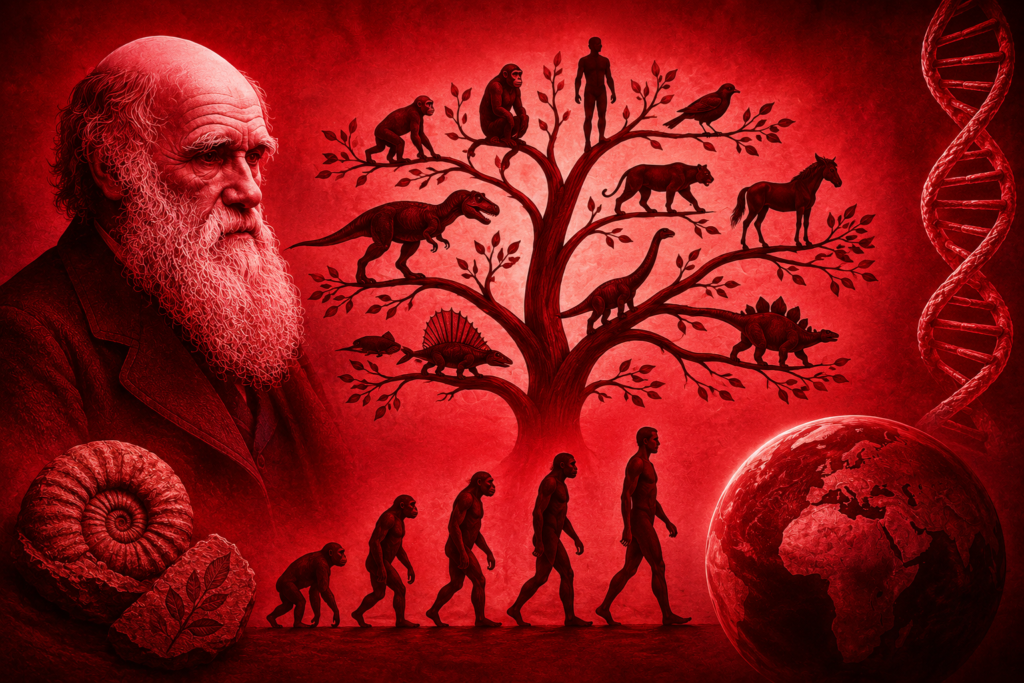
Darwin visualized evolution as a branching tree where all organisms connect through common ancestry.
This evolutionary framework later became known as the tree of life theory.
According to this concept:
- Ancient ancestors form the root
- Species diverge like branches
- New species emerge through adaptation
- Biodiversity expands over time
Modern phylogenetics and DNA sequencing continue supporting this branching model of evolution.
Microevolution and Macroevolution
Descent with modification operates on both small and large evolutionary scales.
Microevolution
Microevolution involves small genetic changes within populations over shorter periods.
Examples include:
- Antibiotic resistance in bacteria
- Changes in insect coloration
- Adaptation to climate conditions
Macroevolution
Macroevolution involves large evolutionary changes creating new species and major biological groups over millions of years.
Examples include:
- Evolution of mammals
- Evolution of birds from dinosaurs
- Evolution of whales from land mammals
Both processes support evolutionary biology concepts and Darwinian inheritance.
Embryology and Homologous Structures
Embryonic development provides another important line of evidence for descent with modification.
Embryos of vertebrates show remarkable similarities during early development stages.
For example:
- Fish, birds, reptiles, and mammals all display related embryonic patterns
- Vertebrates share common skeletal structures
- Similar organs appear in related species
These homologous structures strongly support common ancestry.
Scientists use comparative anatomy and embryology to study evolutionary relationships today.
Darwin and Wallace: Shared Evolutionary Discovery
The development of evolutionary theory was also influenced by Alfred Russel Wallace.
The collaboration between darwin and wallace played a major role in the scientific acceptance of evolution.
Wallace independently developed ideas similar to Darwin’s natural selection theory.
Together, their discoveries transformed humanity’s understanding of life and heredity.
Why Descent With Modification Matters Today
Descent with modification remains one of the most important concepts in modern science.
It helps scientists understand:
- Biodiversity
- Genetics
- Disease evolution
- Conservation biology
- Human ancestry
- Environmental adaptation
Evolutionary theory also supports medical research involving viruses, bacteria, and genetic disorders.
Without descent with modification, modern biology would lack a unifying explanation for life’s diversity.
Misunderstanding Evolutionary Change
Some people mistakenly believe descent with modification means organisms suddenly transform into entirely different creatures.
In reality, evolution occurs gradually over enormous spans of time through small inherited changes.
Evolution does not follow a predetermined direction or final goal.
Instead:
- Populations adapt to environments
- Genetic variation accumulates
- Natural selection shapes survival
- Species gradually diverge
Understanding these principles helps explain how all life on Earth became interconnected through common ancestry.
FAQs About Descent With Modification
What does descent with modification mean?
It means species inherit traits from ancestors while gradually changing over generations through evolution.
Who introduced descent with modification?
Charles Darwin introduced the concept as part of evolutionary theory.
How does natural selection relate to descent with modification?
Natural selection drives evolutionary change by favoring beneficial inherited traits.
What evidence supports descent with modification?
Fossils, DNA sequencing, embryology, comparative anatomy, and genetics all support evolutionary change.
Is descent with modification accepted today?
Yes. Modern evolutionary biology strongly supports the concept through overwhelming scientific evidence.
Why is descent with modification important?
It explains biodiversity, common ancestry, and how species evolved across billions of years.
Conclusion
Descent with modification completely transformed humanity’s understanding of life, evolution, and biological diversity. Charles Darwin’s revolutionary insight revealed that every living organism shares connections through common ancestry and gradual evolutionary change.
Modern genetics, fossils, embryology, and DNA sequencing continue confirming Darwin’s extraordinary ideas. From bacteria to humans, all life on Earth evolved through inherited variation, natural selection, and adaptation across billions of years.
The scientific importance of descent with modification remains enormous because it unifies biology into one powerful explanation of life itself. Darwin’s discoveries stand beside the achievements of many great thinkers whose work reshaped civilization, including those explored in how ancient greek scientists changed modern science.