Darwin orchid research became one of the most fascinating scientific achievements in botanical history. While most people remember Charles Darwin for evolution and natural selection, his detailed work on orchids transformed humanity’s understanding of pollination, plant adaptation, and coevolution between flowers and insects.
Darwin realized orchids were not merely beautiful plants. They were highly specialized evolutionary systems shaped through millions of years of adaptation. By carefully studying orchid structures, Darwin demonstrated how flowers and pollinating insects evolved together in extraordinary ways.
The discoveries connected to darwin orchid research provided powerful evidence supporting evolution and natural selection. Darwin showed that even tiny floral structures could reveal deep evolutionary relationships and biological adaptation.
Today, darwin orchid research remains central to evolutionary botany, pollination biology, ecology, and plant science. Scientists continue studying orchids to understand coevolution, reproductive strategies, and biodiversity.
This article explores Darwin’s orchid experiments, the science of pollination, mathematical principles behind plant reproduction, and how darwin orchid research advanced evolutionary biology forever.
Darwin’s Fascination With Plants (1850 – 1877)
After publishing on the origin of species, Darwin became increasingly interested in plants and reproduction.
He realized flowers contained remarkable adaptations for survival and fertilization.
Darwin carefully studied:
- Flower morphology
- Pollination systems
- Nectar production
- Insect interactions
- Cross fertilization mechanisms
Among all flowers, orchids fascinated him the most because of their extraordinary complexity.
Darwin believed orchids provided strong evidence for the theory of natural selection.
Their intricate structures appeared perfectly adapted for interaction with specific pollinators.
The Fertilization of Orchids (1862)
Darwin published his famous orchid book in 1862 titled:
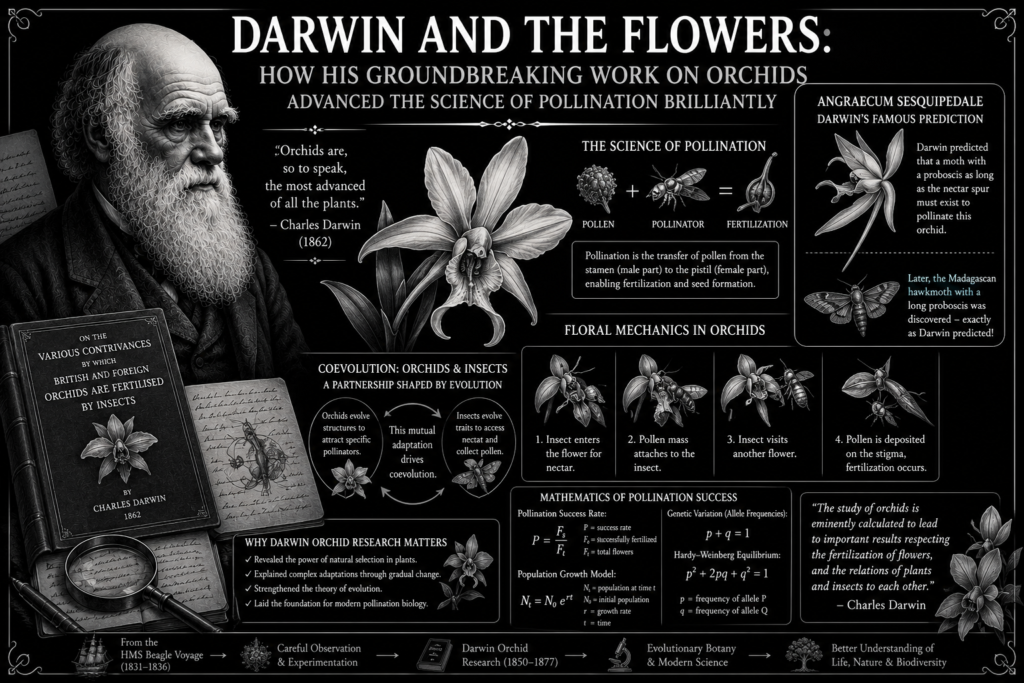
On the Various Contrivances by Which British and Foreign Orchids Are Fertilised by Insects
The book became one of the greatest works in evolutionary botany history.
In the book, Darwin explained how orchids evolved specialized mechanisms helping insects transfer pollen between flowers.
Darwin argued these floral adaptations did not appear suddenly.
Instead, they evolved gradually through natural selection over countless generations.
Darwin orchid research therefore became another major piece of evidence supporting evolution.
What Made Orchids So Special?
Orchids possess some of the most complex reproductive systems in nature.
Darwin discovered that orchid flowers evolved structures specifically designed for pollination by insects.
These structures included:
- Nectar tubes
- Sticky pollen masses
- Specialized petals
- Trigger mechanisms
- Unique floral symmetry
Different orchid species evolved to attract different pollinators including:
- Bees
- Butterflies
- Moths
- Beetles
- Birds
Darwin realized flowers and insects influenced each other’s evolution through coevolution.
Coevolution Between Orchids and Insects
One of the greatest insights from darwin orchid research involved coevolution.
Coevolution occurs when two species evolve together because each influences the other’s survival and reproduction.
Darwin observed that:
- Orchids evolved structures matching insect anatomy
- Insects evolved feeding organs suited to flowers
- Pollination systems became increasingly specialized
This relationship created biological partnerships between plants and pollinators.
For example:
- Long nectar tubes favored insects with long proboscises
- Insects carrying pollen improved plant reproduction
- Better pollination increased evolutionary fitness
Darwin realized evolution could create highly sophisticated biological interactions.
Angraecum sesquipedale and Darwin’s Prediction
One of Darwin’s most famous scientific predictions emerged from darwin orchid research.
Darwin studied an orchid from Madagascar called Angraecum sesquipedale.
The flower possessed a nectar spur approximately 30 centimeters long.
Darwin predicted a moth with an equally long proboscis must exist to pollinate it.
At the time, critics mocked the idea.
However, decades later scientists discovered a giant hawkmoth with the exact tongue length Darwin predicted.
This became one of the most famous confirmations of evolutionary science and coevolutionary biology.
Mathematical Understanding of Pollination and Evolution
Modern plant biology uses mathematics to study pollination systems and evolutionary adaptation connected to darwin orchid research.
Population growth can be represented mathematically:
Where:
- = population size at time t
- = original population
- = growth rate
Genetic variation follows allele frequency equations:
Where:
- = frequency of one allele
- = frequency of another allele
The Hardy-Weinberg equation studies genetic inheritance:
Pollination efficiency can also be modeled mathematically:
Where:
- = pollination success rate
- = successfully fertilized flowers
- = total flowers
These equations help scientists analyze reproduction, adaptation, and floral evolution.
Cross Pollination Versus Self Pollination
Darwin strongly believed cross pollination improved evolutionary success.
He discovered cross fertilization produced:
- Stronger offspring
- Greater genetic variation
- Improved adaptability
- Better reproductive fitness
Darwin orchid research showed many flowers evolved mechanisms preventing self pollination.
These mechanisms encouraged pollen transfer between different plants, increasing biodiversity and genetic diversity.
This insight later became extremely important in genetics and plant breeding science.
Floral Mechanics and Orchid Morphology
Darwin carefully examined orchid anatomy in extraordinary detail.
He studied:
- Pistils
- Stamens
- Pollen packets
- Nectar glands
- Flower symmetry
Many orchids possess mechanical systems activated when insects enter flowers.
Some orchids attach sticky pollen directly onto insects’ bodies.
Others temporarily trap insects to ensure pollination occurs.
Darwin recognized these floral mechanics as evidence for gradual evolutionary adaptation.
Sexual Selection and Plant Attraction
Darwin orchid research also connected closely with sexual selection theory.
Flowers evolved attractive colors, shapes, and scents to attract pollinators.
In many ways, floral attraction resembles animal courtship behavior.
Bright petals, nectar rewards, and floral fragrances increase reproductive success just as ornaments help animals attract mates.
Darwin realized reproduction shapes evolution throughout both plant and animal kingdoms.
Darwin and the Broader Evolutionary Picture
Darwin orchid research expanded evolutionary theory beyond animals.
Darwin demonstrated that:
- Plants evolve through adaptation
- Reproductive success shapes evolution
- Complex biological systems evolve gradually
- Nature contains interconnected relationships
His orchid work strongly supported descent with modification and common ancestry.
The detailed adaptations observed in orchids could not easily be explained without evolution.
Darwin to DNA Evolution and Modern Genetics
Modern molecular biology strongly supports darwin orchid research.
Scientists now study:
- Orchid genomes
- Pollination genes
- Floral developmental pathways
- Plant reproduction genetics
Research involving darwin to DNA evolution revealed how genes control flower color, shape, scent, and pollinator attraction.
DNA sequencing also helps scientists trace evolutionary relationships between orchid species.
Modern genetics continues confirming Darwin’s botanical insights.
Pollination and Ecosystem Importance
Pollination remains one of the most important biological processes on Earth.
Pollinators support:
- Flowering plant reproduction
- Food production
- Ecosystem stability
- Biodiversity maintenance
Without pollination:
- Many plants could not reproduce
- Ecosystems would collapse
- Agricultural production would decline
Darwin orchid research helped scientists understand the deep ecological importance of plant pollination systems.
Why Darwin Orchid Research Still Matters Today
Darwin orchid research remains scientifically important because it demonstrated evolution operating within highly specialized biological systems.
The research continues influencing:
- Evolutionary botany
- Ecology
- Agriculture
- Conservation biology
- Genetics
- Pollination science
Modern climate change and pollinator decline make Darwin’s discoveries even more relevant today.
Scientists continue studying orchid pollination to understand biodiversity and ecosystem resilience.
FAQs About Darwin Orchid Research
What was darwin orchid research about?
Darwin studied how orchids evolved specialized pollination systems involving insects.
Why were orchids important to Darwin?
Orchids provided strong evidence for natural selection and evolutionary adaptation.
What did Darwin predict about orchids?
Darwin predicted a moth with a very long proboscis must exist to pollinate a Madagascar orchid.
What is coevolution in orchids?
Coevolution occurs when orchids and pollinators evolve together through mutual adaptation.
How did Darwin study pollination?
He observed flower structures, insect behavior, fertilization systems, and reproductive mechanisms.
Why is darwin orchid research important today?
It helped establish evolutionary botany and modern pollination science.
Conclusion
Darwin orchid research completely transformed scientific understanding of flowers, pollination, and plant evolution. By studying orchids in extraordinary detail, Charles Darwin revealed how natural selection shapes even the smallest biological structures through adaptation and reproductive success.
From coevolution between flowers and insects to the famous hawkmoth prediction, Darwin’s orchid studies became some of the strongest evidence supporting evolutionary biology. Modern genetics, ecology, and botany continue confirming the remarkable discoveries Darwin first uncovered through his groundbreaking orchid research.
The scientific importance of darwin orchid research stands beside the achievements of many great thinkers whose discoveries reshaped civilization, including those explored in how ancient greek scientists changed modern science.