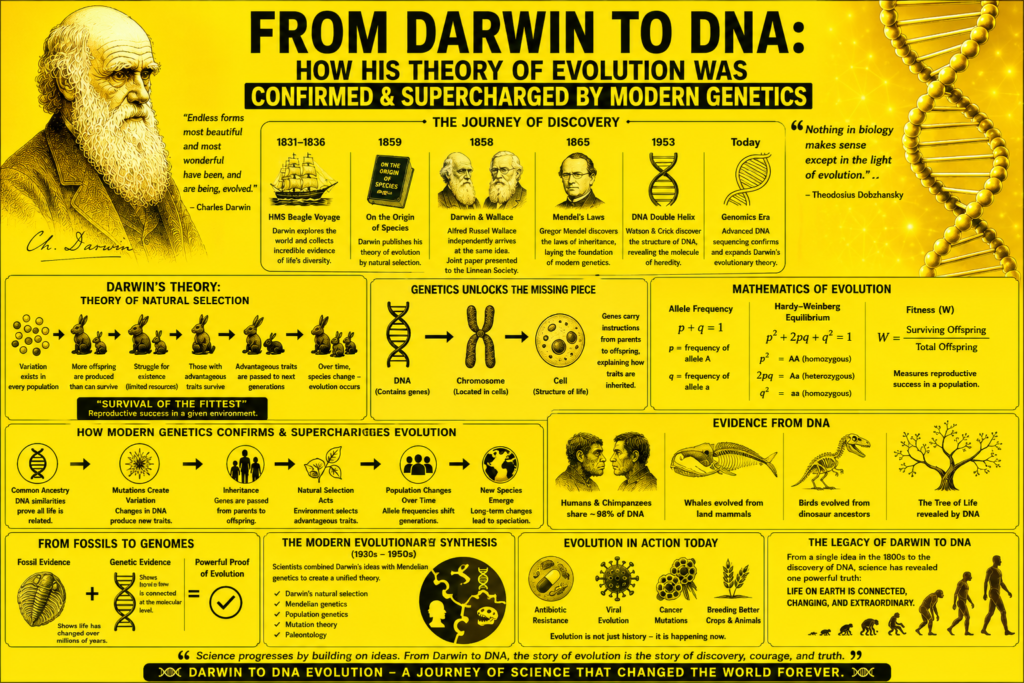
Darwin to dna evolution represents one of the greatest scientific journeys in human history. When Charles Darwin published his theory of evolution in 1859, he explained how species change through natural selection. However, Darwin could not explain exactly how traits were inherited from parents to offspring. The science of genetics did not yet exist.
More than a century later, discoveries involving DNA, chromosomes, genes, and molecular biology confirmed Darwin’s ideas with extraordinary precision. Modern genetics not only supported evolution but also strengthened and expanded it into one of the most powerful scientific theories ever developed.
Today, darwin to dna evolution connects evolutionary biology with genetics, molecular biology, medicine, ecology, and biotechnology. Scientists now trace evolutionary relationships using DNA sequencing, genetic mutations, and genome analysis.
The story of darwin to dna evolution reveals how science progresses over generations. Darwin provided the framework for evolution, while later scientists uncovered the molecular mechanisms driving inheritance and adaptation.
This article explores Darwin’s original theory, Gregor Mendel’s genetics, the discovery of DNA, mathematical population genetics, and how modern molecular biology confirmed evolution forever.
Darwin’s Original Theory of Evolution (1859)
When Charles Darwin published on the origin of species, he introduced the revolutionary theory of natural selection.
Darwin proposed:
- Organisms vary naturally
- More offspring are produced than survive
- Individuals compete for resources
- Useful traits improve survival and reproduction
- Advantageous traits spread through populations
Darwin called this process natural selection.
The theory explained adaptation, biodiversity, and species change over time.
However, Darwin faced one major scientific problem:
He did not know how inheritance worked.
The Missing Piece in Darwin’s Theory
Darwin understood traits pass between generations, but genetics had not yet been discovered.
Scientists during Darwin’s era did not know about:
- DNA
- Genes
- Chromosomes
- Mutations
- Molecular inheritance
Without genetics, critics questioned how useful traits could remain stable across generations.
The mystery of heredity remained unresolved during Darwin’s lifetime.
This missing mechanism became one of the greatest challenges facing early evolutionary biology.
Gregor Mendel and the Birth of Genetics (1865)
While Darwin developed evolution, another scientist named Gregor Mendel quietly studied inheritance in pea plants.
Mendel discovered:
- Traits are inherited through discrete units
- Dominant and recessive patterns exist
- Mathematical inheritance laws govern genetics
Mendel’s discoveries later became foundational for darwin to dna evolution.
Mendel’s inheritance equations included:
For dominant versus recessive trait ratios in monohybrid crosses.
And:
For dihybrid inheritance patterns.
Although Mendel’s work remained largely ignored initially, it later solved Darwin’s inheritance problem.
DNA and the Discovery of the Double Helix (1953)
One of the greatest moments in the story of darwin to dna evolution occurred in 1953.
James Watson and Francis Crick discovered the double helix structure of DNA.
DNA became recognized as the molecule carrying genetic information.
The structure revealed how hereditary information could:
- Replicate
- Mutate
- Pass between generations
- Produce variation
DNA finally explained the molecular basis of evolution.
Darwin’s theory suddenly gained an extraordinary level of biological support.
What Is DNA?
DNA stands for deoxyribonucleic acid.
DNA contains genetic instructions controlling organism development and inheritance.
DNA consists of four nucleotide bases:
- Adenine (A)
- Thymine (T)
- Cytosine (C)
- Guanine (G)
The double helix structure stores biological information within genetic sequences.
Mutations in DNA create variation that natural selection can act upon.
Darwin to dna evolution therefore connected natural selection directly with molecular biology.
Chromosomes and Genetic Inheritance
Scientists later discovered DNA exists within chromosomes inside cells.
Chromosomes contain genes inherited from parents.
Humans possess:
- 23 chromosome pairs
- Approximately 20,000 genes
- Billions of DNA base pairs
Genetic inheritance follows predictable mathematical patterns.
Allele frequencies can be represented as:
Where:
- = frequency of one allele
- = frequency of another allele
These principles became central to population genetics and evolutionary biology.
Hardy-Weinberg Equilibrium
The Hardy-Weinberg equation became one of the most important mathematical tools in darwin to dna evolution.
The equation is:
Where:
- = homozygous dominant frequency
- = heterozygous frequency
- = homozygous recessive frequency
This equation helps scientists analyze:
- Evolutionary change
- Population stability
- Mutation effects
- Natural selection
Population genetics became powerful evidence supporting evolution mathematically.
Mutations and Evolutionary Variation
Modern genetics revealed mutations create biological variation.
Mutations involve changes in DNA sequences caused by:
- Radiation
- Replication errors
- Environmental factors
- Chemical exposure
Most mutations are neutral or harmful, but some improve survival and reproduction.
Natural selection acts upon these variations.
This process directly supports Darwinian evolution.
Darwin to dna evolution therefore united natural selection with molecular inheritance.
Modern Evolutionary Synthesis (1930 – 1950)
Scientists eventually combined Darwinian evolution with genetics in a framework called the Modern Evolutionary Synthesis.
This synthesis connected:
- Natural selection
- Mendelian genetics
- Population biology
- Mutation theory
- Paleontology
The modern synthesis became one of biology’s greatest scientific achievements.
It transformed darwin to dna evolution into a unified scientific framework.
Fossils and DNA Evidence Together
Modern science combines fossils with genetics to reconstruct evolutionary history.
Research involving darwin fossil discoveries showed physical evidence of extinct organisms.
DNA analysis later confirmed many fossil based evolutionary relationships.
Examples include:
- Human ancestry
- Whale evolution
- Bird dinosaur connections
- Mammalian diversification
Fossils and genetics now support evolution simultaneously.
Common Ancestry and the Tree of Life
DNA strongly supports the tree of life theory.
Scientists compare genetic similarities between organisms to trace evolutionary ancestry.
For example:
- Humans share approximately 98% of DNA with chimpanzees
- Mammals share many common genes
- Universal genetic codes exist across life
These patterns strongly support common descent.
Darwin to dna evolution therefore confirmed evolutionary relationships at the molecular level.
Natural Selection and Modern Genetics
Modern genetics strengthened the theory of natural selection enormously.
Scientists now directly observe:
- Genetic mutations
- Allele frequency changes
- Bacterial evolution
- Viral adaptation
- Antibiotic resistance
Evolution is no longer just historical inference.
It can be observed experimentally in real time.
Survival of the Fittest and Molecular Biology
The phrase survival of the fittest gained scientific precision through genetics.
Evolutionary fitness now includes:
- Reproductive success
- Genetic inheritance
- Adaptive mutations
- Population survival
Fitness can be represented mathematically:
Modern molecular biology allows scientists to measure evolutionary fitness genetically.
Darwin and Wallace in Modern Evolution
The discoveries of darwin and wallace laid the foundation for modern genetics and evolutionary science.
Although Darwin and Wallace lacked molecular biology, their evolutionary principles remain central today.
Modern genetics confirmed their revolutionary insights with overwhelming evidence.
DNA Sequencing and Genome Mapping
Modern genome sequencing transformed darwin to dna evolution even further.
Scientists now map entire genomes for:
- Humans
- Animals
- Plants
- Bacteria
- Viruses
Genome comparisons reveal evolutionary relationships with extraordinary accuracy.
DNA sequencing also helps scientists study:
- Genetic drift
- Mutation rates
- Population migration
- Evolutionary divergence
The molecular evidence for evolution became undeniable.
Evolution and Modern Medicine
Darwin to dna evolution also transformed medicine.
Evolutionary genetics now helps scientists understand:
- Disease resistance
- Viral evolution
- Cancer mutations
- Antibiotic resistance
- Human genetic disorders
Medicine increasingly relies on evolutionary biology and molecular genetics.
Darwin’s ideas now influence healthcare worldwide.
Why Darwin to DNA Evolution Still Matters Today
Darwin to dna evolution remains scientifically important because it unified biology into a coherent framework explaining life itself.
The theory now influences:
- Genetics
- Medicine
- Ecology
- Biotechnology
- Conservation biology
- Artificial intelligence
Modern biology would be impossible without the evolutionary framework strengthened through DNA science.
FAQs About Darwin to DNA Evolution
What is darwin to dna evolution?
It refers to how modern genetics confirmed and expanded Darwin’s theory of evolution.
Did Darwin know about DNA?
No. DNA was discovered decades after Darwin’s death.
Who discovered genetics?
Gregor Mendel discovered inheritance laws through pea plant experiments.
How does DNA support evolution?
DNA reveals common ancestry, mutation patterns, and inherited genetic variation.
What is the modern evolutionary synthesis?
It is the combination of Darwinian evolution and modern genetics.
Why is darwin to dna evolution important?
It explains how evolution works at the molecular and genetic level.
Conclusion
Darwin to dna evolution became one of the greatest scientific triumphs in history because modern genetics confirmed and strengthened Darwin’s original theory of evolution. Charles Darwin provided the revolutionary framework explaining natural selection and species change, while later discoveries involving DNA, chromosomes, and molecular biology revealed the hidden mechanisms driving inheritance and adaptation.
From Gregor Mendel’s pea plants to Watson and Crick’s double helix, the scientific journey from Darwin to DNA transformed humanity’s understanding of life itself. Modern genetics now provides overwhelming evidence supporting evolution through fossils, genomes, mutations, and population biology.
The scientific importance of darwin to dna evolution stands beside the achievements of many great thinkers whose discoveries reshaped civilization, including those explored in how ancient greek scientists changed modern science.