Darwin earthworms study became one of the most surprising and important scientific investigations of Charles Darwin’s life. While many people remember Darwin for evolution and natural selection, his detailed research on earthworms completely transformed scientific understanding of soil ecology, decomposition, and ecosystem engineering.
Darwin realized earthworms were not simple underground creatures. They were powerful natural engineers constantly reshaping the Earth’s surface through burrowing, feeding, and soil recycling. Through decades of careful observation, Darwin showed that earthworms play a major role in forming fertile soil, burying organic matter, and improving agriculture.
The discoveries connected to darwin earthworms study revealed how small organisms can produce enormous environmental changes over long periods of time. Darwin demonstrated that slow biological processes shape landscapes just as powerfully as rivers, wind, and geological forces.
Today, darwin earthworms study remains important in ecology, agriculture, environmental science, and soil biology. Scientists continue studying earthworms because they are essential for healthy ecosystems and sustainable farming.
This article explores Darwin’s earthworm experiments, the mathematics of soil formation, the ecological role of earthworms, and why darwin earthworms study remains one of the greatest scientific works on nature’s hidden engineers.
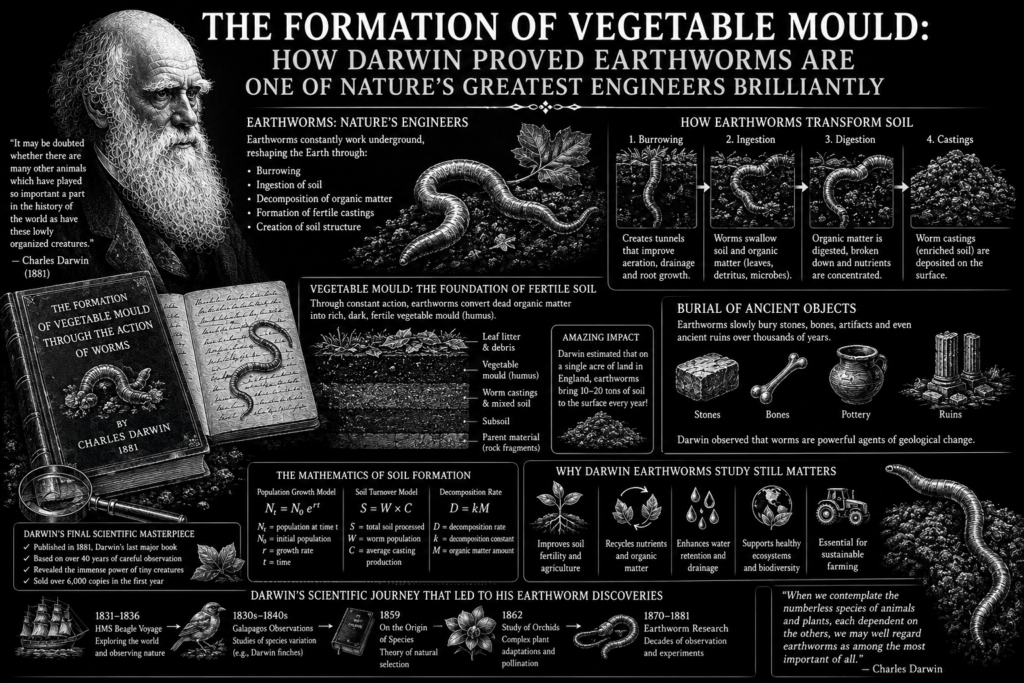
Darwin’s Final Scientific Masterpiece (1870 – 1881)
Late in his life, Charles Darwin became deeply interested in earthworms and soil formation.
Although many people considered worms insignificant creatures, Darwin suspected they performed important ecological functions.
For decades, Darwin observed:
- Earthworm burrowing
- Soil movement
- Organic matter decomposition
- Worm castings
- Soil layer formation
In 1881, Darwin published his final major scientific book:
The Formation of Vegetable Mould Through the Action of Worms
The book became an enormous success and sold thousands of copies shortly after publication.
Darwin earthworms study proved that tiny organisms could gradually reshape entire landscapes through continuous biological activity.
What Is Vegetable Mould?
Vegetable mould refers to fertile topsoil formed through the decomposition of organic matter.
This rich soil contains:
- Decayed leaves
- Plant material
- Humus
- Nutrients
- Microorganisms
Darwin discovered earthworms play a major role in creating vegetable mould by digesting soil and organic matter.
As worms feed and burrow, they produce worm castings rich in nutrients and organic material.
Over long periods of time, this process transforms soil structure and fertility.
Darwin earthworms study showed that earthworms constantly recycle and improve soil ecosystems.
How Earthworms Change Soil
Earthworms influence ecosystems in several remarkable ways.
Burrowing
Earthworms create underground tunnels improving:
- Soil aeration
- Water drainage
- Root growth
- Oxygen circulation
Ingestion of Soil
Earthworms swallow large quantities of soil and organic matter.
Inside the digestive system:
- Organic material decomposes
- Nutrients become concentrated
- Soil particles mix together
Worm Castings
Earthworm castings enrich soil with nutrients and improve fertility.
These castings contain:
- Nitrogen
- Phosphorus
- Organic compounds
- Beneficial microorganisms
Darwin earthworms study revealed that millions of worms continuously reshape agricultural land and natural ecosystems.
Earthworms as Nature’s Engineers
Darwin described earthworms as natural geological workers.
Although tiny individually, enormous earthworm populations collectively move huge amounts of soil every year.
Darwin estimated worms slowly bury:
- Stones
- Bones
- Ancient ruins
- Archaeological artifacts
- Organic matter
This gradual soil movement is called bioturbation.
Earthworms continuously mix soil layers through burrowing and feeding activity.
Darwin realized these small organisms influence landscapes over geological time.
Mathematical Understanding of Soil Formation
Modern ecology uses mathematics to study soil turnover and decomposition connected to darwin earthworms study.
Population growth can be modeled mathematically:
Where:
- = population size at time t
- = initial population
- = growth rate
Soil turnover can also be estimated mathematically:
Where:
- = total soil processed
- = worm population
- = average casting production
Decomposition rates can be modeled as:
Where:
- = decomposition rate
- = decomposition constant
- = organic matter amount
These equations help scientists analyze soil ecology, nutrient cycling, and earthworm environmental impact.
Earthworms and Agriculture
Darwin earthworms study showed earthworms are essential for healthy agriculture.
Earthworms improve farmland by:
- Increasing soil fertility
- Enhancing drainage
- Recycling nutrients
- Breaking down organic matter
- Supporting plant growth
Modern agriculture still depends heavily on earthworm activity.
Fields rich in earthworms often produce healthier crops and better soil structure.
Farmers now recognize earthworms as critical components of sustainable agriculture.
Burial of Ancient Objects
One fascinating part of darwin earthworms study involved buried objects.
Darwin observed that stones, ruins, and artifacts slowly sink into the ground over time.
Earthworms gradually cover objects with soil through:
- Burrowing
- Casting deposition
- Soil movement
Darwin even studied ancient Roman ruins and buried pavements.
He demonstrated that earthworms slowly alter landscapes through continuous soil accumulation.
This discovery connected biology with archaeology and geology.
Earthworms and the Theory of Natural Selection
Darwin earthworms study also supported the theory of natural selection.
Earthworms evolved traits perfectly suited for underground life including:
- Moist skin for respiration
- Muscular bodies for burrowing
- Sensitivity to vibration
- Efficient digestion systems
Darwin believed these adaptations evolved gradually over time through environmental pressures and survival advantages.
Earthworms became another example of biological adaptation in nature.
Decomposition and Ecosystem Recycling
Earthworms play a major role in decomposition and nutrient recycling.
As detritivores, they consume decaying organic material including:
- Dead leaves
- Plant debris
- Microorganisms
- Soil organic matter
This process returns nutrients to ecosystems and supports plant growth.
Without decomposition:
- Organic waste would accumulate
- Nutrient cycles would slow
- Soil fertility would decline
Darwin earthworms study revealed how essential earthworms are for ecosystem balance.
Soil Ecology and Modern Environmental Science
Modern environmental science strongly supports Darwin’s original observations.
Scientists now know earthworms influence:
- Carbon cycling
- Soil fertility
- Ecosystem productivity
- Water retention
- Plant biodiversity
Earthworm populations often indicate soil health.
Healthy ecosystems usually contain large numbers of active earthworms.
Modern ecology continues building upon discoveries first introduced through darwin earthworms study.
Earthworms and Evolutionary Biology
Although earthworms appear simple, Darwin believed they demonstrated the power of gradual biological processes.
Small actions repeated continuously over time can create enormous environmental changes.
This idea connected closely with descent with modification and evolutionary thinking.
Darwin showed nature changes slowly but continuously through countless biological interactions.
Earthworms became symbols of hidden ecological power.
Darwin Orchid Research and Earthworm Studies
Darwin’s later scientific work connected closely with darwin orchid research.
Both studies revealed:
- Biological adaptation
- Specialized ecological roles
- Interconnected ecosystems
- Evolutionary relationships
While orchids demonstrated pollination and coevolution, earthworms demonstrated decomposition and soil engineering.
Together, these studies expanded Darwin’s understanding of ecological complexity.
Darwin to DNA Evolution and Modern Biology
Modern genetics and microbiology continue supporting discoveries connected to darwin earthworms study.
Scientists now study:
- Earthworm DNA
- Soil microorganisms
- Digestive symbiosis
- Ecological genetics
Research involving darwin to DNA evolution helps scientists understand how earthworms adapted to underground environments over millions of years.
Modern biology confirms Darwin’s observations with molecular evidence.
Why Darwin Earthworms Study Still Matters Today
Darwin earthworms study remains scientifically important because it revealed how tiny organisms shape entire ecosystems.
The research continues influencing:
- Soil ecology
- Sustainable agriculture
- Environmental science
- Conservation biology
- Ecosystem restoration
Modern concerns about soil degradation and environmental sustainability make Darwin’s discoveries even more relevant today.
Earthworms remain among the most important organisms supporting life on land.
FAQs About Darwin Earthworms Study
What was darwin earthworms study about?
Darwin studied how earthworms form soil, recycle organic matter, and reshape landscapes.
Why did Darwin study earthworms?
Darwin believed earthworms played an important ecological role in soil formation and decomposition.
What is vegetable mould?
Vegetable mould is fertile topsoil created through decomposition and earthworm activity.
How do earthworms improve soil?
Earthworms aerate soil, recycle nutrients, improve drainage, and create fertile castings.
What is bioturbation?
Bioturbation is the mixing and movement of soil by organisms like earthworms.
Why is darwin earthworms study important today?
It helped establish modern soil ecology and environmental science.
Conclusion
Darwin earthworms study completely transformed scientific understanding of soil, decomposition, and ecosystem engineering. Charles Darwin proved that tiny earthworms are among nature’s most powerful environmental workers, continuously reshaping landscapes through burrowing and soil recycling.
From vegetable mould formation to nutrient cycling and agricultural fertility, Darwin’s earthworm research revealed the hidden biological systems supporting life on Earth. Modern ecology, agriculture, and environmental science continue confirming the extraordinary importance of earthworms in maintaining healthy ecosystems.
The scientific importance of darwin earthworms study stands beside the achievements of many great thinkers whose discoveries reshaped civilization, including those explored in how ancient greek scientists changed modern science.