
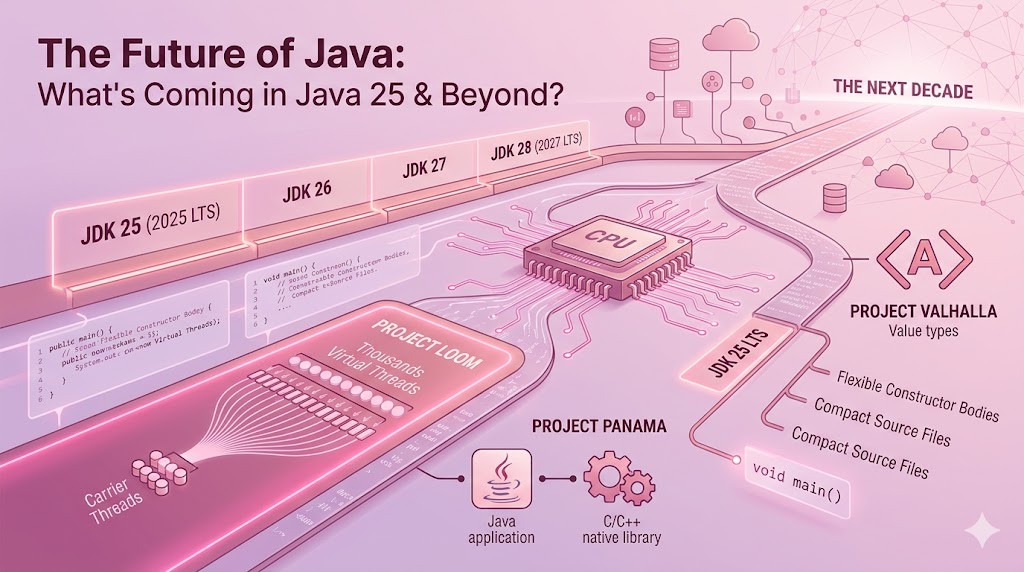
For over three decades, Java has stood as the unyielding backbone of enterprise computing, financial networks, and large-scale cloud architectures. Skeptics frequently predict the decline of older languages, yet the ecosystem consistently path-corrects through an aggressive, highly predictable development cadence. When studying the future java programming changes taking shape across the industry, it becomes immediately apparent that the language is undergoing a monumental modernization phase.
By analyzing these future java programming changes, software architects can design systems that achieve maximum hardware efficiency with minimal boilerplate code. From the revolutionary scaling of virtual threads to the structural adjustments found in the recent Java 25 release updates, the language is positioning itself to conquer the challenges of cloud infrastructure optimization. Let us dive deep into the technical roadmaps, OpenJDK community breakthroughs, and syntactic shifts defining the next generation of enterprise development.
The Six Month Cadence and Evolution of LTS Architecture (2017 – 2021)
Historically, major platform upgrades arrived in massive, unpredictable intervals that stretched across multiple years. If you trace the timeline back through the comprehensive java history: 1991 to today, you will find that this legacy release model often left enterprises stranded on older versions, hesitant to adopt large-scale modifications that might break existing runtime environments.
To solve this stagnation, the OpenJDK strategic roadmap transitioned to a strict, highly dependable Java update schedule. Under this modern engineering arrangement, a new feature release arrives precisely every six months, while a major Long-Term Support (LTS) lifecycle version drops every two years.
[Feature Release] ---> Six Months ---> [Feature Release] ---> Six Months ---> [LTS Release]
   (e.g., JDK 24)                            (e.g., JDK 26)                       (e.g., JDK 25)
This predictable release pattern completely changed how companies adopt upcoming Java platform features. It allows the community to test experimental concepts as pre-release preview features over multiple cycles before locking them down as production-stable standards. This agile, incremental approach has completely revitalized corporate confidence, providing a clear path forward into the future of software engineering, where cloud-scale distribution demands continuous language adaptation.
Deep Dive into the Recent Java 25 Release Updates
The arrival of the Java 25 platform marked a massive milestone for enterprise environment adoption. As an official Long-Term Support release, JDK 25 compiled a series of deeply transformative language modernization trends into a standardized, production-ready framework. Let us explore the core updates that developers are integrating into production codebases.
Flexible Constructor Bodies
For decades, the compiler enforced an absolute rule: if a constructor called a superclass constructor, super() had to be the absolute first statement in the block. This rigid restriction made simple tasks like input validation or parameter configuration highly frustrating.
The finalization of flexible constructor bodies completely changes this workflow. Developers can now run validation statements or compute values before explicitly triggering the super constructor, as long as those lines do not reference the uninitialized object instance itself.
Java
public class PremiumUser extends User Profile {
    private final String accountToken;

    public PremiumUser(String rawEmail) {
        // Enforcing validation BEFORE super construction occurs
        if (rawEmail == null || !rawEmail.contains("@")) {
            throw new IllegalArgumentException("Invalid email pattern provided.");
        }

        // Safe computation independent of instance state
        String processedToken = "TOKEN_" + rawEmail.trim().toUpperCase();

        // Explicitly invoking the parent constructor after validation
        super(rawEmail);
        this.accountToken = processedToken;
    }
}
Module Import Declarations
Managing long lists of import statements has always added clutter to large enterprise source files. JDK 25 solves this via module import declarations. By using the new syntax import module java.base;, developers can import every single public package exported by a core module in a single line of code, significantly streamlining code maintenance.
Project Loom and the Revolution of Virtual Thread Lightweight Concurrency
For decades, writing high-throughput backend applications required complex, non-blocking asynchronous architectures. This complexity stems from the fact that a standard platform thread maps directly to an expensive, heavyweight operating system thread. If you want to review the structural foundations of concurrent processing before exploring these shifts, you can read our complete java multithreading explained overview.
Project Loom completely changes this dynamic by introducing virtual threads. Instead of assigning a costly OS thread to every incoming network request, virtual thread lightweight concurrency allows a single physical platform thread to manage millions of virtual execution tracks simultaneously.
When a virtual thread hits a blocking operation—like a slow database query or an external network call—the underlying JVM automatically unmounts the virtual thread from its physical carrier thread. The system parks the blocked thread in memory and immediately reassigns the carrier thread to execute other active tasks. This automated system resource optimization allows web servers to scale horizontally without crashing under heavy traffic spikes.
Project Panama: Redefining High-Performance Native Access
Modern software applications frequently need to interact with native C or C++ libraries, especially when dealing with high-performance graphics, machine learning frameworks, or hardware-level cryptography. Historically, developers relied on the Java Native Interface (JNI). JNI was notoriously difficult to use, introduced significant performance bottlenecks, and presented severe security risks due to untrusted memory access.
Project Panama completely removes JNI by introducing the Foreign Function & Memory API. This modern update allows developers to safely bind to external native code libraries and manage off-heap memory outside the traditional garbage collection boundaries with zero JNI overhead.
Let us look at a clean example of how Project Panama allocates and reads off-heap native memory with absolute type safety:
Java
import java.lang.foreign.Arena;
import java.lang.foreign.MemorySegment;
import java.lang.foreign.ValueLayout;

public class NativeMemoryDiscovery {
    public static void main(String[] args) {
        // Using an Arena to manage the strict lifecycle of off-heap native memory
        try (Arena customMemoryArena = Arena.ofConfined()) {

            // Allocating off-heap native memory space to hold a 32-bit integer
            MemorySegment nativeBuffer = customMemoryArena.allocate(ValueLayout.JAVA_INT, 2026);

            // Extracting the value directly from the native memory segment
            int extractedValue = nativeBuffer.get(ValueLayout.JAVA_INT, 0);

            System.out.println("Extracted value from off-heap memory is: " + extractedValue);
        } // The Arena automatically releases all native memory structures when closing
    }
}
By removing traditional native call overhead, Project Panama bridges the gap between enterprise business systems and native computation layers, opening up new opportunities for high-performance Java applications over the next decade.
Garbage Collection Algorithm Upgrades and Runtime Optimization
A core focus of the OpenJDK strategic roadmap is continuous optimization of the underlying virtual machine runtime. This commitment to performance is clear when looking at the latest upgrades made to the memory management sub-systems.
Generational Shenandoah Production Finalization
The Shenandoah garbage collection system is famous for keeping application pause times incredibly low by executing memory evacuation tasks concurrently alongside active application threads. JDK 25 takes this further by officially graduating the generational mode of Shenandoah to a stable, product-ready feature. By managing young and old object generations in separate memory regions, the collector drastically reduces CPU cycle waste and improves application throughput.
Compact Object Headers
Every single object instance created inside the HotSpot JVM requires an internal data header to manage metadata like lock states, hash codes, and type pointers. Historically, these headers required between 96 and 128 bits of system memory.
Through the efforts of Project Lilliput, compact object headers have successfully transitioned into a production-ready standard. The JVM now compresses this object header footprint down to just 64 bits on modern architectures. This update yields an automatic 10% to 20% reduction in total heap memory usage across large enterprise applications with zero code changes required.
Syntactic Simplification: Paving the On-Ramp for New Generations
As the language evolved to support massive enterprise architectures, its initial setup boilerplate grew increasingly complex. For a beginner trying to learn the language, writing a simple script required understanding concepts like public access modifiers, static keywords, and class array inputs before running a single line of real logic. If you are a newcomer preparing to set up your local development environment, you can read our step-by-step how to install java guide to get started smoothly.
To simplify this learning process, current trends in Java ecosystem development are focused on an initiative known as “paving the on-ramp.” The finalization of compact source files and instance main methods completely removes this early learning friction.
Java
// A perfectly legal, fully executable Java 25 program file
void main() {
    System.out.println("Streamlined execution without public static class boilerplate!");
}
This clean structure drastically simplifies writing quick microservices and infrastructure scripts. It allows developers to quickly prototype ideas without losing access to the language’s robust type safety. If you want to explore the underlying fundamentals behind these statements, check out our java syntax & data types guide to build a rock-solid coding foundation.
Cloud-Native Improvements for the Next Decade
As deployment environments shift heavily toward cloud infrastructure containerization and microservice architectures, application startup times and memory footprints have become critical metrics. Traditional virtual machines are designed for long-running server environments where a slow warmup phase is acceptable. However, in modern serverless computing environments, rapid scaling is mandatory.
To optimize performance for cloud architectures, the OpenJDK community is investing heavily in Ahead-of-Time (AOT) compiler performance optimization:
- Ahead-of-Time Class Loading & Linking: This feature monitors an application during an initial training run and pre-links all classes into a static cache. Subsequent cold boots can bypass these slow runtime linking steps entirely, dropping startup times significantly.
- AOT Method Profiling Extensions: JDK 25 extends these capabilities by caching code patterns and execution histories. This allows the Just-In-Time (JIT) compiler to instantly generate optimized native machine code upon container startup, eliminating the traditional application warmup lag.
Technical Comparison: Core OpenJDK Modernization Projects
To easily visualize how these major community efforts are shaping the future java programming changes, let us examine their primary architectural focuses:
| Project Name | Primary Core Initiative | Architectural Value |
| Project Loom | Virtual thread lightweight concurrency engine. | Drastically increases server throughput while keeping thread resource costs incredibly low. |
| Project Panama | Foreign Function & Memory API integration. | Replaces risky JNI systems with type-safe, high-performance native library access. |
| Project Lilliput | Compact object header memory compression. | Reduces object layout sizes down to 64 bits, cutting cloud memory costs automatically. |
| Project Valhalla | Value types and advanced primitive enhancements. | Flattens memory storage layouts to match the speed of native hardware cache lines. |
Advanced Coding Strategy: Harnessing Code Pattern Matching Progression
The ongoing progression of pattern matching is fundamentally changing how developers write conditional validation structures. Instead of relying on brittle blocks of casting statements, modern updates allow you to extract data and match types directly within conditional statements.
Java
public class PatternMatchingMastery {
    public static void checkDataToken(Object systemToken) {
        switch (systemToken) {
            // Matching and extracting primitive type options inside a switch
            case int numericValue ->
                System.out.println("Processing primitive int value: " + numericValue);

            case double precisionValue ->
                System.out.println("Processing primitive double value: " + precisionValue);

            case String textValue && textValue.startsWith("SECURE") ->
                System.out.println("Processing verified secure system token: " + textValue);

            default ->
                System.out.println("Encountered unknown or untracked system data signature.");
        }
    }

    public static void main(String[] args) {
        checkDataToken(1050);
        checkDataToken("SECURE_ACCESS_GRANTED");
    }
}
This declarative design pattern significantly improves code readability and eliminates common type-casting bugs before they can reach your production environments. If you are ready to expand your development skills beyond these advanced features, taking time to study our comprehensive advanced java concepts guide will help you master enterprise-grade software architecture.
Frequently Asked Questions (FAQs)
What does the Long-Term Support (LTS) designation mean for enterprise installations?
An LTS release is a specific version of the platform selected by major vendors to receive guaranteed security updates, performance backports, and bug fixes for several consecutive years. This designation provides large enterprises with a highly stable foundation for long-term production deployments, allowing them to avoid the disruption of upgrading their core platform version every six months.
How do Project Loom’s virtual threads differ from traditional Java threads?
Traditional platform threads map directly to native operating system threads, making them expensive to create and maintain in memory. Virtual threads are managed entirely by the Java Virtual Machine runtime. They are lightweight, require very little memory overhead, and allow a single system to run millions of concurrent tasks simultaneously without overwhelming the underlying hardware.
Why are compact object headers so important for modern cloud environments?
In large-scale cloud-native Java improvements, memory usage translates directly to infrastructure costs. Compact object headers reduce the size of object metadata from 128 bits down to 64 bits on 64-bit architectures. This structural optimization can lower the total heap memory footprint of large enterprise applications by 10% to 20% automatically without requiring any source code modifications.
What is the primary purpose of the ongoing Project Valhalla initiative?
Project Valhalla aims to modernize the Java memory model by introducing value objects. These objects combine the expressive power of object-oriented classes with the high-speed performance of primitive data types. This optimization eliminates unnecessary object pointer overhead, allowing data structures to be stored flatly in memory to maximize CPU cache efficiency.
Conclusion
The evolution of the Java platform proves that a mature programming language can adapt to meet the demands of modern cloud environments. The upcoming future java programming changes demonstrate an ecosystem that is successfully modernizing its syntax, maximizing hardware efficiency, and reducing infrastructure costs. By embracing Project Loom’s lightweight concurrency models, leveraging Project Panama’s safe native access, and benefiting from continuous runtime optimizations like compact object headers, Java ensures its position as a dominant force for the next decade of enterprise development. Keeping pace with these architectural updates prepares engineers to build highly scalable, resilient software solutions designed for the future.
If you want to ensure your modern cloud-native systems remain completely stable under heavy concurrent traffic, explore our comprehensive java exception handling guide to learn how to manage runtime errors gracefully.