Introduction to LMM Timeline
The journey from simple chatbots to powerful generative AI is one of the most remarkable stories in technology. The LMM Timeline spans nearly seven decades of research, failure, breakthrough, and triumph. This complete LMM Timeline will take you from the rule based systems of the 1960s to the multimodal giants of 2026. Understanding this LMM Timeline helps us appreciate how machines learned to understand and generate human language.
The LMM Timeline begins in a world without personal computers or the internet. Early researchers dreamed of machine translation and conversation. Their primitive systems barely worked. Yet each decade brought progress. The LMM Timeline accelerated dramatically after 2017. Today, large language models are transforming every industry. This LMM Timeline will help you understand where we came from and where we are going.
large language models history is deeply connected to this timeline. Every innovation built on previous work. The how llms work today traces directly back to foundational research from the 1950s through 2020s. Let us explore this LMM Timeline in detail.
The Early Foundations (1950 – 1990)
The earliest decades of the LMM Timeline were slow but essential. Researchers laid the groundwork for everything that followed.
ELIZA and Rule Based Systems (1964 – 1966)
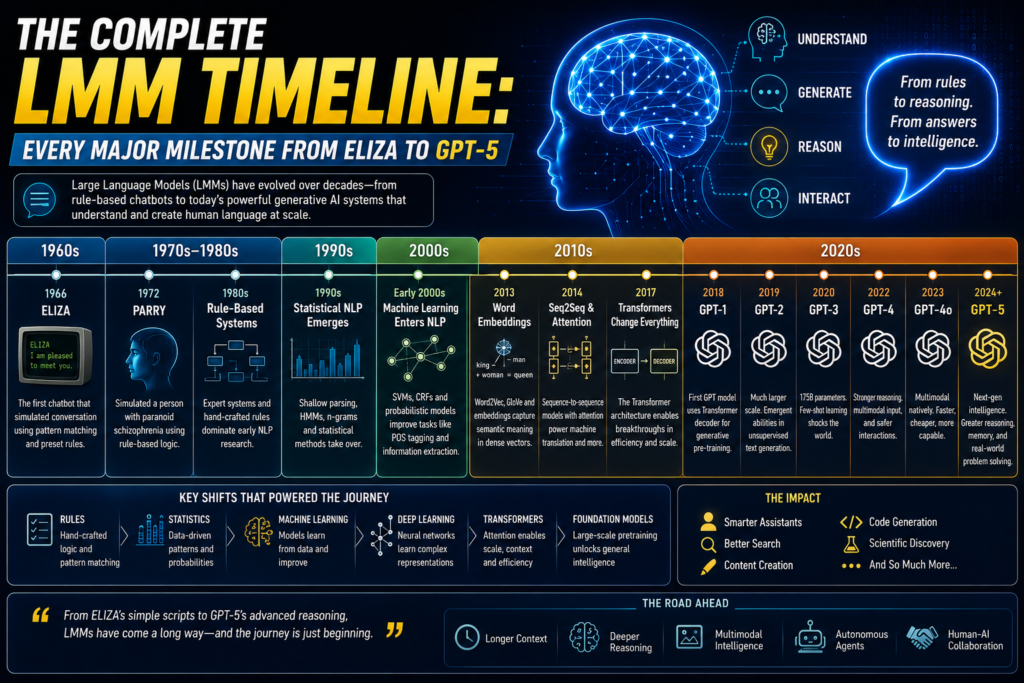
The eliza chatbot history marks the true beginning of the LMM Timeline. Created by Joseph Weizenbaum at MIT between 1964 and 1966, ELIZA simulated a Rogerian psychotherapist using simple pattern matching and substitution rules. It was not intelligent, but it fooled many users into thinking it was.
ELIZA demonstrated a powerful insight: humans project understanding onto machines. A program does not need true comprehension to appear intelligent. This discovery would prove crucial decades later.
The ALPAC Report and AI Winter (1966)
The ALPAC report of 1966 evaluated machine translation research and found it severely lacking. Funding dried up. The first AI Winter began. The LMM Timeline entered a quiet period as researchers struggled for support.
Statistical NLP and Hidden Markov Models (1970 – 1990)
The 1970s and 1980s brought a statistical revolution. Hidden Markov Models (HMMs) allowed researchers to model sequences of words probabilistically. Part of speech tagging, speech recognition, and early machine translation improved significantly. The statistical NLP shift laid the foundation for machine learning approaches to come.
The history of natural language processing during this era showed that data driven methods could outperform handcrafted rules.
The Neural Network Emergence (1990 – 2010)
The 1990s brought neural networks to the LMM Timeline. Progress was slow due to limited data and computing power, but the foundations were laid.
Recurrent Neural Networks and LSTMs (1990 – 1997)
Recurrent neural networks history began in the 1980s, but practical success came in the 1990s. RNNs processed sequences by maintaining a hidden state updated at each step. However, they suffered from the vanishing gradient problem.
What is lstm in ai? Long Short Term Memory networks, introduced in 1997 by Hochreiter and Schmidhuber, solved this problem. LSTMs introduced a cell state acting as a memory highway with gated mechanisms controlling information flow. They could learn dependencies across hundreds of steps.
LSTMs became the dominant architecture for language tasks for nearly two decades. They powered speech recognition, machine translation, and text generation across the LMM Timeline.
Word Embeddings and Word2Vec (2000 – 2013)
What is word2vec? Released by Google researchers in 2013, Word2Vec learned dense vector representations where similar words had similar vectors. “King minus man plus woman equaled queen” became a famous example.
The history of word embeddings shows how this breakthrough enabled neural networks to understand word meanings. Vector space modeling placed words as points in high dimensional space. This was a crucial moment in the LMM Timeline.
The Deep Learning Revolution (2010 – 2017)
The 2010s brought deep learning to the LMM Timeline. Neural networks with many layers achieved state of the art results across language tasks.
Sequence-to-Sequence Models (2014 – 2015)
Seq2seq models history introduced the encoder decoder architecture. The encoder processed input into a vector representation. The decoder generated output from this vector. This proved powerful for machine translation, summarization, and question answering.
However, seq2seq models had a limitation. The fixed length vector became a bottleneck for long sequences. The attention mechanism solved this problem.
Attention Mechanism (2015 – 2017)
Attention mechanism explained simply: attention allows a model to focus on relevant parts of input when generating each output word. Instead of compressing everything into one vector, the model looks back at the entire input.
Attention dramatically improved seq2seq models. Long sentences became manageable. The model could align words between languages. This breakthrough set the stage for the transformer.
The Transformer Revolution (2017 – 2018)
The transformer architecture history begins in 2017. This single paper changed the LMM Timeline forever.
Attention Is All You Need (2017)
The attention is all you need paper to introduce the transformer model. Transformer model explained simply: it is a neural network that processes all words in parallel using attention. Recurrence was eliminated entirely.
Encoder-decoder architecture with multi head attention, position encoding, and layer normalization became standard in every major language model. This parallelism made training much faster. Models could be scaled to unprecedented size.
State-of-the-art (SOTA) results were achieved across nearly every language benchmark. The transformer became the foundation of the LMM Timeline.
GPT-1 and BERT (2018)
Gpt models history began with GPT-1 in 2018. OpenAI’s Generative Pre-trained Transformer used unidirectional language modeling, predicting the next word given previous words.
What is bert model? Bert model history began the same year. Google’s BERT (Bidirectional Encoder Representations from Transformers) introduced masked language modeling. The model predicted randomly masked words using both left and right context. This bidirectional understanding was extremely powerful.
Pre training in ai on massive text corpora, followed by fine tuning in ai on specific tasks, became the standard paradigm. Bert vs gpt vs t5 debates began.
The Large Language Model Explosion (2019 – 2022)
The years 2019 to 2022 saw exponential growth in the LMM Timeline. Models grew larger, data grew bigger, capabilities expanded dramatically.
GPT-2 and GPT-3 (2019 – 2020)
GPT-3 history began with GPT-2 in 2019. OpenAI initially hesitated to release it, concerned about potential misuse.
GPT-3 arrived in 2020 with 175 billion parameters. Model weights and biases at this scale showed emergent abilities. Smaller models could not translate languages or write code. Larger models could. The scaling hypothesis suggested that simply increasing size and data led to new capabilities.
Foundational models emerged as pre trained systems adaptable to many tasks. Tokenization methods improved. Massive Multitask Language Understanding (MMLU) benchmarks were developed.
Release of GPT-3 to GPT-4 (2020 – 2023)
Gpt-4 history arrived in March 2023. It demonstrated multimodal capabilities, processing both images and text. It achieved state of the art results on numerous benchmarks.
Release of GPT-1 to GPT-4 shows a clear trajectory of improvement. Each generation was significantly more capable than the last.
ChatGPT and Public Launch (2022)
Chatgpt history changed everything. Released in November 2022, ChatGPT became the fastest growing consumer application in history. The chatgpt growth 100 million users milestone was reached in two months.
What is rlhf? Reinforcement Learning from Human Feedback aligned ChatGPT with human preferences. Instruction tuning breakthrough allowed the model to follow user instructions effectively.
Openai history entered a new phase. Chatgpt vs google search debates began as users questioned traditional search paradigms.
The Open Source and Competition Era (2023 – 2024)
The LMM Timeline entered a phase of intense competition. Open source models caught up to proprietary systems.
LLaMA and Open Source Models (2023)
Meta llama history began with the release of LLaMA (Large Language Model Meta AI). Unlike OpenAI and Google, Meta released model weights. This democratized access to powerful LLMs.
LLaMA and open-source models proliferated. Mistral AI emergence brought efficient, high performance models. Deepseek ai history demonstrated Chinese innovation. Google PaLM release date brought competition from Google.
Instruction Tuning and Fine Tuning (2023)
Fine tuning in ai became more efficient with parameter efficient methods like LoRA. Instruction tuning breakthrough allowed smaller models to follow instructions almost as well as larger ones.
Anthropic Claude development emphasized safety and helpfulness. Claude ai history showed that RLHF could produce more aligned models.
Context Window Expansion (2023 – 2024)
Context window expansion history saw rapid progress. Early models handled 512 or 2048 tokens. GPT-4 expanded to 8k, then 32k, then 128k. Gemini and Claude pushed to 200k, then 1 million tokens.
Longer context windows allowed models to process entire books, extensive codebases, and lengthy conversations in one go.
The Modern Era (2024 – 2026)
Recent years have seen the LMM Timeline enter a phase of multimodal integration, efficiency, and specialization.
Multimodal Integration (2024 – 2026)
Multi-modal integration allowed models to process images, audio, and video alongside text. Multimodal ai history shows progress from GPT-4V to Gemini to newer models.
Autoregressive models remain dominant architecture. Context window expansion continues.
AI Arms Race Companies (2023 – 2026)
Ai arms race companies battle for dominance. Google bard gemini history shows Google’s rapid response. Mistral ai history demonstrates European innovation. Cohere ai history focuses on enterprise. Microsoft copilot history integrated LLMs into Office.
Grok ai history from xAI brought personality and real time information. Ibm watson vs llms comparisons show how far the field has advanced.
Retrieval Augmented Generation and AI Agents (2025 – 2026)
Retrieval augmented generation rag grounds LLMs in external knowledge, reducing hallucinations. What is ai agent describes autonomous systems that plan, act, and iterate.
Ai generated content history shows how LLMs became content creation tools. Ai regulation history accelerated with the EU AI Act. Ai in education llms transformed classrooms.
The future of large language models points toward efficiency, reasoning, and true understanding.
Frequently Asked Questions
When did the transformer architecture debut?
The transformer debuted in 2017 with the paper “Attention Is All You Need” from Google researchers.
What is the difference between BERT and ROBERTA?
BERT vs. RoBERTa timeline shows RoBERTa as an optimized version of BERT with more data and longer training.
How has the context window expanded over time?
The context window expanded from 512 tokens in early models to over 1 million tokens in modern models like Gemini and Claude.
What is instruction tuning?
Instruction tuning trains models to follow user instructions using examples of commands and desired responses.
When was Google PaLM released?
Google PaLM (Pathways Language Model) was announced in April 2022 with 540 billion parameters.
What are foundational models?
Foundational models are large pre trained models adaptable to many downstream tasks with minimal fine tuning.
Conclusion
The LMM Timeline from ELIZA in 1966 to GPT-5 in 2026 is a remarkable journey of persistence and breakthrough. The best free ai tools 2026 incorporate LLMs in ways early pioneers could only dream of. From rule based systems to billion parameter transformers, each generation built on the last.
The you should also read this timeline and share it with others interested in AI history. The ai tools for productivity we use today barely scratch the surface of what is possible.
Key milestones in the LMM Timeline include the transformer (2017), GPT-1 (2018), BERT (2018), GPT-3 (2020), ChatGPT (2022), GPT-4 (2023), open source LLaMA (2023), and the multimodal models of 2025-2026.
The question of who invented large language models has many answers. The transformer paper authors deserve credit. So do the scaling law researchers. So do the engineers who built training infrastructure at massive scale.
As we look ahead, challenges remain. Hallucinations, bias, safety, and regulation require attention. But the future of large language models is bright. The LMM Timeline is still being written, and the most exciting chapters may lie ahead.