Introduction
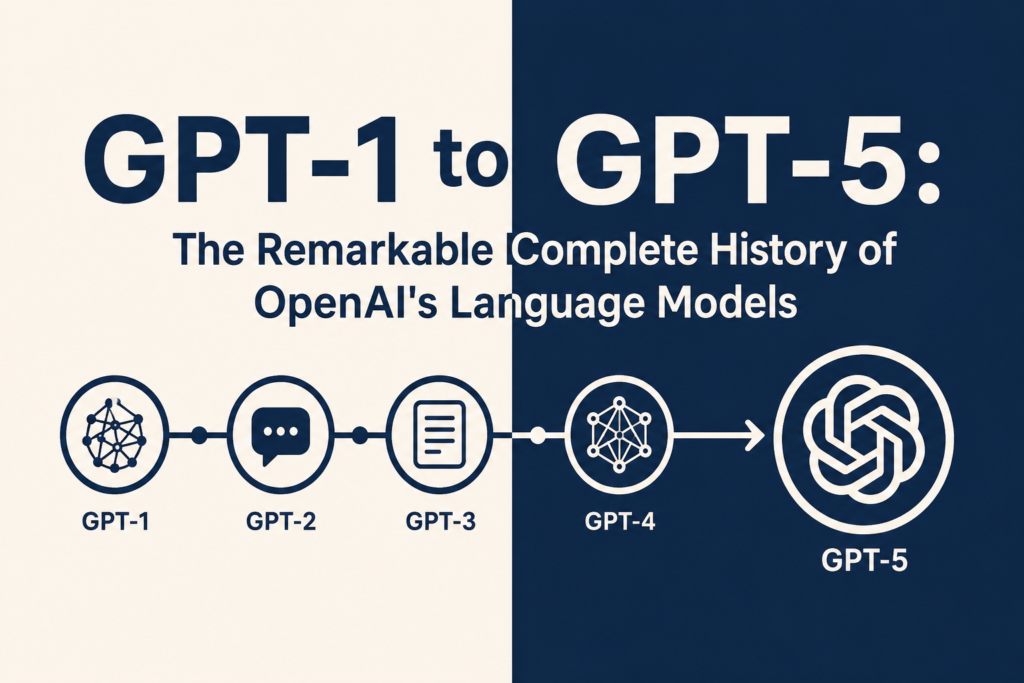
The gpt model’s history is one of the most remarkable technology stories of the past decade. What began in 2018 as a quiet research paper from a San Francisco AI lab has grown into a lineage of models that now shapes how millions of people write, code, search, and communicate every single day. Each new GPT release did not just improve on the last. It redefined what people believed machines were capable of doing with language.
Understanding the gpt model’s history means tracing a journey from an elegant but modest language model trained on digital books to a multimodal, reasoning-capable system that scores near the top of professional examinations. It is a story about scaling laws, brilliant engineering decisions, fierce competition, and the fundamental question of what happens when you keep making language models bigger and training them on more data. The answer, it turned out, kept surprising even the people building these systems.
The Origins: OpenAI and the Pre-GPT Era (2015 – 2017)
To understand the gpt model’s history properly, you need to start with the organization that built it. OpenAI was founded in December 2015 by a group of researchers and investors including Sam Altman, Greg Brockman, Ilya Sutskever, Wojciech Zaremba, and Elon Musk, among others. Its stated mission was to ensure that artificial general intelligence would benefit all of humanity. It launched as a nonprofit with significant early funding and an open research culture.
In its early years, OpenAI worked across reinforcement learning, robotics, and language. The openai history during this period reflects a lab still searching for its central focus. That changed when researchers began taking the transformer architecture seriously as a foundation for language modeling. The 2017 paper “Attention Is All You Need” from Google had shown that self-attention mechanisms could replace recurrence entirely in sequence models. OpenAI researchers saw in the decoder portion of that architecture the seed of something powerful.
The attention mechanism explained was the key insight that made everything that followed possible. By allowing every token in a sequence to directly attend to every previous token, the transformer decoder was perfectly suited for autoregressive language modeling, where the task is to predict each next token given all preceding tokens. This next-token prediction objective is simple, scalable, and requires no labeled data at all.
GPT-1: The Quiet Beginning (2018)
The first entry in the gpt models history arrived in June 2018 with a paper titled “Improving Language Understanding by Generative Pre-Training.” The model was simply called GPT, though it later became known as GPT-1 once successors arrived.
GPT-1 had 117 million parameters and was trained on the BooksCorpus dataset, a collection of around 7,000 unpublished books covering diverse genres. The choice of books rather than web text was deliberate. Books contain long stretches of coherent, well-structured prose, which forces the model to learn long-range dependencies in language rather than relying on short local patterns.
The architecture was a decoder-only transformer architecture with 12 layers and a context window of 512 tokens. There was no encoder. The model simply read text from left to right and learned to predict each next token in a process called autoregressive language modeling. This was OpenAI generative pre-training in its earliest form.
What made GPT-1 genuinely significant was not the raw performance numbers but the demonstration of the pre-training and fine-tuning approach. After pre-training on books, the model was fine-tuned on labeled datasets for specific tasks like textual entailment, question answering, and sentiment classification. It performed competitively on most of these benchmarks despite having been trained on completely different data. This showed that the model had learned broadly useful representations of language during pre-training, representations that transferred well to downstream tasks. The concept of semisupervised learning at scale was beginning to prove itself out.
GPT-2: The Model Too Dangerous to Release (2019)
The next chapter in the gpt models history arrived in February 2019 and immediately generated controversy that had nothing to do with academic benchmarks. GPT-2 was a dramatic scale-up from its predecessor, with 1.5 billion parameters in its largest version, trained on a new dataset called WebText, which consisted of text scraped from web pages that had been shared on Reddit with at least three upvotes. This was OpenAI’s attempt to include higher-quality web content rather than raw web dumps.
The jump in scale produced a qualitative shift in output quality. GPT-2 could generate long, coherent, stylistically consistent passages of text on almost any topic. Sample outputs that OpenAI shared with the public were striking enough that the organization made a then-unprecedented decision: it would not release the full model weights immediately, citing concerns about potential misuse for generating disinformation, fake news, and spam at scale.
This staged model release strategy generated enormous debate in the AI community. Some researchers argued that the risks were overstated and that withholding research was counterproductive. Others agreed with OpenAI’s caution. The controversy itself did something important for the broader public narrative: it made clear that large language models were no longer just an academic curiosity. They were becoming powerful enough to worry about.
OpenAI eventually released the full GPT-2 weights in November 2019 after monitoring the landscape and concluding that comparable models were being developed elsewhere anyway. By then, the research community had already begun probing what GPT-2 had and had not learned. The model showed impressive synthetic text generation but also clear limitations in factual accuracy and consistent reasoning over long passages.
GPT-3: The World Changes (2020)
The single most pivotal moment in the gpt models history came in May 2020 when OpenAI published the GPT-3 paper. With 175 billion parameters, GPT-3 was not just bigger than GPT-2. It was operating in a fundamentally different regime of capability.
The gpt-3 history is inseparable from the discovery and validation of scaling laws in AI. Researchers at OpenAI and other labs had been observing a remarkable pattern: as you increased model size, dataset size, and compute in a coordinated way, performance improved in smooth, predictable ways according to power laws. GPT-3 was the most dramatic confirmation of this pattern yet. More parameters and more data did not just produce incremental gains. They produced qualitative leaps in capability.
GPT-3 introduced the concept of few-shot learning capabilities that genuinely shocked the research community. The model could perform new tasks from just a handful of examples provided in the input prompt, without any gradient updates or fine-tuning at all. You could show it three examples of translating English to French, and it would translate a fourth correctly. You could describe a task in plain English and the model would attempt to complete it. This zero-shot task transfer was not perfect, but it was dramatically better than anything that had come before at this scale.
The context window had expanded, task conditioning via prompts was emerging as a new programming paradigm, and the gpt models history was entering an era where the primary question was no longer “can this work at all?” but “how do we make this safe and useful?”
GPT-3 was not released as open-source. Instead, OpenAI made it available through a commercial API, beginning a shift in the organization’s model from nonprofit research lab toward a capped-profit company capable of funding the enormous compute costs that frontier model development required.
InstructGPT and the RLHF Breakthrough (2022)
Between GPT-3 and GPT-4, OpenAI developed a crucial intermediate step that belongs in any complete gpt models history: InstructGPT. Raw GPT-3 was powerful but often unhelpful or harmful when deployed for general use. It would complete prompts in ways that were technically coherent but not aligned with what users actually wanted. It could generate toxic content, hallucinate facts confidently, and misinterpret instructions.
InstructGPT applied a technique called Reinforcement Learning from Human Feedback, or RLHF. Human raters compared different model outputs and expressed preferences. Those preferences were used to train a reward model, which then guided further fine-tuning of GPT-3 to produce outputs that humans found more helpful, harmless, and honest. The result was a model that was smaller than the largest GPT-3 but dramatically more useful in practice.
This approach directly led to ChatGPT, which launched in November 2022 and became the fastest-growing consumer application in history, reaching 100 million users within two months. The chatgpt history is really the story of RLHF applied at scale on top of the GPT lineage, and it transformed the gpt models history from a research story into a mainstream cultural phenomenon.
GPT-4: Multimodal and More Capable (2023)
OpenAI released GPT-4 in March 2023, and the gpt model’s history entered a new phase. OpenAI was more guarded about technical details with GPT-4 than with previous releases, declining to publish the parameter count or full architectural details. What they did reveal was that GPT-4 was multimodal, capable of accepting both images and text as input, making it part of the broader multimodal ai history that was unfolding across the industry.
The gpt-4 history is defined by performance on professional and academic benchmarks. GPT-4 scored in approximately the 90th percentile on the Uniform Bar Examination, performed well on AP exams across multiple subjects, and showed meaningful improvements in factual accuracy and instruction following compared to GPT-3.5. The context window also expanded significantly, allowing the model to process much longer documents and maintain coherent reasoning over extended conversations.
GPT-4 also highlighted persistent challenges in the gpt models history, particularly around foundation model research focused on hallucination and reliability. The model could still generate plausible-sounding but incorrect information with confidence, a problem that remained one of the field’s most discussed unsolved challenges.
The Competitive Landscape and the GPT Legacy
The gpt model’s history did not unfold in isolation. As OpenAI’s models grew more capable, they triggered a dramatic acceleration in the broader large language models history, with Google, Anthropic, Meta, Mistral, and many others racing to develop their own frontier models. The generative AI breakthroughs that GPT-3 demonstrated convinced every major technology company that large language models were not a research niche but a strategic priority.
Large-scale pre-training datasets became a competitive resource. Context window expansion became a key engineering challenge. Foundation model research accelerated on every front. The gpt models history had, in a real sense, created the conditions for an entire industry.
GPT-5 and What Comes Next
The gpt model’s history continues to evolve. OpenAI has signaled ongoing development of the GPT lineage, with GPT-5 representing the next major step in the progression of parameter counts and capabilities. Based on the pattern established across previous releases, expectations include improved reasoning, greater factual reliability, extended context handling, and deeper multimodal integration.
The future of AI will be shaped significantly by how the GPT lineage develops alongside competing model families. The trajectory of autoregressive language modeling, from GPT-1’s 117 million parameters trained on books to GPT-4’s multimodal capabilities, has been extraordinary by any measure.
Frequently Asked Questions (FAQs)
What does GPT stand for and who made it?
GPT stands for Generative Pre-trained Transformer. It was created by OpenAI, an AI research organization founded in 2015. The first GPT model was released in 2018, and the lineage has continued through GPT-2, GPT-3, GPT-4, and ongoing development.
How is each GPT model different from the previous one?
Each successive GPT model has generally featured a larger parameter count, a larger and more diverse training dataset, a wider context window, and improved performance on language benchmarks. Beyond raw scale, each release has also introduced architectural or training refinements, such as the RLHF fine-tuning used to create ChatGPT from GPT-3.5.
Why was GPT-2 considered controversial when it was released?
OpenAI initially withheld the full GPT-2 model weights in 2019 because the organization was concerned that the model’s ability to generate convincing synthetic text could be misused for disinformation, fake news, and spam. This was the first time a major AI lab had publicly staged a model release for safety reasons, and it sparked significant debate about AI transparency and responsibility.
What is few-shot learning and why did it matter for GPT-3?
Few-shot learning refers to a model’s ability to perform a task correctly after seeing only a small number of examples in its input prompt, without any weight updates or fine-tuning. GPT-3 demonstrated this capability far more powerfully than any prior model, suggesting that large-scale pre-training was encoding a general ability to follow task instructions that went far beyond simple pattern matching.
Is GPT-4 the most capable GPT model available?
As of the time of writing, GPT-4 is the most publicly documented model in the GPT lineage, though OpenAI has released various GPT-4 variants with different capability profiles and context lengths. OpenAI has indicated that further development in the GPT lineage is ongoing, with GPT-5 anticipated as the next major release.
Conclusion
The gpt models history is a story about what happens when a powerful architectural idea meets consistent investment, disciplined scaling, and the courage to release products before the field is fully ready for them. From GPT-1’s quiet 2018 debut on digital books to GPT-4’s multimodal professional-level performance, each chapter in this history has expanded what machines can do with human language.
GPT models history is also a story about consequences. The models OpenAI built did not just advance a research agenda. They launched an industry, triggered a global AI arms race, and brought questions about AI safety, reliability, and regulation into mainstream public debate. The progression from GPT-1 to where the field stands today happened faster than almost anyone predicted, and the next chapters are being written right now.
Understanding this history is not just intellectually rewarding. It is essential context for anyone trying to make sense of the AI-driven world we are all now living in.