Introduction
The story of chatgpt growth 100 million users is one of the most staggering events in the entire history of consumer technology. In a digital landscape where most products spend years clawing toward meaningful adoption numbers, ChatGPT shattered every benchmark that existed, reaching 100 million active users in approximately two months after its November 2022 launch. Nothing in the modern internet era had ever grown so fast.
This was not a growth story built on expensive marketing campaigns or paid acquisition funnels. It was powered by genuine human curiosity, relentless social sharing, and the visceral experience of interacting with an AI that felt unlike anything people had tried before. ChatGPT growth 100 million users became the benchmark that every technology product would be measured against, and understanding how it happened reveals something profound about how transformative technology spreads when the right product meets the right moment.
This article traces the full arc of that explosive rise, from the research breakthroughs that made it possible to the viral dynamics that drove adoption, the infrastructure pressure it created, and what the milestone means for the future of AI.
The Viral Launch That Stunned the World (2022 – 2023)
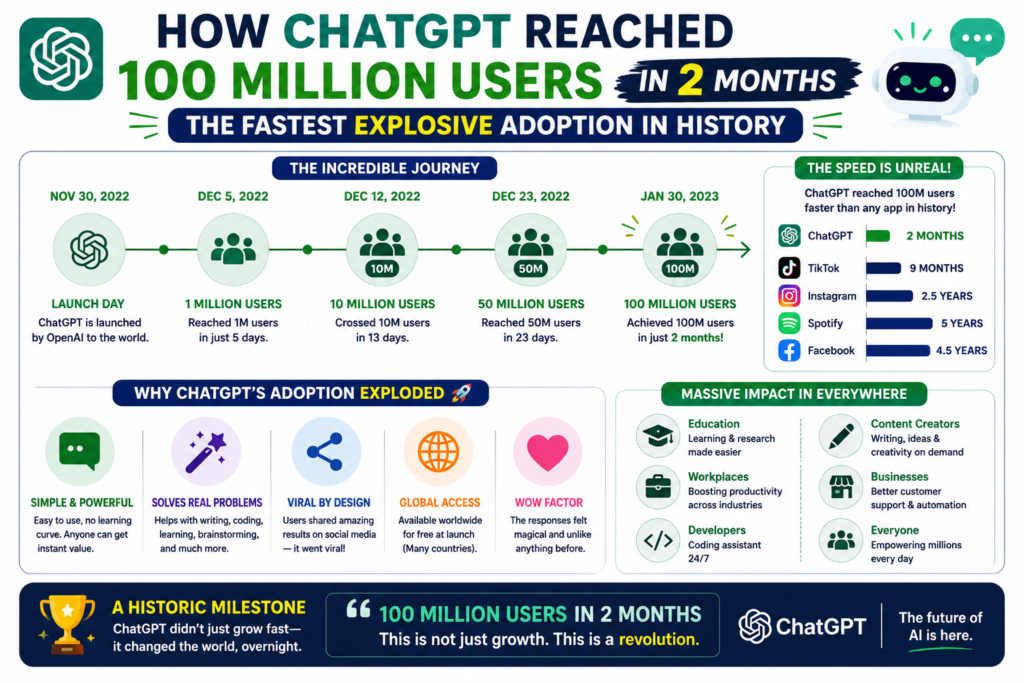
When OpenAI launched ChatGPT on November 30, 2022, it did so with almost no advertising. There was no Super Bowl commercial, no influencer campaign, no paid promotion strategy. What happened instead was a viral AI product launch driven entirely by the reactions of the first people who tried it and immediately told everyone they knew.
Within five days, ChatGPT had one million users. That single statistic became one of the most quoted data points in technology journalism almost immediately. For comparison, Netflix took three and a half years to reach one million subscribers. Facebook took ten months. Instagram took two and a half months. ChatGPT did it in five days.
The chatgpt growth 100 million users phenomenon was fueled in its early weeks by social media behavior that was almost impossible to engineer deliberately. People were sharing screenshots of conversations that surprised them, impressed them, or made them laugh. Developers were posting examples of code ChatGPT had written. Students were sharing essays it had drafted. Writers were exploring its creative range. Every share was a free advertisement reaching people who had never considered using an AI tool before.
This phase also triggered an immediate web application traffic surge that tested OpenAI’s infrastructure in ways the team had not fully anticipated. The servers struggled under demand, access was intermittent, and capacity limits were imposed. None of this slowed the growth. If anything, scarcity made people more eager to get in.
The Foundations That Made It Possible (2010 – 2020)
The chatgpt growth 100 million users story did not begin in 2022. Its roots stretch back more than a decade of research breakthroughs that each contributed a piece of the foundation.
Early conversational AI systems like ELIZA, created in 1966, began the long journey of teaching machines to interact in human language. These were rule-based systems with severe limitations, but they established the intellectual tradition of conversational AI that researchers would spend decades advancing. The eliza chatbot history is the distant origin story of everything that ChatGPT would eventually become.
A critical step forward came with the development of word embeddings, particularly Word2Vec in 2013, which gave machines a way to represent the meaning of words as dense numerical vectors that captured semantic relationships. The history of word embeddings shows how this transformed NLP from brittle keyword matching into something approaching genuine language understanding.
The most decisive breakthrough came in 2017 when Google researchers published “Attention Is All You Need,” introducing the transformer architecture that powers every major language model today. The attention is all you need paper showed that self-attention mechanisms could replace recurrent networks entirely, enabling the massive parallelization that made training large language models economically feasible for the first time.
These developments combined to create the technical substrate from which chatgpt growth 100 million users would eventually emerge.
GPT Evolution and the OpenAI Breakthrough (2020 – 2022)
The immediate technical lineage of ChatGPT runs through the GPT model family that OpenAI developed between 2018 and 2022. The gpt-3 history is particularly central to understanding chatgpt growth 100 million users because GPT-3 was the model that first demonstrated, at public scale, that a language model could generate human-like text across a remarkable range of tasks without task-specific training.
GPT-3’s 175 billion parameters and its few-shot learning capabilities established that scale was the key variable in language model capability. But GPT-3 alone was not ChatGPT. The critical step that transformed a powerful but unpredictable research model into a product that drove chatgpt growth 100 million users was the application of reinforcement learning from human feedback, or RLHF, which taught the model to respond in ways that humans actually found helpful rather than just statistically plausible.
InstructGPT, published by OpenAI in early 2022, demonstrated that an RLHF-aligned model was dramatically preferred by users over raw GPT-3, even when the aligned model was smaller. This was the technical breakthrough that made the user experience of ChatGPT feel genuinely different from every AI tool that had come before it. Users were not fighting with the model to get useful outputs. The model was trying to help them. That shift in dynamic was what created the emotional resonance that drove viral sharing.
The Two-Month Milestone: How User Retention Matched Acquisition
The truly remarkable thing about chatgpt growth 100 million users is that it was not just about acquisition. Plenty of products generate enormous spikes of trial users who disappear after a single session. What separated ChatGPT was the combination of high user retention rates alongside viral new user acquisition.
People who tried ChatGPT kept coming back. They found new use cases. They incorporated it into daily workflows. They brought it to their workplaces. They showed it to their colleagues, their families, and their students. This behavior pattern reflected a tech adoption curve that was both steeper and more durable than what most new platforms experience.
The audience onboarding metrics that emerged from ChatGPT’s growth were studied intensely by researchers, investors, and competing technology companies. UBS analysts, reviewing data from web traffic measurement firms, reported that ChatGPT had reached 100 million monthly active users by January 2023, two months after launch. TikTok had taken nine months to reach that milestone. Instagram had taken two and a half years. The magnitude of the difference was not incremental. It was categorical.
Chatgpt growth 100 million users reflected a genuine network effect in tech that amplified with each passing week. Every new use case that someone discovered and shared online became a reason for someone else to try the product. Every skeptic who tried it to see if the hype was real became a potential convert who then told others about their experience.
Scaling Challenges and Infrastructure Pressure (2023)
The extraordinary speed of chatgpt growth 100 million users created serious technical challenges for OpenAI. Supporting millions of simultaneous conversations in real time required a level of server infrastructure scaling that the organization had not fully built out before the launch. In the first weeks, the service experienced frequent outages, queuing systems that held users in waiting lines, and access restrictions during peak hours.
These infrastructure challenges are worth examining because they reveal something important about how transformative consumer products scale. The demand curve for ChatGPT was not a gradual ramp that allowed time for orderly capacity planning. It was a near-vertical spike that tested every layer of the technical stack simultaneously.
OpenAI leaned heavily on its partnership with Microsoft and Microsoft Azure’s cloud infrastructure to absorb the load. Even with that resource, the scaling challenges were significant. Engineers worked to optimize latency, reduce inference costs per query, and build out capacity at a pace that matched the hyper-growth phenomenon the product was experiencing in the market.
These challenges also highlighted the enormous cost of running frontier AI models at consumer scale. Each conversation required substantial compute, and the economics of providing that compute for free to millions of users required a clear path to revenue that OpenAI was building out simultaneously through its ChatGPT Plus subscription and its enterprise API business.
The Competitive AI Ecosystem That Grew in ChatGPT’s Wake (2023)
The chatgpt growth 100 million users milestone did not happen in a competitive vacuum. It triggered a response across the entire technology industry that reshaped the AI landscape permanently.
Google, whose search business was most directly threatened by ChatGPT’s conversational information retrieval model, declared an internal code red and accelerated development of its own AI products, launching Bard in February 2023 and eventually replacing it with Gemini. Microsoft integrated GPT-4 into Bing, Office, and a suite of products it branded as Microsoft Copilot. Meta released the LLaMA family of open-weight models that put powerful generative AI in the hands of researchers and developers without API fees. Anthropic released Claude with a strong emphasis on safety and helpfulness.
This competitive explosion, triggered directly by the chatgpt growth 100 million users phenomenon, became part of the story itself. The visibility that competitors generated as they tried to match or surpass ChatGPT further normalized the idea of using AI assistants for everyday tasks, expanding the overall market even as it divided user attention. The AI arms race companies dynamic that ChatGPT created accelerated innovation at a pace the field had never experienced.
Understanding AI Limitations as Adoption Grew (2023 – 2024)
As chatgpt growth 100 million users brought generative AI to a mass audience, it also brought the limitations of these systems into mainstream public awareness for the first time. The most consequential limitation was hallucination, the tendency of language models to generate factually incorrect information with confident, fluent prose.
Users encountered hallucination when ChatGPT invented citations, fabricated statistics, or described events that never happened. The gap between the model’s confident presentation style and its actual factual reliability created real problems in professional and educational contexts. This awareness drove significant investment in solutions.
Retrieval augmented generation rag emerged as one of the most important practical responses, allowing AI systems to retrieve verified information from external sources before generating responses rather than relying entirely on knowledge encoded during training. This approach meaningfully reduced hallucination rates for factual queries and made AI systems more trustworthy for professional use cases.
Comparisons between AI tools and traditional search emerged naturally as chatgpt growth 100 million users brought these two paradigms into direct competition for user attention and time. These debates helped define the appropriate use cases for each type of system and contributed to a more nuanced public understanding of what AI could and could not reliably do.
The Future That chatgpt growth 100 million users Made Inevitable (2024 and Beyond)
The 100 million user milestone was not a destination. It was a beginning. The chatgpt growth of 100 million users story set the trajectory for an era of AI adoption that continues to accelerate across every domain of professional and personal life.
The large language models history shows a field that has moved from academic curiosity to global infrastructure in the span of a few years. Multimodal systems that can process images, audio, and video alongside text are expanding what AI assistants can do. Autonomous AI agents capable of taking actions, browsing the web, writing and executing code, and completing multi-step tasks are becoming practical deployment targets rather than research concepts.
The future of AI will almost certainly produce adoption milestones that dwarf chatgpt growth 100 million users, as AI capabilities become integrated into more products, more workflows, and more devices. But none of those future milestones would exist without this one. The 100 million user achievement proved that ordinary people, not just researchers and developers, wanted to use AI tools. It validated a product category, triggered an industry-wide transformation, and set expectations that every AI product developed since has been measured against.
Key Drivers Behind chatgpt growth 100 million users
The speed and durability of ChatGPT’s growth can be traced to a specific combination of factors that aligned in a way that had never happened before in consumer technology.
The product was genuinely useful from day one for a wide range of tasks, which is rarer than it sounds. The interface was conversational and required no technical knowledge to operate. The barrier to entry was zero: no download, no subscription, no credit card required for basic access. The outputs were shareable and naturally prompted social discussion. And the underlying technology was far enough ahead of any comparable product that users had no credible alternative to compare it against.
These elements created the feedback loop: curiosity drove trial, trial drove satisfaction, satisfaction drove sharing, sharing drove new curiosity, and the cycle amplified with every passing day.
Frequently Asked Questions (FAQs)
How fast did ChatGPT actually reach 100 million users?
ChatGPT reached one million users in five days after its November 30, 2022 launch and reached 100 million monthly active users by January 2023, approximately two months after launch. This made it the fastest consumer application to reach 100 million users in history, surpassing TikTok, which took nine months, and Instagram, which took over two years.
What drove ChatGPT’s viral growth?
ChatGPT’s growth was driven by organic curiosity and social sharing rather than paid marketing. People shared impressive, surprising, or entertaining interactions online, which drove new users to try the product themselves. The combination of an accessible conversational interface, genuinely useful outputs across many tasks, and a product that was free to try created the conditions for viral spread.
Did ChatGPT’s servers struggle with the growth?
Yes, OpenAI experienced significant infrastructure challenges in the first weeks after launch. The sudden surge in demand caused outages, service interruptions, and capacity limits that required rapid scaling of server infrastructure through OpenAI’s Microsoft Azure partnership. These challenges were eventually resolved as OpenAI expanded capacity and introduced paid tiers to help manage load.
How did ChatGPT’s growth affect the AI industry?
ChatGPT’s growth triggered an immediate and significant competitive response across the technology industry. Google accelerated development of Bard and Gemini. Microsoft integrated GPT-4 into its products through the Copilot brand. Meta released open-weight LLaMA models. Anthropic expanded Claude’s availability. The competitive dynamic that followed accelerated AI development and adoption across the entire industry.
What does the 100 million user milestone mean for AI’s future?
The 100 million user milestone proved that mainstream consumers, not just technical professionals, were ready and willing to use AI tools in their daily lives. It validated the consumer AI product category, set the stage for intense competition and rapid innovation, and established user expectations for AI capability that every subsequent product has been measured against.
Conclusion
The chatgpt growth 100 million users story is one of the defining technology events of the twenty-first century. It combined a decade of research breakthroughs in transformer architecture and language model scaling with a product that was simple enough for anyone to use and powerful enough to genuinely change how people worked, learned, and communicated.
Chatgpt growth 100 million users was not just a metric. It was a signal that artificial intelligence had crossed a threshold from specialized professional tool to mass consumer technology. It triggered an industry-wide transformation, reshaped competitive dynamics among the world’s most powerful technology companies, and permanently changed public expectations about what machines can do.
The milestone will be referenced for decades as the moment when AI went mainstream. But its greatest significance may be as the starting point of a much larger story, one where the 100 million user milestone looks, in retrospect, like just the very beginning.