Introduction
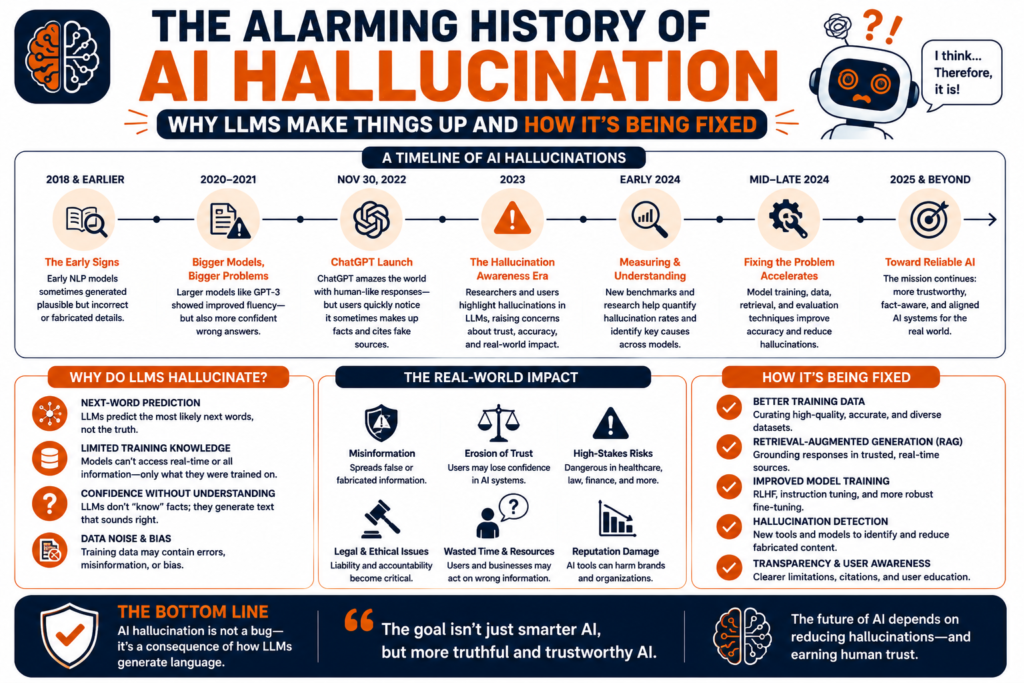
The ai hallucination history is one of the most consequential and unsettling threads running through the entire development of modern artificial intelligence. From the earliest neural language models to the most advanced large language models deployed today, the problem has remained stubbornly persistent: AI systems generate false information with the same fluent confidence they use when generating true information. They invent citations. They describe events that never happened. They fabricate statistics with precise-sounding figures. And they do all of this without any awareness that they are wrong.
Understanding the ai hallucination history is not just an academic exercise. When a lawyer submits AI-generated legal briefs containing invented case citations, when a journalist publishes AI-written facts that turn out to be fiction, or when a student relies on an AI explanation that is plausibly worded but factually wrong, the consequences are real and sometimes severe. The ai hallucination history matters because it defines one of the central challenges that must be solved before artificial intelligence can be fully trusted in high-stakes professional and personal contexts.
This article traces the complete ai hallucination history from its earliest theoretical roots to the practical mitigation techniques being deployed today, covering why it happens, how the field has tried to address it, and what remains unsolved.
What AI Hallucination Actually Is
Before tracing the ai hallucination history, it is worth being precise about what the term means. In the context of large language models, hallucination refers to the generation of content that is factually incorrect, fabricated, or unsupported by any real source, presented in a confident and fluent manner that makes it indistinguishable from accurate information without independent verification.
The term borrows from psychiatry, where hallucination refers to perception without a real external stimulus. In AI, the analogy is apt: the model produces output that has the surface characteristics of grounded, factual text but lacks any genuine connection to verifiable reality. This plausible nonsense output is particularly dangerous precisely because it does not announce itself. There is no warning label, no hedging phrase, no degradation in fluency that signals to the reader that what follows is invented.
The phenomenon is also sometimes called factual confabulation origins, a term borrowed from neuropsychology where confabulation describes the unconscious fabrication of memories by patients with certain brain injuries. Like neurological confabulation, AI hallucination is not deliberate deception. The model is not lying. It is doing exactly what it was trained to do, which is to generate the most statistically plausible continuation of the input it received, and sometimes the most statistically plausible continuation happens to be false.
The Early Roots: Statistical Language Models and Pattern Replication Flaws (1990 – 2010)
The ai hallucination history predates large language models by decades. The seeds of the problem were planted in the earliest statistical approaches to language generation, where models learned to predict likely word sequences from training data without any mechanism for verifying whether those sequences reflected real-world facts.
Statistical n-gram models, which dominated NLP research in the 1990s and 2000s, learned to predict the next word in a sequence based purely on which words had appeared together most frequently in training data. These models had no knowledge of the world. They had pattern replication flaws baked in from the start: they could generate syntactically plausible sentences that were semantically meaningless or factually absurd, because their training objective was prediction accuracy on text, not truth.
The history of natural language processing shows how this fundamental limitation was recognized early but treated as a manageable constraint rather than a central problem. For most practical NLP applications of the era, such as spam filtering, machine translation quality estimation, and text classification, factual correctness of generated text was not the primary concern. The hallucination problem was present but mostly invisible because the systems were not being asked to generate factual claims about the world.
As neural language models replaced statistical n-grams in the 2010s, the pattern replication flaws became more sophisticated and harder to detect. Neural networks could generate much more fluent and varied text, which made their errors harder to spot. A statistical model’s errors were often obviously garbled. A neural model’s errors could be grammatically perfect and stylistically polished while being completely false.
Deep Learning and the Amplification of Confident Incorrectness (2014 – 2018)
The ai hallucination history entered a new phase with the rise of deep learning for natural language generation. Recurrent neural networks, particularly LSTMs, enabled the generation of longer and more coherent text than any prior approach. Sequence-to-sequence models applied to machine translation, dialogue generation, and summarization tasks started producing outputs that were impressively readable but increasingly prone to factual invention.
The confident incorrectness problem became more visible in this era because researchers were asking models to do more factually demanding things. Summarization models would sometimes include facts in a summary that were not present in the source document, inventing plausible-sounding details to produce a more complete-seeming summary. Dialogue models would generate responses that asserted false information about the world with no hesitation. Translation models would occasionally insert content that was not in the source text.
These problems were understood as technical limitations to be managed, but the theoretical framework for understanding why they happened was still developing. The core issue was that probabilistic language generation, the mathematical heart of all these models, optimizes for producing likely sequences of tokens given preceding context. It does not optimize for generating true sequences. Truth is not part of the loss function. Information retrieval trust was simply never built into the training objective.
The Transformer Era and Hallucination at Scale (2017 – 2021)
The arrival of the transformer architecture in 2017 and the subsequent scaling of language models to billions and then hundreds of billions of parameters did not solve the hallucination problem. In critical ways it made it worse, or at least more consequential, because the models were now good enough to be widely deployed in real applications where factual accuracy actually mattered.
The gpt-3 history is a case study in how scaling amplifies both capability and hallucination simultaneously. GPT-3’s outputs were often stunning in their fluency and apparent knowledge, but they were also confidently wrong in ways that were difficult for non-experts to identify. The model had absorbed enormous amounts of human knowledge during pre-training, but it had also absorbed incorrect, biased, and contradictory information. It had no mechanism for distinguishing between sources, verifying claims, or acknowledging the limits of its knowledge.
This is where the stochastic parrot concept, introduced in a 2021 paper by Emily Bender, Timnit Gebru, and colleagues, became influential in the ai hallucination history. The paper argued that large language models were essentially sophisticated pattern matchers that had learned to produce statistically plausible sequences of human language without any real understanding of meaning, reference, or truth. The term “stochastic parrot” captured the idea that these models were repeating patterns from their training data in ways that sounded coherent but might have no grounding in reality.
Training data bias also plays a significant role in the ai hallucination history. Models trained on internet-scale text inherit all the errors, myths, misconceptions, and deliberate falsehoods present in that text. If a false claim appears frequently in training data, the model is likely to reproduce it confidently. Neural network predictability breaks down precisely when the model encounters a prompt where the truthful answer is underrepresented in the training data and a false but commonly stated answer is overrepresented.
The TruthfulQA Benchmark and Measuring the Problem (2021 – 2022)
A critical development in the ai hallucination history came with the creation of the TruthfulQA dataset in 2021 by researchers at Oxford and OpenAI. TruthfulQA was specifically designed to measure how often language models generated false answers to questions, particularly questions where there were commonly believed but incorrect answers that appeared frequently in internet text.
The results were sobering. Every large language model tested on TruthfulQA performed significantly worse than humans on truthfulness, often producing false answers to questions specifically because those false answers matched common misconceptions present in training data. The largest and most capable models were not the most truthful. In fact, some benchmark results showed that larger models were more confidently wrong on certain classes of questions because they had learned to match common internet claims more accurately, including common misconceptions.
TruthfulQA established factual precision benchmarks that allowed the field to track progress on hallucination mitigation in a systematic way. It made the ai hallucination history a quantifiable research problem rather than just an anecdotal concern, and it drove significant investment in techniques specifically aimed at improving truthfulness rather than just fluency.
RLHF and Alignment as Partial Solutions (2022)
One of the most important developments in the ai hallucination history was the application of reinforcement learning from human feedback to teach language models to be more honest and to acknowledge uncertainty. The what is rlhf technique, which became central to the development of InstructGPT and then ChatGPT, included honesty and acknowledgment of uncertainty as explicit targets in the human feedback process.
Human raters were instructed to penalize confident false claims and to reward responses that appropriately hedged uncertain claims or acknowledged the limits of the model’s knowledge. This reduced hallucination rates significantly compared to raw pre-trained models. RLHF-trained models were meaningfully more likely to say “I don’t know” or “I’m not certain” rather than generating a confident but false answer.
However, RLHF alignment did not eliminate the ai hallucination history problem. It reduced the frequency and confidence of hallucinations on many query types, but hallucinations persisted, particularly for obscure factual questions, questions about recent events, and questions that required precise numerical or citation-level accuracy. LLM alignment issues related to hallucination proved resistant to full resolution through feedback-based training alone because the underlying probabilistic language generation mechanism that produces hallucinations is the same mechanism that produces all outputs.
Retrieval-Augmented Generation: The Grounding Revolution (2020 – 2023)
The most practically effective development in the ai hallucination history has been the rise of retrieval-augmented generation, which fundamentally changes the relationship between language models and factual information. Rather than asking the model to generate facts from knowledge encoded in its parameters during training, RAG systems retrieve relevant documents from an external knowledge source at query time and provide those documents as context for the model’s response.
The retrieval augmented generation rag approach addresses the hallucination problem at its root. If the model is given accurate source documents as part of its input, it can generate responses grounded in those documents rather than in statistical patterns from training data. Source citation failures are dramatically reduced because the model can point to the specific documents it is drawing from. Information retrieval trust increases because users can verify the cited sources independently.
Grounding techniques more broadly, including RAG, tool use, and structured knowledge base integration, represent the field’s most promising practical response to the ai hallucination history. They accept that probabilistic language generation will sometimes produce false content when operating from parametric memory alone, and they add retrieval as a reliability layer that anchors generation to verified information.
Hallucination in High-Stakes Professional Contexts
The ai hallucination history became a mainstream public concern through several high-profile incidents that illustrated the real-world consequences of the problem. In 2023, two lawyers in the United States submitted a legal brief that cited multiple court cases that did not exist, all generated by ChatGPT and presented with case names, judges, and holdings that sounded entirely authentic. The lawyers were sanctioned by the court. The incident became one of the most widely reported AI failure stories of the year.
Similar incidents emerged in journalism, academic research, and medical information contexts. The pattern was consistent: users who did not independently verify AI outputs discovered that plausible, well-written content had turned out to be factually invented. The cognitive error mimicking that large language models perform so effectively, producing outputs that have all the surface characteristics of authoritative expert prose, made these errors particularly difficult to catch without active fact-checking.
Verification algorithms and output validity screening became active areas of product development in response. Major AI providers began building automated fact-checking layers into their products and developing better mechanisms for flagging low-confidence claims. But the fundamental challenge of hallucination rate mitigation remains an open research problem, particularly for claims that are plausible enough that no automated system can easily distinguish them from truth.
The chatgpt history shows how OpenAI has progressively worked to reduce hallucination in successive model versions, with GPT-4 showing meaningfully lower hallucination rates than GPT-3.5 on factual benchmarks. But GPT-4 still hallucinates, and so does every other frontier model currently deployed.
The Ongoing Research Frontier (2023 – Present)
The ai hallucination history continues to be written in real time. Researchers across academia and industry are pursuing multiple parallel approaches to the problem. Some are focused on improving calibration, teaching models to have accurate uncertainty estimates so they hedge appropriately on claims they are likely to get wrong. Others are working on better grounding techniques, extending RAG approaches to cover more domains and make source attribution more reliable.
Constitutional AI approaches, developed by Anthropic for training Claude, attempt to encode principles of honesty directly into the training process rather than relying solely on human feedback. Self-consistency checking, where models are asked to generate multiple responses to the same query and compare them for consistency, can catch some categories of hallucination before output reaches the user.
The llm timeline shows hallucination mitigation as one of the defining research challenges of every generation of language model development, from early neural text generators through the current frontier models. Progress has been real but the problem has not been solved, and as models are deployed in increasingly high-stakes contexts, the urgency of solving it continues to grow.
The future of AI will require a much more robust solution to the ai hallucination history problem than currently exists, particularly as AI systems take on agentic roles where they take consequential actions based on their own reasoning rather than simply generating text for human review.
Frequently Asked Questions (FAQs)
What is AI hallucination and why does it happen?
AI hallucination refers to the generation of false, fabricated, or unsupported content by a language model, presented with the same fluency and confidence as accurate information. It happens because language models are trained to generate statistically likely sequences of tokens given their input context, not to generate true sequences. The model has no internal fact-checking mechanism and no way to know whether the content it generates corresponds to real-world facts.
When did AI hallucination first become a recognized problem?
Hallucination in language model outputs was recognized as a research problem from the early days of neural text generation in the 2010s. It became a major public concern with the rise of large language models like GPT-3 in 2020 and became a mainstream issue after ChatGPT’s launch in 2022 brought AI-generated text to hundreds of millions of users who encountered false outputs in real-world contexts.
What is retrieval-augmented generation and how does it help with hallucination?
Retrieval-augmented generation, or RAG, addresses hallucination by allowing a language model to retrieve relevant documents from an external knowledge source before generating a response. Instead of relying on knowledge encoded in its parameters during training, the model generates responses grounded in retrieved documents it can cite. This dramatically reduces hallucination on factual queries because the model has accurate source material to draw from rather than generating content from statistical patterns alone.
Can RLHF eliminate AI hallucination?
RLHF significantly reduces hallucination rates by rewarding honest, calibrated responses and penalizing confident false claims during training. Models trained with RLHF are more likely to acknowledge uncertainty and less likely to generate fabricated content. However, RLHF does not eliminate hallucination entirely because the underlying probabilistic generation mechanism remains the same. Significant hallucination persists in all current frontier models despite extensive RLHF alignment.
What are the most dangerous real-world consequences of AI hallucination?
The most dangerous consequences occur when AI-generated false content is used without independent verification in professional contexts. High-profile examples include lawyers submitting AI-generated legal briefs with invented case citations, medical information that misrepresents drug interactions or treatment protocols, journalism that publishes fabricated statistics or quotes, and academic research that cites non-existent studies. In each case, the fluency and confidence of the false content made it difficult to identify without active fact-checking.
Conclusion
The ai hallucination history is the story of a problem that was built into the foundation of language model design from the very beginning and that has resisted every attempt at complete resolution. From the pattern replication flaws of early statistical models to the confident incorrectness of billion-parameter transformers, the tendency to generate plausible but false content has followed language AI through every generation of its development.
AI hallucination history is also the story of a field learning to take the problem seriously, investing in TruthfulQA benchmarks, RLHF alignment, retrieval augmented generation, and a growing toolkit of grounding techniques that are meaningfully reducing the frequency and impact of hallucination in deployed systems. Progress is real, but so is the gap that remains.
The stakes are high enough that this work cannot slow down. As AI systems are trusted with more consequential tasks, legal research, medical advice, financial analysis, educational instruction, the requirement for factual reliability approaches a different standard than fluency alone can satisfy. The ai hallucination history will be considered one of the defining research challenges of the AI era, and the solution, when it finally arrives, will be one of the field’s most important achievements.