The Early Days of Digital Learning (1960 – 2000)
Long before anyone imagined that a student could have a natural conversation with a machine, the seeds of ai in education llms were being planted in quiet university laboratories. The story begins not with transformers and attention mechanisms, but with much simpler systems. In the mid-1960s, researchers at Stanford created the first computerized tutoring programs, primitive drill-and-practice systems that could present questions and verify answers. These early experiments were rigid and brittle, but they established a vision that would persist for decades. Technology could personalize instruction in ways that a single teacher managing thirty students never could.
The foundational breakthroughs in language understanding were happening in parallel. The eliza chatbot history demonstrated something surprising in 1966. Joseph Weizenbaum’s simple pattern-matching program, which mimicked a Rogerian psychotherapist, showed that humans are deeply willing to engage with machines in conversational ways. Users formed emotional connections with Eliza despite knowing it had no real understanding. This revelation planted an important seed for educational technology. If students would talk to a machine, perhaps they could learn from one too. The history of natural language processing continued to advance through the following decades, but progress remained slow. Rule-based systems required experts to manually encode linguistic knowledge, a process that was expensive and fragile.
The real constraint was computational. The hardware of the era simply could not support the kind of sophisticated language modeling that modern education requires. Yet the intellectual foundations were being laid. Researchers in cognitive science were developing theories of how people learn, while computer scientists were building increasingly capable systems for storing and retrieving information. These parallel tracks would eventually converge, but for most of the twentieth century, the idea of an AI tutor that could truly understand a student’s confusion and respond with empathy and precision remained firmly in the realm of science fiction.
The Rise of Intelligent Tutoring and Adaptive Systems (2001 – 2016)
The new millennium brought a decisive shift from static educational software to truly adaptive platforms. The concept of Adaptive learning platforms emerged as a serious commercial and academic pursuit. Companies like Knewton and DreamBox developed systems that could track student performance on individual problems and dynamically adjust the difficulty and type of content presented. These were not language models in the modern sense, but they embodied the core insight that would later make ai in education llms so powerful. Every student learns differently, and technology can accommodate those differences at scale.
Behind the scenes, the machine learning revolution was gathering momentum. The development of what is word2vec in 2013 by researchers at Google gave machines a way to capture semantic relationships between words as mathematical vectors. This breakthrough, part of the broader history of word embeddings, meant that computers could begin to understand analogy and similarity in human language. A machine could now grasp that “king” relates to “queen” in much the same way that “man” relates to “woman.” For education, this opened up new possibilities for Automated grading systems that could evaluate not just spelling and grammar but the substance of student writing. Formative assessment tools began to evolve beyond multiple-choice questions into systems that could provide meaningful feedback on open-ended responses.
The concept of Intelligent tutoring software also matured significantly during this period. Researchers at Carnegie Mellon and other institutions built systems that modeled expert knowledge in domains like mathematics and physics. These systems could diagnose common student misconceptions and provide targeted remedial instruction. They were expensive to build and limited to narrow domains, but they proved that personalized digital instruction could produce learning outcomes comparable to one-on-one human tutoring. The challenge was scaling this approach to cover the full breadth of human knowledge, a challenge that would require a fundamentally new approach to language understanding.
The Transformer Revolution Hits the Classroom (2017 – 2021)
The publication of the attention is all you need paper in 2017 changed everything. The transformer architecture history that followed made it possible to train models on vast corpora of text with a level of coherence that previous approaches could not approach. When researchers began to release models built on this architecture, the educational potential became immediately apparent. The question of what is bert model capable of doing in a classroom setting went from theoretical to practical almost overnight. BERT could understand search queries and passages with remarkable nuance. It could answer questions about a text by identifying the specific span that contained the answer. These capabilities were directly relevant to the development of Custom study guides and comprehension tools.
The release of gpt-3 history in 2020 was a particularly significant moment for education. For the first time, a publicly accessible language model could generate extended passages of coherent, contextually appropriate text. Teachers began experimenting with using GPT-3 to create Educational content generation workflows. The model could draft lesson plans, write example essays, and generate practice problems across a wide range of subjects. The concept of AI writing assistants for students emerged almost simultaneously, sparking immediate controversy. Some educators saw these tools as a threat to academic integrity, while others recognized their potential to help struggling writers organize their thoughts and express their ideas more clearly.
This period also saw the first serious discussions about EdTech LLM integration at the institutional level. School districts and university systems began piloting AI-powered tools for tasks like answering frequently asked questions, providing writing feedback, and creating accessible content for students with disabilities. The technology was still raw. Models would confidently produce incorrect information, a phenomenon that would later be extensively documented in studies of ai hallucination history. But the trajectory was clear. Language models were improving rapidly, and their potential to transform education was too significant to ignore.
The ChatGPT Shockwave and Mainstream Adoption (2022 – 2023)
The launch of ChatGPT in November 2022 was the moment when ai in education llms became impossible for any educator to ignore. The record-setting chatgpt growth 100 million users in just two months included millions of students who immediately recognized the tool’s potential for completing assignments. The initial reaction from educational institutions was panic. School districts across the United States and around the world rushed to ban the tool on their networks. Academic integrity policies that had been written for an era of physical plagiarism were suddenly obsolete in the face of a machine that could generate original-seeming essays on any topic in seconds.
But the panic soon gave way to a more nuanced conversation. Teachers who experimented with the technology themselves began to discover its legitimate educational applications. The concept of prompt engineering for teachers emerged as a new digital pedagogy skill. Educators learned that carefully crafted prompts could turn a general-purpose language model into a specialized teaching assistant. A history teacher could ask the model to roleplay as a historical figure. A science teacher could generate explanations calibrated to different reading levels. A language teacher could create endless practice conversations. The technology that had seemed like a threat to learning was beginning to look like a powerful tool for it.
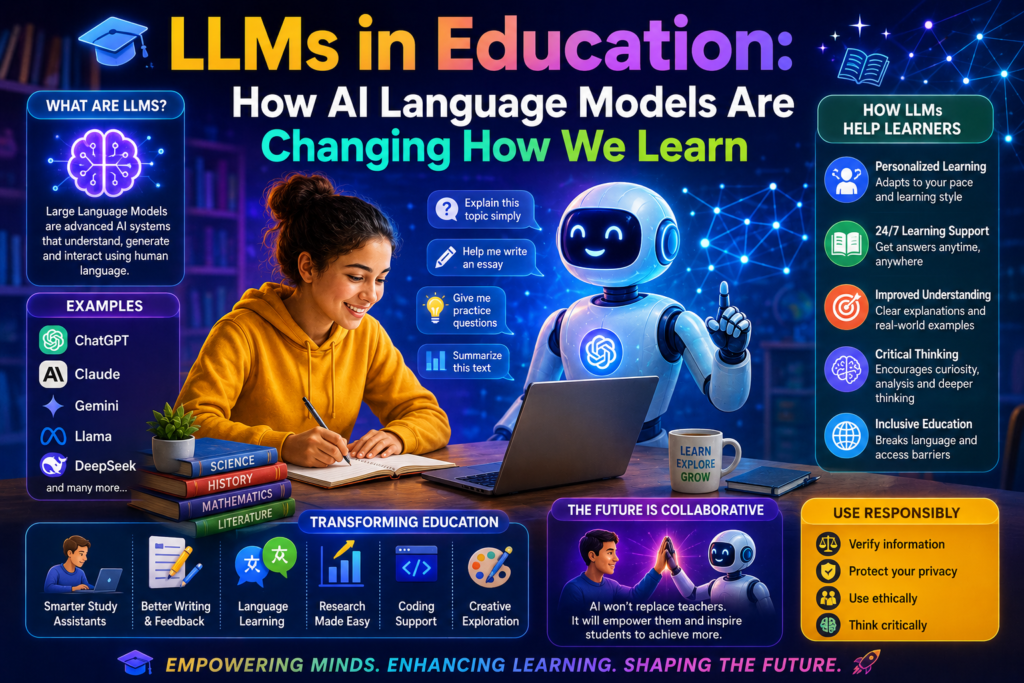
The research community also mobilized to study the impact. Studies of Student engagement metrics showed mixed but promising results. Students who used AI tutors alongside human instruction often demonstrated improved learning outcomes, particularly in subjects where they had fallen behind their peers. Language learning chatbots powered by large language models proved remarkably effective at providing the kind of low-stakes conversational practice that is essential for acquiring a new language. Understanding how llms work became relevant not just for computer scientists but for instructional designers who needed to grasp the strengths and limitations of these tools. The key insight was that ai in education llms worked best not as replacements for teachers but as supplements that could provide personalized support at a scale that human instructors alone could never achieve.
The Personalization Era Takes Shape (2023 – 2024)
As the initial shock of generative AI settled into institutional acceptance, the focus shifted toward true personalization at scale. Personalized learning paths, long a holy grail of educational technology, became genuinely achievable with large language models. Unlike earlier adaptive systems that could only adjust difficulty within a predefined content library, LLM-powered platforms could generate entirely new explanations, examples, and practice exercises tailored to an individual student’s specific misconceptions and interests. A student struggling with fractions because they found abstract numbers meaningless could receive instruction contextualized around their actual interests, whether those were basketball statistics, video game design, or cooking measurements.
The burden reduction for educators also became a central narrative. Teacher administrative workload reduction moved from a nice-to-have benefit to an urgent priority as schools faced growing staffing shortages. Language models proved remarkably capable at handling routine documentation, drafting Individualized Education Programs, generating progress reports, and creating differentiated materials for students at multiple ability levels within the same classroom. Curriculum development tools powered by AI allowed instructional designers to produce high-quality materials in a fraction of the time previously required. This liberation of teacher time created space for the irreplaceable human elements of education, building relationships with students, providing emotional support, and fostering the classroom community.
The technical capabilities of the models themselves continued to advance. The release of gpt-4 history brought multimodal capabilities, allowing models to analyze images, diagrams, and handwritten work in addition to text. This opened up new applications in subjects like geometry, art, and laboratory science that had previously been beyond the reach of language-only systems. Multimodal ai history was being written in real time, and education stood to benefit enormously. A student could now photograph their handwritten math work, and the AI could identify exactly where their reasoning had gone wrong, not just whether they had arrived at the correct answer. This level of detailed, personalized feedback had previously been available only to students whose families could afford private tutors.
Equity, Ethics, and the Digital Divide (2024 – 2025)
The rapid deployment of AI in classrooms has forced a reckoning with questions of equity that the educational technology sector has often preferred to avoid. Educational equity is not automatically served by new technology. In fact, without deliberate intervention, technological advances tend to widen existing gaps. Students with high-speed internet, personal devices, and tech-savvy parents gain advantages that compound over time, while students without these resources fall further behind. The integration of ai in education llms has made this dynamic painfully visible. A student who can access an always-patient AI tutor at home has a fundamentally different educational experience than one who cannot.
These concerns have sparked important policy discussions. School districts serving low-income communities have begun exploring how to provide universal access to AI tutoring tools during school hours and after school. The concept of Virtual classrooms enhanced by AI has gained traction as a way to extend high-quality instruction to rural and underserved areas where teacher shortages are most acute. However, the quality of these tools varies enormously, and the evidence base for what works in different contexts is still being built. The risk of deploying poorly designed AI tools that confuse or mislead vulnerable students is very real, and advocates have called for rigorous testing and regulation before AI becomes a standard part of the educational infrastructure.
The question of academic integrity has also matured. The initial bans on AI use have largely given way to more sophisticated Academic integrity policies that distinguish between acceptable and unacceptable uses of the technology. Many institutions now teach students how to use AI as a research assistant and writing coach while drawing clear lines around submitting AI-generated content as one’s own work. Plagiarism detection software has evolved to identify AI-generated text, though the arms race between generators and detectors continues. The deeper pedagogical question is about what skills matter in a world where AI can produce competent prose on demand. If the machine can write the five-paragraph essay, what should we be teaching students about thinking and communication instead?
The regulatory landscape is also beginning to respond. Just as governments have scrambled to develop frameworks for the broader ai regulation history, specific guidance for educational AI applications is starting to emerge. Ministries of education in several countries have published guidelines for the ethical use of AI in schools, addressing issues like data privacy, algorithmic transparency, and the importance of maintaining human decision-making in high-stakes educational contexts. These frameworks are still nascent, but they represent an important acknowledgment that the deployment of powerful AI tools in learning environments cannot be left entirely to market forces.
Frequently Asked Questions (FAQs)
How are teachers actually using LLMs in their daily work?
The most common use cases are less glamorous than the futuristic visions often portrayed. Teachers use ai in education llms primarily for reducing administrative burden. They draft emails to parents, generate differentiated reading materials, create quiz questions, and develop lesson plans. More adventurous teachers use the tools for creative instructional activities like AI-mediated Socratic dialogues or collaborative story writing where the model serves as a creative partner. The key pattern across successful implementations is that the teacher remains firmly in the loop as the pedagogical decision-maker.
Do AI writing assistants harm student writing development?
The evidence is mixed and evolving. When students use AI writing assistants to generate complete essays that they submit as their own work, learning clearly suffers. However, when the tools are used for targeted support like brainstorming, sentence-level revision feedback, and grammar checking, studies suggest they can actually improve writing outcomes, particularly for English language learners and students with learning disabilities. The critical variable is how the tool is integrated into instruction. Deliberate instruction in prompt engineering for teachers and students appears to be essential for productive use.
Can AI tutors replace human teachers for underserved communities?
No serious research suggests that AI can or should replace human teachers. The most promising models use AI tutors as supplements that extend the reach of human instructors, not substitutes that eliminate the human element. For underserved communities, AI tutoring shows genuine promise for providing additional academic support outside of school hours. However, this only works if students have reliable internet access, appropriate devices, and the support structures needed to engage consistently with digital learning tools. Without addressing these foundational equity issues, AI tutoring risks widening rather than closing achievement gaps.
The Cognitive Science Connection and Learning Design
The most sophisticated applications of ai in education llms are deeply informed by research on how human beings actually learn. Cognitive load management is a central concern. Presenting a student with too much information at once overwhelms working memory and prevents learning. Well-designed AI tutoring systems carefully sequence information, provide worked examples before asking for independent practice, and use techniques like spaced repetition and retrieval practice that have robust evidence behind them. The best systems are not just language models bolted onto flashcard apps. They are carefully engineered learning environments where the AI serves a specific pedagogical function within a broader instructional design.
The development of Digital pedagogy as a discipline has accelerated in response to these new capabilities. Teacher preparation programs are beginning to include training on how to evaluate, select, and integrate AI tools into instruction. The most effective teachers are developing fluency in understanding what language models can and cannot do, recognizing common failure modes like hallucination and shallow reasoning, and designing activities that leverage AI’s strengths while mitigating its weaknesses. This is not a simple skill set, and the professional development infrastructure to support widespread teacher upskilling is still being built. The **chatgpt history** offers valuable lessons about how quickly a transformative tool can reshape user expectations and institutional practices.
Conclusion
The integration of ai in education llms into schools and universities represents one of the most significant shifts in instructional practice since the introduction of the internet. The technology has moved from laboratory curiosity to classroom reality in a remarkably compressed timeframe. Teachers who had never heard of a transformer model five years ago are now using AI tools daily. Students who grew up with search engines are adapting to a world where answers are generated, not just retrieved. The speed of this transition has been disorienting, but the underlying trend is clear and unlikely to reverse.
The most important lesson from the early years of this transformation is that technology alone does not improve education. Thoughtful integration by skilled educators is what makes the difference. The schools and systems that are seeing positive results are those that have invested heavily in professional development, developed clear policies about appropriate use, and maintained a relentless focus on learning outcomes rather than technological novelty. The conversation about the future of ai in learning environments must continue to center the human relationships that make education meaningful. A language model can explain a concept, generate a practice problem, or provide feedback on a draft. But it cannot look a struggling student in the eye and communicate the belief that they are capable of success. That irreplaceable human moment remains the heart of teaching, and the best educational technology serves to create more space for it, not to replace it.