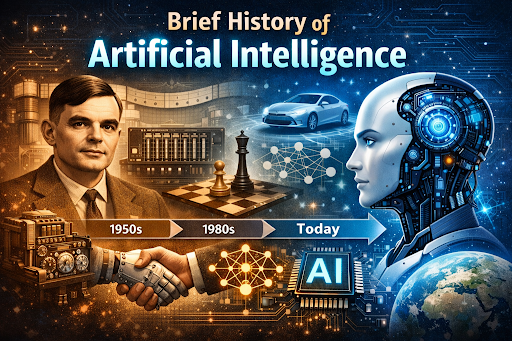
The modern internet is experiencing a massive, unprecedented transformation that is completely rewriting the rules of human expression. If you open any popular social media platform, news website, or digital forum today, you are instantly interacting with a vast sea of digital material. Much of this material is no longer created by human hands. To truly comprehend this jaw-dropping digital media transformation, we must thoroughly examine the complex ai generated content history from its earliest experimental roots to the explosive modern era of autonomous writing.
This magnificent technological evolution did not happen overnight. It is the direct result of decades of intense scientific research, breakthrough mathematical discoveries, and massive capital investments. By exploring the detailed ai generated content history, we can better understand how primitive text prediction tools evolved into the breathtaking, human-like language systems that power our global economy today. Let us embark on a comprehensive journey through time to uncover the remarkable milestones of this digital revolution.
The Primitive Beginnings of Machine Text (1960 – 1980)
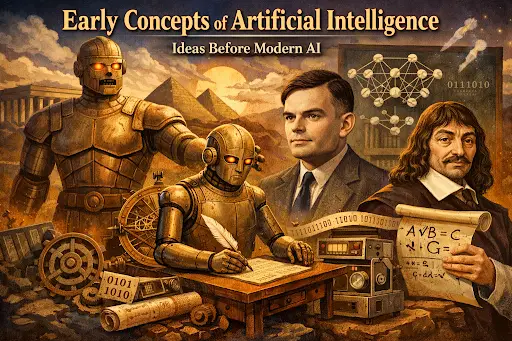
To discover the absolute earliest foundations of the true ai generated content history, we must travel back to the mid twentieth century. During this fascinating era, computer scientists began experimenting with basic language generation technology. These early attempts at automated content history were incredibly limited, relying entirely on rigid, hardcoded rules designed manually by human programmers. Computers lacked the ability to think freely, meaning they could only output exactly what they were strictly programmed to produce.
A major milestone occurred in the 1960s with the creation of the world’s first conversational simulation program. Anyone studying the remarkable eliza chatbot history can easily see how this primitive script laid the groundwork for future conversational interfaces. Eliza could mimic a psychotherapist by simply rearranging user inputs into open ended questions, giving a brief illusion of understanding.
Despite capturing the public imagination, these early systems did not possess genuine contextual awareness. They could not create new ideas or maintain long conversations without breaking character. This initial phase of the AI writing history proved that while machines could manipulate symbols, true machine creativity would require a completely different mathematical framework.
The Rules Based Era and Content Automation (1980 – 2000)
As computing power slowly increased during the late twentieth century, the overarching AI text generation history shifted toward more structured applications. Enterprises and academic institutions wanted practical systems that could handle tedious documentation. This desire gave rise to early automated writing tools designed to generate basic financial summaries, weather updates, and simple sports reports.
During this era, the global tech industry relied heavily on expert systems. These programs contained massive databases of human knowledge combined with thousands of “if then” logical rules. This primitive form of content automation allowed corporations to generate formulaic text quickly, but the outputs were incredibly stiff, repetitive, and completely devoid of natural human emotion.
This era proved that a rules-based approach to the history of AI generated media was fundamentally unscalable. Human language is infinitely complex, filled with subtle nuances, idioms, and shifting contexts that can never be fully captured by static lines of code. The global scientific community realized that to unlock genuine artificial creativity, machines needed to learn language organically from raw data.
The Deep Learning Shift and Statistical Models (2000 – 2015)
The dawn of the twenty-first century brought an absolute paradigm shift to the global computational landscape. Researchers abandoned rigid logical rules and embraced statistical machine learning models. This pivotal transition completely accelerated the AI content timeline, allowing computers to analyze massive datasets of human-written text to discover underlying grammatical patterns independently.
Scientists began developing highly sophisticated neural text generation systems that utilized complex recurrent neural networks. These advanced frameworks allowed data to loop through the system, creating a primitive form of digital memory. Suddenly, digital content tools became much better at predicting the next logical word in a sentence, drastically improving the quality of machine generated text.
As deep learning innovation reached new heights, the tech industry introduced early commercial writing applications. These tools helped marketers generate simple email subject lines and basic product descriptions. While these early platforms were highly useful for basic tasks, they still struggled with long form cohesion and frequently suffered from logical consistency errors.
The Breakthrough of Transformer Architectures (2015 – 2020)
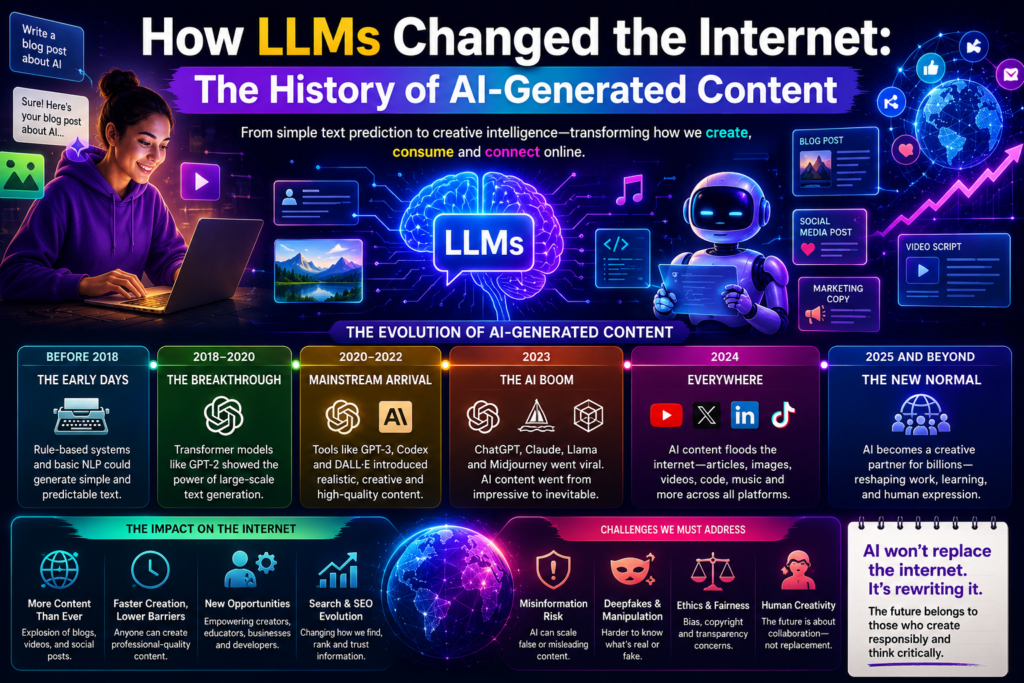
The true turning point in the entire ai generated content history arrived in 2017 when Google researchers published a legendary academic paper introducing the transformer model. This brilliant structural innovation allowed neural networks to process entire sentences simultaneously, rather than word by word. This breakthrough solved massive engineering bottlenecks and allowed models to understand long range context flawlessly.
The global software community quickly utilized this new architecture to build incredibly massive language models. Anyone analyzing the comprehensive large language models history will note that this specific breakthrough completely unlocked the true potential of AI storytelling systems. The internet suddenly witnessed a massive explosion in high quality, coherent automated content.
During this exciting phase of the AI content development history, OpenAI introduced its revolutionary gpt models history to the world. Each new iteration of these models was trained on exponentially larger datasets, leading to jaw-dropping improvements in text fluidity. By the time GPT-3 arrived in 2020, machine generated content history entered a completely new era, as the software could now write essays that were virtually indistinguishable from human work.
The Conversational Explosion and Mass Adoption (2022 – 2024)
While the pre-2022 era was defined by developer-facing APIs, late 2022 marked the absolute democratization of generative algorithms. The public launch of a free, conversational web interface completely shocked the global tech sector. This historic product launch accelerated the AI content evolution, turning a niche engineering concept into a daily productivity tool used by hundreds of millions of people worldwide.
This rapid consumer adoption completely disrupted the traditional digital media landscape. Bloggers, journalists, copywriters, and corporate marketers suddenly integrated these advanced automated writing tools directly into their daily workflows. The sheer volume of machine-generated material across the internet absolutely skyrocketed, permanently altering search engine dynamics and content optimization strategies.
However, this hyper-accelerated era also introduced severe structural challenges. The widespread prevalence of misinformation, copyright disputes, and automated spam forced the industry to confront the dark side of this technology. Educational institutions and regulatory bodies rushed to adapt to this new reality, marking a critical chapter in the global AI writing evolution.
The Multimodal Frontier and Autonomous Workers (2025 – 2026)
By 2026, the historical narrative of machine-created media expanded far beyond simple text generation. The modern internet is now defined by highly sophisticated, unified systems capable of processing and generating multiple types of media simultaneously. We are currently living through a breathtaking phase of multimodal ai history where text, audio, video, and code are completely integrated into single, seamless pipelines.
Today’s digital content tools no longer just write static articles. They can independently script, voice, animate, and edit complete video presentations with zero human intervention. This incredible convergence has completely redefined the boundaries of artificial creativity, giving individual creators the immense production power of entire media studios.
Furthermore, the technology has transitioned from passive writing assistants to highly proactive autonomous workers. These advanced systems can independently research complex topics, cross-reference data across secure networks, and continuously update digital platforms in real time. The internet has transformed into a highly dynamic, personalized ecosystem driven by continuously evolving machine intelligence.
FAQs
What is the earliest example in the ai generated content history?
The earliest foundations date back to the 1960s with rules-based programs like ELIZA, which used basic pattern matching to simulate human conversation. However, true automated text generation based on data learning did not emerge until the statistical machine learning breakthroughs of the early 2000s.
How did the transformer architecture change the internet?
Introduced in 2017, the transformer architecture allowed AI models to process language data simultaneously rather than sequentially. This enabled machines to understand long-term context, write coherent long-form articles, and ultimately power the modern generative tools we use today.
What are the main challenges of machine-generated content today?
The primary challenges include the spread of automated misinformation, intellectual property and copyright complications, and the phenomenon of AI hallucinations where models confidently invent false facts.
Conclusion
The monumental journey through the ai generated content history reveals a profound technological transformation that has permanently altered human communication. What began as a primitive, rules-based computer experiment in isolated labs has rapidly grown into the dominant force shaping the modern digital landscape. The staggering evolution of generative AI creation systems has compressed centuries of media development into a single hyper-accelerated decade.
As we look toward the horizon, the line between human and machine creativity will continue to blur, presenting both immense economic opportunities and deep ethical challenges. To successfully navigate this uncharted digital territory, society must continuously monitor the rapid future of ai to ensure these powerful creation tools remain a force for global innovation, education, and truth.