Artificial intelligence has evolved rapidly over the last decade. Large language models can write articles, answer questions, generate code, and assist with countless tasks. However, these models have one major limitation: they do not always have access to the latest or most accurate information. This challenge led to the development of retrieval augmented generation rag, a revolutionary approach that combines information retrieval with generative AI.
Today, retrieval augmented generation rag is becoming one of the most important technologies in modern AI systems. It helps organizations create more reliable chatbots, search assistants, customer support tools, and enterprise knowledge systems.
In this comprehensive guide, we will explore how retrieval augmented generation rag works, its history, benefits, challenges, real world applications, and what the future holds for this exciting technology.
What Is Retrieval Augmented Generation RAG?
Retrieval augmented generation rag is an AI framework that enhances large language models by providing them with relevant external information before generating a response.
Instead of relying solely on knowledge stored during training, the model first retrieves relevant documents from a database or knowledge source. It then uses those documents to generate a more accurate answer.
This approach significantly improves factual correctness and reduces misinformation.
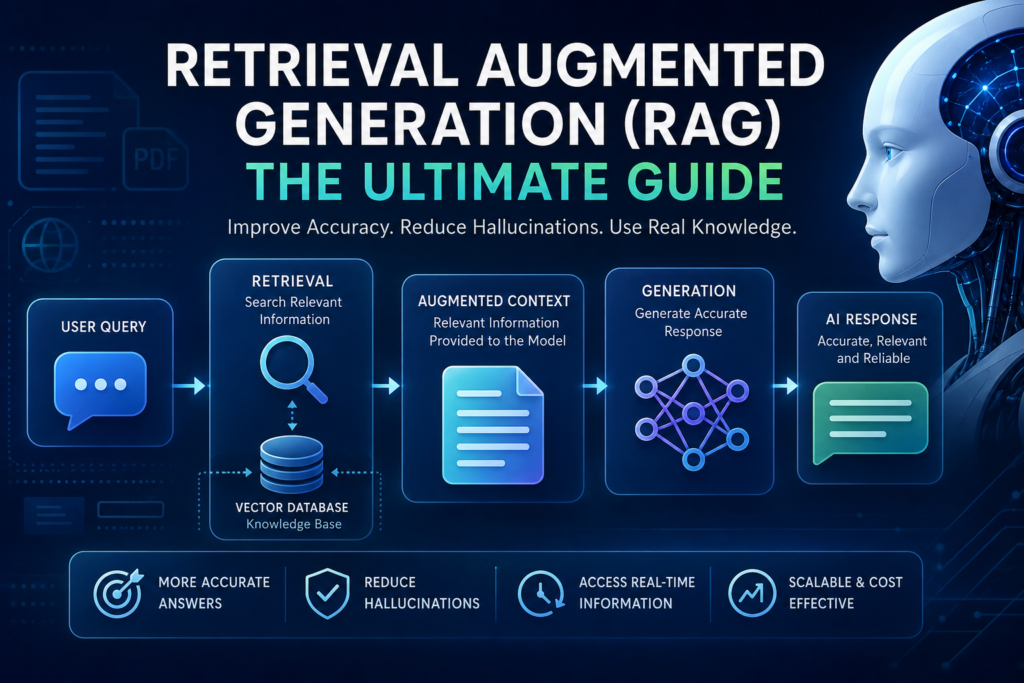
A simple workflow looks like this:
- User submits a query.
- Retrieval system finds relevant documents.
- Documents are sent to the language model.
- Model generates a response based on retrieved information.
This process allows AI systems to access updated information without retraining the entire model.
The Evolution of AI Knowledge Systems (2010 – 2025)
Early AI systems depended heavily on static training data. Once trained, their knowledge became fixed.
Researchers experimented with several approaches to improve language understanding, including what is word2vec, sequence modeling techniques, and advanced neural networks.
Later developments such as transformer model explained architectures dramatically improved language processing capabilities.
The rise of large language models created a new challenge: hallucinations. Models could generate convincing but incorrect information.
To address this issue, retrieval augmented generation rag emerged as a practical solution by connecting language models with external knowledge sources.
By 2025, many leading AI companies had integrated retrieval systems into their products to improve reliability and performance.
Why Retrieval Augmented Generation RAG Matters
The importance of retrieval augmented generation rag cannot be overstated.
Traditional language models face several limitations:
- Outdated knowledge
- Hallucinations
- Limited context windows
- High retraining costs
- Difficulty handling company specific information
Retrieval augmented generation rag solves many of these problems by supplying fresh and relevant information during inference.
Benefits include:
- More accurate responses
- Better factual grounding
- Reduced hallucinations
- Access to private enterprise data
- Lower operational costs
- Faster knowledge updates
These advantages make it attractive for businesses and developers alike.
How Retrieval Augmented Generation RAG Works
The process can be divided into several stages.
Data Collection
Organizations gather information from:
- Documents
- Websites
- Databases
- PDFs
- Knowledge bases
- Internal records
Data Chunking
Large documents are divided into smaller pieces called chunks.
Chunking improves retrieval accuracy because smaller text segments are easier to search.
Embedding Creation
Each chunk is converted into a numerical vector using embedding models.
These vectors represent semantic meaning.
Vector Database Storage
Embeddings are stored inside vector databases such as:
- Pinecone
- Weaviate
- Chroma
- Milvus
- FAISS
Retrieval Phase
When a user asks a question, the system retrieves the most relevant chunks.
Generation Phase
The language model receives:
- User query
- Retrieved documents
The model then generates a grounded response.
Architecture of Retrieval Augmented Generation RAG
A standard retrieval augmented generation rag architecture contains:
- Data Sources
- Document Processing Pipeline
- Embedding Model
- Vector Database
- Retrieval Engine
- Language Model
- Response Generator
This architecture enables AI systems to access knowledge dynamically rather than relying entirely on pre trained information.
For those studying modern AI systems, understanding pre training in ai is essential because RAG complements rather than replaces pre training.
Sample Retrieval Augmented Generation RAG Code
Below is a simplified Python example demonstrating a basic retrieval workflow.
from sentence_transformers import SentenceTransformer
import faiss
import numpy as np

documents = [
    "RAG combines retrieval and generation.",
    "Vector databases store embeddings.",
    "Large language models generate text."
]

model = SentenceTransformer('all-MiniLM-L6-v2')

doc_embeddings = model.encode(documents)

index = faiss.IndexFlatL2(doc_embeddings.shape[1])
index.add(np.array(doc_embeddings))

query = "What does RAG do?"
query_embedding = model.encode([query])

D, I = index.search(np.array(query_embedding), k=2)

for idx in I[0]:
    print(documents[idx])
This simple example demonstrates how semantic retrieval works before the generation stage.
Retrieval Augmented Generation RAG vs Fine Tuning
Many people confuse retrieval augmented generation rag with model customization techniques.
While both improve AI performance, they serve different purposes.
Retrieval Augmented Generation RAG
- Uses external knowledge
- Easy to update
- Reduces hallucinations
- Lower maintenance cost
Fine Tuning
- Modifies model weights
- Requires training resources
- More expensive
- Useful for behavioral adaptation
Learning fine tuning in ai helps clarify when each approach should be used.
In many modern systems, organizations combine both techniques for maximum effectiveness.
Real World Applications of Retrieval Augmented Generation RAG
Retrieval augmented generation rag is transforming industries worldwide.
Customer Support
Companies use RAG powered assistants to answer customer questions using current documentation.
Healthcare
Medical assistants retrieve relevant research and clinical information before generating responses.
Legal Research
Law firms search large legal databases efficiently.
Education
Students receive accurate answers grounded in educational resources.
The growth of AI in classrooms continues to influence ai in education llms initiatives globally.
Enterprise Knowledge Management
Organizations provide employees with instant access to internal knowledge.
How Retrieval Augmented Generation RAG Reduces Hallucinations
One of the biggest challenges in AI is hallucination.
Hallucinations occur when a model generates information that sounds correct but is actually false.
The study of ai hallucination history shows that this problem has existed since the early days of generative AI.
Retrieval augmented generation rag reduces hallucinations by grounding responses in retrieved evidence.
Instead of guessing, the model references actual documents.
This dramatically improves trustworthiness and reliability.
Challenges of Retrieval Augmented Generation RAG
Despite its advantages, retrieval augmented generation rag has limitations.
Retrieval Quality
Poor retrieval leads to poor answers.
Data Freshness
Databases must remain updated.
Latency
Additional retrieval steps increase response time.
Security Risks
Private data must be protected carefully.
Infrastructure Complexity
Organizations need:
- Embedding pipelines
- Vector databases
- Monitoring systems
- Search optimization
Proper implementation is essential for success.
Best Practices for Building a Retrieval Augmented Generation RAG System
To maximize effectiveness:
Use High Quality Data
Clean and accurate documents improve performance.
Optimize Chunk Size
Chunks should be neither too large nor too small.
Select Strong Embedding Models
Embedding quality directly affects retrieval quality.
Evaluate Regularly
Measure:
- Precision
- Recall
- Response quality
- User satisfaction
Monitor Performance
Continuous monitoring ensures long term effectiveness.
Organizations that follow these practices achieve significantly better results.
Retrieval Augmented Generation RAG and Modern Large Language Models
Modern language models increasingly depend on retrieval systems.
As models become larger, the cost of retraining grows dramatically.
Researchers studying gpt models history have observed that retrieval mechanisms provide a scalable alternative to frequent retraining.
Instead of rebuilding models every time information changes, developers can simply update knowledge databases.
This approach is more efficient and practical for real world deployments.
Future of Retrieval Augmented Generation RAG (2026 – 2035)
The future of retrieval augmented generation rag looks incredibly promising.
Several trends are emerging:
Multimodal Retrieval
Future systems will retrieve:
- Text
- Images
- Audio
- Video
Personalized Knowledge Systems
AI assistants will retrieve information tailored to individual users.
Real Time Information Access
Models will connect directly to continuously updated knowledge sources.
Agent Based Systems
The rise of what is ai agent technologies will further increase the importance of retrieval systems.
Enterprise AI Expansion
Businesses will continue deploying RAG powered assistants at scale.
Future of AI
The broader future of large language models will likely involve deep integration between language models, retrieval systems, reasoning engines, and autonomous agents.
Retrieval augmented generation rag will remain a foundational component of this evolution.
Frequently Asked Questions
What is retrieval augmented generation rag?
Retrieval augmented generation rag is an AI framework that combines information retrieval with text generation to improve accuracy and reduce hallucinations.
Why is retrieval augmented generation rag important?
It allows AI systems to access external knowledge sources, making responses more reliable and up to date.
Does retrieval augmented generation rag replace fine tuning?
No. Both techniques serve different purposes and can be used together.
Which industries benefit from retrieval augmented generation rag?
Healthcare, education, legal services, customer support, finance, and enterprise knowledge management all benefit significantly.
Can retrieval augmented generation rag eliminate hallucinations completely?
No. It reduces hallucinations substantially but cannot eliminate them entirely.
Conclusion
Retrieval augmented generation rag represents one of the most important advancements in modern artificial intelligence. By combining powerful language models with external knowledge retrieval, it delivers more accurate, reliable, and context aware responses.
As AI adoption continues to accelerate, retrieval augmented generation rag will play a central role in enterprise applications, research tools, educational platforms, and intelligent assistants. Organizations seeking trustworthy AI solutions are increasingly adopting this technology because it provides a practical balance between scalability, accuracy, and cost efficiency.
The future of AI is not just bigger models. It is smarter systems that can retrieve, reason, and generate information effectively. Retrieval augmented generation rag stands at the center of that transformation.