Introduction
Pre training in ai is the foundational step that gives large language models their extraordinary breadth of knowledge. Before a model can answer your questions, write your emails, or generate working code, it must first spend weeks or months absorbing an almost incomprehensible amount of text from books, websites, scientific papers, and online forums. That initial phase of massive exposure to human knowledge is what pre-training in AI refers to, and understanding it is essential to understanding how modern AI systems actually work.
The idea sounds almost absurdly simple: show a neural network enough text and let it learn to predict what comes next. But the details of how this works, why it works so well, and how researchers arrived at it over decades of trial and error, reveal one of the most important intellectual journeys in the history of computer science. Pre training in ai did not emerge overnight. It grew from a long lineage of ideas about representation learning, transfer learning, and the surprising power of self-supervised learning at scale.
This article traces the complete history of pre-training in ai, from its earliest conceptual roots to the distributed training systems and massive text corpora that power today’s frontier models.
Early Ideas About Representation Learning (1980 – 2000)
The intellectual seeds of pre-training in ai were planted decades before the term itself was in common use. In the 1980s and 1990s, researchers working on neural networks were already grappling with a fundamental problem: how do you initialize a neural network in a way that gives it a useful starting point rather than requiring it to learn everything from scratch?
Early work on weights initialization showed that random initialization worked for small networks on simple tasks, but as networks grew deeper, training became unstable. Gradients would vanish or explode during backpropagation, making it nearly impossible for the network to learn useful latent representations in its deeper layers.
Researchers like Geoffrey Hinton explored the idea of pre-training layers greedily, one at a time, using unsupervised objectives before fine-tuning the full network on a labeled task. This was an early recognition that model initialization mattered enormously and that unsupervised data, which is far more abundant than labeled data, could be used to build useful internal representations before any task-specific supervision was applied.
The core insight was powerful even then: if you could extract general-purpose representations from large amounts of unlabeled data, you could give a neural network a massive head start on any downstream task. The challenge was figuring out how to do this reliably and at scale. That challenge would take another two decades to fully solve.
Word Vectors and the First Practical Pre-Training (2013 – 2016)
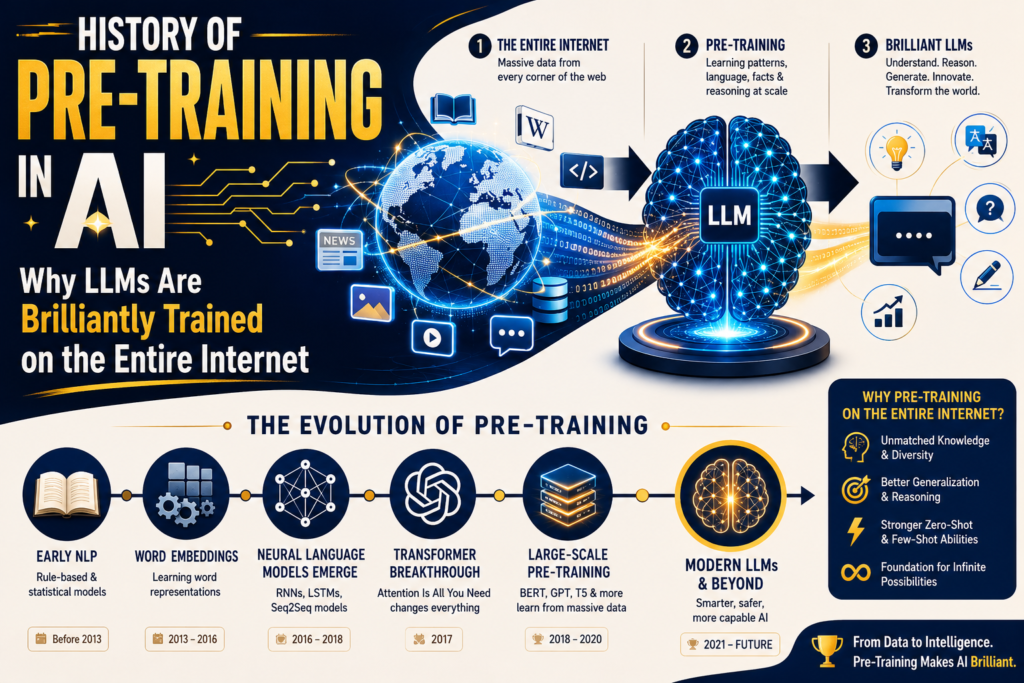
The first widely adopted form of pre training in ai in natural language processing arrived with word embeddings. The history of word embeddings traces how researchers developed methods to represent individual words as dense numerical vectors learned from large amounts of unlabeled text.
Word2Vec, released by Google in 2013, used a shallow neural network architecture trained on a simple self-supervised objective: predict a word from its surrounding context, or predict the surrounding context from a word. Training on hundreds of millions to billions of words, this process produced vector representations that encoded surprising amounts of semantic and syntactic information. Words used in similar contexts ended up geometrically close to each other in the vector space.
GloVe from Stanford followed in 2014 with a slightly different approach based on global co-occurrence statistics across the entire corpus rather than local context windows. Both methods were forms of pre training in ai in a limited sense: they used unlabeled data and self-supervised training objectives to produce general-purpose representations that could then be used as a starting point for downstream NLP tasks.
The limitation was significant. These were static word-level representations. The same word always had the same vector regardless of context, and there was no mechanism for the model to understand how the meaning of a word shifted based on the sentence it appeared in. Feature extraction from these embeddings was useful, but the representations were shallow compared to what would come later.
ELMo and Context-Sensitive Pre-Training (2018)
The next major step in pre training in ai came from the Allen Institute for AI with the release of ELMo in early 2018. ELMo, which stood for Embeddings from Language Models, was a significant departure from static word embeddings. Instead of producing one fixed vector per word, ELMo used a deep bidirectional LSTM trained on a large text corpus to produce context-sensitive representations. The vector for a word depended on the entire sentence it appeared in, not just the word itself.
ELMo was pre-trained on the One Billion Word Benchmark using a language modeling objective, predicting the next word in a sequence in one direction and the previous word in the other. The resulting representations captured how words changed meaning in different contexts, and when used to initialize downstream models, they produced substantial improvements on multiple NLP benchmarks.
This was pre training in ai beginning to look like what the term means today: a self-supervised learning objective applied to a large neural network using massive text corpora, producing general-purpose representations that transfer broadly to downstream tasks. The inductive bias built into this kind of pre-training, essentially the assumption that language follows patterns that can be predicted, turned out to be remarkably well-suited to the structure of human text.
The Transformer Changes Everything (2017 – 2018)
The arrival of the transformer architecture in 2017 gave pre training in ai the vehicle it needed to reach its full potential. The transformer architecture history shows how Google’s “Attention Is All You Need” paper replaced recurrent networks with self-attention mechanisms that could process entire sequences in parallel rather than token by token.
This parallelization was transformative for pre-training because it meant that the training objectives used in pre training in ai could now take advantage of the full power of modern GPUs and TPUs. Recurrent networks processed sequences sequentially, which created a bottleneck that limited how much compute you could throw at pre-training. Transformers removed that bottleneck entirely, enabling distributed training across hundreds or thousands of accelerators simultaneously.
OpenAI released GPT-1 in 2018, demonstrating that a transformer decoder pre-trained on books using a next-token prediction objective could be fine-tuned to achieve strong performance across a wide range of NLP tasks. Google released BERT the same year, showing that a transformer encoder pre-trained with masked language modeling on Wikipedia and books could outperform all prior approaches on benchmark after benchmark.
These two papers established the two dominant forms of pre training in ai that persist to this day: causal language modeling, where the model predicts the next token given all previous tokens, and masked language modeling, where the model predicts randomly hidden tokens using bidirectional context.
What Pre-Training Actually Involves: Data, Compute, and Objectives
To truly understand pre training in ai, it helps to understand what it looks like in practice. The process involves three major components working together: training objectives, large-scale datasets, and computational resources.
The training objective defines what the model is trying to learn. For GPT-style models, the objective is loss function minimization on next-token prediction: given a sequence of tokens, minimize the error in predicting what comes next. This simple objective, applied consistently across trillions of tokens of text, forces the model to develop internal representations that capture grammar, facts, reasoning patterns, and stylistic conventions across the full diversity of human writing.
The data is the other critical ingredient. Modern pre training in ai uses massive text corpora assembled from multiple sources. Common Crawl corpus, a regularly updated scrape of a large portion of the accessible web, is typically the largest component. It contains petabytes of raw text that must be extensively cleaned, deduplicated, and filtered before use. Unlabeled data processing at this scale is a major engineering undertaking in itself. Tokenization strategies, which determine how raw text is broken into the discrete units the model actually processes, have a significant impact on training efficiency and downstream performance.
The computational resources required are staggering. Training a frontier language model requires thousands of specialized GPUs or TPUs running continuously for weeks or months. Distributed training across this hardware requires sophisticated systems for coordinating gradient updates across thousands of parallel processes without introducing errors or bottlenecks. The financial cost of a single pre-training run for a frontier model is now estimated in the tens of millions of dollars.
The Scaling Era and Pre-Training at Extreme Scale (2020 – 2023)
One of the most significant developments in the history of pre training in ai was the empirical discovery and systematic study of scaling laws. Researchers at OpenAI published work in 2020 showing that model performance on language modeling improved in smooth, predictable ways as you scaled model size, dataset size, and compute simultaneously. This gave the field a roadmap: more of everything kept making models better, and the improvements showed no sign of plateauing at the scales then being explored.
This discovery triggered an era of extreme-scale pre-training. GPT-3 was pre-trained on roughly 300 billion tokens. PaLM from Google was pre-trained on 780 billion tokens. LLaMA 2 from Meta used two trillion tokens. The Chinchilla model from DeepMind, released in 2022, argued that most large models had been undertrained relative to their size, and that a smaller model trained on more data could match or outperform a larger model trained on less. This influenced how subsequent models approached the balance between model size and data volume during pre training in ai.
The llm timeline during this period shows an industry racing to push the boundaries of what was possible through scale. Each organization developed its own approach to data curation, tokenization, and distributed training, treating these as competitive advantages. The Common Crawl corpus became a shared foundation across many pre-training datasets, though the filtering and quality control applied to it varied significantly between organizations.
Pre-Training Across Modalities (2021 – Present)
Pre training in ai has expanded well beyond text. Vision transformers showed in 2021 that the same self-supervised pre-training approach that worked so well for language could be applied to images by treating image patches as tokens. Models pre-trained on large collections of images learned rich visual representations that transferred powerfully to downstream vision tasks.
Multimodal pre-training, which trains models on combinations of text and images simultaneously, has become one of the most active areas of AI research. Models like CLIP from OpenAI were pre-trained on hundreds of millions of image-text pairs scraped from the web, learning to align visual and linguistic representations in a shared space. This foundational knowledge acquisition across modalities enables models to describe images, answer visual questions, and generate images from text descriptions.
The what is bert model page explains how BERT-style pre-training for text was the template that vision and multimodal researchers adapted for their own domains. The core principle remains the same: use self-supervised learning on massive unlabeled data to build general-purpose representations before task-specific fine-tuning.
Why Pre-Training on the Entire Internet Works
The philosophical question behind pre training in ai is worth addressing directly: why does training on internet-scale text actually produce models that can reason, follow instructions, and solve novel problems?
The answer lies in what massive text corpora implicitly contain. Human writing, in aggregate, encodes an enormous amount of knowledge about the world, about how language works, about logical relationships, about cause and effect, and about social and professional norms. A model that successfully learns to predict the next token across trillions of tokens of diverse human text must, in the process, develop internal representations that capture this knowledge in some form.
Scalability in AI turns out to be a crucial property here. The inductive bias of next-token prediction is weak enough that the model is not constrained to learn any particular type of knowledge, yet strong enough that it must learn whatever is genuinely useful for predicting text. At sufficient scale, what turns out to be useful for prediction is a surprisingly rich model of the world.
This is why pre training in ai on internet-scale data produces models with capabilities that seem to emerge discontinuously as scale increases. The model is not being explicitly taught to reason or to follow instructions. It is learning patterns across so much text that reasoning and instruction-following emerge as useful sub-skills for the prediction task.
The future of AI will continue to be shaped by advances in pre training in ai, as researchers push toward more efficient data use, better tokenization strategies, and training objectives that encode more useful inductive biases from the start.
For a broader view of how pre-training connects to the full arc of language model development, the gpt models history shows how each successive generation of GPT models refined and scaled the pre-training approach pioneered in 2018.
FAQs
What is pre-training in AI and why does it matter?
Pre training in ai is the process of training a large neural network on massive amounts of unlabeled data using a self-supervised learning objective before any task-specific fine-tuning occurs. It matters because it gives the model broad foundational knowledge about language, facts, and reasoning that transfers powerfully to a wide range of downstream tasks. Without pre-training, you would need enormous amounts of labeled data for every new task you wanted a model to perform.
What data is used for pre-training large language models?
Most large language models are pre-trained on a combination of web text from sources like Common Crawl, books, Wikipedia, scientific papers, and code repositories. The raw data must be extensively filtered, deduplicated, and processed before use. The resulting datasets typically contain hundreds of billions to trillions of tokens of text representing an enormous range of human knowledge and language use.
How long does pre-training take and how expensive is it?
Pre-training a frontier language model typically takes weeks to months of continuous training on thousands of specialized GPUs or TPUs. The cost of a single pre-training run for a large model is estimated in the range of tens of millions of dollars. This is why pre-training is typically done once by well-resourced organizations and the resulting model is then fine-tuned many times for different applications.
What is the difference between pre-training and self-supervised learning?
Self-supervised learning is the training paradigm used during pre-training. It means the model generates its own supervision signal from the structure of the data itself rather than requiring human-labeled examples. For language models, the self-supervised objective is typically next-token prediction or masked token prediction. Pre-training is the broader process of using self-supervised learning on large datasets to build general-purpose representations before fine-tuning.
Why is pre-training on internet-scale data so effective?
Human text at internet scale encodes an extraordinary amount of world knowledge, linguistic structure, logical relationships, and reasoning patterns. A model trained to predict the next token across trillions of tokens of diverse text must develop internal representations that capture this knowledge in order to predict accurately. At sufficient scale, these representations turn out to generalize remarkably well to tasks that were never explicitly part of the training objective.
Conclusion
Pre training in ai is the silent foundation beneath every impressive thing a large language model can do. It is what happens before the fine-tuning, before the safety alignment, before the product launch, and before the user ever types their first message. It is the phase where a model absorbs the collective textual output of human civilization and learns to find the patterns within it.
Pre training in ai has evolved from early greedy layer-wise pre-training on small datasets to self-supervised learning at a scale that was unimaginable just a decade ago. It has moved from text to images to audio to video and to combinations of all of these simultaneously. It has driven an era of models whose capabilities keep exceeding expectations precisely because pre-training on more data with larger models keeps revealing new emergent behaviors.
Understanding pre training in ai is understanding the engine that drives the entire field. Everything else in modern AI, from fine-tuning to RLHF to retrieval augmentation, is built on top of the rich foundation that pre-training creates. That foundation is why LLMs can do what they do, and why the race to build better pre-training pipelines remains one of the most consequential competitions in technology today.