The induction motor is one of the most important inventions in human history. Although many people recognize Nikola Tesla for his work with electricity, the invention that arguably changed the modern world the most was the induction motor. Today, nearly every industry relies on this remarkable machine. From factory equipment and elevators to air conditioners, pumps, electric vehicles, and household appliances, the induction motor quietly powers civilization.
Before Tesla introduced this revolutionary technology, electric motors were often inefficient, complicated, and difficult to maintain. His breakthrough design created a reliable, efficient, and maintenance-free motor that transformed industrial production and modern electrification.
Understanding the induction motor means understanding how Tesla’s genius continues to influence everyday life more than a century after his invention.
The World Before the Induction Motor (1870 – 1888)
During the late nineteenth century, electrical engineering was still developing.
Many early electric motors relied on brushes and mechanical commutators. These components required regular maintenance and limited performance.
Engineers sought a more efficient solution that could operate continuously without excessive wear.
At the same time, electricity distribution systems were evolving rapidly. Tesla believed that electric motors should work seamlessly with alternating current systems.
His vision eventually led to the invention of the modern induction motor, a machine that solved many engineering problems simultaneously.
Nikola Tesla’s Revolutionary Idea (1888)
The story of the induction motor begins with the extraordinary creativity of Nikola Tesla visionary inventor.
Tesla realized that a motor could operate without direct electrical connections to the rotating part of the machine.
Instead, he used electromagnetic induction to create motion.
This breakthrough eliminated brushes and significantly improved reliability.
The invention became closely connected to tesla alternating current, which supplied the alternating electrical energy needed for operation.
Tesla’s discovery would soon become the foundation of modern industrial power systems.
Understanding Electromagnetic Induction
The operating principle of every induction motor is electromagnetic induction.
When a conductor experiences a changing magnetic field, an electromotive force is generated.
Faraday’s Law is:
E = -N(dΦ/dt)
Where:
- E = induced voltage
- N = number of coil turns
- Φ = magnetic flux
- t = time
This equation explains how changing magnetic fields generate electrical currents.
Tesla used this principle to create motion without physical electrical contact between stationary and rotating components.
The result was one of the most elegant machines ever invented.
The Rotating Magnetic Field Discovery
Tesla’s greatest conceptual breakthrough was the rotating magnetic field.
Instead of using a stationary magnetic field, he created magnetic fields that continuously rotated.
This was achieved using multiple alternating current phases.
In a three-phase system:
Phase A = Vₘ sin(ωt)
Phase B = Vₘ sin(ωt − 120°)
Phase C = Vₘ sin(ωt − 240°)
The interaction of these currents creates magnetic flux rotation inside the motor.
The rotating magnetic field pulls the rotor around without direct electrical contact.
This discovery became the heart of the modern induction motor.
Main Components of an Induction Motor
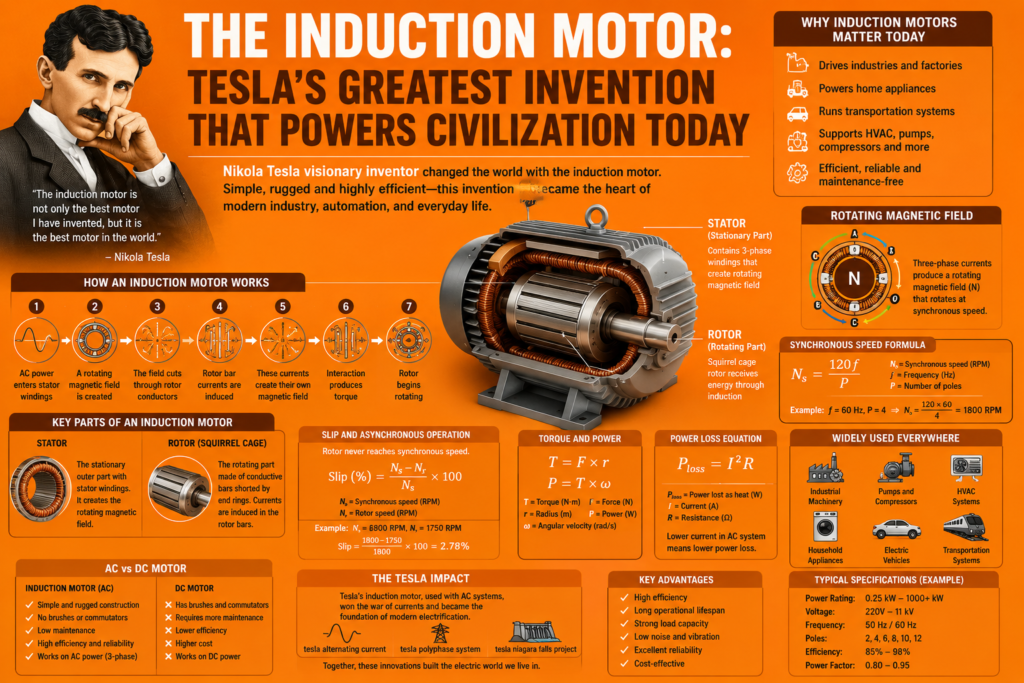
A typical AC induction motor contains two major sections:
Stator
The stator is the stationary outer section.
It contains stator windings connected to an AC power supply.
These windings generate the rotating magnetic field.
Rotor
The rotor is the rotating inner component.
Most motors use a squirrel cage rotor made from conductive bars connected by end rings.
The rotor receives energy through electromagnetic induction rather than direct wiring.
This design contributes to the motor’s reputation as a maintenance-free motor.
How an Induction Motor Works
The operation of an induction motor occurs in several steps:
- AC power enters the stator windings.
- A rotating magnetic field is created.
- The field cuts through the rotor conductors.
- Rotor bar currents are induced.
- These currents create their own magnetic field.
- Interaction between fields produces torque.
- The rotor begins rotating.
This process converts electrical energy into mechanical energy efficiently and reliably.
Because there are no brushes, the motor experiences minimal wear and enjoys a long operational lifespan.
Slip Speed Physics and Asynchronous Operation
One unique characteristic of the induction motor is that the rotor never rotates at exactly the same speed as the magnetic field.
This difference is called slip.
Slip is calculated as:
Slip (%) = ((Ns − Nr) / Ns) × 100
Where:
- Ns = synchronous velocity
- Nr = rotor speed
For example:
Ns = 1800 RPM
Nr = 1750 RPM
Slip = ((1800 − 1750)/1800) × 100
Slip = 2.78%
Because the rotor operates below synchronous speed, the machine is also called an asynchronous motor.
Without slip, electromagnetic induction would cease and torque production would stop.
Synchronous Velocity Formula
The rotating magnetic field speed is called synchronous velocity.
It is calculated as:
Ns = (120f)/P
Where:
- Ns = synchronous speed (RPM)
- f = frequency
- P = number of poles
Example:
f = 60 Hz
P = 4
Ns = (120 × 60)/4
Ns = 1800 RPM
This equation remains fundamental in electric motor design.
The Tesla Polyphase System and Motor Success
The success of the induction motor depended heavily on the tesla polyphase system.
Single-phase power can operate motors, but three-phase power provides smoother performance and greater efficiency.
Three-phase motor wiring creates balanced magnetic fields that improve torque production and reduce vibration.
This combination of alternating current and polyphase transmission enabled the widespread adoption of Tesla’s motor technology.
Without the polyphase system, industrial motor applications would have been far less practical.
The War of Currents and Motor Adoption (1888 – 1896)
The famous edison vs tesla conflict played a major role in the adoption of the induction motor.
Thomas Edison supported direct current systems.
Tesla and George Westinghouse promoted alternating current.
Because induction motors operate naturally on AC power, the success of alternating current directly supported motor adoption.
As AC systems expanded, Tesla’s motors became increasingly valuable.
Factories quickly recognized their advantages and embraced the technology.
The Niagara Falls Demonstration (1895 – 1896)
One of the greatest milestones in electrical engineering occurred through the tesla niagara falls project.
The hydroelectric facility generated large amounts of alternating current electricity.
Tesla’s technology demonstrated how electrical energy could travel long distances and power motors efficiently.
The project proved that AC systems and induction motors could support entire cities and industries.
This achievement accelerated worldwide adoption of modern electrical infrastructure.
Torque Production and Mechanical Power
The purpose of every induction motor is producing torque.
Torque is calculated as:
T = F × r
Where:
- T = torque
- F = force
- r = radius
Mechanical power output is:
P = Tω
Where:
- P = power
- T = torque
- ω = angular velocity
These equations explain how electrical energy becomes useful mechanical work.
Motor designers carefully optimize torque speed curve characteristics to suit different applications.
Why Induction Motors Became Dominant
Several advantages made the induction motor the preferred choice worldwide:
- Simple construction
- High reliability
- Low maintenance
- Excellent load capacity
- Long operational lifespan
- Strong efficiency
- Low manufacturing cost
These benefits helped establish induction motors as the backbone of modern industry.
Today they are considered among the most successful machines ever created.
Applications in Industry and Everyday Life
The induction motor powers countless systems.
Examples include:
Industrial Factory Machinery
Industrial factory machinery depends heavily on induction motors.
Manufacturing plants use them for:
- Conveyors
- Pumps
- Compressors
- Machine tools
- Industrial automation systems
HVAC Systems
HVAC compressors rely on induction motors to provide heating and cooling.
Household Appliances Motors
Many household appliances motors use induction technology, including:
- Washing machines
- Refrigerators
- Fans
- Air conditioners
Heavy Manufacturing
Heavy manufacturing facilities utilize large motors capable of producing thousands of mechanical horsepower.
Induction Motors in Transportation
Modern transportation increasingly depends on electric motors.
Applications include:
- Electric traction systems
- Rail transportation
- Industrial vehicles
- Electric vehicle drivetrain technology
Tesla’s original concepts continue influencing transportation innovation more than a century later.
Many modern electric vehicles use motor designs inspired by induction motor principles.
Efficiency and Modern Standards
Motor efficiency standards have become increasingly important.
Efficiency is calculated as:
η = (Output Power / Input Power) × 100
Example:
Input = 1000 W
Output = 950 W
η = (950/1000) × 100
η = 95%
Modern motors often exceed 95% efficiency.
Such performance reduces energy consumption and operating costs.
Power factor optimization further improves electrical efficiency in industrial systems.
Engineering Challenges and Solutions
Despite its advantages, the induction motor faces engineering challenges:
Magnetic Core Saturation
Excessive magnetic flux can reduce efficiency.
Engineers carefully design magnetic circuits to prevent magnetic core saturation.
Armature Reaction
Although primarily associated with other motor types, armature reaction concepts influence magnetic behavior and machine performance.
Thermal Dissipation
Large motors generate heat.
Proper thermal dissipation systems ensure reliable operation under heavy loads.
These engineering solutions contribute to the exceptional durability of induction motors.
Tesla’s Legacy Through the Induction Motor
Many inventions contributed to Tesla’s reputation, but the induction motor stands above most of them.
While innovations such as nikola tesla patents, wireless systems, and electrical experiments earned attention, the induction motor transformed daily life more directly than almost any other invention.
Every factory, office building, hospital, airport, and industrial facility benefits from Tesla’s vision.
The influence of the induction motor remains visible everywhere modern civilization operates.
FAQs
What is an induction motor?
An induction motor is an AC electric motor that operates using electromagnetic induction rather than direct electrical connections to the rotor.
Why did Tesla invent the induction motor?
Tesla wanted a more reliable and efficient motor that could operate effectively using alternating current systems.
What is a squirrel cage rotor?
A squirrel cage rotor is a rotor design consisting of conductive bars connected by end rings that allow induced currents to flow.
Why is it called an asynchronous motor?
It is called an asynchronous motor because the rotor rotates slightly slower than the rotating magnetic field.
Where are induction motors used?
They are used in factories, HVAC systems, household appliances, transportation systems, pumps, compressors, and industrial machinery.
Conclusion
The induction motor remains one of the most influential inventions in technological history. By combining electromagnetic induction, rotating magnetic fields, and alternating current power, Nikola Tesla created a machine that transformed civilization.
From industrial automation and heavy manufacturing to household appliances and electric vehicles, the induction motor continues to drive modern life. Its reliability, efficiency, simplicity, and durability have made it the preferred motor technology across the world.
More than a century after its invention, Tesla’s induction motor remains a remarkable example of engineering brilliance, proving that a single breakthrough idea can reshape the future of humanity.