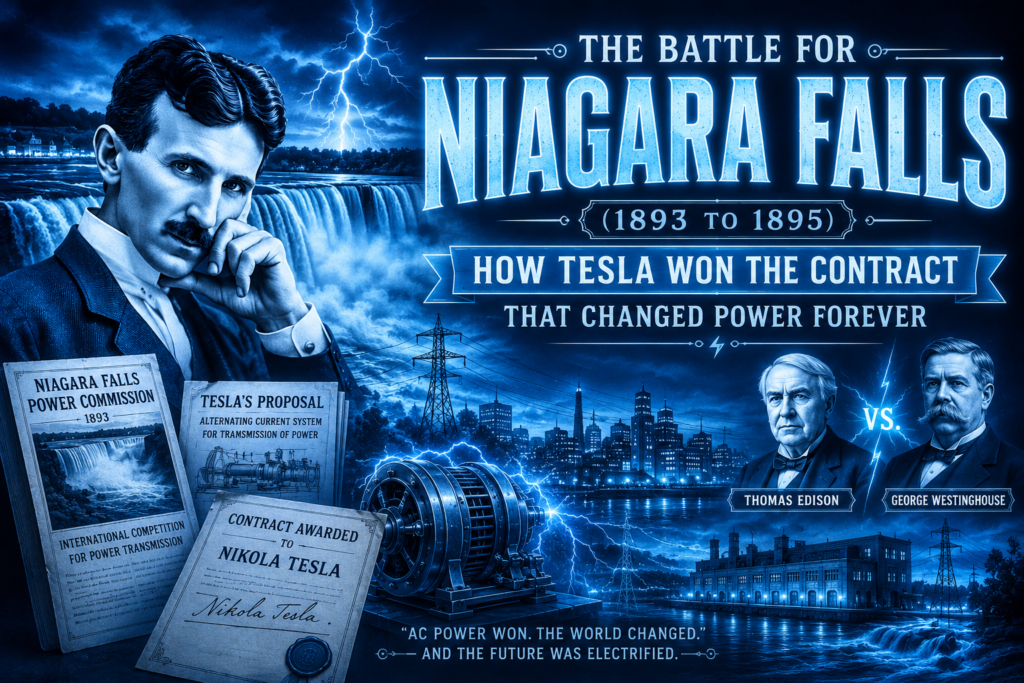
The battle for niagara falls stands as one of the most important events in the history of electricity. It was far more than a competition for a construction contract. It was a decisive test that would determine whether alternating current or direct current would become the foundation of the modern electrical world.
During the late nineteenth century, engineers, investors, scientists, and governments closely watched the race to harness the tremendous power of Niagara Falls. Whoever succeeded would prove that their electrical system could operate on an unprecedented scale. The project eventually became one of the greatest industrial engineering achievements ever completed and transformed the future of global energy distribution.
For Nikola Tesla, the success of the battle for niagara falls represented the ultimate validation of his electrical theories. For Thomas Edison and supporters of direct current, it was a challenge that threatened the future of their technology. The outcome changed electricity forever.
Why Niagara Falls Became the World’s Greatest Energy Opportunity (1885 – 1893)
Niagara Falls had fascinated engineers for decades. The immense flow of water represented a nearly unlimited source of mechanical energy.
Industrial leaders recognized that if this energy could be converted into electricity efficiently, it could power cities, factories, transportation systems, and economic growth on an enormous scale.
The challenge was not generating power.
The challenge was transmitting it.
At the time, existing electrical systems struggled to move energy over long distances. The project therefore became the perfect testing ground for competing technologies.
This challenge eventually evolved into the battle for niagara falls, one of the most significant technological competitions in history.
Formation of the Niagara Falls Power Company
To manage the project, the niagara falls power company was established.
Its mission included:
- Harnessing the falls
- Building an industrial power station
- Developing large scale electrical infrastructure
- Supplying power to surrounding regions
The company assembled some of the world’s most respected engineers and scientists to determine the best technological approach.
Their decision would influence electrical infrastructure for generations.
The International Niagara Commission
The international niagara commission was created to evaluate proposals from leading inventors and engineering firms.
The commission included distinguished experts from multiple countries.
One of its most influential members was Lord Kelvin, a highly respected physicist and engineer.
Initially, many experts remained uncertain regarding the best method of transmitting electricity over long distances.
The commission carefully reviewed competing proposals before making a final recommendation.
The Edison DC Bid
At the heart of the battle for niagara falls was the competition between direct current and alternating current.
The edison dc bid relied on direct current power systems similar to those already operating in major cities.
Direct current offered advantages such as:
- Simpler equipment
- Existing infrastructure
- Proven local operation
However, DC faced serious limitations when transmitting electricity over long distances.
The Niagara project required a solution capable of serving regions far beyond the immediate vicinity of the falls.
This challenge exposed weaknesses in the direct current approach.
Tesla’s Alternating Current Solution
Tesla proposed a radically different strategy based upon tesla alternating current technology.
Alternating current provided several major advantages:
- Long distance transmission
- Higher efficiency
- Lower operating costs
- Flexible voltage control
Tesla’s system depended on transformers that could raise voltage for transmission and lower it for safe consumption.
This capability became a critical factor in the battle for niagara falls.
The Mathematics That Favored AC
The success of alternating current was supported by fundamental electrical principles.
Electrical power is calculated as:
P = V × I
Where:
- P = Power (Watts)
- V = Voltage (Volts)
- I = Current (Amperes)
Rearranging:
I = P ÷ V
For the same amount of power, increasing voltage reduces current.
Transmission losses follow:
Loss = I²R
Where:
- I = Current
- R = Resistance
Example:
If current decreases by half:
Loss = (½I)²R
Loss = ¼I²R
This means transmission losses fall to only 25 percent of their original value.
These calculations strongly supported Tesla’s approach during the battle for niagara falls.
Westinghouse AC Contract (1893)
George Westinghouse recognized the value of Tesla’s inventions and purchased rights to many of Tesla’s patents.
The resulting westinghouse ac contract became one of the most important partnerships in electrical history.
Westinghouse agreed to implement Tesla’s AC system for the Niagara project.
This decision provided Tesla with the opportunity to prove that alternating current could succeed on a scale never attempted before.
Lord Kelvin Decision
Lord Kelvin initially favored alternative solutions and expressed reservations regarding alternating current.
However, extensive engineering analysis gradually demonstrated the superiority of Tesla’s approach.
The lord kelvin decision eventually supported AC implementation.
This endorsement carried enormous weight because Kelvin was among the most respected scientific authorities of the era.
His support helped solidify confidence in the project.
The Role of Tesla’s Polyphase System
A major reason Tesla prevailed in the battle for niagara falls was the effectiveness of the tesla polyphase system.
Polyphase AC systems offered:
- Greater efficiency
- Better power transmission
- Reliable motor operation
- Improved phase synchronization
These advantages made large scale electrical distribution practical.
The polyphase system remains the foundation of modern power grids today.
Rotating Magnetic Field and Generator Design
Tesla’s discovery of the rotating magnetic field transformed electrical engineering.
This principle allowed efficient conversion between electrical and mechanical energy.
In Niagara’s generating equipment, rotating magnetic fields played an essential role in:
- Generator operation
- Motor functionality
- Energy transfer
- Mechanical to electrical conversion
Without this breakthrough, the Niagara project would have been far more difficult to implement.
Construction of Power House Number One (1893 – 1895)
The construction phase represented an extraordinary industrial engineering feat.
The cataracts construction company participated in major structural work associated with the project.
Engineers faced numerous challenges:
- Massive excavation
- Water management
- Turbine installation
- Generator assembly
- Infrastructure development
The resulting facility became known as power house number one.
It represented one of the most advanced power generating stations ever built.
Water Turbine Coupling and Energy Conversion
The Niagara facility transformed falling water into electrical energy.
The process involved:
- Water flow from Niagara Falls.
- Turbine rotation.
- Generator activation.
- Electricity production.
Mechanical power follows:
P = τω
Where:
- P = Power
- τ = Torque
- ω = Angular velocity
This equation describes how mechanical energy transfer occurs between turbines and generators.
The system enabled efficient hydraulic power exploitation on a massive scale.
Tesla Induction Motor and Industrial Applications
Another critical factor in the battle for niagara falls involved the tesla induction motor.
Factories required practical motors capable of utilizing AC electricity.
Tesla’s induction motor provided:
- Reliability
- Efficiency
- Simplicity
- Industrial scalability
The motor became a key component in heavy industry electrification and helped demonstrate the practicality of alternating current systems.
Massive Generators and High Volume Energy Generation
The Niagara station featured some of the largest generators ever constructed at the time.
These massive generators enabled:
- Utility scale energy production
- Regional grid development
- Long-distance industrial power delivery
- Economic expansion
The facility quickly became an energy hub supporting industrial growth throughout the region.
Its success validated Tesla’s engineering vision.
Buffalo Electrification 1896
One of the most important milestones occurred shortly after project completion.
The buffalo electrification 1896 initiative successfully transmitted power from Niagara Falls to Buffalo, New York.
This achievement demonstrated that alternating current could deliver electricity across significant distances.
The accomplishment became a transmission milestone that influenced electrical projects worldwide.
It represented one of the strongest victories in the battle for niagara falls.
The Economic Transformation of the Region
The Niagara project produced substantial economic benefits.
Industries gained access to affordable electricity.
New businesses emerged.
Manufacturing expanded.
Employment increased.
The project accelerated economic transformation throughout the surrounding region and demonstrated the value of large scale electrical infrastructure.
Commercial Validation of Tesla’s Vision
Before Niagara Falls, many people considered alternating current unproven.
After Niagara Falls, opinions changed dramatically.
The project’s success provided:
- Commercial validation
- Engineering credibility
- Investor confidence
- Public acceptance
This achievement effectively settled many remaining questions regarding AC technology.
The Connection to Edison vs Tesla
The success of Niagara Falls cannot be separated from edison vs tesla.
The project became the ultimate demonstration that alternating current offered superior performance for large scale electrical distribution.
While Edison contributed enormously to electrical development, Niagara Falls confirmed that AC was better suited for modern power networks.
This outcome shaped electrical standards worldwide.
Tesla’s Broader Legacy
The Niagara project represented only one part of Tesla’s remarkable career.
His innovations also included:
- tesla hydroelectric power
- nikola tesla patents
- Nikola Tesla biography studies that document his achievements
These contributions collectively transformed electrical engineering and continue influencing modern technology.
The success of the battle for niagara falls remains one of the greatest accomplishments of his career.
Frequently Asked Questions
What was the Battle for Niagara Falls?
The Battle for Niagara Falls was the competition to determine which electrical system would power the Niagara Falls hydroelectric project during the 1890s.
Why was Niagara Falls important?
Niagara Falls provided a massive source of renewable energy capable of generating electricity on an unprecedented scale.
Who won the Niagara Falls contract?
George Westinghouse and Nikola Tesla’s alternating current system won the contract.
Why did alternating current succeed?
Alternating current enabled efficient long distance transmission through the use of transformers and higher voltages.
What happened after the project was completed?
Electricity was successfully transmitted to Buffalo in 1896, proving the practicality of large scale AC power distribution.
Conclusion
The battle for niagara falls was one of the defining moments in technological history. It demonstrated that alternating current could generate, transmit, and distribute electricity efficiently across large distances. Through innovative engineering, visionary leadership, and groundbreaking inventions, Nikola Tesla and George Westinghouse achieved what many thought impossible.
The successful completion of the Niagara Falls project transformed electrical infrastructure, accelerated industrial growth, and established the foundation of modern power systems. More than a century later, the influence of the battle for niagara falls can still be seen in power grids around the world, making it one of the greatest engineering triumphs ever achieved.