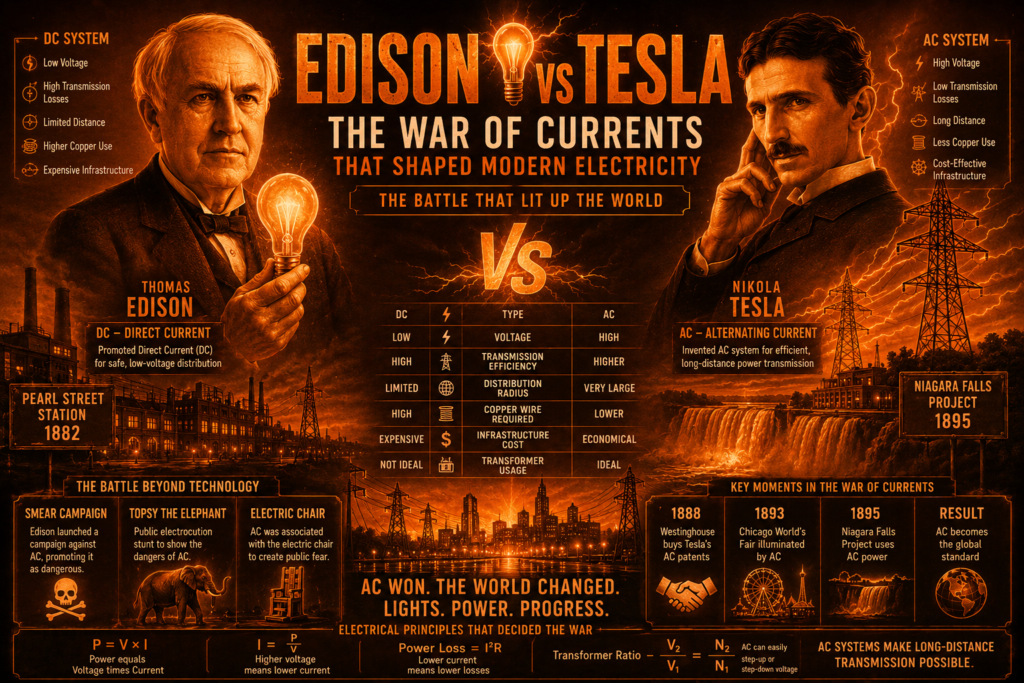
The story of edison vs tesla is one of the most fascinating rivalries in technological history. It was not simply a competition between two brilliant inventors. It was a battle that determined how electricity would be generated, transmitted, and used across the world.
During the late nineteenth century, Thomas Edison promoted direct current (DC), while Nikola Tesla visionary inventor championed alternating current (AC). Their conflict eventually became known as the War of Currents. The outcome influenced electrical infrastructure, industrial development, urban growth, and the future of global energy systems.
Today, nearly every modern power grid relies on technology that emerged from the edison vs tesla debate. Understanding this historic conflict helps explain why our electrical systems function the way they do and why Tesla’s innovations remain so influential.
The State of Electricity Before Edison vs Tesla (1870 – 1885)
Before the War of Currents began, electricity was still a developing technology. Most cities relied on gas lamps for illumination, while electrical systems remained limited and expensive.
Thomas Edison focused on creating practical electrical networks for homes and businesses. His approach centered on direct current systems that supplied electricity through local power stations.
At the same time, researchers around the world were exploring new methods of generating and distributing electrical energy.
The stage was set for the historic edison vs tesla rivalry that would transform modern civilization.
Understanding Direct Current and Alternating Current
The core issue in edison vs tesla involved two different methods of delivering electricity.
Direct Current (DC)
Direct current flows in only one direction.
Graphically:
Current → → →
Batteries are common examples of DC sources.
Alternating Current (AC)
Alternating current changes direction periodically.
Mathematically:
I(t) = I₀ sin(ωt)
Where:
- I(t) = Current at time t
- I₀ = Maximum current
- ω = Angular frequency
AC continuously reverses direction, allowing electricity to be transformed efficiently to different voltages.
This distinction became the foundation of the War of Currents.
Thomas Edison and the Direct Current System
Thomas Edison invested heavily in DC technology.
His electrical network included:
- Generators
- Distribution wires
- Meters
- Lighting systems
One of his most important projects was the pearl street station in New York City.
Opened in 1882, the station supplied electricity to customers within a relatively small distribution radius.
Although innovative, DC systems faced significant limitations.
Electricity could only travel short distances before voltage decay and line losses reduced effectiveness.
As cities expanded, these challenges became increasingly problematic.
Nikola Tesla and Alternating Current
Tesla believed AC offered a superior solution for large scale power distribution.
His work on tesla alternating current introduced methods for transmitting electricity over much greater distances.
Tesla developed:
- AC motors
- Polyphase systems
- High voltage transmission techniques
- Efficient transformers
These innovations dramatically improved transmission efficiency and reduced infrastructure cost.
As a result, AC became a serious competitor to Edison’s DC networks.
Why Alternating Current Had an Advantage
The primary strength of AC involved voltage transformation.
Electrical power is calculated using:
P = V × I
Where:
- P = Power (Watts)
- V = Voltage (Volts)
- I = Current (Amperes)
For a fixed amount of power:
I = P ÷ V
Increasing voltage reduces current.
Because power loss follows:
Power Loss = I²R
Reducing current significantly decreases transmission losses.
Example:
If current is reduced by half:
Loss = (½I)²R
Loss = ¼I²R
This means losses decrease to only 25%.
This mathematical advantage became a major factor in the edison vs tesla battle.
The Importance of Transformers
Transformers function efficiently only with alternating current.
The transformer equation is:
V₂ / V₁ = N₂ / N₁
Where:
- V₂ = Secondary voltage
- V₁ = Primary voltage
- N₂ = Secondary turns
- N₁ = Primary turns
Transformers allowed AC systems to:
- Increase voltage for transmission
- Reduce current
- Minimize losses
- Improve grid architecture
DC systems lacked this capability during the late nineteenth century.
This gave Tesla’s approach a major practical advantage.
Westinghouse and Tesla Join Forces (1888)
An important chapter in edison vs tesla began when industrialist George Westinghouse purchased Tesla’s AC patents.
Westinghouse recognized the enormous potential of alternating current.
This partnership strengthened Tesla’s position and intensified the rivalry.
The conflict evolved into a major contest between competing electrical companies, often described as westinghouse vs edison.
The financial stakes were enormous because the winner would influence the future of the electrical industry.
The War of Currents History
The war of currents history involved technical debates, business competition, and public relations campaigns.
Both sides attempted to convince governments, investors, and consumers that their technology was superior.
The battle extended beyond engineering and became a struggle for market dominance.
Issues included:
- Technology adoption
- Infrastructure cost
- Public safety campaigns
- Corporate monopoly concerns
- Grid lobbying
These factors transformed the conflict into one of the most significant industrial rivalries ever recorded.
Thomas Edison Smear Campaign
One of the most controversial aspects of edison vs tesla involved efforts to portray AC as dangerous.
The thomas edison smear campaign included public demonstrations designed to emphasize the risks associated with high-voltage AC dangers.
Animals were sometimes electrocuted publicly to show the effects of electrical shock.
These demonstrations generated significant media attention and contributed to growing public fear regarding alternating current.
Many historians consider these events examples of corporate sabotage and aggressive business tactics.
The Electric Chair Controversy
During the War of Currents, alternating current became associated with the electric chair.
The electric chair electrocution process was promoted partly as evidence that AC was dangerous.
Supporters of DC hoped this association would discourage public acceptance of AC systems.
However, engineers continued recognizing the superior efficiency and practicality of alternating current for power transmission.
Ultimately, technical advantages proved more influential than fear based campaigns.
Topsy the Elephant Execution
One of the most frequently discussed incidents connected to electrical publicity campaigns was the topsy the elephant execution.
Although it occurred after many major War of Currents battles had already been decided, the event became symbolic of efforts to associate electricity with danger.
Historians continue debating the exact relationship between this incident and broader electrical industry rivalries.
Regardless of interpretation, it remains one of the most controversial episodes linked to early electrical history.
Tesla’s Polyphase Revolution
Tesla’s greatest contribution may have been the tesla polyphase system.
Polyphase AC systems improved power generation and transmission efficiency dramatically.
The system worked together with the rotating magnetic field principle, enabling practical AC motors.
These inventions allowed factories, transportation systems, and industrial machinery to operate more effectively.
Without these breakthroughs, modern electrical infrastructure would look very different.
The Tesla Induction Motor
Another key innovation was the tesla induction motor.
Unlike many earlier motors, Tesla’s design operated efficiently using alternating current.
The induction motor became essential for:
- Manufacturing
- Transportation
- Mining
- Agriculture
- Industrial automation
Even today, induction motors remain among the most widely used electrical machines in the world.
Their success strengthened Tesla’s position during the edison vs tesla conflict.
The Chicago World’s Fair (1893)
A major victory for Tesla and Westinghouse occurred at the 1893 World’s Columbian Exposition in Chicago.
Westinghouse won the contract to illuminate the fair using AC technology.
Millions of visitors witnessed alternating current powering thousands of lights.
The event demonstrated the practicality and reliability of Tesla’s electrical system.
It significantly improved public confidence in AC technology.
The Niagara Falls Project (1895)
Perhaps the most decisive moment in edison vs tesla occurred when AC technology was selected for the tesla niagara falls project.
The hydroelectric facility generated electricity using Niagara Falls and transmitted power over long distances.
This achievement demonstrated that AC could successfully serve entire cities.
The project became a landmark success for alternating current and effectively settled many debates regarding large scale power distribution.
The General Electric Merger
As the electrical industry evolved, competition reshaped major corporations.
The general electric merger contributed to the formation of powerful industry leaders that influenced future electrical standards.
Eventually, AC technology became the dominant system for public electricity distribution.
This outcome reflected practical engineering advantages rather than promotional campaigns alone.
Why AC Won the War of Currents
Several factors explain why Tesla’s system ultimately prevailed.
Greater Transmission Efficiency
AC reduced line losses during long distance transmission.
Lower Infrastructure Costs
Fewer generating stations were required.
Flexible Voltage Control
Transformers simplified power distribution.
Industrial Applications
AC motors enabled large scale industrial growth.
Expanding Electrical Infrastructure
Cities and rural areas could be connected more effectively.
These advantages proved decisive in the edison vs tesla competition.
The Lasting Legacy of Edison vs Tesla
Although Tesla’s system won the War of Currents, both inventors made significant contributions.
Edison advanced:
- Commercial lighting
- Power generation
- Electrical business development
Tesla advanced:
- Alternating current
- Electric motors
- Power transmission
- Modern electrical engineering
Their rivalry accelerated innovation and helped create the electrical world we know today.
Frequently Asked Questions
What was the War of Currents?
The War of Currents was a competition between Thomas Edison’s DC system and Nikola Tesla’s AC system for electrical power distribution.
Why did Tesla support AC?
Tesla recognized that alternating current could be transmitted efficiently over long distances using transformers.
Why did Edison oppose AC?
Edison had invested heavily in DC infrastructure and believed it was safer and more commercially viable.
Who won the War of Currents?
Alternating current ultimately became the dominant system for public electricity distribution worldwide.
Is DC still used today?
Yes. Batteries, electronics, solar systems, and some transmission applications still use direct current.
Conclusion
The story of edison vs tesla remains one of the most important technological rivalries in human history. What began as a disagreement over electrical systems evolved into a battle that shaped modern civilization.
Tesla’s alternating current system ultimately prevailed because it offered superior transmission efficiency, lower costs, and greater flexibility. Meanwhile, Edison’s efforts helped establish the foundations of commercial electricity and public electrical infrastructure.
More than a century later, the outcome of the War of Currents continues influencing how electricity is generated, transmitted, and used around the globe. The legacy of edison vs tesla serves as a reminder that scientific progress often emerges through competition, innovation, and the relentless pursuit of better solutions.