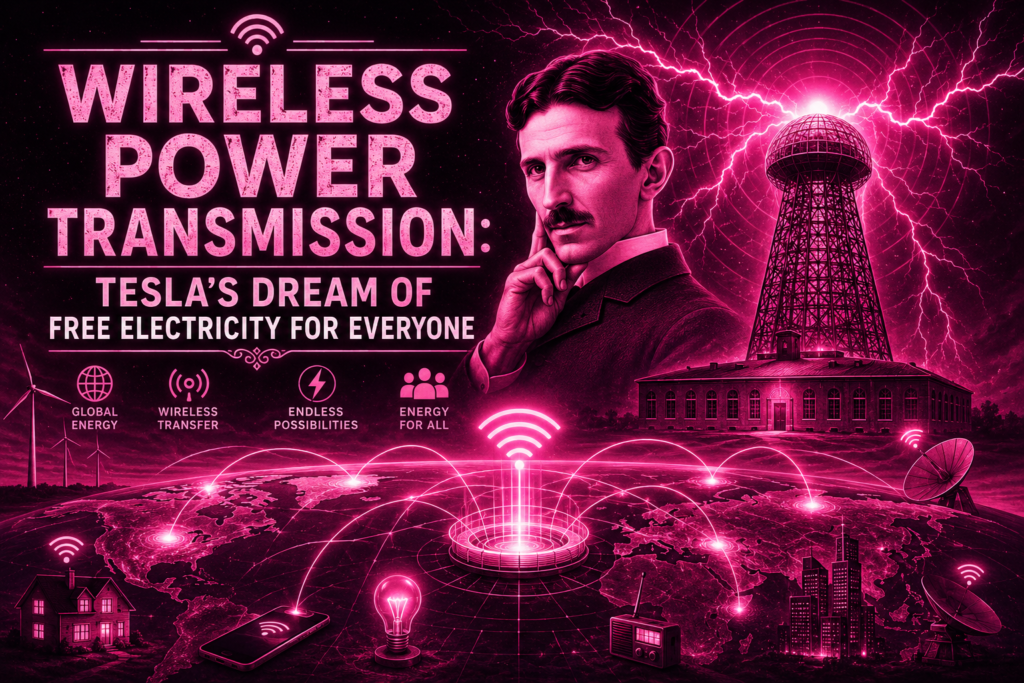
Wireless power transmission is one of the most ambitious concepts ever proposed in the history of science and engineering. The idea of delivering electricity without wires captured the imagination of inventors, governments, researchers, and dreamers alike. More than a century ago, Nikola Tesla visionary inventor envisioned a future where electrical energy could be transmitted across vast distances without cables, allowing people around the world to access electricity freely and efficiently.
Although many people associate wireless power with smartphone chargers and modern consumer electronics, Tesla imagined something far greater. His goal was a worldwide system capable of delivering energy through the Earth and atmosphere itself. This revolutionary vision of wireless power transmission continues to inspire scientists today as they explore new methods of energy delivery.
The story of wireless power transmission combines science, engineering, innovation, and one of the most fascinating chapters in technological history.
The Origins of Wireless Power Transmission (1890 – 1900)
During the late nineteenth century, electricity was rapidly transforming society. Cities were becoming electrified, industries were expanding, and electrical engineering was advancing at an unprecedented pace.
Tesla had already achieved remarkable success through his work on tesla alternating current, which enabled efficient long distance power distribution. However, he believed wires themselves would eventually become unnecessary.
Through experiments involving high frequency electricity and resonance, Tesla developed theories suggesting that electrical energy could travel through the Earth and atmosphere. These ideas became the foundation of wireless power transmission.
His investigations were supported by discoveries related to the rotating magnetic field, which had already revolutionized electrical machinery and power generation.
What Is Wireless Power Transmission?
Wireless power transmission refers to the transfer of electrical energy from a source to a load without physical conductors connecting them.
Instead of traditional wires, energy is transferred through electromagnetic fields, resonance, radio waves, microwave beams, or other methods.
Modern examples include:
- Wireless phone chargers
- Electric toothbrush chargers
- RFID systems
- Medical implants
- Industrial sensors
However, Tesla’s vision of wireless power transmission extended far beyond these localized applications.
He imagined a global electrical network capable of delivering power to homes, businesses, ships, and remote locations anywhere on Earth.
Tesla’s Theory of Global Energy Distribution
Tesla believed the Earth itself could function as a global transmission medium.
According to his theory, electrical oscillations introduced into the planet could travel through electrical ground currents and be received at distant locations.
His proposed system relied on:
- Earth resonance frequency
- Atmospheric electricity
- Conductive atmosphere
- Ionosphere conduction
- Geoelectric field interactions
Tesla argued that properly tuned transmitters could inject energy into the Earth’s natural electrical structure and distribute it worldwide.
This concept became one of the most famous interpretations of wireless power transmission.
The Role of the Tesla Coil
Tesla’s experiments relied heavily upon devices capable of generating enormous voltages and frequencies.
Many of these experiments were based on principles discussed in tesla coil explained research and demonstrations.
The Tesla coil allowed Tesla to study:
- High frequency currents
- Electrical resonance
- Electromagnetic wave propagation
- Wireless gas discharge lighting
- Non-radiative energy transfer
Through these investigations, Tesla gained confidence that wireless energy systems could be developed on a much larger scale.
Understanding Resonance in Wireless Energy Transfer
Resonance is one of the most important principles behind wireless power transmission.
When two systems operate at the same natural frequency, energy transfer becomes highly efficient.
The resonant frequency equation is:
f = 1 / (2π√LC)
Where:
- f = Frequency (Hz)
- L = Inductance (H)
- C = Capacitance (F)
This relationship allows transmitter and receiver systems to exchange energy effectively through resonant inductive coupling.
Today, this principle is used in many commercial wireless charging technologies.
Resonant Inductive Coupling
One of the most practical forms of wireless energy transfer is resonant inductive coupling.
Energy moves between two coils tuned to identical frequencies.
The power transfer efficiency depends on:
- Coil alignment
- Distance
- Frequency matching
- Magnetic coupling strength
The induced voltage follows:
V = N(dΦ/dt)
Where:
- V = Induced voltage
- N = Number of turns
- Φ = Magnetic flux
This equation explains how changing magnetic fields can transfer energy without direct electrical contact.
Modern wireless charging systems are based on this same principle.
Tesla’s Colorado Springs Experiments (1899)
In 1899 Tesla moved to Colorado Springs to conduct large scale experiments involving wireless power transmission.
The region provided open space and favorable conditions for high voltage testing.
During these experiments Tesla generated:
- Massive electrical discharges
- Artificial lightning
- High frequency oscillations
- Atmospheric electrical effects
He studied wave propagation through the Earth and investigated terrestrial stationary waves.
Tesla believed these experiments confirmed that electrical energy could travel significant distances through the ground.
Although some of his conclusions remain debated, the Colorado Springs experiments remain among the most famous electrical research projects ever conducted.
The Wardenclyffe Tower Project (1901 – 1917)
Tesla’s most ambitious effort to achieve wireless power transmission was the wardenclyffe tower project.
Constructed on Long Island, New York, the facility was designed to become a global communication and energy transmission station.
Tesla envisioned the tower providing:
- Worldwide communication
- Global electrical grid services
- International broadcasting
- Wireless energy transfer
The structure was intended to operate using a powerful magnifying transmitter capable of exciting electrical oscillations within the Earth.
Unfortunately, financial difficulties halted construction before the project could be fully completed.
As a result, the true capabilities of the Wardenclyffe system were never fully tested.
Magnifying Transmitter Technology
The magnifying transmitter represented Tesla’s advanced evolution of the Tesla coil.
Unlike conventional transformers, it was specifically designed to produce extremely high voltages and powerful oscillations.
Its objectives included:
- Increasing field intensity
- Enhancing wave propagation
- Supporting localized power transmission
- Improving long distance resonance
Tesla considered this device essential for achieving practical wireless power transmission.
Earth Resonance and Schumann Resonance
Tesla believed the Earth possessed natural resonant characteristics.
Modern science recognizes phenomena such as Schumann resonance, which occurs within the cavity formed by the Earth’s surface and ionosphere.
The fundamental Schumann resonance frequency is approximately:
7.83 Hz
Although Tesla’s theories differed from modern understanding, both concepts involve global electromagnetic behavior.
Researchers continue studying Earth resonance frequency phenomena to better understand planetary electrical systems.
The Science Behind Electromagnetic Wave Propagation
Electromagnetic wave propagation plays an important role in many wireless technologies.
The speed of electromagnetic waves is determined by:
c = λf
Where:
- c = Speed of light
- λ = Wavelength
- f = Frequency
This equation forms the foundation of radio communication, satellite systems, and many modern wireless technologies.
Tesla’s vision of wireless power transmission involved not only electromagnetic radiation but also electrical ground currents and atmospheric conduction mechanisms.
Wireless Power Transmission vs the Free Energy Myth
A common misunderstanding surrounding Tesla’s work is the free energy myth.
Tesla never claimed that energy could be created from nothing.
Instead, he sought more efficient methods of energy distribution.
Energy conservation remains governed by:
Energy Input = Energy Output + Losses
No wireless system can avoid transmitter power loss completely.
Every practical power transfer system experiences losses due to:
- Resistance
- Radiation
- Heat generation
- Electromagnetic interference
Therefore, wireless power transmission is not free energy. It is simply an alternative method of delivering energy.
Challenges Facing Global Wireless Power Transmission
Several major obstacles limit large scale deployment.
Field Intensity Decay
As distance increases, signal strength decreases significantly.
Power Losses
Transmitter power loss grows with transmission distance.
Safety Concerns
High energy electromagnetic fields require careful management.
Infrastructure Costs
Building a worldwide wireless power grid would require enormous investment.
Electromagnetic Interference
Strong transmission systems may affect communication networks and electronic devices.
These challenges help explain why Tesla’s vision has not yet been fully realized.
Modern Wireless Power Technologies (2000 – Present)
Although Tesla’s global network remains unrealized, many technologies now use principles related to wireless power transmission.
Examples include:
- Smartphone charging pads
- Electric vehicle charging systems
- Medical implant charging
- Industrial robotics
- Aerospace power beaming
Researchers continue improving efficiency and transmission distance through advanced engineering techniques.
Wireless Industrial Grid Concepts
Future engineers are exploring wireless industrial grid systems capable of supplying energy to factories, warehouses, and automated equipment.
Potential benefits include:
- Reduced wiring costs
- Greater flexibility
- Improved equipment mobility
- Simplified infrastructure
These developments demonstrate how Tesla’s ideas continue influencing modern innovation.
Energy Democratization and Tesla’s Vision
Tesla believed electricity should be accessible to everyone.
His dream of energy democratization focused on making power available regardless of geographic location.
Remote communities, developing regions, and isolated facilities could potentially benefit from advanced wireless power transmission systems.
Although complete global implementation remains distant, the concept continues motivating research efforts worldwide.
The Lasting Legacy of Tesla’s Vision
The influence of wireless power transmission extends far beyond the laboratory.
Tesla’s ideas inspired generations of engineers, scientists, and inventors.
His broader achievements, documented through numerous nikola tesla patents, helped shape modern electrical engineering.
His work also inspired many of the future innovations predicted in tesla technology predictions, many of which remarkably resemble technologies used today.
Understanding the story becomes even more fascinating when explored alongside a detailed Nikola Tesla biography, which reveals the determination and creativity behind his groundbreaking ideas.
Frequently Asked Questions
Did Nikola Tesla successfully create wireless power transmission?
Tesla demonstrated wireless energy transfer over short distances, but he never completed a fully operational global wireless power system.
What was the purpose of the Wardenclyffe Tower?
The Wardenclyffe Tower was intended to support worldwide communication and wireless energy transmission.
Is wireless power transmission used today?
Yes. Wireless charging devices, medical implants, RFID systems, and industrial applications all use forms of wireless power transmission.
What is resonant inductive coupling?
It is a method of transferring energy between resonant coils tuned to the same frequency, enabling efficient wireless energy transfer.
Was Tesla trying to create free electricity?
No. Tesla sought efficient energy distribution methods, not the creation of unlimited free energy.
Conclusion
Wireless power transmission remains one of the most captivating concepts in the history of science and engineering. Nikola Tesla envisioned a world where electrical energy could travel across continents without wires, reaching people everywhere through the Earth and atmosphere itself.
Although technological and economic challenges prevented the full realization of his dream, Tesla’s pioneering research laid the foundation for many modern wireless technologies. From wireless charging systems to advanced power beaming research, elements of his vision continue influencing innovation today.
More than a century later, wireless power transmission remains a powerful symbol of scientific ambition, creative thinking, and humanity’s ongoing pursuit of better ways to deliver energy to the world.