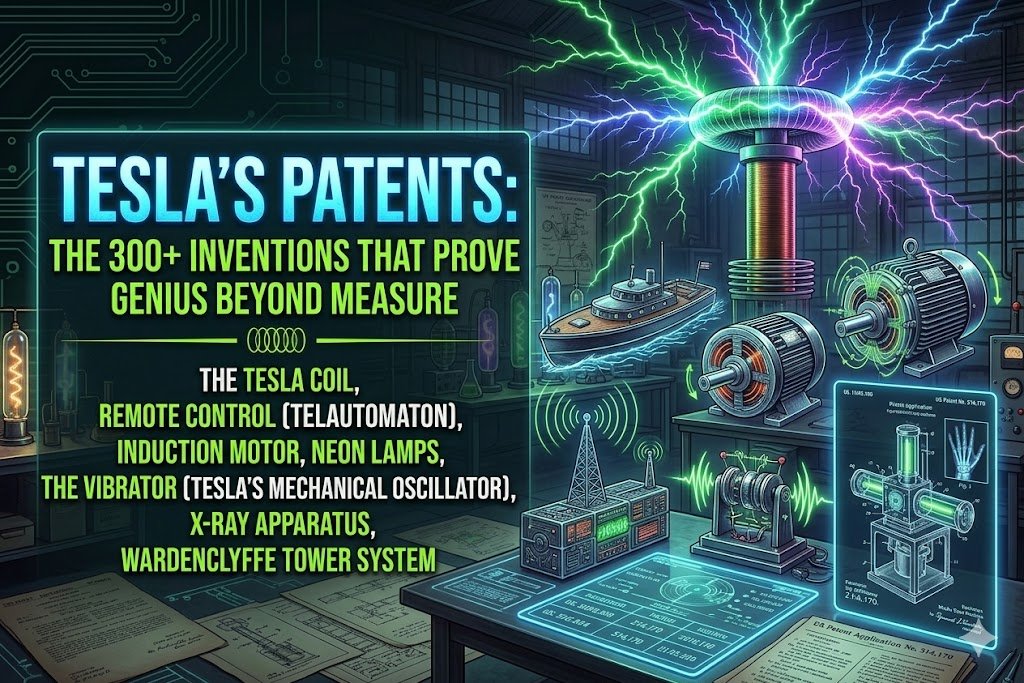
There are inventors who change an industry. There are inventors who change a generation. And then there is the rare, almost mythological figure who changes the architecture of civilization itself. nikola tesla patents represent that third, rarest category. Spanning more than 300 registered inventions across over 26 countries, these filings cover alternating current systems, high-frequency resonance transformers, fluid dynamics devices, wireless communication apparatus, and aeronautical designs that the world was not ready to build until decades after Tesla himself was gone.
To study nikola tesla patents is not to read legal documents. It is to walk through the mind of a man who was living thirty, fifty, and sometimes a hundred years ahead of everyone around him. Every page of those filings tells the same story: a genius who translated pure mathematical intuition into iron, copper, glass, and code, and then handed that translation to the world in the form of enforceable intellectual property.
How Tesla Built His Patent Empire (1884 – 1900)
Tesla arrived in the United States in 1884 carrying almost nothing except the contents of his mind. Within four years, he had filed some of the most consequential engineering design blueprints in the history of the us patent office archives. His earliest US patents, granted between 1888 and 1891, covered the alternating current induction motor and the polyphase power transmission system, two inventions so fundamental that their influence on modern civilization cannot be overstated.
What distinguished nikola tesla patents from the very beginning was not just their technical content but their systemic completeness. Where most inventors patented a single device, Tesla patented entire ecosystems of interdependent technologies. A single patent cluster from 1888 might include the generator design, the transformer configuration, the transmission line topology, and the receiving motor, all specified together as a unified multi-disciplinary system. This approach to intellectual property was architecturally ambitious in a way that patent examiners of the era had rarely encountered.
Tesla was also meticulous about filing dates and legal patent protection across multiple jurisdictions. He filed worldwide patent filings in the United Kingdom, France, Germany, Austria-Hungary, Canada, and Australia, understanding that the commercial value of a pioneering technology depended on controlling its production rights internationally, not merely domestically. The result was a patent empire that Westinghouse Electric was willing to pay approximately $60,000 upfront to license, a staggering sum in 1888, along with royalty arrangements that Tesla later voluntarily surrendered to help Westinghouse survive competitive financial pressure.
The AC Induction Motor: The Patent That Runs the World (1887 – 1888)
If nikola tesla patents could be ranked by economic consequence, the induction motor patents filed in 1887 and granted in 1888 would sit unchallenged at the top. These filings describe the operating principles, winding configurations, and system architecture of the AC induction motor, a machine so well-designed that its fundamental structure has remained essentially unchanged for over 130 years.
The tesla induction motor operates on the principle that a rotating magnetic field in the stator induces currents in the rotor, and those induced currents interact with the stator field to produce rotational torque. The synchronous speed of the rotating field is determined precisely by:
n_s = (120 × f) / P
Where:
- n_s = synchronous speed in RPM
- f = supply frequency in Hz
- P = number of stator poles
For a standard 4-pole motor operating on a 60 Hz US supply:
n_s = (120 × 60) / 4 = 1,800 RPM
The rotor runs slightly behind this field at a speed n_r, and the slip s that drives torque production is:
s = (n_s − n_r) / n_s
The electromagnetic torque developed is related to rotor current and rotor resistance:
T = (3 / ω_s) × (I_r² × R_r / s)
Where ω_s is the synchronous angular velocity in radians per second, I_r is rotor current, and R_r is rotor resistance per phase. This mathematical relationship, whose physical reality Tesla grasped through geometric visualization before formal derivation, governs the torque output of every induction motor on earth today, from the motors in washing machines to those in electric vehicles and industrial compressors.
The proprietary mechanics described in these patent filings were so complete and so precise that Westinghouse engineers could build production-ready machines directly from the specifications. That is the mark of truly exceptional patent documentation: it does not just protect an idea, it transmits a craft.
The Polyphase System Patents: Rewriting Power Transmission (1888 – 1893)
Closely linked to the induction motor patents, and equally transformative, are nikola tesla patents covering the polyphase alternating current power system. The tesla polyphase system filings describe how multiple phase-shifted AC voltages can be generated, transmitted, and utilized simultaneously to deliver power with dramatically superior efficiency compared to single-phase approaches.
The mathematical advantage of three-phase power is captured in a fundamental equation:
P₃φ = √3 × V_L × I_L × cos(φ)
Where V_L is line-to-line voltage, I_L is line current, and cos(φ) is the power factor. For the same conductor cross-section and the same line voltage, three-phase transmission delivers approximately 1.732 times the power of a single-phase system. This 73 percent increase in power density per unit of copper is not a marginal improvement. It is a transformational efficiency gain that determined how every electrical grid on earth was designed.
The design specifications in these polyphase patents also covered transformer winding configurations, specifically the delta and star (wye) connection schemes that are still standard in power engineering textbooks and power plant designs today. The innovative schematics Tesla filed showed exact winding geometries, phase relationships, and connection topologies that engineers could implement without ambiguity.
Tesla’s polyphase patents directly enabled the Niagara Falls power project of 1895 to 1896, where Westinghouse built the world’s first large-scale AC generating station using tesla alternating current system designs licensed from these filings. The power generated at Niagara under those patents traveled 35 kilometers to illuminate Buffalo, New York, and permanently settled the debate about whether AC or DC would power the modern world.
The Tesla Coil and High-Frequency Patents: Voltage Without Limit (1891 – 1897)
Among the most recognizable entries on the tesla patent list are the high-frequency resonant transformer patents, the devices that bear his name most directly. The tesla coil explained in these patent filings is a resonant air-core transformer in which both primary and secondary circuits are tuned to the same natural frequency, enabling energy to transfer between them with exceptional efficiency through magnetic resonance.
The resonant frequency shared by both circuits is:
f₀ = 1 / (2π√(LC))
Where L is inductance in Henries and C is capacitance in Farads. The voltage amplification achieved at resonance is governed by the quality factor Q of the secondary circuit:
V_out = Q × V_in
Where Q for Tesla’s designs routinely exceeded 500 and sometimes surpassed 1,000. For a primary input of 10,000 volts and a Q of 600:
V_out = 600 × 10,000 = 6,000,000 V
Six million volts from a primary coil energized at ten thousand: this is the breathtaking reality of resonant energy amplification that Tesla patented and demonstrated in his laboratory. The technical drawings in these patent filings show coil geometries, inter-winding clearances, and discharge terminal designs with a level of precision that reflects not just mathematical competence but deep experimental mastery.
These high-frequency patents were the direct foundation for tesla wireless power transmission apparatus patents that followed. Tesla understood that if energy could be made to resonate in a circuit, it could also be made to resonate in the earth itself, potentially enabling power distribution without any physical conductors at all. The Wardenclyffe Tower was the intended full-scale demonstration of this idea.
The Tesla Valve: Fluid Dynamics Without Moving Parts (1916 – 1920)
One of the most ingenious and least celebrated of nikola tesla patents is the valvular conduit patent, filed in 1916 and granted in 1920. This device, now widely known as the tesla valve, achieves directional fluid flow control with zero moving parts, a feat that engineers had previously considered impossible outside of living biological systems.
The device consists of a series of looping internal channels that guide fluid smoothly in the forward direction but create turbulent eddies and dramatically increased resistance in the reverse direction. The fluid dynamics engineering behind this behavior is rooted in the transition between laminar and turbulent flow, characterized by the dimensionless Reynolds number:
Re = (ρ × v × D) / μ
Where:
- ρ = fluid density (kg/m³)
- v = fluid velocity (m/s)
- D = characteristic length or diameter (m)
- μ = dynamic viscosity (Pa·s)
For Re below approximately 2,300, flow is laminar and smooth. For Re above approximately 4,000, flow becomes turbulent and energy-dissipating. The tesla valve fluidics design forces reverse-direction flow into geometric configurations that trigger turbulence at lower velocities than forward flow, effectively creating a passive diode for fluids. The diodicity ratio, defined as:
Di = ΔP_reverse / ΔP_forward
achieves values of approximately 200 in Tesla’s original device blueprint, meaning reverse flow experiences 200 times the pressure resistance of forward flow at the same volumetric rate. Modern computational fluid dynamics analyses have confirmed this performance and identified applications in microfluidic lab-on-chip devices, implantable medical pumps, and industrial chemical processing systems where moving parts would be impractical or dangerous.
Radio Patents and the Battle for Priority (1897 – 1943)
Among the most contentious and consequential of nikola tesla patents are the radio frequency oscillator and wireless signal transmission patents filed between 1897 and 1900. Tesla filed the first comprehensive radio system patent in 1897, describing a four-circuit tuned radio transmission apparatus with independently resonant transmitter and receiver circuits that provided far superior frequency selectivity and transmission range than earlier wireless experiments.
The US Patent Office initially recognized Tesla’s priority and granted his radio patents. The subsequent filing of competing patents by Guglielmo Marconi, and the famous tesla and marconi radio invention dispute, launched one of the most prolonged and bitter patent monetization battles in the history of intellectual property law.
The core technical difference between the systems lay in their use of tuned circuits. Tesla’s design used four independently resonant circuits, two in the transmitter and two in the receiver, each tuned to the same frequency f₀:
f₀ = 1 / (2π√(LC))
This four-circuit resonant design dramatically reduced interference from off-frequency signals and enabled much higher power transfer efficiency than the untuned or single-circuit systems Marconi initially deployed. The device blueprint Tesla filed was, by every technical measure, more sophisticated and more capable than Marconi’s competing design.
Legal enforcement of Tesla’s radio patents was repeatedly undermined by corporate interests backing Marconi, whose company had by that point secured substantial investment from financiers connected to Thomas Edison’s industrial network. The legal patent protection Tesla was entitled to under his filing dates was not vindicated until the US Supreme Court issued its landmark ruling in 1943, the year of Tesla’s death, confirming that Marconi’s most fundamental radio patents were invalid because Tesla’s prior filings had anticipated them.
The Oscillator and Mechanical Patents: Vibrations as Power (1893 – 1910)
Beyond the electrical domain, nikola tesla patents extend into the realm of precision mechanical engineering. The mechanical fluid oscillator patents, sometimes called the Tesla steam oscillator or reciprocating electrodynamic motor patents, describe devices that convert fluid pressure oscillations into precisely controlled mechanical vibrations or electrical output.
The natural frequency of a mechanical oscillator is:
f = (1 / 2π) × √(k / m)
Where k is the spring constant or restoring force coefficient of the system and m is the oscillating mass. Tesla designed his mechanical oscillators to operate at their natural resonant frequency, where energy input requirements are minimized and amplitude of oscillation is maximized. This is the same resonance principle he applied in his electrical coils, now expressed in purely mechanical terms.
The tesla oscillators and vibrations patents included designs for steam-powered oscillators capable of generating precise sinusoidal mechanical output at controlled frequencies, which Tesla envisioned as both power conversion devices and seismic investigation tools. He famously claimed that a sufficiently large version of his mechanical oscillator could, if tuned to the resonant frequency of a structure, cause that structure to vibrate to destruction, an idea that engineers now understand through the phenomenon of resonance-induced structural failure.
Aeronautical and Future-Facing Patents: Inventing for Tomorrow (1921 – 1928)
The final major cluster of nikola tesla patents demonstrates perhaps most vividly his habit of inventing for a future that had not yet arrived. In the 1920s, Tesla filed patent documentation for a vertical takeoff aircraft, a machine that would rise from the ground on directed air thrust, hover in place, and transition to horizontal flight without the need for a runway.
The thrust required for vertical liftoff equals the aircraft weight:
F_thrust = m × g
For a 2,000 kg aircraft:
F_thrust = 2,000 × 9.81 = 19,620 N
This thrust is generated by accelerating a mass flow of air downward:
F = ṁ × Δv
Where ṁ is the mass flow rate in kg/s and Δv is the velocity increase imparted to the air. For Δv = 150 m/s:
ṁ = 19,620 / 150 = 130.8 kg/s
This air mass flow rate is achievable with the type of high-speed centrifugal blowers that Tesla’s bladeless turbine patents described in detail. As a Nikola Tesla visionary inventor, he was specifying in the 1920s the propulsion arithmetic that aerospace engineers would not formalize until the 1940s and 1950s. Nikola tesla patents in aeronautics remain largely uncredited in popular histories of aviation, despite their technical clarity and their chronological priority over much better-known vertical flight research.
FAQs:
How many patents did Tesla actually receive in the United States?
Tesla received approximately 112 patents in the United States alone. Including worldwide patent filings across more than 26 countries, his total registered inventions exceed 300. Many additional inventions were never formally patented, either because Tesla lacked funds to file or because he deliberately withheld certain ideas from public documentation.
What was Tesla’s single most important patent?
Most engineering historians point to the AC induction motor patent of 1888 as the most consequential entry on the tesla patent list. It enabled the alternating current power revolution, displaced Edison’s DC infrastructure, and forms the mechanical basis of virtually every electric motor operating on earth today.
Did Tesla profit financially from his patents?
Tesla earned significant sums early in his career through Westinghouse licensing payments. He subsequently surrendered his royalty rights voluntarily and spent his later years in chronic financial difficulty despite holding some of the most valuable intellectual property in industrial history. Patent monetization in his era required sustained legal enforcement capacity that Tesla, as an independent inventor, often lacked.
Why were Tesla’s radio patents not honored during his lifetime?
The radio patent dispute involved powerful corporate interests backing Marconi’s competing claims. Legal patent protection requires not just a strong case but sustained financial resources to pursue litigation, and Tesla’s deteriorating finances through the 1900s and 1910s made it impossible for him to mount the legal enforcement campaign his filings deserved. The Supreme Court vindicated his priority only after his death.
Are any nikola tesla patents still actively used in modern technology?
Yes. The AC induction motor patents underpin modern electric vehicle drive systems. The tesla valve fluidics design is being actively researched for microfluidic medical devices. Resonant wireless power transfer, as demonstrated in modern phone charging pads and EV wireless charging systems, implements principles Tesla described in his high-frequency transmission patents. His mechanical oscillator patents inform modern vibration analysis in structural engineering.
Conclusion
The full archive of nikola tesla patents is one of the most extraordinary intellectual monuments in human history. From the AC induction motor that drives the electric vehicle revolution of the twenty-first century, to the tesla valve that engineers are now fabricating at microscopic scale for medical implants, to the radio frequency transmission systems that the US Supreme Court confirmed as Tesla’s rightful creation, these patents prove something that transcends their individual technical content.
They prove that one human mind, properly ignited and properly focused, can lay the technical foundations for an entire civilization. Tesla filed his patents with the same care and completeness that an architect applies to a building that must stand for centuries. Those filings have done exactly that. They have stood, and the world that has been built on them is still catching up with the man who imagined it first.
nikola tesla patents are not just documents in an archive. They are letters from the future, written by someone who lived there before anyone else arrived.