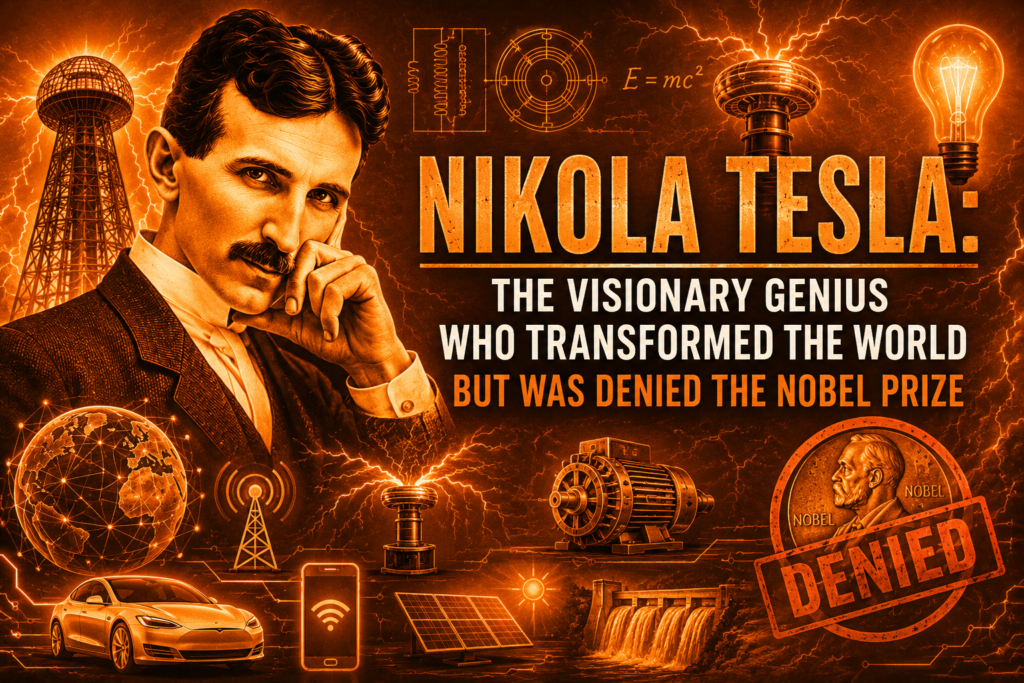
There are stories in the history of science that make you angry. Stories of breakthroughs dismissed, credit stolen, and greatness left unrewarded by the very institutions that exist to honor it. The story of tesla denied nobel prize recognition is one of the most powerful and painful of them all. Here was a man who invented the alternating current motor, the polyphase power system, the radio transmission framework, the resonant transformer, the remote-controlled machine, and dozens of other foundational technologies that collectively built the modern world. And yet the Nobel Prize in Physics, the highest formal honor the scientific establishment could have conferred, never bore his name.
This is not merely a footnote in science history. It is a case study in award politics, institutional bias, peer recognition failures, and the brutal gap that can exist between a genius’s contribution and the formal honors they receive. Understanding why tesla denied nobel prize status remains one of the most important and underexamined conversations in the history of science.
The Nobel Prize and What It Was Supposed to Reward (1901 – 1915)
The Nobel Prize in Physics was first awarded in 1901, the year Tesla was at the peak of his productive powers. The prize was endowed by Alfred Nobel to recognize discoveries and inventions that conferred the greatest benefit on mankind. By every possible reading of that mandate, Nikola Tesla should have been among the first names on the committee’s list.
The alternating current power system Tesla had developed and patented in the late 1880s was already, by 1901, supplying electrical power to cities across North America and Europe. The tesla induction motor was spinning in factories and powering industrial machinery on a continental scale. The mathematical principles encoded in his polyphase patents, specifically the rotating magnetic field that generated torque through electromagnetic induction, represented a foundational contribution to applied physics of the highest order.
The torque equation governing induction motor performance that Tesla’s work made practical:
T = (3 / ω_s) × (V₁² × R₂/s) / ((R₁ + R₂/s)² + (X₁ + X₂)²)
Where:
- T = electromagnetic torque (N·m)
- ω_s = synchronous angular velocity (rad/s)
- V₁ = stator phase voltage (V)
- R₁, R₂ = stator and rotor resistance (Ω)
- X₁, X₂ = stator and rotor reactance (Ω)
- s = slip
This equation, derived from circuit theory applied to Tesla’s rotating field concept, governs the behavior of every induction motor on earth. The Nobel committee in 1901 was awarding prizes for X-ray physics and classical mechanics. Tesla’s contribution to electromagnetic energy conversion was arguably more consequential to human civilization than any of the early Nobel physics awards. Yet the tesla denied nobel prize situation began accumulating from the very first year of the prize’s existence.
The Edison Rumor: Did Tesla Refuse a Joint Award? (1915)
The most dramatic episode in the tesla denied nobel prize story erupted in November 1915 when the New York Times and several other major newspapers reported that Nikola Tesla and Thomas Edison were to share the Nobel Prize in Physics. The story generated enormous public excitement. Here, finally, was the recognition that both men’s supporters had long demanded.
Then, within days, the rumor collapsed. The Nobel Committee in Stockholm made no such announcement. The 1915 Nobel Prize in Physics went to William Henry Bragg and William Lawrence Bragg for their work on X-ray crystallography. Neither Tesla nor Edison was mentioned.
What happened? The historical record is genuinely murky, and it has generated decades of academic snub speculation. Several accounts suggest that Tesla refused to share a prize with Edison, whom he considered a man of commercial cunning rather than scientific principle. This interpretation is consistent with the depth of personal and professional bitterness between the two men following the edison vs tesla direct current versus alternating current war of the 1880s and 1890s.
Other accounts suggest that the Nobel Committee never seriously considered either man, and that the newspaper report was based on unreliable rumors or deliberate misinformation. A third interpretation, supported by some historians, is that institutional pushback from Edison’s powerful industrial allies, who had the resources and motivation to lobby scientific establishment bodies against Tesla, played a role in keeping his name off the final list.
Whatever the precise mechanism, the outcome was the same: the world’s greatest living inventor walked away from 1915 without a Nobel Prize, and the pattern of peer recognition failure that had begun in 1901 continued without interruption.
The Science of What Tesla Gave the World (1888 – 1900)
To fully grasp the injustice of tesla denied nobel prize treatment, you must appreciate the scope of what Tesla actually contributed to physics and engineering in just the twelve years from 1888 to 1900.
His polyphase AC system, documented in a series of patents beginning in 1888, solved the fundamental problem of electrical power transmission at scale. The efficiency advantage of three-phase AC over DC transmission is captured in the power equation:
P₃φ = √3 × V_L × I_L × cos(φ)
For the same conductor size carrying the same line current I_L, raising the line voltage V_L through AC transformers reduces current proportionally for the same power delivery, slashing resistive losses according to:
P_loss = I² × R
Doubling the transmission voltage reduces line losses to one quarter. This mathematical relationship, which Tesla’s AC system exploited through transformer technology that DC systems of the era could not replicate, is why every electrical grid on earth transmits power at high AC voltages today. The economic value generated by this single insight has been calculated in the hundreds of trillions of dollars over the twentieth and twenty-first centuries.
Beyond the AC system, Tesla’s tesla coil explained resonant transformer technology demonstrated electromagnetic resonance phenomena that Nobel prizes were given to other researchers for investigating in less applied contexts. His high-frequency oscillator work, producing electromagnetic radiation across a wide spectrum, overlapped directly with the physics being honored by the Nobel Committee in its early years.
His tesla x ray experiments, conducted before Wilhelm Röntgen’s formal announcement of X-rays in December 1895, placed him at the experimental frontier of the physics that won Röntgen the very first Nobel Prize in Physics in 1901. The shadowgraph photographs Tesla produced before 1895 using his high-voltage vacuum discharge tubes showed bone structure with diagnostic clarity, yet it was Röntgen, not Tesla, whose name entered the textbooks and the Nobel records.
The Radio Patent Dispute: Another Prize That Slipped Away (1901 – 1943)
The Nobel Prize was not the only formal recognition that Tesla was denied through the combination of award politics and scientific community politics. The invention of radio represents another case of historical injustice that compounded the tesla denied nobel prize wound.
Tesla had filed comprehensive radio transmission patents in 1897, two years before Guglielmo Marconi’s competing filings. The US Patent Office had initially granted radio priority to Tesla. Yet when Marconi achieved transatlantic radio communication in 1901 and became a global celebrity, the Nobel Committee awarded Marconi and Karl Ferdinand Braun the Nobel Prize in Physics for radio in 1909, while Tesla received nothing.
The tesla and marconi radio invention dispute was not resolved in Tesla’s favor until 1943, when the US Supreme Court confirmed that Tesla’s radio patents had priority over Marconi’s most fundamental claims. By then, Tesla had been dead for several months and the Nobel Prize cannot be awarded posthumously.
This timing is one of the cruelest facts in the history of science politics. Had the Supreme Court ruling come twenty years earlier, the Nobel Committee would have had an unambiguous legal and technical basis for recognizing Tesla’s radio contribution. Instead, the ruling arrived just in time to vindicate a dead man, far too late for formal honors to follow.
The radio frequency resonance principle underlying Tesla’s radio system is:
f₀ = 1 / (2π√(LC))
Tesla’s four-circuit tuned radio system, described in his 1897 patents, used this resonant coupling principle at both transmitter and receiver to achieve frequency selectivity and transmission efficiency far superior to Marconi’s early untuned systems. The physics prize of 1909 was awarded to a less sophisticated implementation of a technology Tesla had patented first and designed better.
Academic Isolation and the Failure of Peer Validation (1900 – 1943)
One factor that contributed powerfully to the tesla denied nobel prize outcome was Tesla’s increasing alienation from the academic and institutional structures that influenced prize nominations. Nobel Prizes in Physics are awarded based on nominations from qualified nominators, primarily university professors, members of national academies, and previous Nobel laureates. A scientist operating outside major university affiliations, without a stable institutional home, and in growing conflict with the scientific establishment, faces a structural disadvantage in the nomination process regardless of the quality of their work.
Tesla worked primarily as an independent inventor and engineer rather than as a university researcher. After the collapse of his Wardenclyffe project and his financial deterioration in the 1900s and 1910s, he became increasingly isolated from the academic community whose peer validation the Nobel Committee relied upon. The scientists who might have nominated him were either personally alienated by his increasingly grand claims or professionally invested in rival attribution narratives.
His insistence on the priority of his radio patents, his public disputes with Marconi, and his later claims about earthquake machines and death rays made him an uncomfortable figure for the scientific establishment to formally honor, even when the underlying science of his earlier career was beyond dispute. The prize dynamics of the Nobel system, which reward careful, documented, peer-reviewed breakthroughs, were poorly suited to recognizing the kind of sweeping, patent-based, industrially applied innovation that defined Tesla’s career.
There is also the matter of posthumous fame versus contemporary recognition. Tesla’s reputation underwent a dramatic reversal after his death. The intellectual recognition that the Nobel Committee denied him during his lifetime has been replaced by a kind of popular canonization in the twenty-first century. But posthumous fame, however deserved, cannot replace the formal honors that the institutions of science failed to deliver when they had the opportunity.
What Tesla’s Nobel Would Have Meant for Science (1915 – 1943)
It is worth pausing to consider what a Nobel Prize awarded to Tesla might have changed, not just for Tesla personally, but for the trajectory of scientific research and public investment in his ideas.
The most immediate consequence would have been financial. Nobel laureates in Tesla’s era received a cash award equivalent to approximately twenty years of a professor’s salary. For Tesla, who spent his later decades in desperate financial circumstances, unable to fund the experiments he had planned and often unable to pay his hotel bills, this resource infusion could have been transformative. The Wardenclyffe project, abandoned for lack of investment capital, might have found a second life.
More broadly, a Nobel Prize would have conferred the scientific legitimacy that might have attracted serious institutional funding to Tesla’s wireless power transmission research. The academic snub he suffered contributed to the marginalization of ideas that, as the twenty-first century has demonstrated, were scientifically sound and technologically realizable. Resonant wireless power transmission, now commercial in consumer electronics and under development for electric vehicle charging, arrived fifty to a hundred years later than it might have with proper funding and institutional support.
As a Nikola Tesla visionary inventor, Tesla understood, with some bitterness, that the prize dynamics of his era did not favor the kind of integrated, system-level innovation he practiced. He once remarked that the Nobel Committee honored those who discovered what nature already contained, while he was concerned with creating what nature had not yet provided. That distinction, between discovery and invention, between revealing and creating, placed him slightly outside the prize committee’s criteria, even though his work was grounded in physics as rigorous as any that the Nobel roster celebrates.
Tesla’s Legacy: The Prizes That History Has Given Him (1943 – Present)
If formal honors were denied to tesla denied nobel prize petitions during his lifetime, history itself has conferred a recognition far more durable than any committee’s verdict. The SI unit of magnetic flux density is the tesla (T), named in his honor in 1960 by the General Conference on Weights and Measures. This is the highest form of scientific commemoration: a unit so fundamental that it appears in every physics textbook, every engineering calculation, and every electromagnetic measurement made anywhere in the world.
The tesla as a unit is defined as:
1 T = 1 Wb/m² = 1 kg/(A·s²)
Where Wb is the Weber, the unit of magnetic flux. The magnetic flux density B experienced in a region carrying a magnetic field is expressed in teslas, and the force on a current-carrying conductor in that field follows:
F = I × L × B × sin(θ)
Where I is current in amperes, L is conductor length in meters, B is flux density in teslas, and θ is the angle between the conductor and field direction. Every engineer who calculates motor torque, transformer performance, or magnetic resonance imaging field strength uses the tesla as their unit of measurement. That is a legacy no Nobel citation could match.
The electric vehicle company Tesla, Inc., which has done more than any other single entity to accelerate the adoption of the AC induction motor in personal transportation, carries his name into the twenty-first century’s central technology transition. The irony is profound: the inventor who died penniless in a New York hotel room now has his name on the world’s most valuable automotive brand, built around the very motor technology that his patents established
FAQs:
Why did Tesla never receive the Nobel Prize?
The reasons are multiple and interconnected: award politics and institutional pushback from rivals including Edison’s allies, academic isolation from the university structures that nominated prize candidates, the 1915 joint Edison-Tesla Nobel rumor that collapsed without explanation, and the Nobel Committee’s tendency to favor academic discovery over applied industrial invention. The legacy evaluation of Tesla’s contributions required decades that the prize committee did not afford him.
Is it true that Tesla refused to share the Nobel Prize with Edison?
Some historical accounts suggest Tesla refused a joint award with Edison in 1915, citing his contempt for Edison’s commercial rather than scientific approach. However, there is no confirmed documentary evidence from the Nobel Committee that such an award was actually planned. The story may have been based on newspaper speculation rather than any genuine committee decision.
Did Tesla ever win any prestigious scientific award?
Tesla received honorary doctoral degrees from Yale and Columbia universities and the Elliott Cresson Medal from the Franklin Institute in 1894. In 1917 he received the Edison Medal from the American Institute of Electrical Engineers, an honor he accepted with characteristic ambivalence given its association with his greatest rival. None of these matched the global recognition of the Nobel Prize.
Why was Marconi given the Nobel Prize for radio instead of Tesla?
The 1909 Nobel Prize for radio was awarded based on Marconi’s public commercial achievement of transatlantic transmission and his contemporary celebrity. The deeper question of patent priority, which the US Supreme Court would not resolve in Tesla’s favor until 1943, was not part of the committee’s deliberation. Scientific community politics and the institutional weight of Marconi’s financial backers also played a role.
How is Tesla recognized in science today despite the Nobel snub?
The SI unit of magnetic flux density, the tesla (T), named in 1960, ensures that his name appears in every physics and engineering calculation involving magnetic fields. His induction motor principles power the global electric vehicle revolution. Wireless power transfer, resonant coupling, and high-frequency electromagnetic systems all trace directly to his patents. The historical injustice of tesla denied nobel prize recognition has been partially addressed by this permanent embedding of his name in the language of science itself.
Conclusion
The story of tesla denied nobel prize recognition is ultimately a story about the gap between contribution and credit, between what a civilization builds on and what it chooses to formally celebrate. Nikola Tesla gave the world its power grid, its electric motors, its radio communication framework, its wireless power concepts, and its first glimpse of a future connected by electromagnetic signals. In return, the Nobel Committee gave those prizes to other men, driven by a combination of award politics, historical injustice, academic isolation, and the simple brutal fact that Tesla was too far ahead of his time to fit comfortably into the institutional categories that formal honors required.
But history, when it settles, is a more honest judge than any committee. The tesla unit carries his name into every physics laboratory on earth. The induction motor carries his mathematics into every electric vehicle. The wireless systems carry his principles into every smartphone transmission. And the growing recognition, in the twenty-first century, that Tesla was among the two or three most consequential scientific and engineering minds of the modern era, is a form of breakthrough validation that no prize can confer and no oversight can permanently deny.
The Nobel Committee was wrong. The world knows it now. And that knowing, however late, is its own kind of justice.