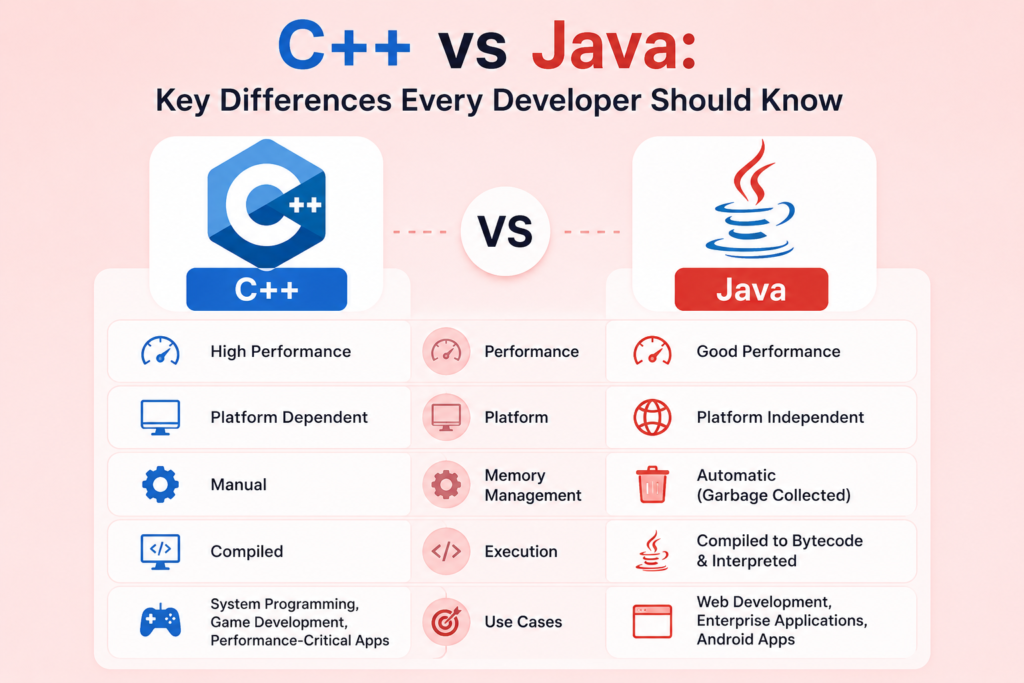
Two languages have shaped the professional software development world more than almost any others. c++ vs java is a comparison that developers, students, hiring managers, and technology architects have been having for over thirty years. Both languages are powerful, mature, and backed by enormous communities. Both have produced software that runs critical infrastructure around the world. But they are built on fundamentally different philosophies, make dramatically different trade-offs, and excel in very different domains.
Understanding c++ vs java deeply is not just an academic exercise. It is a practical decision that shapes your career path, the kinds of projects you can work on, and the skills you develop as a programmer. This article breaks down every critical dimension of the c++ vs java comparison with real code examples, honest analysis, and clear guidance on which language fits which goals.
The Origins of Two Industry Giants (1979 – 1995)
The story of c++ vs java begins with their very different origins. C++ was created by Bjarne Stroustrup at AT&T Bell Laboratories starting in 1979. Stroustrup wanted to extend the C language with object-oriented programming while preserving every bit of C’s legendary performance and hardware-level control. C++ was built by a systems programmer, for systems programmers, to solve real engineering problems in distributed computing and operating systems.
Java was created by James Gosling at Sun Microsystems and officially released in 1995. The original goal was to build a language for consumer electronics devices that could run the same code on any hardware platform. That goal evolved into the famous “write once run anywhere” promise: compile your Java code once into bytecode, and it runs on any machine with a Java Virtual Machine installed. Java was designed with safety, simplicity, and platform independence as its primary values rather than raw performance.
These origins explain everything that follows in the c++ vs java comparison. C++ was built to be fast and powerful above all else. Java was built to be safe, portable, and accessible. Every technical difference between them flows from this fundamental distinction in design philosophy.
Compilation and Execution: JVM vs Native Machine Code
One of the most important technical differences in c++ vs java is how each language runs your code. C++ is a compiled language. Your source code is processed by a compiler that transforms it directly into native machine code specific to your target operating system and processor architecture. When you run a C++ program, the processor executes that machine code directly with no intermediary layer. This is why C++ programs are extraordinarily fast.
Java takes a completely different approach. Java source code is compiled into bytecode, a platform-independent intermediate representation. That bytecode is then executed by the Java Virtual Machine, which either interprets the bytecode or uses just-in-time compilation to translate it into native machine code at runtime. The JVM is what makes platform independence possible. The same compiled Java bytecode runs on Windows, Linux, and macOS without modification.
Here is a simple comparison of how each language prints output and declares a basic class:
C++ version:
#include <iostream>
#include <string>
using namespace std;

class Greeting {
private:
    string message;
public:
    Greeting(string msg) : message(msg) {}
    void display() {
        cout << message << endl;
    }
};

int main() {
    Greeting g("Hello from C++!");
    g.display();
    return 0;
}
Java version:
public class Greeting {
    private String message;

    public Greeting(String msg) {
        this.message = msg;
    }

    public void display() {
        System.out.println(message);
    }

    public static void main(String[] args) {
        Greeting g = new Greeting("Hello from Java!");
        g.display();
    }
}
The structural similarities are visible immediately. Both use classes, access specifiers, constructors, and methods. The syntactic differences reflect each language’s priorities. C++ requires a main function outside classes and uses standard output streams. Java requires everything inside a class, reflecting its strict object-oriented design philosophy.
The trade-off here is clear. C++ gives you native speed at the cost of platform-specific compilation. Java gives you universal portability at the cost of virtual machine overhead.
Performance: Where c++ vs java Gets Serious
In terms of raw application performance, C++ holds a consistent advantage over Java in most benchmarks. C++ code compiles directly to optimized machine instructions that the processor executes without any intermediary layer. Memory layout can be controlled precisely. Cache behavior can be optimized deliberately. The zero-overhead principle means that unused language features cost nothing at runtime.
Java’s performance has improved enormously since the early JVM days thanks to sophisticated just-in-time compilation, hotspot optimization, and modern garbage collectors. For many enterprise applications, Java’s performance is more than adequate and the productivity advantages of the platform easily outweigh the performance gap. But for applications where every microsecond matters, C++ still wins decisively.
Here is a simple numeric benchmark in both languages:
C++ benchmark:
#include <iostream>
#include <chrono>
using namespace std;

int main() {
    auto start = chrono::high_resolution_clock::now();

    long long sum = 0;
    for (long long i = 0; i < 500000000LL; i++) {
        sum += i;
    }

    auto end = chrono::high_resolution_clock::now();
    auto ms = chrono::duration_cast<chrono::milliseconds>(end - start).count();

    cout << "Sum: " << sum << endl;
    cout << "Time: " << ms << " ms" << endl;
    return 0;
}
Java benchmark:
public class Benchmark {
    public static void main(String[] args) {
        long start = System.currentTimeMillis();

        long sum = 0;
        for (long i = 0; i < 500000000L; i++) {
            sum += i;
        }

        long end = System.currentTimeMillis();
        System.out.println("Sum: " + sum);
        System.out.println("Time: " + (end - start) + " ms");
    }
}
In practice, the C++ version typically runs two to five times faster for pure computational tasks like this. The JVM’s just-in-time compiler closes the gap significantly for longer-running programs, but cold start time, memory footprint, and garbage collection pauses remain areas where Java pays a consistent cost compared to C++.
Memory Management: Control vs Convenience in c++ vs java
Memory management is one of the most fundamental differences in the c++ vs java comparison and one that has the most practical impact on how you write code.
C++ gives you complete, direct control over memory. You decide when to allocate memory on the heap using the new keyword and when to release it using delete. This control enables extraordinary performance optimization, precise memory layout, and deterministic resource management. It also introduces the risk of memory leaks if you forget to release memory, dangling pointers if you use memory after releasing it, and segmentation faults if you access memory incorrectly.
For a deeper understanding of how C++ handles memory, studying C++ pointers reveals the full power and responsibility that comes with direct memory access.
Java uses automatic garbage collection. The JVM tracks all object references and automatically reclaims memory when objects are no longer reachable. This eliminates entire categories of memory bugs that plague C++ code and makes Java significantly safer for developers who are not memory management experts.
// C++ - Manual memory management
#include <iostream>
using namespace std;

class Player {
public:
    string name;
    int health;
    Player(string n, int h) : name(n), health(h) {}
};

int main() {
    Player* p = new Player("Arthur", 100);
    cout << p->name << ": " << p->health << endl;
    delete p;       // Must manually free memory
    p = nullptr;    // Prevent dangling pointer
    return 0;
}
java
// Java - Automatic garbage collection
public class MemoryDemo {
    static class Player {
        String name;
        int health;
        Player(String n, int h) {
            this.name = n;
            this.health = h;
        }
    }

    public static void main(String[] args) {
        Player p = new Player("Arthur", 100);
        System.out.println(p.name + ": " + p.health);
        // No delete needed - garbage collector handles it
    }
}
The Java approach is safer and more beginner-friendly. The C++ approach gives you total control and eliminates the unpredictable pauses that garbage collection can introduce in latency-sensitive applications. Modern C++ smart pointers like unique_ptr and shared_ptr bring much of Java’s safety into C++ without sacrificing performance.
Object-Oriented Programming: Strict vs Flexible
Both C++ and Java support object-oriented programming, but their approaches differ significantly. Java enforces strict object-oriented design. Almost everything in Java must be inside a class. There are no standalone functions outside classes, no global variables, and no procedural code at the top level. This strict OOP requirement keeps large codebases organized but can feel limiting for smaller tasks.
C++ takes a flexible approach. You can write fully procedural code, fully object-oriented code, generic code with templates, or any combination of these paradigms within the same program. C++ does not force you into any single way of thinking. For anyone studying OOP in C++, this flexibility is one of the language’s most powerful characteristics.
Another significant difference is how each language handles multiple inheritance. C++ supports multiple inheritance, allowing a class to inherit from more than one base class. Java does not support multiple inheritance of classes to avoid the diamond problem, instead offering interfaces that a class can implement from multiple sources.
// C++ Multiple Inheritance
class Flyable {
public:
    void fly() {
        cout << "Flying!" << endl;
    }
};

class Swimmable {
public:
    void swim() {
        cout << "Swimming!" << endl;
    }
};

class Duck : public Flyable, public Swimmable {
public:
    void quack() {
        cout << "Quack!" << endl;
    }
};
java
// Java uses interfaces instead of multiple inheritance
interface Flyable {
    void fly();
}

interface Swimmable {
    void swim();
}

class Duck implements Flyable, Swimmable {
    public void fly() {
        System.out.println("Flying!");
    }
    public void swim() {
        System.out.println("Swimming!");
    }
    public void quack() {
        System.out.println("Quack!");
    }
}
Both approaches achieve similar outcomes but through different mechanisms. C++ multiple inheritance is more powerful but can create complex ambiguity issues if not managed carefully. Java’s interface approach is cleaner and safer, though it requires more explicit implementation.
c++ vs java for Game Development
Game development is a domain where c++ vs java shows a sharp contrast. Professional game development at the highest level is dominated almost entirely by C++. Unreal Engine, the industry-leading game engine powering countless AAA titles, is built in C++. The reason is performance. Game engines need to process physics simulations, rendering pipelines, artificial intelligence, audio systems, and player input all within a fraction of a second to maintain smooth frame rates.
For anyone serious about entering the games industry, learning through C++ game development resources is the direct path to professional game engine work. The real-time performance demands of modern games make C++ the only practical choice at the professional level.
Java is used in game development but primarily for mobile games through the Android platform and for simpler games. Minecraft, one of the world’s most popular games, was originally written in Java. However, the performance limitations of Java have led Minecraft’s developers to build separate high-performance editions in C++ for consoles and mobile platforms. Java is an excellent choice for mobile game development on Android but cannot match C++ for demanding real-time applications.
Cross-Platform Development: Java’s Greatest Strength
Platform independence is where Java genuinely shines in the c++ vs java comparison. Write your Java code once, compile it to bytecode, and it runs on any operating system that has a JVM installed. This write once run anywhere promise has made Java enormously popular for enterprise software where applications must run across diverse server environments.
C++ applications are compiled for a specific platform. A C++ program compiled on Windows produces a Windows executable. Running that same program on Linux requires recompiling the source code for Linux. While C++ code can be written to be portable across platforms, achieving that portability requires careful coding practices and often conditional compilation directives.
cpp
// C++ platform-specific code example
#ifdef _WIN32
    #include <windows.h>
    void clearScreen() { system("cls"); }
#elif __linux__
    void clearScreen() { system("clear"); }
#elif __APPLE__
    void clearScreen() { system("clear"); }
#endif
java
// Java - same code runs everywhere
public class CrossPlatform {
    public static void clearScreen() {
        try {
            if (System.getProperty("os.name").contains("Windows")) {
                new ProcessBuilder("cmd", "/c", "cls").inheritIO().start().waitFor();
            } else {
                Runtime.getRuntime().exec("clear");
            }
        } catch (Exception e) {
            System.out.println("\033[H\033[2J");
        }
    }
}
For enterprise applications deployed across diverse server environments and cloud platforms, Java’s platform independence is a genuine, practical advantage. For systems software, game engines, and embedded applications where you know your target platform precisely, this advantage matters much less.
Safety Features: c++ vs java Risk Profiles
Java was designed with safety as a primary concern. The JVM provides several layers of protection that C++ does not offer by default. There are no explicit pointers that could be used to access arbitrary memory locations. Array bounds are checked automatically, throwing exceptions if you exceed them. Type safety is enforced strictly. The garbage collector prevents use-after-free bugs. These safety features make Java significantly more forgiving for developers who are not experts in low-level programming.
C++ gives you the tools to write extremely safe code but does not enforce safety by default. Accessing an array beyond its bounds in C++ causes undefined behavior rather than a clean exception. Raw pointers can be cast to incompatible types. Memory can be freed and then accidentally accessed. These risks are manageable with discipline and modern C++ practices, but they require genuine knowledge and attention.
Here is an example showing how each language handles an out-of-bounds array access:
cpp
// C++ - undefined behavior, no automatic protection
#include <iostream>
#include <vector>
using namespace std;

int main() {
    vector<int> numbers = {10, 20, 30};

    // Safe: using .at() throws exception on out-of-bounds
    try {
        cout << numbers.at(5) << endl;
    } catch (const out_of_range& e) {
        cout << "Error: " << e.what() << endl;
    }

    return 0;
}
java
// Java - automatic bounds checking throws exception
public class SafetyDemo {
    public static void main(String[] args) {
        int[] numbers = {10, 20, 30};

        try {
            System.out.println(numbers[5]);
        } catch (ArrayIndexOutOfBoundsException e) {
            System.out.println("Error: " + e.getMessage());
        }
    }
}
Java automatically throws an ArrayIndexOutOfBoundsException when you access an invalid index. C++ raw arrays do not protect you, but using vector’s .at() method provides the same protection. Modern C++ can be written as safely as Java when developers choose the right tools, but safety in C++ requires deliberate choices while safety in Java is the default.
c++ vs java in Enterprise and Industry Applications
The enterprise software world has been dominated by Java for decades. Banking systems, insurance platforms, e-commerce backends, and large-scale web applications have been built on Java because of its stability, platform independence, and the enormous ecosystem of enterprise frameworks like Spring, Hibernate, and Jakarta EE. Java’s automatic garbage collection and strict OOP make it easier to maintain large codebases developed by hundreds of developers over many years.
In C++ in modern technology, the picture is different. C++ rules in domains where performance is non-negotiable. Operating system kernels, database engines, browser rendering engines, financial trading systems processing millions of transactions per second, and embedded systems in everything from automobiles to medical devices all rely on C++. The sectors where C++ dominates tend to be those where the cost of slow software is measured not in user frustration but in financial loss, safety failures, or competitive disadvantage.
For developers exploring advanced C++ concepts, the language’s template metaprogramming, constexpr evaluation, and compile-time optimization capabilities open doors to performance engineering that Java’s runtime model simply cannot match.
The History and Evolution of Both Languages (1979 – 2026)
Understanding the history of C++ and the evolution of Java together paints a fascinating picture of how programming languages develop in response to each other and to the changing needs of the industry. C++ introduced object-oriented programming to the systems world in the 1980s. Java brought safe, portable OOP to the enterprise world in the 1990s. C++ responded with major modernization in C++11 and subsequent standards. Java introduced lambdas and streams in Java 8. Both languages have continued evolving rapidly.
In 2026, C++ is on C++23 with C++26 in development, bringing modules, concepts, ranges, and coroutines into mainstream use. Java is on Java 21 and beyond, with pattern matching, records, sealed classes, and virtual threads transforming what enterprise Java looks like. Both languages have learned from each other and from newer competitors, incorporating modern features while maintaining backward compatibility with decades of existing code.
Frequently Asked Questions
Which Is Faster, C++ or Java?
C++ is generally faster than Java, particularly for computation-intensive tasks, real-time systems, and applications with strict latency requirements. C++ compiles directly to native machine code while Java runs through the Java Virtual Machine, which adds overhead even with just-in-time compilation. For enterprise business logic applications, modern Java is fast enough that the difference rarely matters. For game engines, trading systems, and embedded software, C++ wins decisively.
Is Java Easier to Learn Than C++?
Yes, Java is generally considered easier to learn than C++ for most beginners. Java hides memory management behind automatic garbage collection, enforces strict object-oriented structure that guides code organization, provides automatic bounds checking on arrays, and eliminates raw pointers entirely. C++ requires learning memory management, pointers, manual resource cleanup, and a more complex type system. However, C++ teaches deeper understanding of how computers actually work.
Which Language Is Better for Enterprise Software Development?
Java has historically dominated enterprise software development due to its platform independence, robust standard library, mature frameworks, and automatic memory management that reduces certain categories of bugs in large team environments. Languages like Spring Boot have made Java the backbone of countless enterprise applications. C++ is used in enterprise contexts where performance is critical, such as financial trading platforms and database engines, but Java owns the broader enterprise application market.
Can You Use C++ and Java in the Same Project?
Yes, through the Java Native Interface, commonly called JNI, Java programs can call C and C++ code. This allows developers to write performance-critical components in C++ and expose them to Java applications. Android development uses this approach extensively, with performance-sensitive operations implemented in C++ and called from Java or Kotlin code through the Android NDK. This hybrid approach captures the best of both worlds in many real projects.
Which Language Has Better Long-Term Career Prospects?
Both languages offer strong long-term career prospects but in different domains. Java remains the dominant language for enterprise software, Android development, and large-scale backend systems. C++ is essential for game development, systems programming, embedded systems, and high-performance computing. C++ specialists often command higher salaries in their niches due to the specialized knowledge required. The best choice depends entirely on which industry and type of software excites you most.
Conclusion
The c++ vs java debate is not one that has a universal winner. It has the right answer for specific goals, industries, and programming philosophies. Java excels at enterprise software, cross-platform development, Android applications, and any context where developer safety and productivity matter more than absolute performance. C++ excels at game development, operating systems, embedded software, financial trading platforms, and any context where raw speed, memory control, and hardware access are non-negotiable.
c++ vs java ultimately comes down to what you are building and where you want to work. If you are drawn to enterprise software, large-scale web applications, and Android development, Java is a powerful and rewarding choice. If you are drawn to game engines, systems programming, embedded devices, and the kind of performance engineering that shapes the invisible infrastructure of the digital world, C++ will take you exactly where you want to go.
Both languages have survived and thrived for decades because they are genuinely excellent tools for the jobs they were designed to do. Learning either one deeply will make you a better developer. Learning both will make you nearly unstoppable.