The story of how machines learned to see is one of the most remarkable journeys in the history of science. It took more than six decades, thousands of researchers, billions of dollars in computing investment, and several near-total failures before the goal came into reach. Today, machines can read X-rays, identify faces in a crowd, navigate city streets, and generate photorealistic images from a sentence of text. None of that happened by accident. Understanding how machines learned to see means understanding the ideas, the data, and the computational power that made it possible.
What It Actually Means for a Machine to See
Humans take vision for granted. You open your eyes and the world is simply there, rich with color, depth, and meaning. For a machine, none of that is automatic. A camera captures a grid of numbers representing light intensity at each pixel. The machine has no idea what those numbers mean. Teaching it to extract meaning from pixels, to recognize a dog, read a sign, or detect a tumor, is the central challenge of computer vision.
The gap between computer vision vs human vision is still enormous in many ways. Human vision is effortless, context-aware, and capable of understanding scenes never encountered before. Machines need carefully constructed training datasets and millions of labeled examples just to learn a single category of object. But in narrow, well-defined tasks, machines learned to see well enough to outperform human specialists, which represents one of the great technological achievements of the modern era.
The Very First Attempts (1950 – 1963)
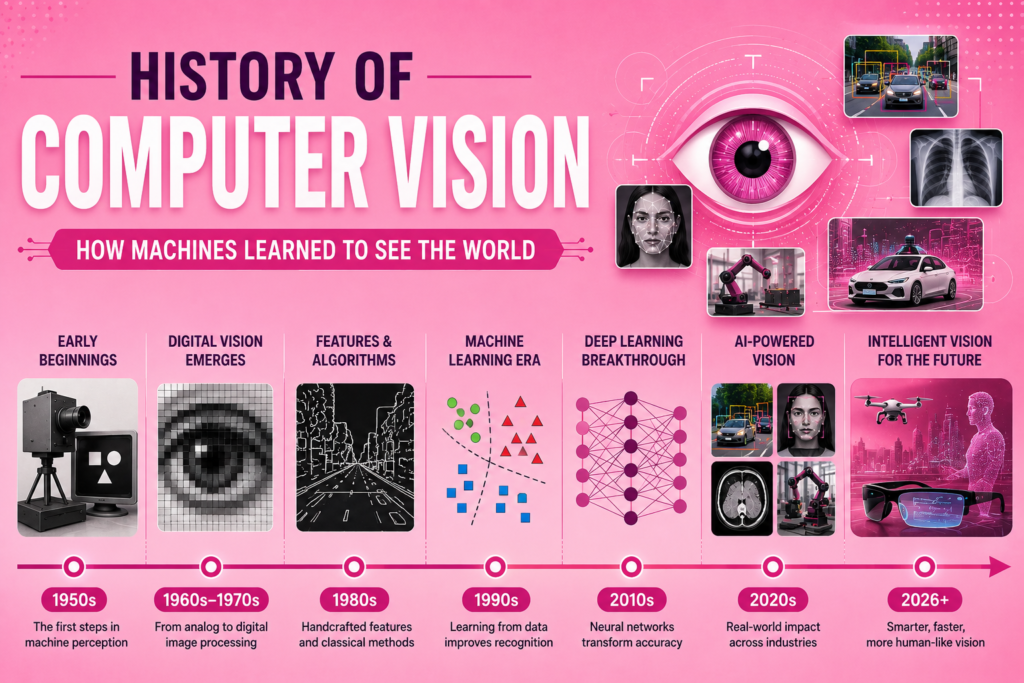
The question of how machines learned to see begins in the 1950s with researchers who barely had programming languages, let alone image datasets. Frank Rosenblatt’s Perceptron in 1957 was the first system that could learn to classify inputs by adjusting weights through experience. It was primitive by every modern measure, but it demonstrated a principle that would define the field: machines could improve their recognition by training on data rather than following hand-coded rules.
The first computer vision experiments with actual images came in the early 1960s. Lawrence Roberts at Massachusetts Institute of Technology published his landmark 1963 dissertation showing that a computer could analyze a two-dimensional photograph of geometric objects and reconstruct a three-dimensional model of the scene. Machines learned to see their very first shapes in a controlled laboratory, using mathematical edge detection to find boundaries and geometric reasoning to interpret them.
These early attempts used no supervised learning in the modern sense. There were no training datasets, no backpropagation, and no convolutional layers. Everything was hand-engineered, which severely limited what the systems could do. But the conceptual proof was there: vision was a computational problem, and computation could at least partially solve it.
Foundations of Seeing: Edge Detection and Structure (1963 – 1975)
The earliest lesson in how machines learned to see was that edges matter. Before a machine can identify an object, it needs to know where that object ends and the background begins. The history of edge detection is therefore the story of the first tools machines used to parse the visual world.
Roberts developed the first edge detection operator as part of his 1963 work. Later, researchers including Irwin Sobel, John Canny, and others refined these methods into increasingly robust algorithms. The Canny edge detector, published in 1986, applied Gaussian smoothing to reduce noise, computed gradient magnitudes to find candidate edges, and used a process called non-maximum suppression to thin them to single-pixel width. It became, and remains, one of the most widely used algorithms in all of image processing.
Alongside edge detection, researchers developed tools for image segmentation, which groups pixels into meaningful regions based on color, texture, or intensity. The ability to divide an image into regions was a necessary step toward understanding what was in it. Feature maps, which represent the responses of filters applied at each location in an image, emerged as a key concept during this period.
The history of pattern recognition in this era focused on building mathematical classifiers that could sort input signals into categories. Statistical models, template matching, and distance metrics were all applied to visual inputs, with limited but genuine success on narrow, well-defined tasks.
David Marr and the Theory of Seeing (1970 – 1982)
One of the most important contributions to how machines learned to see was not a piece of software or a dataset. It was a theory. David Marr at MIT developed a complete computational account of visual perception, published in his posthumous 1982 book “Vision.”
Marr argued that the visual system builds a series of progressively richer representations of a scene, starting from a primal sketch of edges and boundaries, progressing through a two-and-a-half-dimensional model of surfaces, and culminating in a full three-dimensional object representation. Each stage was both computationally necessary and biologically grounded.
His framework influenced how researchers thought about visual cortex simulation in computational terms. If the goal was to teach machines to see the way humans see, Marr’s theory provided a roadmap. Modern deep neural networks do not explicitly follow his stages, but the intuition that vision requires hierarchical processing from simple to complex representations runs through every major architecture built since.
Neural Networks Learn to See Shapes (1980 – 1998)
The history of how machines learned to see shifted fundamentally in 1980 when Kunihiko Fukushima introduced the Neocognitron, a hierarchical neural network directly inspired by the human visual cortex. Fukushima designed layers of simple units that detected local features and complex units that combined them, echoing the structure Hubel and Wiesel had discovered in biological vision.
The Neocognitron could recognize handwritten characters, but it could not be trained with backpropagation, which limited how well it could learn from large datasets. That limitation was resolved by Yann LeCun, who combined the convolutional architecture with backpropagation training to create LeNet in the late 1980s. LeNet used convolutional layers to extract feature maps from input images, applied pooling to reduce spatial dimensions, and fed the results through fully connected layers to produce a classification. It was trained with supervised learning on labeled examples of handwritten digits and deployed in bank check processing systems.
This was a genuine breakthrough in how machines learned to see. Weight optimization through backpropagation meant the network could be trained automatically on data, discovering useful features rather than relying on hand-designed rules. Overfitting was managed through careful use of limited model capacity, and the system worked reliably in a real commercial setting.
The problem was that it required enormous effort to extend beyond digits to more complex visual categories, and the computational power needed to scale up was not yet available.
Machines Learned to See With Features and Math (1999 – 2011)
The late 1990s and 2000s brought a wave of powerful feature-based methods that let machines learned to see objects in natural images, not just controlled laboratory settings. SIFT, the Scale-Invariant Feature Transform introduced by David Lowe, could identify distinctive keypoints in images that remained stable across changes in scale, rotation, and lighting. These features could be matched between images to recognize objects even under difficult conditions.
Support vector machines, which use matrix multiplication and kernel functions to find optimal boundaries between classes, became the preferred classifier for many visual tasks during this period. Combined with features like SIFT and HOG (Histogram of Oriented Gradients), these methods produced solid results on benchmark datasets and powered early commercial applications in face detection and image search.
The history of image processing during this era produced tools for segmentation, tracking, stereo vision, and optical flow that enabled machines to interpret video as well as still images. OpenCV, launched publicly in 2000, gave researchers and developers a shared toolkit that dramatically accelerated experimentation.
Deep neural networks were still considered mostly impractical during this period. Training deep architectures suffered from the vanishing gradient problem, where backpropagation signals became too small to update weights in the early layers of a deep network. Overfitting was another major problem, as deep models required far more training data than was typically available.
The GPU Revolution and ImageNet (2006 – 2012)
The turning point in how machines learned to see came from an unexpected direction: video games. NVIDIA and other manufacturers had spent years developing graphics processing units optimized for the matrix multiplication operations that drive computer graphics. Researchers realized these same operations were exactly what deep neural networks needed.
Training deep neural networks on GPUs rather than CPUs made previously impossible experiments feasible. Training time dropped from weeks to hours. Researchers could now experiment with much deeper architectures and much larger datasets.
Fei-Fei Li provided the other missing ingredient. Her ImageNet dataset, assembled starting in 2006, contained millions of labeled images across thousands of categories. The ImageNet Large Scale Visual Recognition Challenge, launched in 2010, created an annual competition where machines learned to see an increasingly broad range of objects and scenes. Progress was steady from 2010 to 2011, then explosive in 2012.
AlexNet: The Moment Machines Really Learned to See (2012)
In 2012, Alex Krizhevsky, Ilya Sutskever, and Geoffrey Hinton submitted AlexNet to the ImageNet challenge. The result was staggering. Previous top systems had achieved error rates around 26 percent. AlexNet achieved 15 percent. The gap was so large that many researchers assumed there had been a mistake.
There was no mistake. AlexNet used deep convolutional layers with rectified linear unit activations, dropout regularization to control overfitting, and was trained on two GPUs in parallel. Its success demonstrated conclusively that deep neural networks trained on large datasets with sufficient computational power could see far better than any previous approach.
This was the moment the field changed direction completely. The combination of computational power through GPUs, supervised learning on massive training datasets, and deep neural networks with many convolutional layers produced a system that could genuinely understand images at a level nobody had achieved before. Machines learned to see objects not because a programmer described every rule, but because the network discovered the rules itself from millions of examples.
Seeing More: Detection, Segmentation, and Beyond (2013 – 2020)
Once machines learned to see what was in an image, researchers pushed toward seeing where things were and understanding scenes in finer detail. The history of object detection produced R-CNN, Fast R-CNN, Faster R-CNN, and YOLO in rapid succession between 2013 and 2016. Each generation was faster and more accurate than the last.
The history of image segmentation moved from coarse region labeling to pixel-precise masks with systems like Fully Convolutional Networks and Mask R-CNN. Transfer learning in computer vision made it possible to apply models trained on ImageNet to new tasks with small datasets, dramatically lowering the barrier to entry for specialized applications.
Medical imaging AI, self-driving cars and computer vision, and computer vision in manufacturing all became serious commercial fields during this period as machines learned to see well enough to be trusted in high-stakes environments. Visual cortex simulation inspired architectures were being deployed in hospitals, factories, and on public roads.
Seeing and Understanding Together (2020 – 2026)
The most recent chapter in how machines learned to see is the merger of vision and language. Vision transformers, introduced in 2020, replaced convolutional layers with self-attention mechanisms that let the network relate every part of an image to every other part. This produced models that could generalize better across diverse visual tasks.
Deep learning transformed computer vision once more when multimodal models like CLIP, GPT-4V, and Gemini showed that training on paired images and text could produce systems that understood visual content in the context of language, answering questions, generating captions, and reasoning about scenes in ways that pure vision systems could not.
Video understanding in ai advanced alongside still image recognition, with models learning to interpret motion, sequence, and temporal context. The history of pose estimation, depth estimation, and image segmentation all benefited from these new architectural ideas.
Frequently Asked Questions
How did machines first learn to see?
The first steps came in the early 1960s when researchers like Lawrence Roberts developed systems that could analyze simple geometric images and extract structural information. These systems used hand-designed mathematical operations rather than learning from data. Machines learned to see in the modern sense, through training on labeled examples, began with Yann LeCun’s LeNet in the late 1980s and reached full maturity with AlexNet in 2012.
What made deep learning so important for machine vision?
Deep learning allowed machines to learn visual features directly from data rather than requiring engineers to specify them manually. Convolutional layers automatically discover edges, textures, and shapes at multiple levels of abstraction. Trained with backpropagation on large datasets, these networks can generalize to new images in ways that hand-engineered feature extractors cannot. The combination of deep neural networks, large training datasets, and computational power from GPUs produced the breakthrough.
What is supervised learning in computer vision?
Supervised learning in computer vision involves training a model on a labeled dataset where each image is paired with a correct answer, such as a class label or a bounding box. The model makes predictions, compares them to the labels, and adjusts its weights through backpropagation to reduce the error. Over many training examples, the network learns representations that generalize to new images it has never seen before.
Can machines see better than humans?
In narrow, well-defined tasks, yes. Systems trained for specific medical imaging tasks have matched or exceeded specialist radiologists on some benchmarks. Object detection systems can process thousands of images per second without fatigue. But in terms of broad, flexible, context-aware visual understanding, human vision still has advantages. Machines struggle with unusual viewpoints, ambiguous lighting, and situations far outside their training distribution.
What is the next frontier in machine vision?
The current frontier is integrating vision with language, reasoning, and action. Multimodal systems that can see, understand, and respond in natural language are already widely deployed. Embodied AI, where vision drives real-world action in robots and autonomous vehicles, is an area of intense research. The question of how machines learned to see is being replaced by the question of how machines can act intelligently based on what they see.
Conclusion
The journey of how machines learned to see spans more than sixty years and involves some of the most creative minds in science and engineering. It required neuroscience to understand biological vision, mathematics to formalize it, computer science to implement it, and the modern GPU to make it fast enough to be useful. Every piece had to fall into place before the whole system could work.
Today, computer vision technology is embedded in nearly every industry on earth. The machines that learned to see are now diagnosing diseases, building cars, inspecting crops, and generating art. The machines learned to see because thousands of people refused to give up on an idea that seemed unreachable for most of the time they were working on it. That persistence produced one of the most transformative technologies in human history.