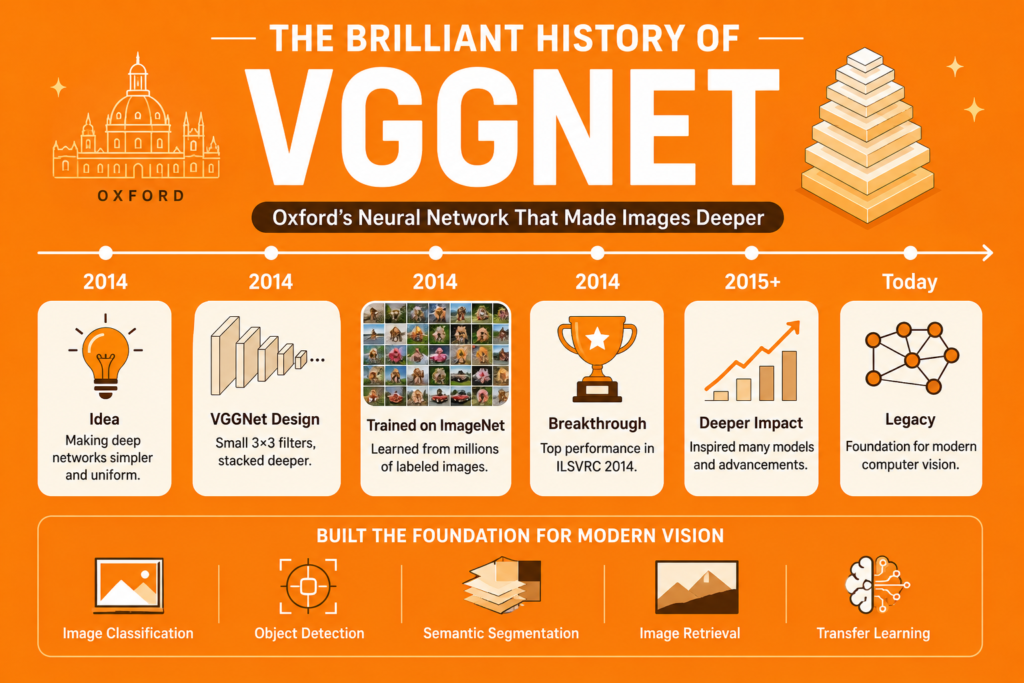
The history of vggnet is a story of architectural elegance triumphing over complexity. In the frantic, gold-rush atmosphere that followed the 2012 AlexNet breakthrough, research teams around the world scrambled to build better, faster, and more powerful neural networks. Amid this chaos, a group from Oxford University proposed something deceptively simple: just make the network deeper, but do it with a pure, almost austere design philosophy. The history of vggnet is about proving that depth alone, when applied with discipline and uniformity, could unlock unprecedented visual understanding. This work from the Oxford Visual Geometry Group did not just create a winning architecture; it created a timeless standard, a benchmark that remains foundational in deep learning education and practice today.
Before 2014, the immediate reaction to AlexNet’s success was a wild proliferation of architectural ideas. Researchers experimented with different filter sizes, pooling strategies, and connectivity patterns in a frantic search for an edge. The first deep convolutional neural network success had opened the floodgates, but the optimal path forward was far from clear. The Oxford Visual Geometry Group VGGNet history began with a remarkably focused hypothesis: that the most critical factor for performance was not the cleverness of the connections, but the sheer depth of the network. They stripped away the complex, multi-sized filters of their predecessors and replaced them with an almost monastic commitment to one tiny, powerful building block. This discipline defines the history of vggnet and set it apart from every other architecture of its era.
The Pre-VGGNet Landscape and the Depth Problem (2012 – 2014)
To appreciate the history of vggnet, one must look at the architectural turbulence of its time. The history of alexnet had demonstrated that a large, eight-layer network trained on GPUs could crush hand-crafted features. AlexNet used a mixture of large 11×11 and 5×5 filters in its first layers, an intuitive approach borrowed from earlier pattern recognition work. These large filters captured broad spatial context but were computationally monstrous, coming with an explosion of parameters.
The immediate successor, which deeply influenced VGGNet’s design, was found in the history of ZFNet, the 2013 ILSVRC winner that visualized AlexNet’s features and tuned its hyperparameters. More importantly, a radical idea was taking hold: the history of the development of deeper CNN architectures showed that you could replace a single large 7×7 filter with a stack of smaller 3×3 filters. This factorization of convolutions was not just a computational trick; it was a profound realization. Two 3×3 layers had the same effective receptive field as one 5×5, but with fewer parameters and, critically, more non-linearity. The Oxford group seized on this principle with total conviction. They asked a question that would shape the entire history of vggnet: what if we use only 3×3 filters, everywhere, and just keep stacking them, layer after layer, to achieve groundbreaking depth?
The Oxford Visual Geometry Group and the Birth of VGGNet (2014)
The definitive chapter in the history of vggnet was published in 2014 by Karen Simonyan and Andrew Zisserman of the University of Oxford. The Simonyan and Zisserman VGG history is one of rigorous empirical science. Their paper, titled “Very Deep Convolutional Networks for Large-Scale Image Recognition,” presented a family of architectures that were breathtaking in their uniformity. They abandoned all large filters and proposed a network built entirely from a chain of stacked convolutional layers using nothing but 3×3 receptive fields.
This was the small 3×3 convolution filters breakthrough. The logic was beautiful: by stacking, for example, three 3×3 convolutional layers, the network achieved the same receptive field as a single 7×7 layer. However, the stack inserted two extra non-linearities, making the decision function more discriminative. It also dramatically reduced the parameter count. The architecture of VGGNet came in several variants, named for the number of weight layers. The two most famous, VGG16 and VGG19 architecture evolution, defined a new scale of deep learning. VGG16, with 16 layers, and VGG19, with 19, were enormous by the standards of 2014. The fully connected layers alone contained an overwhelming number of parameters, pushing the total to a staggering 138 million parameters for the largest configurations. This level of over-parameterization presented new training bottlenecks, but the result was a model with an extraordinary capacity to learn complex visual concepts.
The entire model followed a homogeneous architecture. Every convolutional layer was 3×3 with stride 1 and same padding, preserving spatial dimensions until a max pooling downsampling layer aggressively cut the height and width in half. This pattern, a block of convolutions followed by a pool, created a beautiful, step-wise reduction in spatial size and a corresponding doubling in the number of feature map channels scaling. The depth of the feature maps scaled from 64, to 128, to 256, and finally 512, encoding increasingly abstract semantic concepts. The whole network was implemented in the then-popular Caffe framework implementation, which helped its rapid dissemination across the research community. The final layers flattened the feature maps and passed them through massive fully connected layers before a linear softmax layer made the final 1000-way ImageNet classification.
VGGNet’s 2014 ImageNet Performance and Impact
The VGGNet ImageNet 2014 performance history is a tale of a silver medal that outshone the gold. In the 2014 ILSVRC, VGGNet secured a remarkable top-5 test error of just 7.3%, a massive leap from AlexNet’s 15.3% just two years prior. It lost the top spot only to GoogLeNet, an architecture that took the opposite, highly complex and engineered path with its Inception modules. Yet, the history of VGGNet is proof that a single, pure idea executed with flawless rigor can achieve essentially the same, world-class result.
The legacy of VGGNet lies in its immediate adoption not just as a classifier, but as a universal visual feature extractor. The VGGNet vs AlexNet parameter comparison reveals why. While AlexNet was a finely tuned and somewhat brittle system, VGGNet’s depth and homogeneous architecture produced features that generalized astonishingly well to other tasks and datasets. If you wanted to build an object detector, you took a pre-trained VGG16 and slapped your detection network on top. For semantic segmentation, VGG was the backbone of choice. The evolution of generic feature extraction backbones begins, in many ways, with VGGNet. It was the first model where the power of transfer learning in computer vision became an industrial standard. You simply downloaded a model, stripped off the linear softmax layer, and you had a state-of-the-art visual feature extractor. This is why VGGNet became a computer vision baseline that is still taught in classrooms and used in initial prototyping today.
The Design Philosophy: Simplicity and Depth
The true genius in the history of vggnet is its philosophical commitment to simplicity. In an era of increasingly fractal and complex network designs, VGGNet was a monument to restraint. The decision to only use a 3×3 stack throughout the entire network was not just an aesthetic choice; it was a deep insight into the nature of visual computation. By replacing larger filters with stacked convolutional layers, the network effectively increased its depth, adding more non-linear decision boundaries without blowing up the parameter count in the convolutional portion.
However, this design came with a notorious downside. The over-parameterization bottlenecks were in the fully connected layers, which held the vast majority of those 138 million parameters. This made VGGNet computationally expensive to train and deploy, consuming over half a gigabyte of disk space just for the weights. The network’s massive memory footprint became a key challenge that later architectures like ResNet would solve elegantly. Yet, this over-parameterization was also, in a sense, a feature. It meant the network had immense capacity, and when combined with the power of the Caffe framework implementation and multi-GPU training, it could absorb the massive ImageNet dataset without overfitting too quickly. The history of vggnet is thus a crucial lesson in the double-edged sword of scale: depth and width brought unparalleled accuracy, but at a steep computational price that would spur the next wave of innovation.
Frequently Asked Questions
Why Did VGGNet Use Only Small 3×3 Convolution Filters?
The exclusive use of small 3×3 convolution filters was the foundational design philosophy of VGGNet. As discovered in the Simonyan and Zisserman VGG history, a stack of two 3×3 layers has the same receptive field as a single 5×5 layer, but with fewer parameters. This factorization of convolutions inserts more non-linearities, making the model more discriminative while maintaining a homogeneous architecture that was elegant and easy to implement.
How Did VGGNet Compare to AlexNet and GoogLeNet?
The VGGNet vs AlexNet parameter comparison is striking, with VGGNet dwarfing AlexNet at 138 million parameters versus 60 million. This depth allowed the VGGNet ImageNet 2014 performance history to reach a 7.3% top-5 error, a massive leap from AlexNet’s 15.3%. While it was slightly outperformed by the history of GoogLeNet in 2014, VGGNet’s simpler, more predictable structure made it far more popular as a generic feature extraction backbone for transfer learning.
What Made VGG16 and VGG19 the Most Famous Architectures?
The VGG16 and VGG19 architecture evolution represented the sweet spot of the VGG family. These configurations, with 16 and 19 weight layers respectively, demonstrated the power of very deep networks. Their homogeneous architecture and straightforward max pooling downsampling patterns, combined with public release in the Caffe framework, made them instantly accessible. The evolution of generic feature extraction backbones truly took off because VGG16 was simple to understand, modify, and adapt to new tasks, cementing its place as a timeless baseline.
Conclusion
The history of vggnet is a masterclass in the power of depth and simplicity. At a moment when the field could have exploded into unmanageable complexity, the Oxford Visual Geometry Group imposed a breathtaking order on the design of neural networks. They demonstrated that a disciplined commitment to stacking the smallest conceivable building blocks, the 3×3 filter, could build a model that saw the world with unprecedented clarity. VGGNet was not just a step up in performance; it was a philosophical statement that elegance and uniformity were not constraints but superpowers.
The impact of this philosophy is permanent. The discovery that a feature extraction backbone pre-trained on ImageNet could be surgically attached to entirely different tasks reshaped the entire field of computer vision technology. The model’s weight file became one of the most downloaded artifacts in AI history, used to bootstrap everything from medical image analysis to artistic style transfer. While later architectures have surpassed its raw efficiency, the history of vggnet remains the critical bridge between the chaotic early days of deep learning and the sophisticated, hyper-efficient models of today. Its spirit of exploring depth through simplicity is a lasting legacy, a reminder that the most profound breakthroughs are often the most beautifully straightforward.