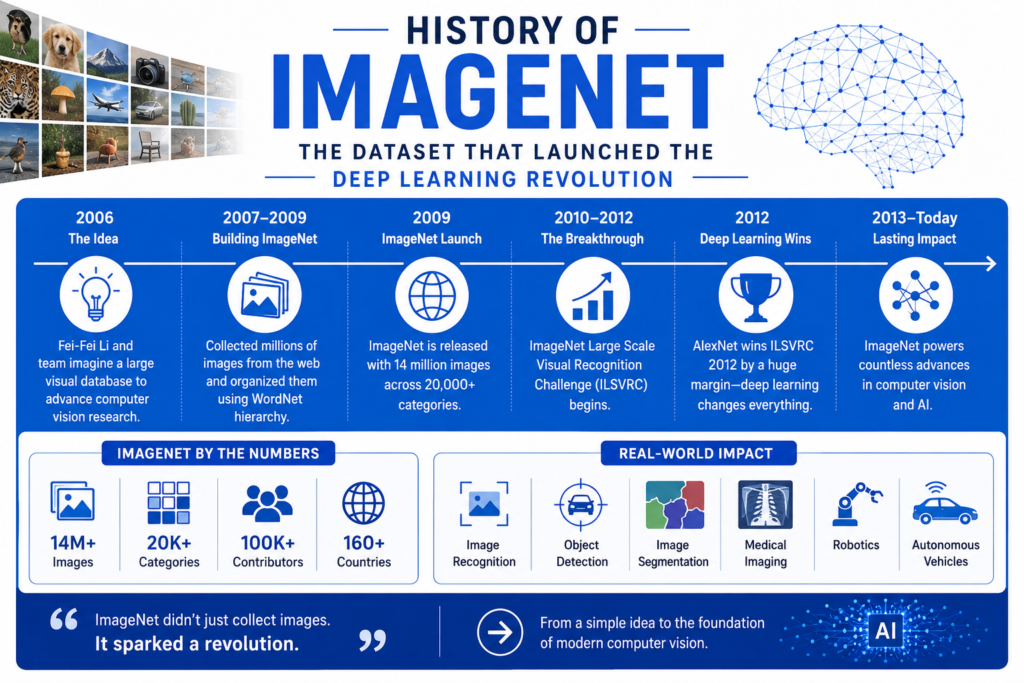
In 2012, a single dataset became the proving ground for an algorithm that would reshape artificial intelligence. But the history of imagenet does not start with that dramatic moment. It starts years earlier, with a researcher who believed that the biggest obstacle to better computer vision was not better algorithms, but better data, and who was willing to spend years building something nobody had asked for. This article tells the full story of how ImageNet was conceived, built, and ultimately became the foundation of the deep learning era.
The Idea Behind ImageNet
By the mid-2000s, computer vision research had a data problem. Most benchmark datasets used to evaluate algorithms contained only a few thousand images across a handful of categories. Researchers were essentially trying to teach machines to recognize the visual world using a tiny, curated sample of it.
Fei Fei Li ImageNet history begins around 2006, when Fei-Fei Li, then a researcher conducting Princeton University research, became convinced that the field was approaching the problem backward. Rather than continuing to refine algorithms on small datasets, she argued that researchers needed a dataset that reflected the genuine scale and diversity of the visual world. If human children learn to recognize objects by seeing thousands of examples of each one in countless contexts, perhaps machines needed something similar.
This was a controversial idea at the time. Building a dataset at the scale Li envisioned seemed impractical, expensive, and possibly unnecessary if the right algorithmic breakthrough came along instead. The history of imagenet is, in many ways, the story of a bet on data over algorithms, a bet that would not pay off for several years but would ultimately prove decisive.
Building on WordNet: A Structure for the Visual World (2007 – 2009)
One of the most important early decisions in the history of imagenet was structural. Rather than inventing a new way to organize categories, Li’s team built ImageNet around WordNet, an existing lexical database of the English language developed by linguists including Christiane Fellbaum at Princeton.
WordNet organizes words into synsets and word taxonomy, sets of synonyms representing distinct concepts, arranged in a hierarchical structure. The word “dog,” for example, sits within a hierarchy that includes broader categories like “canine,” “mammal,” and “animal,” as well as more specific categories for different breeds. This hierarchical structure gave ImageNet a principled way to organize its categories, eventually covering more than 20,000 distinct synsets, ranging from common objects to specific species and even abstract concepts.
The decision to use WordNet’s structure was significant because it meant ImageNet was not just a collection of images, but a collection of images organized according to a rich semantic hierarchy that reflected genuine conceptual relationships. This structure would later prove valuable for tasks beyond simple classification, including research into how visual concepts relate to each other.
The Crowdsourcing Challenge (2007 – 2009)
Once the structure was decided, the team faced an enormous practical problem: how do you collect and label millions of images across tens of thousands of categories? Crowdsourcing ImageNet history is largely the story of how this seemingly impossible task became achievable.
The team used Amazon Mechanical Turk, a crowdsourcing platform that allowed large numbers of workers around the world to perform small, well-defined tasks for modest payment. For ImageNet, this meant having workers verify whether candidate images, gathered through automated web searches for each WordNet category, actually depicted the concept in question.
Data annotation scaling at this level had never been attempted before in computer vision research. The team developed quality control mechanisms to ensure labeling accuracy, since with so many workers and so many images, errors and inconsistencies were inevitable without careful process design. The result, after years of effort, was a dataset eventually containing 14 million labeled images, organized according to the WordNet hierarchy, representing by far the largest and most diverse image classification benchmark ever assembled.
ImageNet Dataset Release (2009)
The ImageNet dataset release 2009 marked the public unveiling of the project, presented at the Conference on Computer Vision and Pattern Recognition. The CVPR poster session 2009 where ImageNet was first shown to the broader research community did not generate the immediate excitement that might be expected given what would follow. Many researchers were skeptical about the practical value of such a massive dataset, given that the dominant algorithms of the time were not designed to take advantage of datasets at this scale.
This initial reception illustrates an important pattern in the history of science and technology: a resource can be genuinely transformative without anyone immediately recognizing its significance. ImageNet existed for several years as an enormous, carefully constructed dataset that the field had not yet developed the tools to fully exploit.
The ILSVRC Competition Begins (2010 – 2012)
The next major chapter in the history of imagenet began with the History of the ILSVRC competition, the ImageNet Large Scale Visual Recognition Challenge, launched in 2010. The ILSVRC used a subset of the full ImageNet dataset, approximately 1.2 million images across 1,000 categories, as a standardized image classification benchmark that researchers could use to compare their algorithms directly against each other, year after year.
The early years of the ILSVRC saw steady, incremental progress. Object localization challenges, which required not just identifying what was in an image but also where it was located, were introduced alongside the classification task, providing additional benchmarks that pushed researchers toward more complete scene understanding rather than simple labeling.
Through 2010 and 2011, the leading approaches still relied heavily on hand-engineered features combined with traditional machine learning classifiers. Progress was real but modest, the kind of year-over-year improvement the field had grown accustomed to over the preceding decade. Nothing about these early results suggested that anything dramatic was about to happen.
The Breakthrough Year (2012)
Then came 2012, and the history of imagenet intersected with the history of AlexNet in a way that changed the trajectory of artificial intelligence. Alex Krizhevsky, Ilya Sutskever, and Geoffrey Hinton entered a deep convolutional neural network into the ILSVRC, achieving a top-5 error rate of approximately 15 percent, compared to roughly 26 percent for the next best entry.
This result represented a paradigm shift toward data in a way that vindicated Fei-Fei Li’s original bet. AlexNet’s deep architecture had millions of parameters, far more than previous approaches, and training a network with that many parameters effectively required a dataset as large as ImageNet to avoid severe overfitting. Without ImageNet, AlexNet’s architecture could not have been trained successfully. Without AlexNet’s architecture, ImageNet’s scale would not have been fully exploited.
This combination, massive labeled data plus a deep architecture capable of learning from it, became the template for nearly all subsequent progress in computer vision. The history of AlexNet is inseparable from the history of imagenet, each providing the necessary condition for the other’s significance.
How ImageNet Changed Computer Vision Benchmarks (2012 – 2018)
In the years immediately following 2012, How ImageNet changed computer vision benchmarks became one of the central stories of the field. Every major architecture that followed, the history of VGGNet in 2014, the history of GoogLeNet the same year, and the history of ResNet in 2015, was developed and validated primarily by competing on the ILSVRC image classification benchmark.
By 2015, the ResNet architecture achieved a top-5 error rate of 3.57 percent on ImageNet, surpassing the approximately 5 percent error rate typically attributed to human performance on the same task. This milestone, machines outperforming humans on a benchmark that had been considered a meaningful test of visual intelligence, would have seemed like science fiction when ImageNet was first released in 2009.
Transfer learning in computer vision emerged as one of the most important practical consequences of ImageNet’s existence. Networks pretrained on ImageNet’s 1.2 million images learned visual representations general enough to be useful for an enormous range of other tasks, from medical imaging ai to satellite analysis to facial recognition, often requiring only a small amount of additional task-specific training data to achieve strong performance.
ImageNet’s Legacy: The Dataset That Saved Artificial Intelligence
It is not an exaggeration to call ImageNet the dataset that saved artificial intelligence. Before 2012, neural networks were widely regarded within parts of the research community as an interesting but largely impractical approach, having fallen out of favor during periods sometimes referred to as AI winters. The dramatic success of AlexNet on ImageNet provided concrete, undeniable proof that deep neural networks, given sufficient data and computational power, could outperform every alternative approach by a wide margin.
This proof triggered an enormous wave of investment, research, and development that continues to this day. The history of imagenet is therefore not just the history of a dataset, but the history of the evidence that justified an entire field’s pivot toward deep learning, a pivot that has produced everything from the history of object detection advances like YOLO and Faster R-CNN to the multimodal systems and generative models that define artificial intelligence in the mid-2020s.
ImageNet’s influence extends beyond its direct use as a benchmark. The methodology it established, building large, carefully labeled datasets organized around meaningful semantic categories, became a template that researchers applied to countless other domains, from medical imaging to natural language processing to autonomous driving.
Frequently Asked Questions
Who created ImageNet?
ImageNet was created primarily by Fei-Fei Li, beginning around 2006 while she was conducting research that would later continue at Stanford University. The project involved significant collaboration with other researchers and relied on the WordNet lexical database, developed by linguists including Christiane Fellbaum, for its categorical structure.
How big is the ImageNet dataset?
The full ImageNet dataset eventually contained over 14 million labeled images across more than 20,000 categories, organized according to the WordNet hierarchy. The subset used for the ImageNet Large Scale Visual Recognition Challenge contained approximately 1.2 million images across 1,000 categories.
Why was ImageNet so important for deep learning?
ImageNet provided, for the first time, a dataset large and diverse enough to train deep neural networks with millions of parameters without immediate severe overfitting. When AlexNet was trained on ImageNet in 2012 and dramatically outperformed previous methods, it proved that the combination of large datasets and deep architectures could achieve results far beyond what hand-engineered approaches had achieved, triggering the modern deep learning revolution.
What is the ILSVRC and how does it relate to ImageNet?
The ImageNet Large Scale Visual Recognition Challenge, or ILSVRC, is an annual competition launched in 2010 that used a subset of the ImageNet dataset as a standardized benchmark for image classification and object localization. The history of the ILSVRC competition is closely tied to the history of imagenet, as the competition provided the venue where ImageNet’s scale was first dramatically exploited by deep learning approaches.
Is ImageNet still used today?
Yes, though its role has evolved. ImageNet remains a standard benchmark for evaluating new computer vision architectures and is widely used as a source of pretraining data for transfer learning. While newer, larger, and more diverse datasets have since been developed, ImageNet’s historical significance and continued use as a reference point make it one of the most important datasets in the history of artificial intelligence.
Conclusion
The history of imagenet is a reminder that some of the most important contributions to a field are not algorithms, but infrastructure. Fei-Fei Li’s decision to spend years building a dataset that, at the time, the field’s algorithms were not yet equipped to fully exploit, turned out to be one of the most consequential decisions in the history of artificial intelligence. When the right algorithm finally arrived in 2012, ImageNet was waiting, ready to provide the scale that algorithm needed to prove its worth.
Every system built on computer vision technology today, from the cameras that recognize faces to the models that generate images from text, exists in a world shaped by ImageNet’s influence. Understanding the history of imagenet means understanding that sometimes the most important breakthrough is not a clever new idea, but the patient, unglamorous work of building the resource that makes future breakthroughs possible.