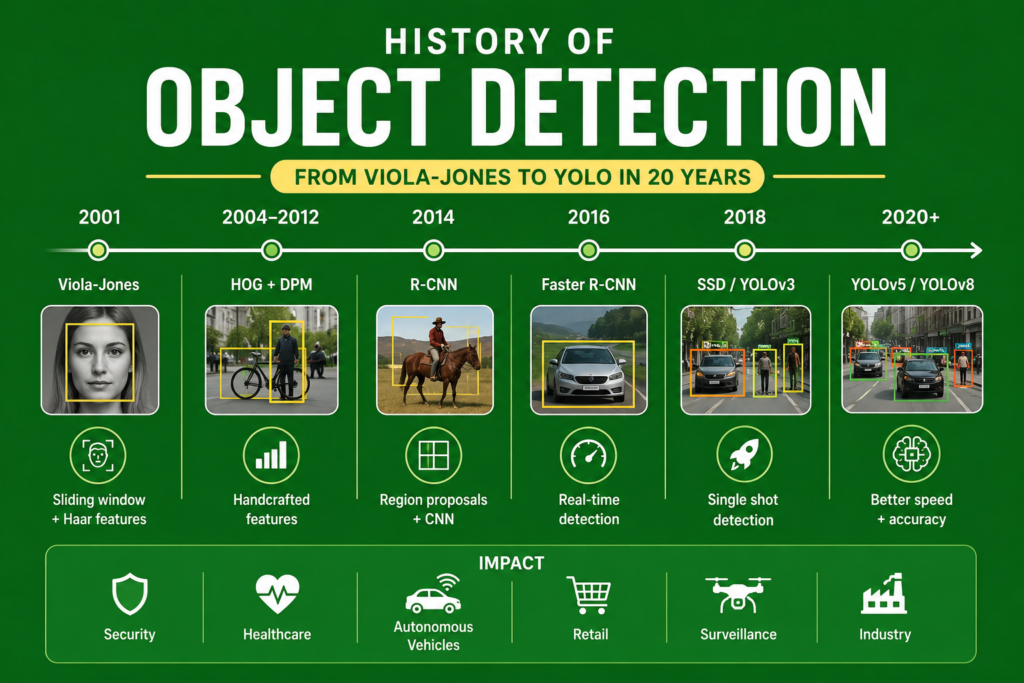
The rich history of object detection represents one of the most exciting and disruptive journeys in the field of artificial intelligence. Today, we take for granted that autonomous cars can effortlessly track pedestrians in real time, that surveillance systems can instantly flag security anomalies, and that smartphones can automatically focus on human faces. However, the path to achieving this seamless spatial awareness required overcoming massive computational roadblocks and deep mathematical hurdles.
Over the past two decades, this critical engineering discipline has undergone a total transformation, pivoting from rigid manual pixel sorting to fluid deep learning systems. By exploring the history of object detection, we can see exactly how global researchers taught machines to not only see pixels but to deeply comprehend where distinct objects reside within a chaotic physical environment.
The Handcrafted Feature Era (2001 – 2012)
The modern history of object detection officially began with a desperate quest to solve the immense challenge of face localization using highly restrictive computer hardware. During the early days of digital image processing, computers lacked the raw processing power required to run deep multi-layered neural networks. To bypass these severe technical constraints, early machine learning pioneers focused strictly on human engineered spatial shortcuts.
The first massive breakthrough arrived in the form of the Viola-Jones framework (2001). This monumental engineering milestone relied heavily on simple, rectangular Haar-like features that could be computed instantly using an ingenious data structure known as an integral image. By pairing these simple features with an aggressive boosting algorithm called AdaBoost, the viola-jones algorithm became the world’s very first highly practical, real-time face detection system. This completely revolutionized the market, laying the baseline framework for the early history of face and pedestrian detection software across consumer electronics.
As the technology sector moved deeper into the decade, researchers needed to identify far more complex items than human faces, which possess a relatively uniform layout. This demand drove the evolution of object detection paradigms toward more robust local feature descriptors. Scientists developed the Scale-Invariant Feature Transform (SIFT) to accurately identify specific landmark objects despite massive changes in scale, rotation, or lighting.
Shortly thereafter, the introduction of the Histogram of Oriented Gradients (HOG) method provided a highly effective way to extract edge directions across localized regions of an image. When paired with a Support Vector Machine (SVM) classifier, HOG features quickly became the absolute gold standard for tracking pedestrians in dynamic urban environments. This represented a major leap forward in the baseline history of object detection.
Despite these incredible mathematical victories, this initial phase in the history of object detection hit a rigid wall. These traditional frameworks relied entirely on moving from handcrafted features to end to end object detection, meaning human engineers had to manually predict every single visual variable. If a target object was slightly occluded, rotated, or placed under an unfamiliar shadow, the rigid mathematical formulas broke down completely, resulting in poor spatial localization and frequent system failures.
The Deep Learning Disruption (2012 – 2014)
Everything changed in the timeline of artificial intelligence when a massive neural network completely crushed traditional algorithms at the international ImageNet competition. The historic arrival of deep convolutional neural networks completely shattered the reliance on human engineered feature extraction. Instead of manually programming edge filters, scientists realized that multi scale deep models could autonomously learn their own highly generalized visual hierarchies directly from raw image inputs. This paradigm shift permanently altered the history of object detection.
The first deep model to successfully conquer traditional vs deep learning object detection history and improve the history of bounding box localization was the regional convolutional neural network. The history of r-cnn represents the historic bridge connecting traditional machine learning with deep neural networks. Instead of running a heavy network uniformly across every single pixel of an image, R-CNN utilized an external localization algorithm called Selective Search to generate roughly two thousand region proposals that were highly likely to contain distinct objects.
These isolated regions were then cropped, warped, and passed directly through a deep convolutional backbone to extract rich feature vectors before final classification occurred. To accurately evaluate how well these predicted shapes overlapped with actual human labels, developers heavily relied on the Intersection over Union (IoU) metric.
While R-CNN achieved an unprecedented leap in overall classification accuracy, it was incredibly slow to execute. Because the framework had to run a heavy deep network thousands of times for a single digital photograph, processing a single image took up to forty-five seconds on premium server hardware. This massive speed bottleneck highlighted the critical need for a more integrated, efficient approach within the history of object detection.
Rise of the Two Stage Dominance (2014 – 2015)
To decisively solve the extreme computational inefficiencies plaguing early region-based models, researchers focused heavily on unifying the entire pipeline. The prominent history of R-CNN, Fast R-CNN, and Faster R-CNN highlights a highly competitive era of rapid, iterative software optimization. The first major improvement came when the feature extraction process was moved to the very beginning of the pipeline, allowing the model to process the entire image as a single coherent matrix just once.
The history of faster r-cnn marked the true dawn of highly integrated, end-to-end deep spatial localization networks. Rather than relying on external, slow region proposal algorithms like Selective Search, Faster R-CNN introduced an ingenious internal component known as Region Proposal Networks (RPN). This structural addition shared full convolutional features directly with the rest of the object detection network, allowing the system to propose regions autonomously at a fraction of the previous computational cost.
This system relied heavily on the development of anchor box regression, which placed a fixed grid of reference bounding boxes across the entire image map. The network then calculated slight mathematical adjustments to these reference shapes to wrap around target objects flawlessly. This methodology permanently transformed the trajectory of the history of object detection.
This highly coordinated multi stage architecture solidified the two stage vs one stage detectors timeline. The two-stage paradigm clearly separated the localization task into two distinct phases: first proposing areas of high interest, and then performing intense classification. This strategy yielded massive gains across global evolution of mean average precision (mAP) benchmarks, making these networks highly trusted for complex industrial applications where absolute precision was mandatory.
The Real Time One Stage Revolution (2015 – 2020)
While two stage networks achieved incredible precision, they were still far too slow to handle live video feeds natively on standard commercial processing hardware. This operational limitation triggered another massive pivot in the history of object detection. Ambitious developers began asking a fundamental question: could a neural network simultaneously predict bounding boxes and classify objects in a single, lightning fast step?
The historic answer arrived with the launch of the You Only Look Once framework. The history of yolo completely redefined the limits of computer vision by framing spatial localization as a single, straightforward regression problem. Instead of isolating regions, YOLO split the incoming image into a clean geometric grid, predicting multiple bounding boxes and class probabilities all at once. For the very first time in human history, computers could process live video streams at a stunning sixty frames per second.
Shortly after YOLO took the world by storm, another highly competitive one-stage alternative emerged to alter the history of object detection. The single shot detector framework, officially known as the Single Shot MultiBox Detector, optimized real-time processing by utilizing feature maps from multiple different depths of the network. This allowed the model to detect tiny items in early layers and massive items in deeper layers simultaneously.
The YOLO and SSD real time detection history proved to the global technology sector that speed and accuracy did not have to be mutually exclusive. This rapid evolution allowed spatial tracking software to be safely deployed in fast-moving real-world systems like delivery drones, factory automation pipelines, and advanced driver assistance systems.
| Detector Paradigm | Core Strategy | Primary Advantage | Main Bottleneck |
| Traditional Handcrafted | Manual mathematical descriptors (SIFT, HOG) paired with classic SVMs. | Extremely lightweight, requires no GPU hardware. | Highly brittle, easily fails under altered lighting. |
| Two-Stage Deep Learning | Separate region proposals (RPN) followed by independent classification. | Exceptional spatial precision and high mAP scores. | High computational cost, struggles with live video. |
| One-Stage Deep Learning | Unified regression grid predicting bounding boxes and classes at once. | Lightning fast processing, ideal for real-time video. | Slight drop in accuracy for ultra-small objects. |
Modern Open Vocabulary and Foundation Models (2020 – 2026)
In recent years, the history of object detection has broken out of its traditional boundaries to embrace unprecedented flexibility. For nearly two decades, even the most advanced models suffered from a major limitation: they could only detect specific object categories that they were explicitly trained on during their initial development phase. If a model was trained on a dataset of one hundred items, it would remain completely blind to the rest of the physical world.
The modern open vocabulary object detection evolution completely shatters this long-standing limitation, marking a golden era in the history of object detection. By pairing deep spatial networks with massive language models, modern systems can locate absolutely any object described to them via natural human text prompts. This technological milestone utilizes advanced Grounding DINO integration to actively match incoming visual pixels with abstract linguistic concepts in real time.
Furthermore, the introduction of massive foundation models (SAM) background has brought unparalleled pixel-level segmentation capabilities to the mainstream market. Modern systems regularly deploy advanced Vision Transformers (ViT) object tracking to monitor complex paths over time with extreme resilience. The history of object detection has officially evolved from a hyper specialized tool into a universally applicable foundation for global spatial intelligence.
Frequently Asked Questions
What is the core difference between a two-stage and a one-stage object detector?
Two stage detectors first isolate highly likely regions of interest before passing them to a separate classification head, prioritizing maximum accuracy. One stage detectors predict bounding boxes and classification categories simultaneously in a single forward pass through the network, maximizing operational speed. This distinction defines a major chapter in the history of object detection.
Why was the Viola-Jones framework considered a major milestone in 2001?
The Viola-Jones framework was the world’s very first system capable of executing face detection in real time on highly limited computer hardware. It achieved this feat by pairing simple, fast Haar-like features with an optimized boosting algorithm, completely bypassing the need for heavy neural networks.
What role do anchor boxes play in modern spatial tracking models?
Anchor boxes serve as a predefined set of reference bounding boxes of various shapes and sizes placed uniformly across an image. The neural network calculates precise mathematical adjustments relative to these reference shapes to wrap around target objects with extreme accuracy.
What is the primary purpose of the Intersection over Union (IoU) metric?
Intersection over Union is a critical mathematical benchmark used to evaluate the accuracy of an object detector. It calculates the exact ratio of the overlapping area between the predicted bounding box and the true human labeled bounding box, ensuring the model is localizing items correctly throughout the history of object detection benchmarks.
Conclusion
The monumental twenty year history of object detection is a stunning testament to the power of open source collaboration and architectural innovation. By constantly breaking through hardware limitations, moving fluidly from handcrafted algorithms to unified deep models, global software researchers have effectively given machines a highly sophisticated, human-like understanding of physical space. As next-generation foundational models continue to merge visual processing with natural language, the core underlying principles of spatial localization will undoubtedly remain at the absolute vanguard of computer vision technology, driving the next great wave of automation, robotics, and industrial artificial intelligence across the globe.