The amazing history of augmented reality is a remarkable journey of human innovation. What once existed purely in the realm of futuristic science fiction has rapidly evolved into an accessible tool used daily by millions around the globe. To fully grasp this technological marvel, one must first look at the brilliant history of computer vision, which gave machines the fundamental ability to perceive and understand our physical environments. Without algorithms capable of processing visual data, creating a seamless blend of digital graphics and the real world would be utterly impossible. The fascinating history of augmented reality shows us how researchers tirelessly bridged the massive gap between flat computer screens and immersive three dimensional overlays. By seamlessly combining software intelligence with advanced optics, developers unlocked a completely new way for humans to interact with digital information. Today, we stand on the precipice of a spatial computing revolution, where our physical surroundings are constantly enriched by interactive data. This deep dive into the past will reveal how initial bulky prototypes slowly transformed into sleek, powerful wearable devices.
Early Visions and Hardware (1960 – 1980)
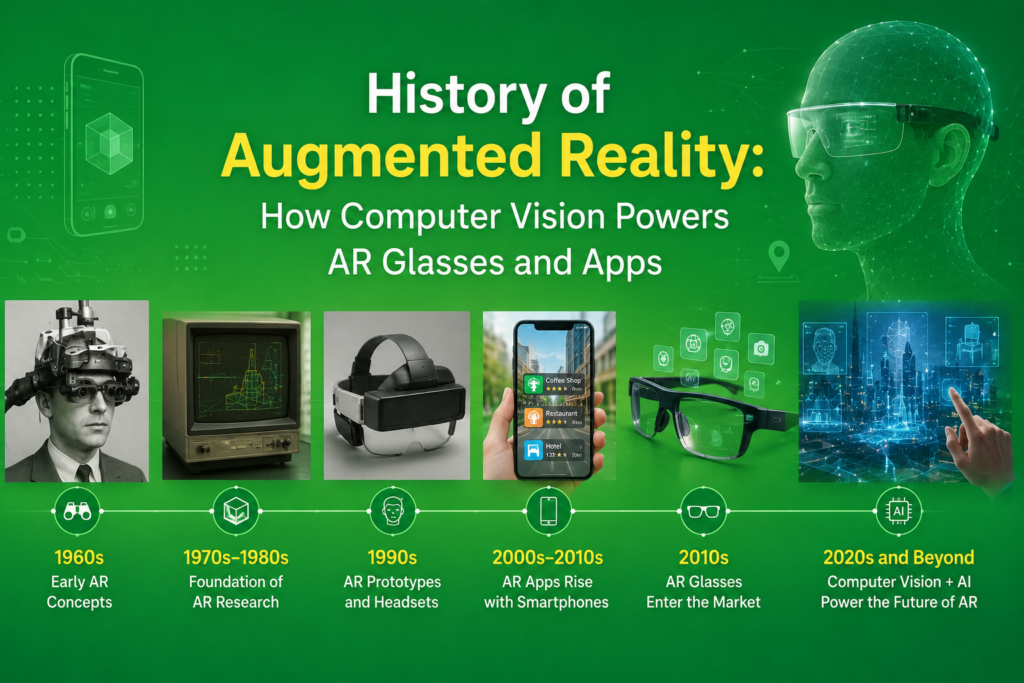
The very foundation of the history of augmented reality was established inside specialized academic and military laboratories during the mid twentieth century. Long before modern smartphones existed, ambitious scientists dreamed of overlaying computer generated graphics onto the real world. A pivotal moment during this era was the famous Ivan Sutherland Sword of Damocles history. In the late nineteen sixties, Sutherland and his students constructed a massive, heavy contraption suspended from the ceiling. This incredible invention is widely recognized as one of the first functioning head mounted displays. Because of its massive weight, it had to be securely tethered overhead, giving the device its highly memorable nickname.
During this same period, the first computer vision experiments were taking place, attempting to teach massive mainframe computers how to recognize simple geometric shapes. The Early head mounted display experiments history highlights how researchers struggled with incredibly slow processing speeds and rudimentary graphics. Yet, they successfully proved that Optical see-through displays could theoretically project a wireframe cube into a user’s field of vision. These initial setups required tightly controlled environments and massive computing power that filled entire rooms. However, despite these severe limitations, the core concept of the history of augmented reality was successfully born. The seeds were planted for a future where digital and physical realities would seamlessly intertwine.
Rise of Industrial Applications (1980 – 2000)
As processing power slowly increased and hardware became slightly more compact, researchers began exploring practical uses for these visual technologies. The history of image segmentation became highly relevant as programmers needed computers to differentiate between a physical desk and a projected digital object. The History of augmented reality in industrial maintenance began to take shape during these crucial decades. Engineers theorized that complex assembly tasks could be performed significantly faster if workers had visual instructions projected directly into their line of sight.
A massive breakthrough occurred with the development of the Virtual fixtures system (1992) by the United States Air Force. This sophisticated platform was designed to assist human operators in controlling distant robotic arms. By overlaying helpful digital guides onto the user’s physical workspace, the system drastically improved operational efficiency and mechanical precision. Later in the decade, the introduction of the ARToolkit open source library completely democratized development. This powerful software allowed independent programmers to experiment with digital overlays using standard consumer webcams. The history of augmented reality entered a highly collaborative phase, moving beyond classified military projects into university computer labs worldwide. This specific era solidified the notion that augmented overlays could provide massive financial and operational benefits to large scale manufacturing environments.
The Smartphone Revolution (2000 – 2015)
The dawn of the new millennium brought an absolute explosion in consumer electronics, most notably the widespread adoption of the smartphone. The history of augmented reality shifted dramatically from bulky headsets to portable pocket computers equipped with cameras and sensors. This era gave rise to the fascinating Chronological history of AR mobile apps, starting with simple novelty programs and evolving into highly sophisticated tools. Developers quickly realized that the screen of a mobile phone could act as a magic window into an augmented world. The history of depth estimation played a crucial role here, as smartphone cameras needed to understand how far away physical objects were in order to scale digital graphics correctly.
During these years, the intense History of marker based vs markerless AR debate dominated developer circles. Early mobile applications heavily relied on printed black and white physical markers. When the smartphone camera detected the printed marker, it would generate a 3D model on top of it. However, as computer algorithms became exponentially smarter, the industry aggressively pushed toward markerless tracking. By analyzing the natural features of a room, modern software could place a virtual piece of furniture on a bare floor without needing a printed code. This massive leap in visual capability supercharged the history of augmented reality, making the technology universally accessible to everyday consumers without requiring specialized hardware.
Wearables and Spatial Computing (2015 – 2025)
The past decade has been profoundly defined by the aggressive Development of smart glasses and AR headsets. Major technology corporations poured billions of dollars into creating wearable devices that could free users from staring down at their phone screens. The Google Glass and Magic Leap historical timeline perfectly illustrates both the massive hype and the significant engineering challenges of this period. Early consumer smart glasses faced massive public backlash regarding privacy concerns, while enterprise focused headsets found strong success in medical training and warehouse logistics. The history of augmented reality during this phase was characterized by intense hardware miniaturization.
To make these wearables function effectively, engineers had to drastically improve environmental tracking. The integration of advanced Spatial mapping sensors allowed headsets to scan and remember the precise layout of an entire room. This was powered by highly complex Visual Inertial Odometry (VIO) algorithms and robust Simultaneous Localization and Mapping (SLAM) techniques. These systems allowed a digital object to remain perfectly anchored to a physical table even if the user walked out of the room and returned later. Additionally, the incredible history of google lens showcased how artificial intelligence could instantly translate physical text or identify real world objects through a camera lens. The overall history of augmented reality reached unprecedented heights as digital elements began interacting directly with the physical geometry of the user’s environment.
Future Paradigms (2025 – 2035)
As we aggressively push toward the future, the exciting Evolution of augmented reality technology promises to fundamentally reshape human interaction. The next decade will undoubtedly be defined by the widespread consumer adoption of discreet, lightweight smart glasses. The Future projection of AR hardware interfaces suggests that we will eventually move away from handheld screens entirely, relying instead on subtle voice commands and intuitive eye tracking. A critical component of this future is the perfection of Waveguide display optics, which bounce light directly into the user’s retina to create incredibly crisp, transparent images.
The ongoing history of augmented reality will see massive improvements in Real-time occlusion tracking. This means a virtual character will be able to hide seamlessly behind a real physical couch, perfectly mimicking the laws of real world physics. Developers are also focusing heavily on precise Digital asset geometry projection to ensure that virtual shadows and lighting match the physical room exactly. However, engineers still face significant challenges, particularly regarding Field of view (FOV) constraints and battery life. Despite these engineering hurdles, Spatial computing and AR tech evolution continues to accelerate at a breathtaking pace. The glorious history of augmented reality is poised to enter its most transformative chapter yet, blending our physical and digital lives into one cohesive experience.
FAQs:
What exactly is the history of augmented reality?
It is the chronological timeline of technological advancements that allow computer generated graphics to be overlaid onto the physical world. It covers everything from massive, room sized military prototypes in the nineteen sixties to the sleek, artificially intelligent smart glasses available on the market today.
How does spatial computing differ from virtual reality?
Virtual reality entirely replaces your physical environment with a closed, simulated world. In contrast, augmented systems actively enhance your existing physical surroundings by adding useful digital information, interactive graphics, or contextual data on top of what you can naturally see.
What role do smartphone cameras play in this technology?
Smartphones acted as the crucial bridge for public adoption. Because modern phones are equipped with high resolution cameras and powerful processors, they allow everyday consumers to experience sophisticated augmented environments without needing to purchase expensive, dedicated hardware headsets.
Why are industrial companies investing so heavily in these visual tools?
Large factories and medical facilities utilize these systems to dramatically improve accuracy and reduce training times. By projecting step by step instructions directly onto a complex machine or a patient, workers can perform their jobs significantly faster and with far fewer errors.
Conclusion
The spectacular history of augmented reality beautifully demonstrates the relentless power of human curiosity and engineering brilliance. What started as incredibly bulky, academic prototypes has smoothly transitioned into highly sophisticated digital ecosystems. We have journeyed through decades of intense innovation, witnessing the birth of smart glasses and the democratization of mobile spatial computing. All of these incredible milestones were heavily dependent upon the continuous advancement of computer vision technology, which finally gave machines the intelligence to perceive our chaotic physical world. The ongoing history of augmented reality serves as a powerful reminder that the line between the digital and physical realms is rapidly vanishing. As hardware becomes smaller and software becomes infinitely smarter, these visual tools will soon become as ubiquitous as the smartphone itself. The future promises a truly interactive world where information is no longer confined to flat screens, but seamlessly integrated into the very fabric of our everyday lives.