The rapidly advancing field of video understanding in ai represents a monumental leap in how artificial intelligence processes the visual world. When examining the Video understanding vs static image processing AI debate, the fundamental distinction is incredibly clear: static images are frozen snapshots of a single moment in time, whereas videos inherently involve the highly complex fourth dimension of time. To successfully master video understanding in ai, a software algorithm must not only detect what specific physical objects exist within a given digital frame, but it must also comprehend exactly how those individual objects interact and evolve over a continuous sequence of frames. This requires highly advanced neural systems capable of grasping scene context, tracking rapid movement continuously, and inferring the underlying intent behind human actions and environmental shifts. As we look backward at the broader history of computer vision, the remarkable engineering journey from identifying simple black-and-white edges to analyzing real-time high-definition video streams has been nothing short of miraculous. Every major breakthrough in video understanding in ai has been driven by the relentless desire to make machines perceive the dynamic world exactly as humans do. This extensive article provides a comprehensive overview of the history and evolution of video understanding in ai, detailing the major architectural breakthroughs, the massive shift toward deep neural networks, and the modern commercial applications that allow our machines to truly watch, learn, and dynamically react to moving scenes.
Early Foundations and Optical Flow (1980 – 2000)
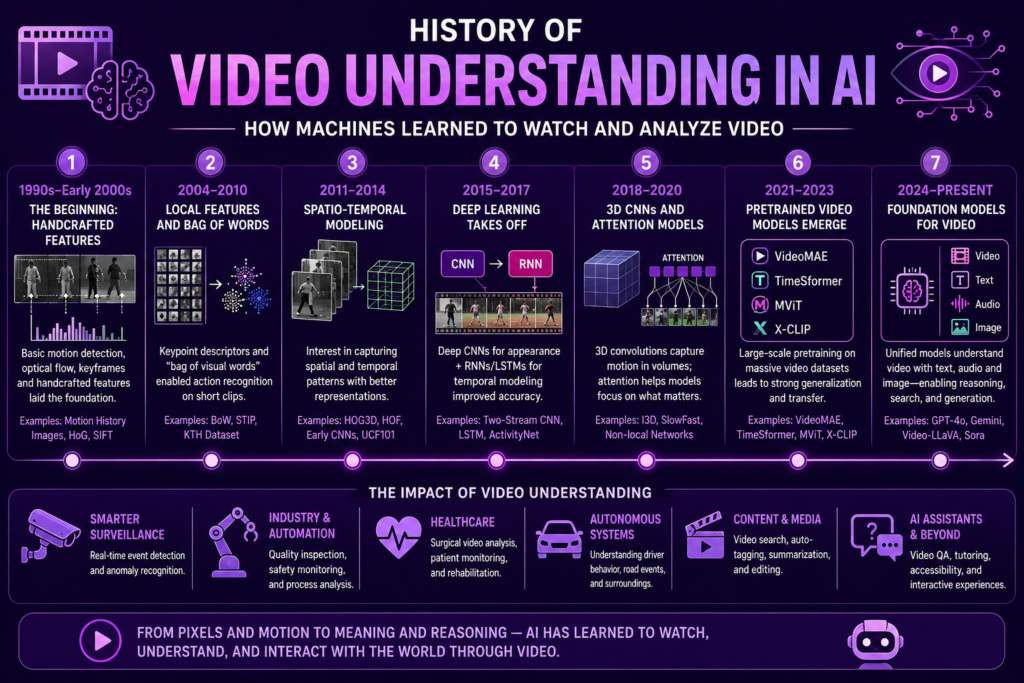
For several decades, early computer science researchers were primarily focused on static pictures, making the history of image processing heavily biased toward single-frame mathematical analysis. During the late twentieth century, however, scientists began to realize that true artificial perception required a deep, fundamental understanding of continuous motion. Initial laboratory efforts relied heavily on traditional physics-based calculations rather than machine learning. Dedicated researchers developed highly complex algorithms to compute Optical flow tracking fields, which meticulously estimated the apparent motion of pixels between two consecutive frames in a digital sequence. These early mathematical models allowed bulky computers to detect whether a physical object was moving left, right, closer, or further away purely based on the continuous displacement of light patterns across the screen.
While this was a significant conceptual step forward, the Evolution of temporal action recognition software was painstakingly slow and fraught with technical roadblocks. Computing Optical flow tracking fields required immense processing power and massive memory allocation that simply did not exist in standard laboratory computers of that specific era. Furthermore, these classical heuristic methods were highly sensitive to environmental changes; simple shifts in lighting, slight camera shakes, and background clutter would instantly break the tracking algorithms. Because of these severe hardware limitations, researchers frequently had to rely on extreme Frame rate subsampling techniques, dropping a massive number of frames from the video feed just to allow the machine to process a low-resolution, choppy clip. Although these early computer systems were highly rudimentary and fragile, they firmly established the critical foundational theory that temporal dynamics were just as important as spatial features when attempting to achieve true video understanding in ai.
The Deep Learning Era and Spatiotemporal Features (2010 – 2015)
The entire technological landscape changed dramatically and permanently when deep neural networks entered the computing mainstream. As machines learned to see with unprecedented accuracy using two-dimensional convolutional neural networks, ambitious researchers immediately sought to apply these massive successes directly to the temporal video domain. The initial development of Deep learning models for video understanding faced a major, fundamental hurdle: a standard convolutional network only mathematically understood height and width, completely ignoring the depth of time. This frustrating limitation birthed the Spatiotemporal feature extraction deep learning history, an exciting period of intense global innovation where software engineers completely redesigned the fundamental building blocks of neural networks from the ground up.
One of the absolute most crucial historical breakthroughs during this vibrant era was the highly anticipated introduction of 3D Convolutional layers (C3D). The History of 3D convolutional networks for video is essentially the fascinating story of expanding mathematical image filters to move across height, width, and time simultaneously. C3D models could rapidly digest short, continuous clips of video and extract rich, dense mathematical features that captured both the physical appearance of objects and their high-speed motion trajectories. Shortly after this innovation, the highly effective Two-stream network architecture was formally proposed to the scientific community. This architecture utilized two completely separate neural pathways working in parallel: one pathway dedicated strictly to analyzing the static, high-resolution spatial frames, and another dedicated to analyzing the temporal optical flow vectors. The raw mathematical outputs of these two independent streams were then fused together to make a final action prediction, vastly improving the reliability and accuracy of action recognition systems worldwide.
The RNN Architecture and Dataset Boom (2015 – 2018)
As deep learning models grew significantly larger and more complex, engineers quickly realized that maintaining a robust memory of past events was absolutely critical for interpreting long, continuous video sequences. This stark realization led to a massive industry surge in Video classification using recurrent neural networks. By feeding the dense spatial features successfully extracted by convolutional layers directly into advanced recurrent architectures, intelligent systems could finally maintain Long short-term context windows. This incredible capability meant that an AI could watch a lengthy cooking tutorial video and reliably remember that a chef had chopped an onion thirty seconds prior to placing it in a heated frying pan.
During this highly productive period, the innovative concept of Temporal Segment Networks (TSN) also emerged from major research laboratories. This architecture allowed models to strategically sample short snippets from across an entire long-form video rather than just processing a single continuous, localized chunk. This sparse, distributed sampling approach gave the AI a much broader, more holistic understanding of the entire video narrative structure. However, researchers pushing the boundaries of video understanding in ai quickly encountered the massive Challenges of video understanding datasets scale. Training these massive, complex temporal networks required millions of manually annotated video clips. The industry responded aggressively by creating massive, standardized digital libraries, the most famous and impactful being the Kinetics dataset benchmarks. With hundreds of thousands of meticulously categorized video clips, these datasets provided the essential fuel necessary for models to properly learn precise Action localization bounding tracks. This enabled algorithms to accurately draw tight digital boxes around human activities as they actively happened on screen. The maturation of these tracking technologies conclusively proved that video understanding in ai was finally ready for massive commercial deployment.
Vision Transformers and Modern Surveillance (2018 – 2026)
The most recent, profound, and arguably disruptive shift in video understanding in ai has been the widespread, industry-wide adoption of vision transformers. Originally designed exclusively for processing written text in natural language models, the highly scalable transformer architecture proved to be exceptionally skilled at identifying hidden mathematical relationships between distant, disconnected elements in a sequential stream. By treating sequential video frames as a long series of distinct visual patches, researchers achieved incredible milestones in Automated video summarization using vision transformers. These powerful, massive models utilize complex Video transformer block mechanics to mathematically weigh the importance of different video frames, completely discarding irrelevant background information and focusing the processing power strictly on the core, underlying action.
This modern era has seen an absolute explosion of Real time scene video understanding tools deployed across various industries. Today’s commercial systems possess an incredibly advanced grasp of Scene transformation dynamics, allowing them to accurately predict how a physical environment or a moving object will change over the next several seconds. This predictive, real-time capability has thoroughly revolutionized the history of surveillance technology. Modern Video understanding technology for automated surveillance can now automatically monitor thousands of live security camera feeds simultaneously. These systems are actively intelligently identifying anomalous human behavior, seamlessly tracking individuals across multiple camera angles, and instantly alerting security personnel to potential threats without requiring any direct human supervision. The sheer computational speed and flawless accuracy of these modern systems perfectly demonstrate how incredibly far we have come from the fragile, pixel-counting optical flow algorithms of the early days.
FAQs:
What is the main difference between static imaging and video processing?
Static imaging analyzes a single, frozen moment without any context of what happened before or after. Video processing, however, incorporates the dimension of time, allowing algorithms to analyze motion, track continuous changes, and deduce the overarching narrative or intent of a scene.
Why were 3D convolutions such an important milestone?
They were a critical breakthrough because they allowed neural networks to process temporal depth. Instead of just looking at the height and width of a single image, 3D convolutions extract features across a sequence of frames, capturing the exact trajectory and speed of moving objects.
How do recurrent networks help machines watch videos?
Recurrent networks act as a form of short-term memory for an AI system. They take the information extracted from earlier frames and hold onto it, allowing the software to build contextual understanding over long periods, which is essential for classifying complex, multi-step activities.
What role do vision transformers play today?
Transformers represent the absolute cutting edge of the industry. They use advanced mathematical attention mechanisms to determine which specific frames or parts of a frame are the most important, enabling highly efficient, real-time processing and automated summarization of massive video files.
How does video understanding in ai impact modern security?
It entirely changes the security landscape by automating the monitoring process. Advanced systems can simultaneously watch hundreds of live camera feeds, track movement, and immediately flag suspicious behavior, significantly improving response times and reducing the burden on human security guards.
Conclusion
In conclusion, the sprawling journey of video understanding in ai represents a massive triumph of modern software engineering and complex mathematical innovation. From the very early, frustrating days of struggling to compute basic optical flow to the highly advanced modern era of massive transformer networks predicting complex human behaviors in real time, the technological progress has been truly extraordinary. We have watched in awe as rudimentary tracking algorithms steadily evolved into highly sophisticated, conscious systems capable of recognizing human intent, accurately summarizing hours of long sequences, and flawlessly monitoring massive physical environments in real time. The seamless integration of 3D convolutions, robust recurrent memory banks, and hyper-advanced attention mechanisms has fundamentally solved the daunting challenge of processing the fourth dimension of time. As global computational power continues to grow exponentially and training datasets become even richer and more detailed, the boundaries of what these systems can achieve will only expand further. Ultimately, this ongoing evolution of computer vision technology promises to create a significantly safer, deeply interactive, and highly automated global future where our machines can perceive, analyze, and understand our dynamic physical world just as seamlessly as we do.