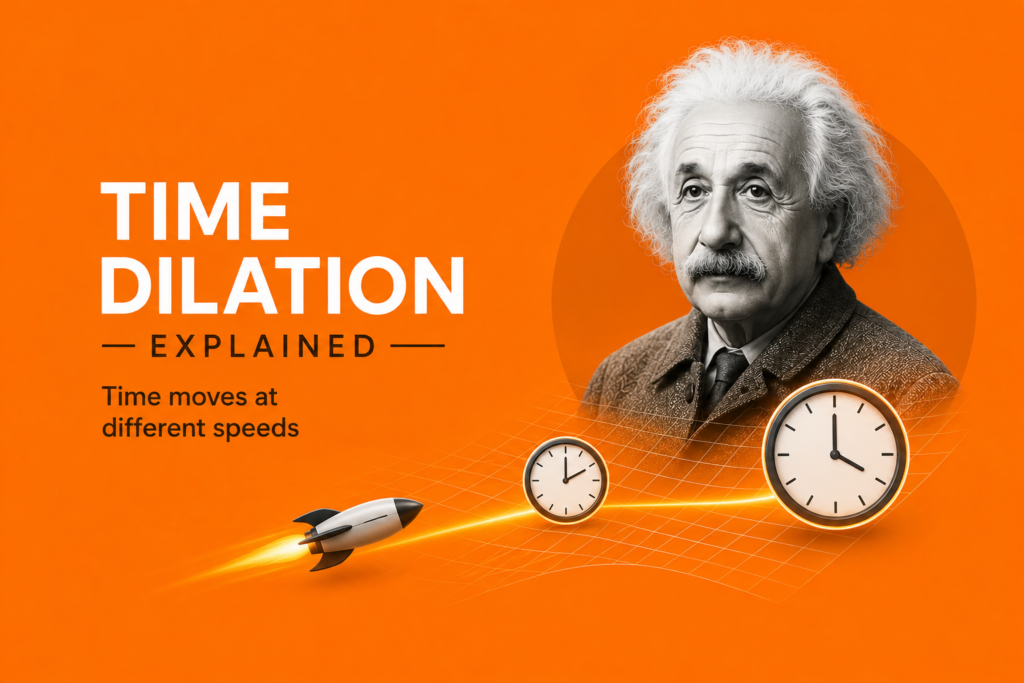
Most people assume time ticks forward at exactly the same rate everywhere in the universe, a steady, unchanging rhythm shared by everyone regardless of circumstance. Albert Einstein proved this assumption completely wrong. Time dilation explained through his groundbreaking work reveals something genuinely astonishing: time itself moves at different speeds depending on how fast you are traveling and how strong the gravitational field around you happens to be.
Understanding time dilation explained means confronting one of the strangest, yet most thoroughly confirmed, predictions in the history of physics, a discovery that transformed time from an absolute constant into something flexible, relative, and deeply connected to motion itself.
The Classical View of Time Before Einstein
Before the twentieth century, physicists assumed time functioned as an absolute, universal backdrop against which all events unfolded identically for every observer. Isaac Newton’s classical mechanics treated time as completely separate from space, ticking forward at the same steady rate regardless of an observer’s location, motion, or circumstances.
This intuitive assumption matched everyday human experience perfectly. A clock in London and a clock in Tokyo seemed to tick at identical rates, and nothing in daily life suggested otherwise. It took Einstein’s revolutionary insight to reveal that this comfortable assumption breaks down dramatically under extreme conditions.
Einstein’s Foundational Insight (1905)
Time dilation explained traces directly back to Einstein’s 1905 introduction of special relativity explained, built upon two deceptively simple postulates. First, physical laws remain identical across all inertial reference frames. Second, and far more radical, the speed of light constant remains exactly the same for every observer, regardless of their own motion.
From these two assumptions, Einstein derived velocity time dilation, one of the most counterintuitive consequences in the history of science, revealing that moving clocks run slow relative to a stationary observer’s perspective.
The Mathematics Behind Time Dilation
The precise time dilation formula, central to any complete explanation of time dilation explained, is expressed as:
t’ = t / √(1 − v²/c²)
Here, t’ represents the dilated time interval measured by a stationary observer watching a moving clock, t represents the proper time physics interval experienced by the moving observer themselves, v represents relative velocity, and c represents the invariant speed of light.
The term √(1 − v²/c²) appearing in this equation is closely related to what physicists call the Lorentz factor gamma, often written simply as γ, calculated using:
γ = 1 / √(1 − v²/c²)
As velocity v approaches the speed of light c, this Lorentz factor γ calculation grows increasingly large, causing time dilation effects to become dramatically more pronounced. At everyday speeds, this effect remains utterly negligible, which explains why humans never notice time dilation during ordinary daily experiences.
The Twin Paradox: Making Time Dilation Personal
Perhaps the most famous illustration of this phenomenon is the twin paradox relativity, a thought experiment involving two identical twins. One twin remains on Earth while the other travels through space aboard a high speed spacecraft approaching a significant fraction of light speed, then returns home.
According to relativity twin paradox resolved calculations, the traveling twin experiences less proper time tau passing compared to their Earth-bound sibling, meaning they would return measurably younger than their twin who remained stationary. While this scenario sounds like pure time travel physics fiction, the underlying mathematics has been confirmed repeatedly through real world experiments.
Proof Through Atomic Clocks (1971)
One of the most compelling experimental confirmations of time dilation explained came through the famous Hafele Keating experiment conducted in 1971. Scientists placed extraordinarily precise cesium atomic clock test instruments aboard commercial airplanes, flying them around the world in both directions while comparing their readings against identical stationary clocks remaining on the ground.
The results matched Einstein’s predictions with remarkable precision. The airborne atomic clocks, experiencing both velocity time dilation and gravitational potential difference effects at altitude, showed measurably different elapsed times compared to their stationary counterparts, providing direct experimental proof that moving clocks run slow exactly as relativity predicted.
Muons and Cosmic Ray Confirmation
Another striking confirmation involves muon decay atmosphere experiment observations. Muons, unstable subatomic particles created when cosmic rays strike Earth’s upper atmosphere, decay extremely quickly according to their own internal clock. Classical physics predicts that most muons should decay before ever reaching Earth’s surface.
Yet detectors on the ground consistently observe far more muons than classical calculations would predict. This discrepancy occurs precisely because high speed time dilation extends the muons’ effective lifespan from an outside observer’s frame of reference, allowing significantly more of these fast moving particles to survive their journey through the atmosphere and reach ground level detectors.
Gravitational Time Dilation: Einstein’s Second Discovery (1915)
Time dilation explained does not end with special relativity alone. In 1915, Einstein expanded these ideas further through general relativity explained, revealing that gravitational time dilation occurs due to differences in gravitational potential difference, meaning time itself passes more slowly within stronger gravitational fields.
This discovery connects directly to the revolutionary concept that gravity is curved spacetime, rather than a simple force acting instantly across distance. Near extremely massive objects, spacetime worldline curvature becomes so severe that time itself measurably slows down compared to regions further from the gravitational source.
GPS Satellites: Time Dilation in Everyday Technology
Perhaps the most practical, everyday demonstration of time dilation explained involves GPS satellite time dilation corrections. GPS satellites orbit Earth at high orbital velocity time gap speeds while also experiencing weaker gravity at altitude compared to observers on Earth’s surface, creating two competing time dilation effects operating simultaneously.
Engineers must carefully calculate precise nanosecond synchronization adjustments, accounting for both velocity based and gravity based time dilation, to ensure GPS positioning remains accurate. Without these corrections, GPS positioning errors would accumulate rapidly, rendering the entire system essentially useless within just a few hours.
Time Dilation Near Black Holes
The most extreme demonstration of gravitational time dilation occurs near black holes, where gravitational fields become so intense that time itself appears to approach an event horizon time freeze from an outside observer’s perspective. This connects closely to ongoing research regarding einstein and black holes physics, revealing just how dramatically extreme gravitational conditions can distort the passage of time itself.
Connecting Time Dilation to Quantum Physics
Interestingly, time dilation explained also connects historically to quantum theory through the relationship between einstein and planck. Just as Planck’s quantum hypothesis revealed that energy exists in discrete packets, Einstein’s relativity revealed that time itself behaves as a flexible, relative quantity rather than a fixed universal constant, together representing two of the most transformative conceptual shifts in early twentieth century physics.
Why Time Dilation Still Matters Today
Beyond satellite technology, time dilation explained continues influencing modern physics research, including precise cesium atomic clock test comparisons, particle accelerator experiments involving relativistic jet particles, and ongoing theoretical work exploring extreme gravitational environments throughout the universe. The Albert Einstein legacy surrounding this discovery demonstrates how deeply relativity has reshaped our fundamental understanding of time itself.
Frequently Asked Questions
What is time dilation explained simply?
Time dilation refers to the phenomenon where time passes at different rates depending on relative velocity and gravitational field strength, a direct consequence of Einstein’s theories of relativity.
How was time dilation proven experimentally?
The Hafele Keating experiment in 1971 used atomic clocks aboard airplanes to confirm time dilation, while muon decay observations in Earth’s atmosphere provide additional experimental support.
What is the twin paradox in relativity?
The twin paradox describes a scenario where a twin traveling at high speed through space ages less than their twin who remains stationary on Earth, a real consequence of velocity based time dilation.
Why do GPS satellites need time dilation corrections?
GPS satellites experience both velocity based and gravity based time dilation simultaneously, requiring precise corrections to maintain accurate positioning data for users on Earth.
Does time dilation happen in everyday life?
Yes, though the effects remain extremely small at everyday speeds and gravitational conditions, making them undetectable without extremely precise scientific instruments like atomic clocks.
Conclusion
Time dilation explained stands as one of the most remarkable confirmed predictions in the history of physics, revealing that time itself is not the fixed, universal constant classical physics once assumed. From Einstein’s original 1905 insights through special relativity to his later expansion into gravitational time dilation, this discovery continues to shape modern technology, from GPS satellites to particle physics research. More than a century later, time dilation remains one of nature’s most astonishing truths, quietly proving that time truly does move at different speeds throughout our universe.