For over two hundred years, physicists understood gravity as an invisible force reaching instantly across space, pulling objects toward one another according to Isaac Newton’s elegant but ultimately incomplete equations. Then, in 1915, Albert Einstein revealed something far stranger and more beautiful. General relativity explained gravity not as a force at all, but as the natural consequence of massive objects bending the very fabric of space and time itself.
Understanding general relativity explained means abandoning the comfortable Newtonian picture of gravity entirely and embracing a genuinely geometric theory of gravitation, one where planets, stars, and even light itself simply follow the curved paths carved into spacetime by mass and energy.
Newton’s Gravity and Its Hidden Limitations
Before diving into general relativity explained, it helps to understand the theory it replaced. Newtonian physics described gravity as an attractive force acting instantaneously between any two masses, regardless of distance. This framework worked remarkably well for centuries, accurately predicting planetary orbits and falling objects alike.
However, cracks began appearing when astronomers studied mercury perihelion precession, a small but persistent discrepancy in the orbit of Mercury that Newtonian gravitational mechanics simply could not fully explain. This nagging anomaly hinted that something deeper was missing from the classical picture of gravity.
Building on Special Relativity (1905 – 1907)
The story of general relativity explained begins shortly after Einstein introduced special relativity explained in 1905. That earlier theory successfully unified space and time for objects moving at constant velocity, but it deliberately excluded gravity and acceleration entirely, leaving Einstein searching for a way to extend his ideas further.
The breakthrough insight arrived around 1907, through what Einstein later called the happiest thought of his life. He imagined a person falling freely in an elevator, realizing they would feel completely weightless, unable to distinguish their situation from floating freely in empty space. This became known as the equivalence principle, the foundational idea stating that gravitational acceleration and ordinary acceleration are physically indistinguishable from one another.
The Long Road to 1915
Turning this simple insight into a complete mathematical theory took Einstein nearly a decade of intense work. He needed an entirely new mathematical language capable of describing curved, four dimensional spacetime, eventually adopting tools from Riemannian geometry and differential geometry, branches of mathematics dealing with non-Euclidean geometry that most physicists of his era knew little about.
Working through complex tensor calculus, Einstein gradually developed the mathematical framework needed to describe how mass and energy influence the shape of spacetime itself, finally publishing his complete relativity 1915 paper describing the general theory of relativity.
The Core Idea: Gravity Is Curved Spacetime
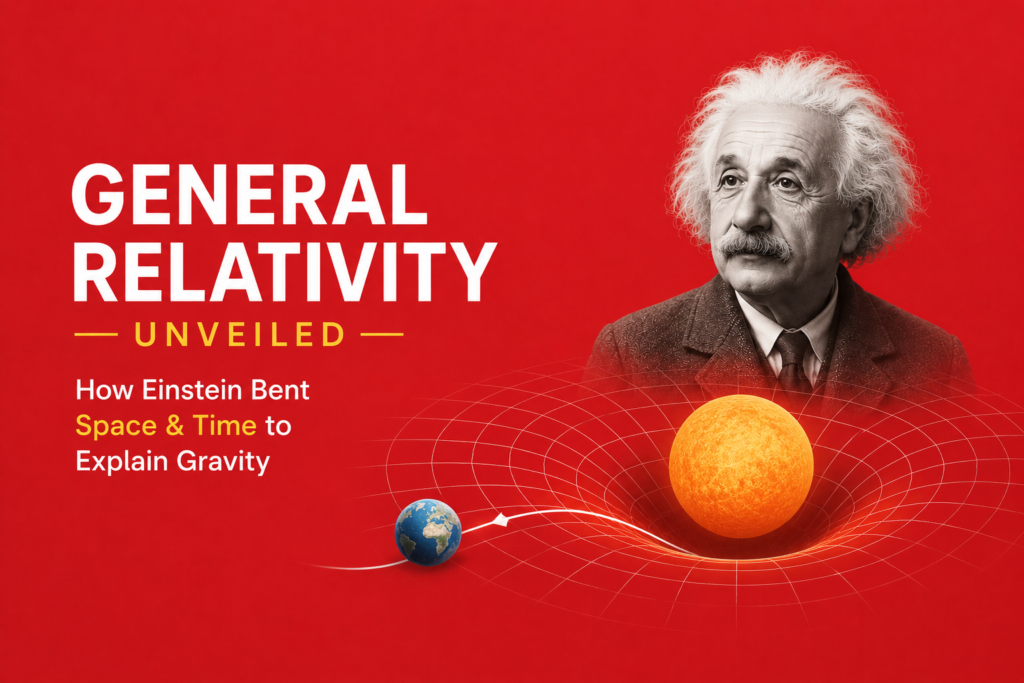
At the heart of general relativity explained lies a genuinely revolutionary concept, that gravity is curved spacetime rather than a conventional force. According to this geometric theory of gravitation, massive objects like stars and planets do not pull on each other directly. Instead, they warp the surrounding spacetime fabric, and other objects simply follow the straightest possible paths, called geodesic motion, through this curved geometry.
Einstein famously summarized this idea through his Einstein field equations, often expressed in simplified tensor notation as:
G_μν = 8πG/c⁴ × T_μν
Here, G_μν represents the curvature tensor describing spacetime curvature, T_μν represents the stress energy tensor describing the distribution of mass and energy, G is the gravitational constant, and c is the speed of light. This elegant equation essentially states that spacetime curvature on one side directly corresponds to mass and energy distribution on the other, connecting geometry and physics in a single unified framework.
Understanding the Metric Tensor
Central to this mathematical framework is the metric tensor g_ij, a mathematical object that describes precisely how distances and angles behave within curved spacetime, replacing the simple flat geometry assumptions built into Newtonian physics. Related mathematical tools called Christoffel symbols help describe how objects move along curved paths within this spacetime manifold, allowing physicists to calculate precise geodesic motion for any given mass distribution.
While this mathematics appears intimidating, the underlying physical picture remains remarkably intuitive. Imagine placing a heavy ball on a stretched rubber sheet. The sheet curves downward around the ball, and smaller objects rolling nearby naturally curve toward it, not because the ball pulls them directly, but because the surrounding surface itself has changed shape.
Confirming the Theory: The 1919 Eclipse
General relativity explained made several bold, testable predictions that differed measurably from Newtonian gravity, including bending of light by gravity, the idea that massive objects should bend light passing near them due to spacetime curvature.
This prediction received spectacular confirmation during Arthur Eddington 1919 eclipse observations. By photographing stars positioned near the sun during a total solar eclipse, Eddington’s team measured a light deflection angle matching Einstein’s predictions with remarkable precision, instantly transforming Einstein into an international scientific celebrity and providing dramatic testing general relativity evidence.
Explaining Mercury’s Mysterious Orbit
General relativity explained also successfully resolved the long-standing mercury perihelion precession mystery that had puzzled astronomers for decades. Einstein’s equations predicted the exact additional orbital shift observed in Mercury’s path around the sun, a small but precise correction that Newtonian gravity had never been able to fully account for, providing yet another powerful confirmation of the new theory.
Gravitational Redshift and Time Distortion
Another remarkable prediction involves gravitational redshift, the phenomenon where light loses energy as it escapes a strong gravitational field, shifting toward longer, redder wavelengths. This effect connects directly to time dilation explained, since general relativity predicts that time itself passes more slowly within stronger gravitational fields, an effect later confirmed through precise atomic clock experiments conducted at different altitudes.
Black Holes: General Relativity’s Most Extreme Prediction
Perhaps the most dramatic consequence of general relativity explained involves the Schwarzschild metric, a mathematical solution to Einstein’s field equations describing spacetime around an extremely massive, compact object. This solution predicted the existence of what we now call black holes, regions where spacetime curvature becomes so extreme that nothing, not even light, can escape.
Research into einstein and black holes physics continues today, with modern telescopes having directly imaged these extraordinary objects, providing stunning visual confirmation of predictions Einstein’s equations made over a century earlier, despite Einstein himself initially doubting whether such extreme objects could actually exist in nature.
Gravitational Lensing: Seeing Spacetime Curvature Directly
Modern astrophysics general relativity research regularly observes gravitational lensing effect phenomena, where massive galaxies or galaxy clusters bend and magnify light from more distant objects behind them, essentially acting as enormous cosmic magnifying glasses built entirely from curved spacetime itself. This effect has become an essential tool for modern astronomers studying distant galaxies and even searching for dark matter throughout the universe.
Why General Relativity Still Matters Today
Beyond pure theoretical physics, general relativity explained underlies essential modern technology, including GPS satellite systems, which must account for gravitational time dilation to maintain accurate positioning. The Albert Einstein legacy surrounding this theory continues expanding through ongoing gravitational wave astronomy research, directly confirming predictions about spacetime distortion that Einstein’s original 1915 equations first described.
Frequently Asked Questions
What is general relativity explained simply?
General relativity describes gravity not as a force, but as the curvature of spacetime caused by mass and energy, with objects following curved paths through this warped geometric fabric.
How is general relativity different from special relativity?
Special relativity deals with objects moving at constant velocity without gravity, while general relativity extends these ideas to include gravity, acceleration, and curved spacetime.
What evidence supports general relativity?
Evidence includes the 1919 eclipse observations confirming light bending, the explanation of Mercury’s orbital precession, and modern detections of gravitational waves and black holes.
How do black holes relate to general relativity?
Black holes emerge directly from solutions to Einstein’s field equations, describing regions where spacetime curvature becomes so extreme that nothing, including light, can escape.
Why is general relativity important for GPS technology?
GPS satellites must account for gravitational time dilation predicted by general relativity to maintain accurate positioning data for users on Earth’s surface.
Conclusion
General relativity explained stands as one of the most profound intellectual achievements in the history of science, transforming gravity from a mysterious invisible force into an elegant geometric consequence of curved spacetime itself. From explaining Mercury’s puzzling orbit to predicting black holes and gravitational waves decades before their eventual discovery, Einstein’s 1915 masterpiece continues shaping modern astrophysics and technology more than a century later. Few scientific theories have proven as consistently accurate, or as genuinely beautiful, as this remarkable vision of space and time bending beneath the weight of mass and energy throughout the universe.