For over two centuries, humanity believed gravity worked exactly the way Isaac Newton described it, an invisible force reaching across space and pulling objects toward one another. Then Albert Einstein arrived with an idea so strange it initially seemed almost absurd. Gravity is not a force at all, he argued. It is simply the natural consequence of massive objects bending the fabric of space and time itself, an idea that would eventually reshape humanity’s entire understanding of the universe.
Understanding why gravity is not a force means abandoning the comfortable, intuitive picture most of us grew up believing and embracing something far stranger, a universe where planets, stars, and even falling apples are not being pulled by anything at all. They are simply following the straightest possible path through curved space.
The Newtonian Picture: Gravity as an Invisible Pull
Before exploring why gravity is not a force according to Einstein, it helps to understand the classical view it replaced. Isaac Newton described gravity as an attractive force acting instantaneously between any two masses, growing weaker with distance according to a precise mathematical relationship. This framework worked remarkably well, accurately predicting planetary orbits, falling objects, and ocean tides for over two hundred years.
Under this Newtonian gravity vs Einstein comparison, objects were assumed to physically pull on one another across empty space, an invisible force of gravity myth that seemed to require no explanation beyond simple mathematical description. Yet this picture left a nagging question unanswered. How exactly does this force actually travel across empty space, and why does it seem to act instantly, regardless of distance?
Einstein’s Happiest Thought (1907)
The seeds of understanding why gravity is not a force began growing around 1907, when Einstein experienced what he later called the happiest thought of his life. He imagined someone falling freely, perhaps inside a falling elevator, and realized they would feel completely weightless, experiencing free fall weightlessness identical to floating freely in empty space with no gravity present whatsoever.
This simple but profound realization became known as the equivalence principle, stating that gravitational acceleration and ordinary acceleration are physically indistinguishable from one another. If a person cannot tell the difference between falling freely and floating in gravity-free space, perhaps gravity itself was not truly a genuine force at all, but something else entirely.
Building Toward General Relativity (1907 – 1915)
Turning this insight into a complete scientific theory took Einstein nearly a decade of intense mathematical work, building carefully upon his earlier 1905 breakthrough involving special relativity explained. Eventually, in 1915, Einstein published his complete theory, now known as general relativity explained, which finally provided a rigorous mathematical framework describing exactly why gravity is not a force in the traditional sense.
The Real Explanation: Curved Spacetime Gravity
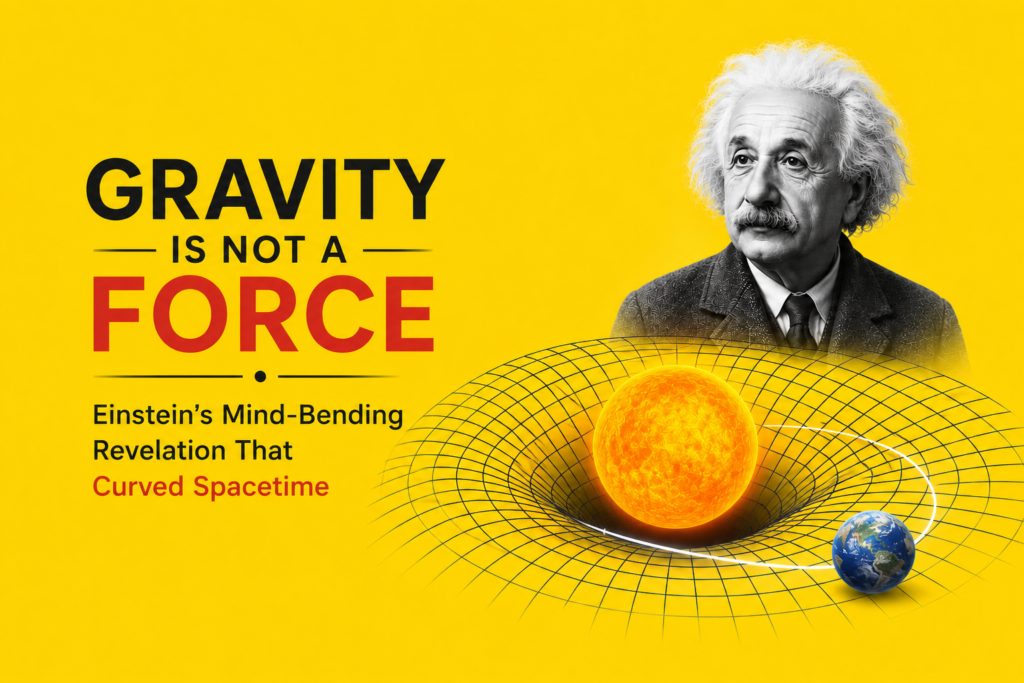
According to Einstein’s revolutionary insight, curved spacetime gravity replaces the old Newtonian picture entirely. Massive objects like stars and planets do not reach out and pull on other objects directly. Instead, they create a spacetime well, a distortion in the very fabric of space and time surrounding them, much like a heavy ball placed on a stretched rubber sheet analogy gravity creates a dip that nearby objects naturally roll toward.
Under this framework, planets orbiting the sun are not being pulled by any invisible force whatsoever. They are simply following geodesic path in spacetime, the straightest possible trajectory available within the curved geometry surrounding a massive object like our sun.
Understanding Geodesics: Straight Lines in Curved Space
To fully grasp why gravity is not a force, you need to understand the concept of straight lines in curved space. On a flat surface, the shortest distance between two points is a simple straight line. However, within curved spacetime geometry gravity, the equivalent concept becomes a geodesic line definition, the natural path an object follows when no additional forces act upon it.
Consider an airplane flying between two distant cities. Although the flight path appears curved on a flat map, it actually represents the shortest possible route across our planet’s curved surface, called a great circle route. Similarly, planets orbiting stars are simply tracing geodesic equation paths through curved spacetime, following what amounts to a straight, natural trajectory within their locally curved environment, rather than being pulled by any genuine gravitational interaction force.
Why This Feels Like a Force: The Illusion of Gravity
If gravity is not a force, why does it feel so real when you jump and fall back down, or when you feel your own weight while standing still? This apparent contradiction resolves once you understand the concept of an accelerated reference frame. When you stand on Earth’s surface, you are not actually in free fall. Instead, the ground beneath you is constantly pushing upward, preventing your natural geodesic motion through spacetime.
This means the sensation of weight you feel is actually a kind of fictitious force gravity, an apparent gravitational force experienced specifically because you are being prevented from following your natural curved path through spacetime. This non-inertial frame illusion explains why gravity feels so convincingly real in everyday experience, even though it is not, technically speaking, a genuine force acting between objects.
The Mathematics Behind Curved Spacetime
Einstein’s mathematical framework describing why gravity is not a force relies on his famous field equations, often expressed in simplified tensor notation as:
G_μν = 8πG/c⁴ × T_μν
Here, G_μν represents spacetime curvature itself, T_μν represents the distribution of mass and energy responsible for creating that curvature, G is the gravitational constant, and c represents the speed of light constant. This elegant equation reveals that mass and energy directly determine spacetime geometry distortion, and objects moving through this distorted geometry naturally follow curved paths without requiring any additional pulling force whatsoever.
Time Distortion: Another Consequence of Curved Spacetime
Interestingly, understanding why gravity is not a force also connects directly to time dilation explained, since general relativity predicts that time itself passes more slowly within regions of stronger spacetime curvature. This effect has been confirmed repeatedly through precise atomic clock experiments conducted at different altitudes, providing yet another powerful demonstration that gravity fundamentally involves geometric spacetime distortion rather than a simple, traditional force.
Extreme Proof: Black Holes and Tidal Forces
Perhaps the most dramatic demonstration supporting why gravity is not a force comes through research into einstein and black holes physics. Near these extraordinarily dense objects, spacetime curvature becomes so severe that even light itself cannot escape following its natural geodesic path, illustrating the ultimate extreme case of curved spacetime gravity in action.
Additionally, tidal forces general relativity phenomena, the stretching effect experienced by objects near massive bodies, emerge directly from variations in spacetime curvature across different points, further confirming that gravitational effects originate from geometric distortion rather than a uniform, traditional pulling force.
Why This Revelation Still Matters Today
Understanding why gravity is not a force extends far beyond abstract theoretical physics. This geometric gravity framework underlies modern GPS satellite technology, which must account for spacetime curvature to maintain accurate positioning data. It also continues driving cutting edge astrophysics research, including gravitational wave detection and modern black hole imaging. The Albert Einstein legacy surrounding this profound insight demonstrates how questioning even our most basic assumptions about reality can lead to discoveries reshaping science for generations.
Frequently Asked Questions
Why is gravity not considered a force in general relativity?
Gravity is not a force because Einstein demonstrated it results from the curvature of spacetime caused by mass and energy, with objects simply following natural curved paths rather than being pulled by any actual force.
What is the rubber sheet analogy for gravity?
The rubber sheet analogy compares massive objects to heavy balls placed on a stretched sheet, creating a curved dip that nearby objects naturally roll toward, illustrating how mass curves spacetime.
Why does gravity feel like a real force if it isn’t one?
Standing on Earth prevents your natural free fall motion through spacetime, and this resistance creates the sensation of weight, even though gravity itself is fundamentally geometric rather than a traditional force.
How does this idea relate to black holes?
Black holes represent the most extreme example of spacetime curvature, where curved geometry becomes so severe that not even light can escape following its natural geodesic path.
Does understanding gravity as curved spacetime have practical applications?
Yes, GPS satellite systems must account for spacetime curvature effects to maintain accurate positioning, demonstrating the real world importance of this theoretical insight.
Conclusion
Understanding why gravity is not a force represents one of the most profound conceptual shifts in the history of science, replacing centuries of intuitive but incomplete Newtonian thinking with an elegant, geometric description of the universe. From Einstein’s happiest thought about falling elevators to the extreme curvature found near black holes, this revelation continues reshaping modern physics and astrophysics research. More than a century later, the idea that gravity is not a force but rather curved spacetime itself remains one of science’s most beautiful, thoroughly confirmed, and genuinely mind-bending truths.