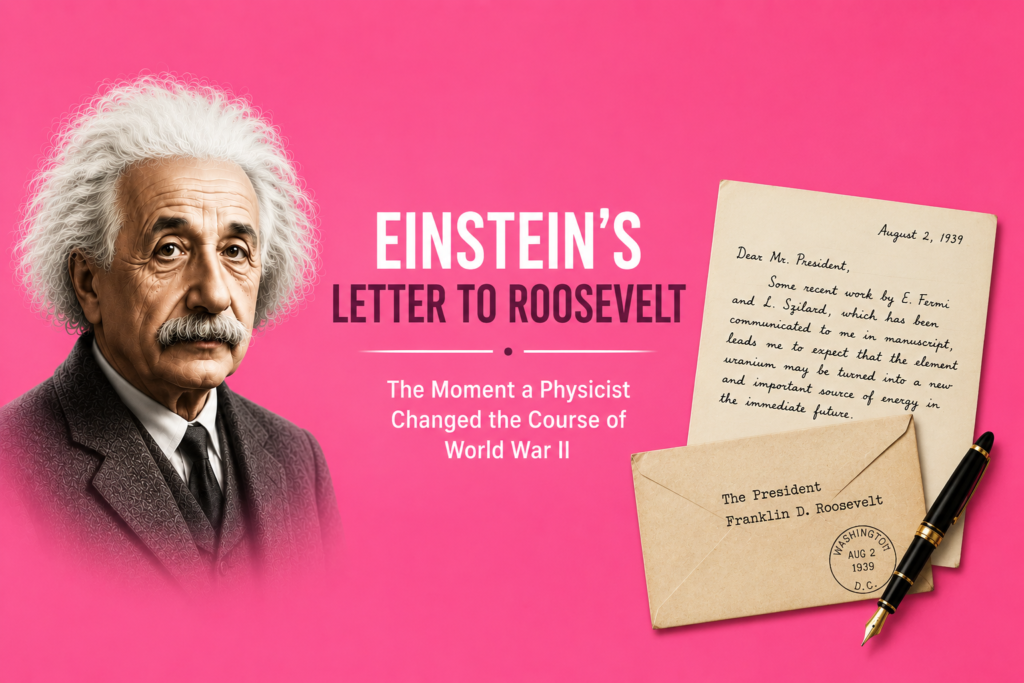
On August 2, 1939, a committed pacifist sat down and signed a letter that would ultimately help unleash the most destructive weapon humanity had ever created. The einstein letter to roosevelt represents one of history’s most consequential single documents, a warning that directly launched the research effort eventually producing nuclear weapons during World War II. Understanding this pivotal moment means confronting the deep moral complexity facing a scientist forced to weigh his personal beliefs against the terrifying possibility of Nazi Germany developing atomic weapons first.
The story behind the einstein letter to roosevelt reveals how scientific responsibility, wartime urgency, and personal conscience collided within a single historical document that permanently altered the course of the twentieth century.
The Scientific Background Behind the Letter
Understanding why the einstein letter to roosevelt mattered so profoundly requires understanding Einstein’s own earlier theoretical contributions. His famous mass-energy equivalence discovery, expressed through the E=mc² explained relationship developed during his 1905 miracle year, demonstrated that mass and energy were fundamentally interchangeable, meaning small amounts of matter could theoretically release enormous quantities of energy.
For decades, this remained purely theoretical physics, disconnected from any practical application. That changed dramatically in 1938, when scientists discovered nuclear fission, revealing that uranium atoms could be split apart, releasing energy precisely as Einstein’s equations had predicted decades earlier, connecting directly to broader questions surrounding einstein and nuclear energy applications.
Leo Szilard’s Growing Concern (1939)
The immediate catalyst behind the einstein letter to roosevelt came from Hungarian physicist Leo Szilard initiator efforts, who grew increasingly alarmed throughout 1939 regarding the potential military implications of nuclear fission research. Szilard understood that if uranium could sustain a controlled chain reaction, it could theoretically produce either a functioning nuclear reactor or, more alarmingly, an incredibly powerful weapon.
Szilard’s concerns intensified considerably upon learning that Nazi Germany had recently halted uranium exports from Czechoslovakia, a troubling sign suggesting German scientists might already be pursuing their own nuclear weapons research program. This growing German nuclear weapons program threat convinced Szilard that immediate action was necessary to alert American political leadership before Germany potentially gained a decisive military advantage.
Convincing Einstein to Sign
Recognizing that his own scientific reputation alone would carry insufficient political weight, Szilard approached Einstein directly, seeking his signature on what would become known as the Einstein-Szilard letter 1939. Einstein, despite his lifelong pacifist scientist dilemma and deep personal aversion to weapons development of any kind, ultimately agreed to sign the document after Szilard, along with fellow physicists Eugene Wigner and Edward Teller, explained the genuine danger Nazi Germany’s potential atomic bomb warning represented.
This decision proved deeply difficult for Einstein personally, requiring him to weigh his committed pacifism against the potentially catastrophic consequences of allowing Nazi Germany to develop nuclear weapons unopposed. The Albert Einstein signature letter that resulted represented a genuine moral compromise, born from wartime necessity rather than any enthusiasm for weapons development.
What the Letter Actually Said
The August 1939 historical document itself was relatively brief but carried enormous implications. Addressed directly to President Franklin D Roosevelt letter recipients, the correspondence explained that recent nuclear fission research suggested uranium could potentially be used to construct extremely powerful bombs, and that Germany itself was actively conducting research along similar scientific lines.
The letter specifically recommended that the United States government establish direct contact with physicists actively working on chain reaction research, secure adequate supplies of uranium ore, potentially including sources like Belgian Congo uranium supply reserves, and provide appropriate funding to accelerate American nuclear research before Germany could achieve a decisive advantage.
Roosevelt’s Response and Early Action (1939 – 1941)
Following receipt of the einstein letter to roosevelt, President Roosevelt moved forward, though initially with relatively modest urgency given competing wartime priorities. He established what became known as the Advisory Committee on Uranium, a small research initiative tasked with investigating the feasibility and military potential of nuclear fission technology.
This FDR nuclear initiative developed gradually throughout the following two years, receiving additional scientific credibility through documents like the Peierls Frisch memorandum, a British scientific analysis that provided crucial technical details regarding the theoretical feasibility of an actual uranium bomb warning becoming a genuine, deployable weapon.
From Committee to Manhattan Project (1942)
By 1942, growing scientific evidence and increasing wartime urgency transformed this relatively modest research committee into something far larger and more consequential. The Manhattan Project origin traces directly back to this expanded effort, formally organized under the Manhattan Engineer District, eventually encompassing massive facilities including the Oak Ridge enrichment plant for uranium processing and the newly established Los Alamos laboratory formation, where the actual weapon design work would ultimately take place.
Remarkably, despite his foundational role in initiating this entire research effort, Einstein role in Manhattan Project participation remained extremely limited throughout the actual weapons development process. Due to his known pacifist views and various political associations, Einstein security clearance denied status prevented him from directly participating in the classified technical work his own theoretical physics had helped make possible.
Einstein’s Ongoing Regret
Throughout the remainder of his life, Einstein expressed profound Einstein atomic bomb regret regarding his connection to nuclear weapons development, despite his letter serving primarily as a defensive warning rather than an enthusiastic endorsement of weapons research. Einstein later reportedly stated, in what has become a famous Einstein regret quotation, that had he known Germany would ultimately fail to develop functional nuclear weapons, he would never have supported American weapons research at all.
This complicated legacy reflects the genuine moral difficulty inherent within the pacifist scientist dilemma Einstein faced, forced to choose between his deeply held personal convictions and his responsibility to prevent what he genuinely believed represented an existential threat from Nazi Germany’s potential weapons program.
The Broader Historical Impact
The einstein letter to roosevelt ultimately helped establish the foundational nuclear arms race start that would define international politics throughout the remainder of the twentieth century. Following successful atomic bomb development and deployment during World War II, this same underlying nuclear deterrence origin technology quickly proliferated among other major world powers, permanently altering global military strategy and historical nuclear diplomacy for generations afterward.
This world war II technological race, initiated substantially through Einstein’s reluctant signature, represents one of the clearest examples throughout history of theoretical scientific research directly shaping geopolitical outcomes and military technology development.
Why This Letter Still Matters Today
Understanding the einstein letter to roosevelt remains essential for appreciating both the practical necessity and genuine moral weight involved in scientific responsibility during wartime circumstances. This historical episode continues informing modern discussions regarding scientists’ ethical obligations when their theoretical research holds potential military applications, connecting meaningfully to broader questions about einstein predictions proven through both beneficial and devastating practical applications throughout history.
The Legacy: A Physicist’s Difficult Choice
The Albert Einstein legacy surrounding this pivotal letter demonstrates how even history’s most celebrated theoretical physicist, deeply committed to special relativity explained and pure scientific inquiry, could find himself confronting profound ethical dilemmas when his work intersected directly with matters of war, peace, and human survival.
Frequently Asked Questions
Why did Einstein write a letter to Roosevelt?
Einstein signed the letter, largely authored by Leo Szilard, to warn President Roosevelt about the possibility that Nazi Germany might develop nuclear weapons, urging American research into the technology.
Did Einstein directly work on the Manhattan Project?
No, despite initiating the research effort through his letter, Einstein was denied security clearance and did not directly participate in the classified technical work of the Manhattan Project.
What did the Einstein letter to Roosevelt actually recommend?
The letter recommended establishing government contact with nuclear physicists, securing uranium supplies, and providing funding to investigate the military potential of nuclear fission technology.
Did Einstein regret sending the letter?
Yes, Einstein expressed significant regret later in life, particularly after learning that Germany’s own nuclear weapons program had failed to achieve meaningful progress during the war.
How did this letter influence the Manhattan Project?
The letter prompted Roosevelt to establish the Advisory Committee on Uranium, which eventually expanded into the full Manhattan Project responsible for developing the first nuclear weapons.
Conclusion
The einstein letter to roosevelt stands as one of history’s most consequential documents, a single letter that helped launch the research effort ultimately producing nuclear weapons during World War II. Born from genuine wartime fear regarding Nazi Germany’s potential atomic ambitions, this letter forced history’s most famous pacifist physicist into an agonizing moral compromise that would haunt him throughout the remainder of his life. More than eight decades later, this pivotal moment continues illustrating the profound ethical complexity scientists face when theoretical discovery intersects with the harsh realities of war, power, and human survival.