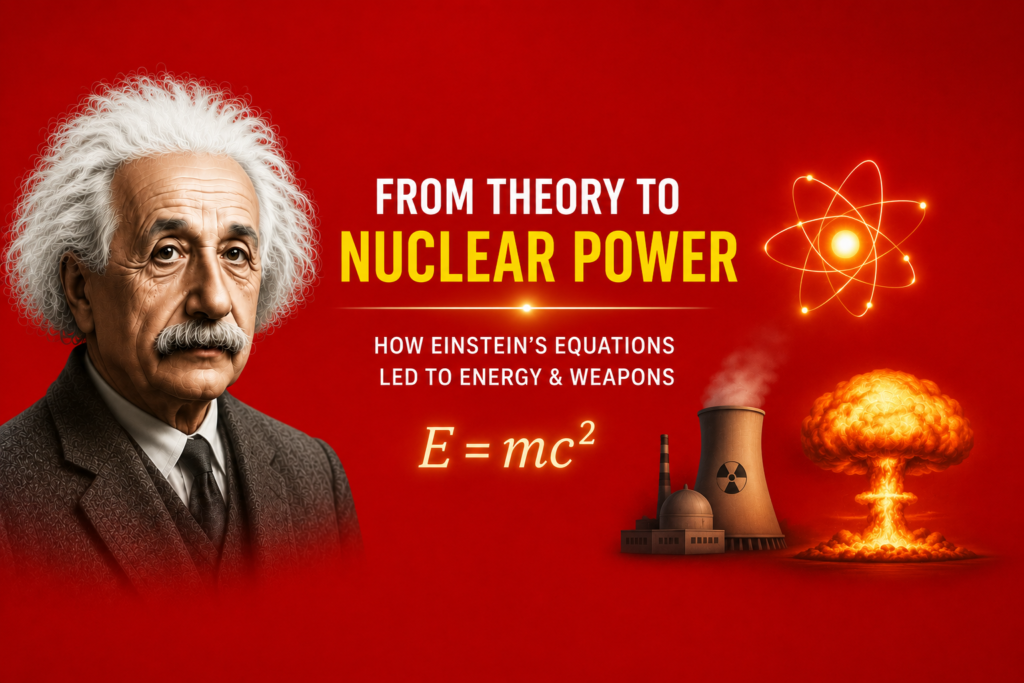
In 1905, Albert Einstein published a short, almost unassuming paper describing a mathematical relationship between mass and energy. He had no way of knowing that this same equation would eventually lead to both clean, abundant electricity and the most destructive weapons humanity has ever created. The story of einstein nuclear energy connections reveals how pure theoretical physics, developed decades before anyone imagined splitting an atom, became the essential foundation for one of the twentieth century’s most consequential technological developments.
Understanding einstein nuclear energy history means tracing a remarkable path from abstract mathematical theory through wartime urgency to modern power plants generating electricity for millions of people today.
The Theoretical Foundation (1905)
The story of einstein nuclear energy begins with Einstein’s celebrated mass-energy equivalence discovery during his 1905 miracle year, expressed through his now legendary formula:
E = mc²
Here, E represents energy, m represents mass, and c represents the speed of light. This E=mc² explained relationship revealed that mass and energy are fundamentally interchangeable, meaning even tiny amounts of matter could theoretically release enormous quantities of energy if properly converted.
At the time, this remained purely theoretical, an elegant mathematical consequence of Einstein’s broader work on special relativity explained, with no obvious practical application. Nobody, including Einstein himself, immediately recognized how this abstract formula might eventually reshape global energy production and warfare simultaneously.
Discovering Nuclear Fission (1938)
The theoretical connection between einstein nuclear energy concepts and practical application became clear in 1938, when scientists Lise Meitner Otto Frisch fission research revealed something remarkable. When uranium atoms absorbed additional neutrons, their nuclei could split apart into smaller fragments, a process called nuclear fission.
Crucially, careful measurements showed that the combined mass of the resulting fission fragments was measurably less than the original uranium atom’s mass. This missing mass had not simply vanished. According to Einstein’s mass-energy equivalence, it had converted directly into an enormous release of energy, providing the first concrete experimental evidence connecting relativistic theory to genuine nuclear mass defect conversion processes.
The Physics Behind Fission Energy
Nuclear fission relativity connections become clearer when examining Uranium-235 fission reaction processes specifically. When a U-235 nucleus absorbs a neutron, it becomes unstable and splits into two smaller nuclei, releasing additional neutrons along with substantial energy. This energy release directly corresponds to the binding energy per nucleon difference between the original heavy nucleus and the resulting lighter fragments.
This process demonstrates fission mass loss precisely as Einstein’s formula predicted decades earlier. Even though the actual percentage of mass converted remains remarkably small, roughly one tenth of one percent of the total mass involved, the enormous conversion constant embedded within c squared ensures this tiny mass loss produces staggering amounts of usable energy.
Chain Reactions: Multiplying the Effect
Scientists quickly realized that fission released neutrons could trigger additional fission events within nearby uranium atoms, creating what became known as chain reaction criticality. If enough fissile material, exceeding what physicists call critical mass threshold, was assembled together, this chain reaction could become self-sustaining, continuously releasing energy through successive fission events.
This discovery held obvious potential for both peaceful power generation and devastating weapons, depending entirely on how carefully the chain reaction was controlled and regulated.
Einstein’s Fateful Letter (1939)
Despite his deep personal commitment to pacifism, Einstein became directly involved in nuclear weapons development through circumstances he found deeply troubling. In 1939, colleagues alerted Einstein regarding potential Nazi Germany nuclear research, prompting him to send his now famous einstein letter to roosevelt, warning President Franklin Roosevelt about the theoretical possibility of nuclear weapons and urging American research into this dangerous new technology before Germany could develop it first.
This letter, though Einstein himself contributed no direct technical work toward weapons development, directly influenced the creation of the Einstein Manhattan project connection, the massive American research effort that ultimately produced the first nuclear weapons during World War II.
From Theory to Atomic Bomb
The atomic bomb physics explained through this program relied entirely on achieving rapid, uncontrolled chain reactions within either enriched Uranium-235 fission reaction material or plutonium-239 fission alternatives. Scientists used isotope enrichment U-235 techniques, often involving enrichment centrifuge technology, to concentrate the specific uranium isotope capable of sustaining explosive chain reactions.
The resulting blast yield mass conversion from these weapons demonstrated Einstein’s equation with horrifying clarity, converting relatively small amounts of nuclear material into destruction potential Emc2 on a scale never previously witnessed in human history, representing perhaps the most devastating example of einstein predictions proven through practical application.
Peaceful Applications: Nuclear Power Plants
Fortunately, the same underlying physics also enabled far more constructive applications through nuclear power plant physics. Modern thermal nuclear power plant facilities carefully control fission chain reactions using nuclear reactor moderator materials, slowing neutrons to sustainable levels that generate steady, controllable heat rather than explosive energy release.
This controlled nuclear reaction approach allows nuclear power generation to produce substantial electricity without carbon emissions, using nuclear decay energy release principles to heat water, generate steam, and ultimately turn turbines producing electricity for millions of homes and businesses worldwide.
Nuclear Fusion: The Next Frontier
Beyond existing fission technology, scientists continue researching nuclear fusion tokamak systems, attempting to replicate the same process powering our sun. Fusion reactions, which combine lighter atomic nuclei rather than splitting heavier ones, promise even greater energy output with reduced radioactive waste, though achieving controlled, sustainable fusion for practical thermonuclear power generation remains an ongoing scientific and engineering challenge.
The Ethical Complexity of Einstein’s Legacy
Einstein himself expressed considerable ambivalence regarding his indirect connection to nuclear weapons development throughout his remaining life. Despite writing his famous warning letter, he later expressed regret regarding the destructive applications his theoretical work had helped enable, reportedly stating he would have preferred remaining a simple watchmaker had he foreseen these consequences.
This complicated relationship between pure theoretical physics and devastating practical application represents one of the most morally complex chapters within the broader Albert Einstein legacy, illustrating how scientific discovery, however elegant and theoretically pure, can eventually produce consequences its original creator never fully intended or desired.
Why This Connection Still Matters Today
Understanding einstein nuclear energy history remains essential for appreciating both the tremendous benefits and genuine dangers inherent within nuclear technology today. Modern nuclear power generation continues providing substantial carbon-free electricity worldwide, even as nuclear weapons proliferation remains a serious ongoing global security concern, both tracing their theoretical foundation directly back to Einstein’s simple, elegant 1905 equation.
Frequently Asked Questions
How did Einstein’s theory lead to nuclear weapons?
Einstein’s mass-energy equivalence equation showed that mass could convert into enormous energy, providing the theoretical foundation later used to understand and develop nuclear fission weapons during World War II.
Did Einstein personally help build the atomic bomb?
No, Einstein did not directly contribute technical work toward bomb development, though his famous 1939 letter to President Roosevelt helped initiate American nuclear weapons research through the Manhattan Project.
How does nuclear fission relate to E = mc²?
During nuclear fission, resulting fragments have slightly less mass than the original nucleus, with this missing mass converting directly into energy according to Einstein’s famous equation.
What is the difference between nuclear fission and fusion?
Fission splits heavy atomic nuclei apart to release energy, while fusion combines lighter nuclei together, both processes converting small amounts of mass into substantial energy according to relativistic principles.
Did Einstein regret his connection to nuclear weapons?
Yes, Einstein expressed significant regret throughout his later life regarding his indirect role in nuclear weapons development, despite his theoretical work being purely scientific in original intention.
Conclusion
The journey from Einstein’s abstract 1905 equation to functioning nuclear power plants and devastating weapons represents one of history’s most striking examples of theoretical physics transforming practical reality. What began as elegant mathematical reasoning about mass and energy equivalence eventually reshaped global energy production, warfare, and international politics throughout the twentieth century and beyond. This complex legacy, encompassing both life-saving power generation and horrifying destructive potential, continues reminding us that scientific discovery often leads toward consequences far beyond what its original creators could have ever anticipated or intended.