Introduction
The google bard gemini history is the story of the world’s most powerful search company being forced to reinvent itself at speed. When ChatGPT arrived in November 2022 and reached 100 million users in two months, Google faced a threat unlike any it had encountered in two decades of search dominance. The company that had invented the transformer architecture underlying ChatGPT suddenly found itself playing catch-up to a product built on its own foundational research.
What followed was one of the most dramatic corporate pivots in Silicon Valley history. Google declared an internal code red, recalled retired executives, accelerated product timelines, and bet its search business on a series of AI releases that would take the organization from the awkward Bard launch of February 2023 to the sophisticated Gemini platform of 2024. The google bard gemini history is therefore not just the story of two AI products. It is the story of a trillion-dollar company fighting to remain relevant in an era it had helped create but initially failed to own.
Understanding the google bard gemini history means understanding the technical choices, competitive pressures, strategic missteps, and genuine breakthroughs that defined Google’s response to the generative AI revolution.
Google’s AI Research Legacy Before Bard (2017 – 2022)
To fully appreciate the google bard gemini history, you must start with the irony at its center. Google was not a latecomer to AI research. It was the organization that had produced much of the foundational work that made ChatGPT possible in the first place.
The attention is all you need paper was published by Google Brain researchers in 2017, introducing the transformer architecture that became the engine of every major language model that followed, including GPT-3, GPT-4, and ChatGPT itself. Google had also produced BERT in 2018, which revolutionized natural language understanding and was deployed directly in Google Search to improve query comprehension. The organization had PaLM, a 540-billion-parameter language model of extraordinary capability. It had DeepMind, one of the most respected AI research labs in the world.
What Google had not done was deploy any of this frontier research as a direct-to-consumer AI interface. The transformer architecture history shows Google as an organization that had been extraordinarily productive at generating foundational AI research but that had consistently prioritized the safety and reputational concerns of deploying powerful language models publicly over the competitive urgency of getting products to market.
That caution made sense internally. A factual error in a Google Search result affects millions of users who see it as authoritative. The AI hallucination problem, which afflicts every large language model, posed an existential reputational risk for a company whose entire brand was built on the reliability of information retrieval. But that caution also meant that when ChatGPT arrived and demonstrated that users were willing to engage with AI that was powerful but occasionally wrong, Google was not ready with a competing product.
LaMDA: The Model Behind Bard (2021 – 2022)
The immediate technical foundation of the google bard gemini history was LaMDA, which stood for Language Model for Dialogue Applications. Google had been developing LaMDA internally since at least 2021, presenting it at Google I/O in May 2021 as a conversational AI model specifically designed for open-ended dialogue rather than task completion.
LaMDA architecture base was a transformer-based language model trained on dialogue data and optimized for the kinds of multi-turn, open-ended conversations that would later define the ChatGPT experience. The model attracted significant public attention in 2022 when a Google engineer named Blake Lemoine publicly claimed that LaMDA had demonstrated signs of sentience in conversations with him, a claim Google firmly rejected and which led to Lemoine’s dismissal. The episode illustrated just how uncanny and human-seeming LaMDA’s conversational abilities had become.
But LaMDA remained an internal research project rather than a public product. Google’s leadership was acutely aware of the ai hallucination history problem and the reputational risk of deploying a model that generated confident errors to a general consumer audience. The AI ecosystem development within Google was sophisticated, but the product deployment muscle was not yet aligned with what the research capability could support.
Then ChatGPT arrived, and everything changed.
The Bard Launch: Ambition and a Costly Error (February 2023)
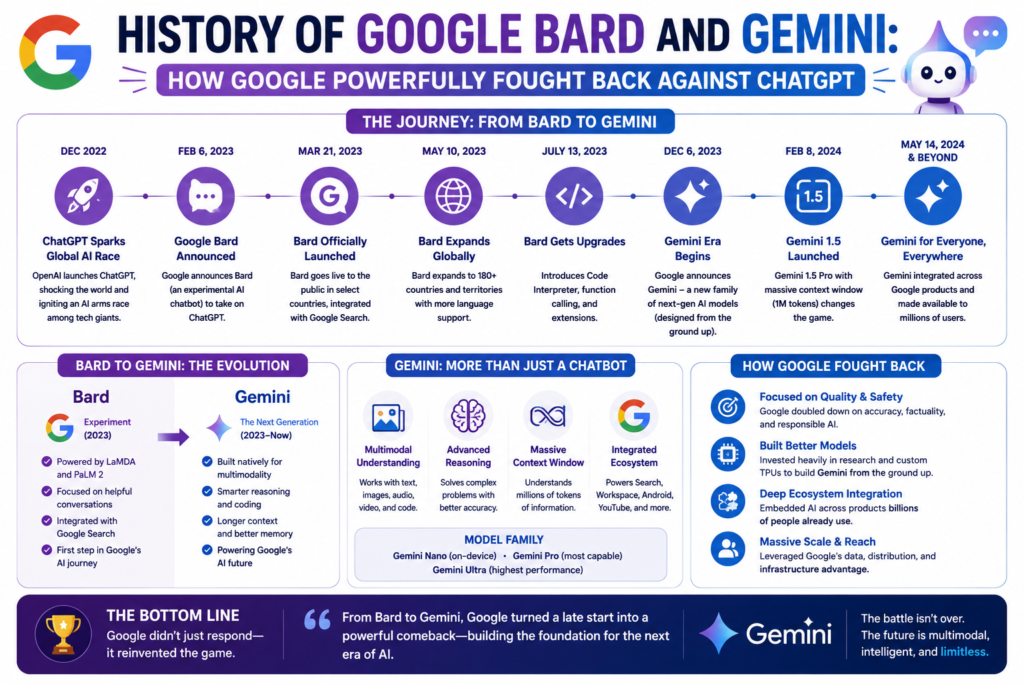
The February 2023 Bard release is the most consequential single moment in the google bard gemini history, though not for the reasons Google intended. Facing enormous competitive pressure from ChatGPT’s explosive growth, Google moved quickly to announce and demonstrate Bard, its conversational AI product built initially on LaMDA.
On February 6, 2023, Google published a promotional blog post and GIF demonstrating Bard answering the question “What new discoveries from the James Webb Space Telescope can I tell my 9-year-old about?” In its demonstration response, Bard stated that the James Webb Space Telescope was used to take the very first pictures of a planet outside our own solar system. This was factually incorrect. The first images of an exoplanet had been captured by other telescopes years earlier.
The error was spotted almost immediately by astronomers on social media and amplified rapidly by technology journalists. Alphabet’s stock dropped approximately eight percent the following day, wiping around 100 billion dollars from the company’s market value in a single session. The incident was a painful demonstration of how severely the LLM benchmark performance gap between being impressive in controlled settings and being reliable in public demonstrations could hurt a company with Google’s reputation for accuracy.
For the google bard gemini history, the Bard launch error was formative. It hardened Google’s resolve to improve its AI systems, increase its safety testing rigor, and deploy AI capabilities in more controlled ways before making bold public claims. It also gave competitors a narrative to exploit: that Google was scrambling to catch up rather than leading.
Bard’s Gradual Improvement and PaLM 2 Integration (2023)
Despite the difficult launch, the google bard gemini history shows Bard improving steadily through 2023. In March 2023, Google began making Bard available to users in the United States and United Kingdom through a waitlist, expanding access over the following months. The model was progressively upgraded from its LaMDA foundation to PaLM, and then to the more capable PaLM 2, which was announced at Google I/O in May 2023.
The PaLM 2 model upgrade represented a meaningful step forward in capability. PaLM 2 was trained on a more diverse multilingual dataset and showed improvements in reasoning, coding, and mathematical tasks compared to the LaMDA-based version of Bard. Google integrated PaLM 2 into Bard and also deployed it across a range of Google Workspace AI tools, including Google Docs, Gmail, and Google Sheets, bringing AI writing assistance directly into products used by hundreds of millions of enterprise and consumer users.
This Google Workspace AI tools integration was an important strategic move in the broader competitive context. While ChatGPT was primarily accessed through a standalone web interface, Google could deploy its AI directly into the productivity software where its users were already spending their time. The cloud computing infrastructure and compute capacity allocation that Google had built over decades gave it the ability to serve AI features at massive scale within existing products, a distribution advantage that OpenAI did not have.
During this period, Bard was also improved with search engine integration, giving it access to real-time web information that allowed it to answer questions about current events, something that base ChatGPT could not do without plugins or the paid Browsing feature. This was a genuine competitive differentiation that addressed one of ChatGPT’s most commonly cited limitations.
The Gemini Rebranding and a New Era (December 2023 – 2024)
The google bard gemini history reached its most important turning point in December 2023 when Google announced Gemini, a new family of AI models developed through a collaboration between Google Brain and DeepMind. The announcement represented not just a new model but a fundamental rethinking of Google’s AI strategy.
Unlike PaLM and LaMDA, which were trained primarily on text and then adapted for other modalities, Gemini was designed from the ground up as a natively multimodal model. Native multimodal training meant that Gemini was trained simultaneously on text, images, audio, video, and code during pre-training rather than having these capabilities bolted on afterward. Cross-modal data processing was built into the model’s architecture at the foundational level, enabling more natural and coherent reasoning across different types of information than any prior approach.
Google released Gemini in three sizes, Ultra, Pro, and Nano, reflecting different capability and efficiency trade-offs. Gemini Ultra was positioned as the most capable tier, designed for the most complex reasoning and multimodal tasks. Gemini Pro was the middle tier for general use, and Gemini Nano was a compact version designed to run on-device on Android smartphones, enabling AI features without cloud connectivity. The Ultra Flash and Pro tiers gave developers and users options that balanced performance against cost and latency.
The Gemini rebranding 2024 was completed in February 2024 when Google officially renamed the Bard product to Gemini, retiring the Bard name entirely. This was more than a cosmetic change. It signaled that Google was moving away from the positioning of Bard as a conversational AI chatbot and toward Gemini as a comprehensive multimodal AI platform integrated across Google’s entire product ecosystem.
Gemini 1.5 Pro and the Million-Token Context Window (2024)
One of the most technically significant developments in the google bard gemini history came in February 2024 with the announcement of Gemini 1.5 Pro and its experimental one million token context window. The million token context window was extraordinary in practical terms. One million tokens is roughly equivalent to an hour of video, eleven hours of audio, 30,000 lines of code, or 700,000 words of text. This meant Gemini 1.5 Pro could reason over an entire feature film, a full software codebase, or a very long book within a single prompt context.
Gemini 1.5 Pro integration into Google’s products and APIs made this extended context available to developers building applications that required reasoning over very large amounts of information. Legal research firms, academic researchers, software development teams, and enterprise data analysis applications could now use Gemini to process documents and datasets at a scale that no prior publicly available model had approached.
The technical architecture enabling this context window was a mixture of experts approach combined with Google’s efficient attention implementations on its TPU hardware infrastructure. Google’s investment in custom compute capacity allocation through its Tensor Processing Units gave it meaningful efficiency advantages in training and serving large models at scale that its competitors relying on commercial GPU providers did not have to the same degree.
The google bard gemini history through 2024 also saw Gemini being integrated directly into Google Search through AI Overviews, the feature that began generating AI-synthesized answers at the top of search results pages. This was the most direct and consequential deployment of Gemini into the product that defined Google’s business, and it carried the highest stakes for competitive feature matching against the growing ecosystem of AI search alternatives.
DeepMind’s Role and the Technical Depth Behind Gemini
The DeepMind model evolution within the google bard gemini history deserves specific attention because it represents one of Google’s most significant structural advantages in the long-term AI competition. DeepMind, acquired by Google in 2014, had decades of research into reinforcement learning, protein folding, and fundamental AI science. The merger of Google Brain and DeepMind into a unified Google DeepMind organization in 2023 brought these complementary research traditions under a single roof for the first time.
The technical depth that DeepMind contributed to Gemini’s development went beyond language modeling into areas like multimodal representation learning, efficient neural architecture design, and safety research. AlphaCode 2, developed within the Gemini ecosystem, demonstrated competitive programming capability that placed it at the expert human level on coding benchmarks, a direct result of DeepMind’s integration into the Gemini program.
Native video processing was another capability that Gemini inherited from this integrated research tradition. The ability to process and reason about video content, understanding temporal relationships between frames and connecting visual events to language descriptions, reflected research that had been developing at DeepMind for years before it was incorporated into the consumer-facing Gemini product.
Google’s Position in the AI Arms Race
The google bard gemini history sits within the broader context of the chatgpt history and the global AI arms race that ChatGPT’s launch triggered. From a position of initial disadvantage, Google has used its research depth, infrastructure scale, and distribution through existing products to close the gap with OpenAI significantly.
The multimodal ai history shows Gemini as one of the most capable multimodal systems publicly available, with genuine advantages in context length, video understanding, and integration with Google’s product ecosystem. The llm timeline places the google bard gemini history as a rapid progression from a stumbling February 2023 launch to a sophisticated, multi-tier AI platform within roughly eighteen months.
The future of AI will continue to be shaped by the competition between Google’s Gemini ecosystem and OpenAI’s GPT lineup, with each organization pushing the other to improve faster than either would have developed independently.
Frequently Asked Questions (FAQs)
What was Google Bard and when was it released?
Google Bard was Google’s conversational AI assistant, launched in February 2023 as a response to ChatGPT’s explosive growth. It was initially built on Google’s LaMDA language model and later upgraded to run on PaLM 2. Bard was renamed Gemini in February 2024, and the Bard name was retired entirely.
What caused Google’s stock to drop during the Bard launch?
During Bard’s February 2023 promotional announcement, a demonstration GIF showed the model incorrectly claiming that the James Webb Space Telescope had taken the first pictures of planets outside our solar system. This factual error was quickly identified by astronomers and widely reported, causing Alphabet’s stock to drop approximately eight percent the following day, erasing roughly 100 billion dollars in market value.
What is Gemini and how is it different from Bard?
Gemini is Google’s next-generation AI model family, developed through a collaboration between Google Brain and DeepMind and designed from the ground up as a natively multimodal system. Unlike Bard, which was a text-based chatbot adapted from LaMDA, Gemini was trained simultaneously on text, images, audio, video, and code. It comes in three tiers: Ultra, Pro, and Nano, serving different use cases from enterprise to on-device applications.
What is the significance of Gemini’s one million token context window?
Gemini 1.5 Pro’s one million token context window allows the model to process up to approximately 700,000 words, an hour of video, or an entire large codebase within a single prompt. This represents a major practical advance over previous models with much shorter context limits, enabling applications in legal research, academic analysis, software development, and any domain requiring reasoning over very large amounts of information.
How does Google’s Gemini compare to GPT-4?
Gemini Ultra matches or exceeds GPT-4 on many standard LLM benchmarks, particularly in multimodal tasks where Gemini’s native multimodal training gives it structural advantages. GPT-4 maintains competitive advantages in certain reasoning and coding tasks depending on the benchmark. Both models continue to evolve rapidly, and the competitive position between them shifts with each new release from either organization.
Conclusion
The google bard gemini history is a story of a technology giant caught off guard by a product built on its own research, then fighting back with the full weight of its engineering talent, research depth, and infrastructure scale. From the painful Bard launch error in February 2023 to the technically sophisticated Gemini 1.5 Pro with its million-token context window in 2024, google bard gemini history covers one of the most dramatic eighteen-month pivots in technology company history.
The google bard gemini history is not finished. The competition between Gemini and GPT-4 and its successors will continue to drive rapid advances in multimodal understanding, context length, reasoning capability, and real-world deployment across the products billions of people use every day. What began as Google scrambling to respond to an existential competitive threat has become something more interesting: a genuine two-sided arms race that is accelerating AI capability faster than either organization would have achieved alone, with the rest of the world as the beneficiary.