Few scientific relationships have shaped the modern world quite like the bond between planck and einstein. One was a cautious, deeply traditional German professor devoted to classical thermodynamics. The other was a young, unconventional patent clerk with a genius for questioning fundamental assumptions. Together, almost by accident, they became the twin architects of the quantum revolution, transforming physics forever.
Understanding planck and einstein means understanding how two remarkably different personalities, working sometimes in parallel and sometimes in direct partnership, built the foundation of modern physics from a single radical idea about energy.
Two Very Different Beginnings
Max Planck was born in 1858 into a respected academic family in Germany, trained rigorously in classical thermodynamics at the Berlin Academy of Sciences under renowned mentors. By contrast, Albert Einstein, born in 1879, spent his early career working quietly at the patent office bern in Switzerland, far removed from the traditional academic path that shaped Planck’s career.
Despite these vastly different starting points, both men would eventually converge on the same revolutionary idea, that energy does not behave the way classical physics assumed. This shared insight became the true beginning of the relationship between planck and einstein, even before they ever worked directly together.
Planck’s Reluctant Discovery (1900)
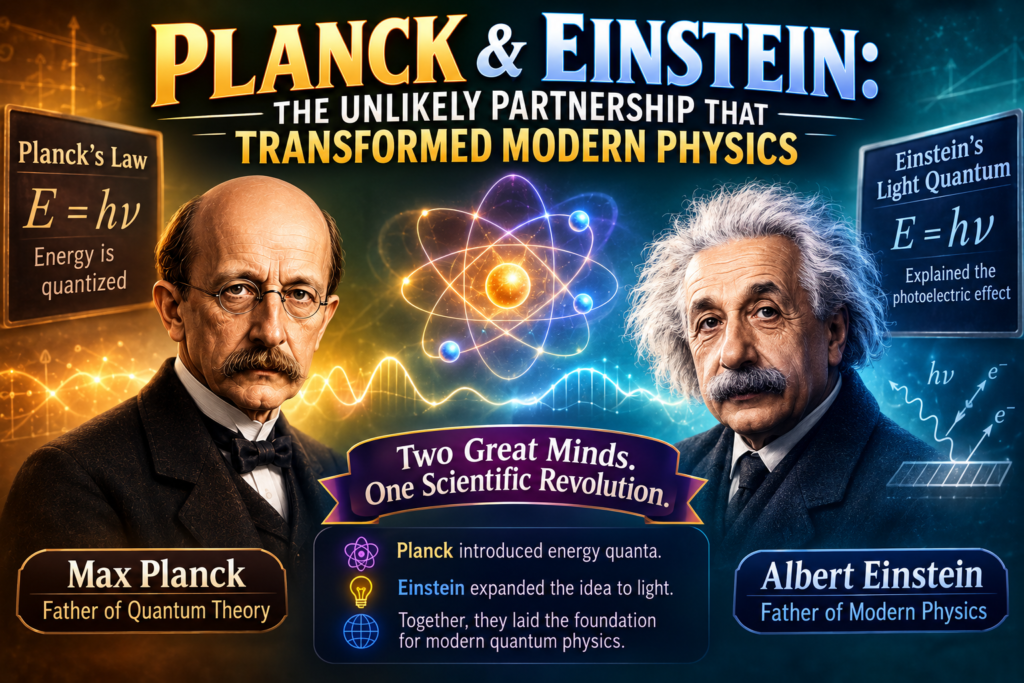
The story of planck and einstein truly begins in December 1900, when Max Planck proposed a solution to the blackbody radiation problem, a puzzle involving how heated objects emit energy based purely on temperature. Planck suggested that energy is exchanged only in discrete packets, an idea known as the quantum hypothesis, expressed through the equation:
E = hν
Here, E represents the energy of a quantum, ν (nu) is frequency, and h is planck’s constant, valued at approximately 6.626 × 10⁻³⁴ joule seconds. Importantly, Planck initially viewed this equation as a mathematical convenience rather than a literal description of physical reality, never intending to overturn classical physics entirely.
Einstein Takes the Idea Further (1905)
Five years later, working largely in isolation from the mainstream physics community germany, Einstein took Planck’s quantum hypothesis and applied it in a way Planck himself had not dared to consider. In 1905, Einstein proposed his light-quantum hypothesis, suggesting that light itself travels as discrete packets, later called photons, each carrying energy according to the same formula, E = hν.
This idea successfully explained the photoelectric effect, a phenomenon where light striking a metal surface ejects electrons, but only when the light’s frequency exceeds a certain threshold, regardless of its intensity. Classical wave theory could not explain this behavior, yet Einstein’s application of quantum principles matched experimental results perfectly, earning him the Nobel Prize in Physics in 1921. This breakthrough, sometimes called photoelectric effect explained, marked the moment when planck and einstein truly became scientific partners, even without direct collaboration at the time.
Bringing Einstein to Berlin (1913 – 1914)
The professional relationship between planck and einstein deepened significantly when Planck personally helped recruit Einstein to Berlin in 1913 and 1914, securing him a prestigious position at the newly formed kaiser wilhelm institute. This was no small gesture. Planck, already a towering figure in German physics, staked his considerable reputation on Einstein, whose ideas were still viewed with skepticism by parts of the physics community germany at the time.
This decision proved historically significant, allowing Einstein to develop his general theory of relativity while working closely alongside some of the greatest scientific minds of the era, with Planck serving as both mentor and advocate throughout this critical period.
A Partnership Built on Mutual Respect
Despite their differing views on certain aspects of quantum theory, planck and einstein maintained deep mutual respect throughout their careers. Their relationship has sometimes been described using the term quantum brotherhood, reflecting how these two brilliant minds, despite philosophical disagreements, worked within the same intellectual tradition to reshape modern physics.
Planck greatly admired Einstein’s work on the theory of relativity, recognizing its revolutionary implications even when other physicists remained doubtful. Meanwhile, Einstein consistently credited Planck’s original quantum hypothesis as the essential foundation upon which his own contributions were built, a mutual admiration reflected in the surviving planck einstein letters exchanged between the two men over the years.
Philosophical Differences Between Planck and Einstein
Interestingly, planck and einstein did not always agree on the deeper implications of quantum theory. As quantum mechanics matured throughout the 1920s, incorporating concepts like wave-particle duality and inherent uncertainty at the atomic scale, Einstein grew increasingly uncomfortable with the probabilistic nature the theory seemed to demand.
Planck, despite originating the quantum hypothesis himself, also remained cautious about fully embracing every implication of the emerging quantum revolution. Yet unlike some critics, both men continued engaging seriously and respectfully with the evolving theory, even as their personal interpretations diverged over time.
Surviving Turbulent Times Together
The relationship between planck and einstein also endured through extraordinarily difficult historical periods. As antisemitism grew within Germany during the 1930s, Einstein eventually emigrated, while Planck remained in the country, quietly using his diminishing influence to protect Jewish scientists where possible under the Nazi regime.
Though physically separated and facing vastly different personal circumstances, the intellectual bond between planck and einstein remained a defining feature of early twentieth century physics, one that historians continue to study as an example of scientific collaboration history at its most consequential.
Why Their Partnership Still Matters Today
The combined legacy of planck and einstein extends far beyond their individual discoveries. Their work together, whether through direct collaboration or parallel intellectual development, established the two pillars of modern physics, quantum mechanics and relativity, that continue to shape scientific research today.
Planck’s legacy in modern physics lives on through ongoing research into quantum computing, semiconductor technology, and fundamental physics, all of which trace their origins back to the original quantum hypothesis that Einstein helped confirm and expand upon.
The Legacy: Max Planck Quantum Universe
The intellectual partnership between planck and einstein helped establish what is now known as the Max Planck Quantum Universe, a reality built on discrete energy quanta, wave-particle duality, and principles that continue to define modern physics more than a century later. Few scientific relationships in history have left as lasting or profound an impact on human understanding of the universe.
Frequently Asked Questions
How are Planck and Einstein connected in physics history?
Planck introduced the quantum hypothesis in 1900, which Einstein later used in 1905 to explain the photoelectric effect, establishing a foundational intellectual connection between the two physicists.
Did Planck and Einstein work together directly?
While they did not collaborate on original research together extensively, Planck helped bring Einstein to Berlin in 1914 and championed his work throughout their overlapping careers.
Did Einstein agree with all of Planck’s quantum ideas?
Not entirely. While Einstein confirmed and expanded upon Planck’s quantum hypothesis, he remained skeptical of the probabilistic interpretation that quantum mechanics later adopted.
What did Planck do to support Einstein’s career?
Planck used his considerable reputation to recruit Einstein to a prestigious position in Berlin and consistently supported Einstein’s theory of relativity even amid skepticism from other physicists.
Why is the relationship between Planck and Einstein important today?
Their combined work established the foundations of both quantum mechanics and relativity, the two pillars of modern physics that continue to influence scientific research today.
Conclusion
The story of planck and einstein reveals how two vastly different scientific minds, one cautious and traditional, the other bold and unconventional, came together to build the foundation of modern physics. From Planck’s reluctant quantum hypothesis to Einstein’s confirmation through the photoelectric effect, their intertwined contributions transformed science forever. Even amid philosophical disagreements and turbulent historical circumstances, the partnership between planck and einstein remains one of the most important intellectual relationships in scientific history, a collaboration whose influence still shapes physics today.