For more than two hundred years, physics ran on certainty. Given enough information about a system, scientists believed the future could be predicted with perfect accuracy, down to the smallest detail. Then, quietly and almost reluctantly, Max Planck introduced an idea that would eventually replace this certainty with something stranger and far more unsettling: quantum probability. What began as a narrow mathematical fix for a radiation problem ended up forcing humanity to accept that reality itself is not fully predictable, even in principle.
Understanding quantum probability means understanding one of the most profound philosophical shifts in the history of science, a transition from a universe governed by strict cause and effect to one governed by chance at its deepest level.
The World of Certainty Before Planck
Before 1900, classical physics operated on a foundation of deterministic vs probabilistic physics debates that classical physics had already settled, at least in the minds of most scientists. Isaac Newton’s laws of motion and later James Clerk Maxwell’s equations for electromagnetism painted a picture of a clockwork universe, one where every future state could theoretically be calculated from present conditions.
This idea was perhaps best captured by the philosopher and mathematician Pierre-Simon Laplace, who imagined a hypothetical intellect, now famously called laplace’s demon, capable of knowing the exact position and momentum of every particle in the universe. According to Laplace, such an intellect would be able to predict the entire future and reconstruct the entire past with absolute precision. This was the world classical physicists believed they lived in, a world of complete determinism.
The Crack in Classical Certainty (1859 – 1900)
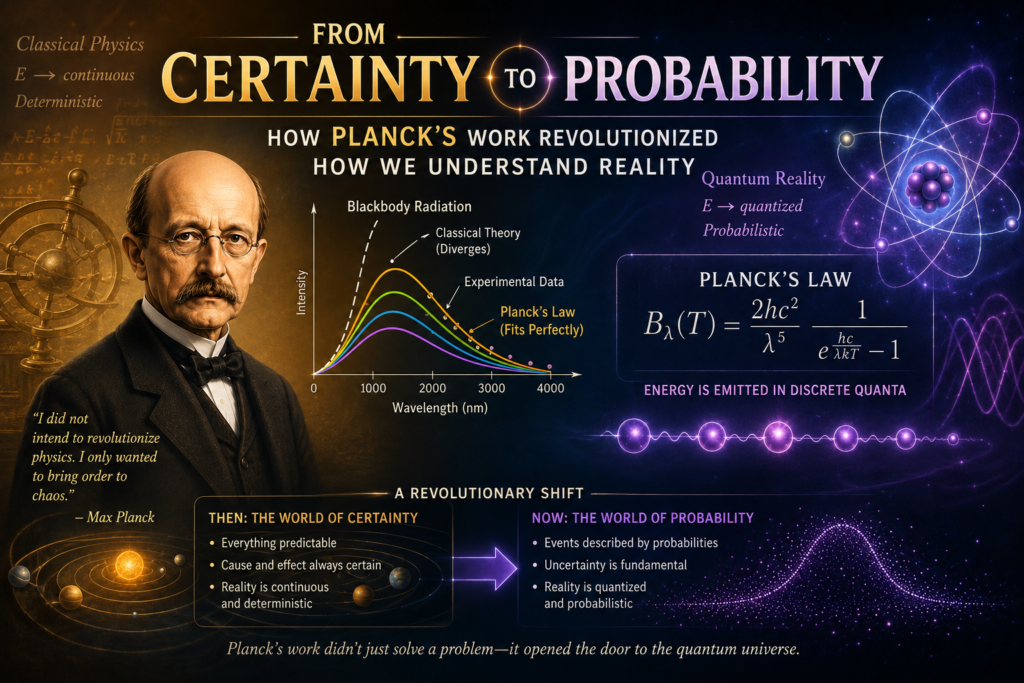
That confident worldview began to crumble when physicists confronted the blackbody radiation problem, a puzzle involving how heated objects emit energy based purely on temperature. Classical formulas predicted that a black body should emit infinite energy at short wavelengths, an impossible result known as the ultraviolet catastrophe.
This failure was not just an inconvenient miscalculation. It was a sign that something fundamental about classical assumptions was wrong, though no one yet understood that the fix would eventually introduce quantum probability into the heart of physics.
Planck’s Reluctant Breakthrough (1900)
In December 1900, Max Planck proposed a solution to the blackbody radiation problem that would later be recognized as the birth of an entirely new worldview. He suggested that energy is not emitted continuously, but only in fixed, discrete packets, an idea known as the quantum hypothesis, expressed through the equation:
E = hν
Here, E is the energy of a quantum, ν (nu) is frequency, and h is planck’s constant, approximately 6.626 × 10⁻³⁴ joule seconds. Planck himself initially treated this idea as a mathematical convenience, never intending to challenge deterministic physics directly. Yet this single assumption planted the seed that would eventually grow into full quantum probability.
From Quantized Energy to Genuine Uncertainty
At first, quantization simply meant that energy came in discrete steps rather than a smooth continuum. It did not immediately imply that nature was unpredictable. That deeper realization came later, as physicists began exploring the strange behavior of particles at atomic and subatomic scales.
The turning point arrived with Werner Heisenberg’s famous uncertainty principle, which states that certain pairs of physical properties, such as position and momentum, cannot both be known with perfect precision simultaneously. Mathematically, this is expressed as:
Δx × Δp ≥ h / 4π
Where Δx represents uncertainty in position and Δp represents uncertainty in momentum. This was not a limitation of measurement instruments. It reflected a genuine, built-in feature of physical reality itself. This was the moment quantum probability replaced deterministic certainty as the governing principle of the subatomic world.
Wave Function Collapse and the Role of Chance
Quantum mechanics further deepened this shift through the concept of wave function collapse. Before measurement, a quantum particle exists in a superposition of multiple possible states simultaneously, described mathematically by a wave function. Only upon measurement does the system “collapse” into one specific, definite outcome, with quantum probability determining the likelihood of each possible result.
This radical idea is famously illustrated through the schrödinger’s cat thought experiment, in which a cat inside a sealed box is imagined to be simultaneously alive and dead until observed, a deliberately absurd scenario designed to highlight just how strange quantum probability truly is when applied to everyday objects.
Planck and Einstein: Diverging Views on Reality (1900 – 1955)
Interestingly, not every physicist embraced this probabilistic worldview. Planck and einstein shared a complicated relationship when it came to accepting the full implications of quantum theory. While Einstein helped confirm quantum ideas through his explanation of the photoelectric effect in 1905, he later became deeply uncomfortable with the idea that quantum probability represented a fundamental feature of nature rather than a temporary gap in human knowledge.
Einstein famously argued that “God does not play dice,” expressing his belief that hidden variables, unseen factors not yet accounted for, might eventually restore determinism to physics. Planck, though the originator of the quantum hypothesis, similarly remained cautious throughout his life about fully embracing the probabilistic interpretation his own discovery had helped create.
The Philosophical Weight of Quantum Probability
The rise of quantum probability forced physicists and philosophers alike to reconsider deep questions about cause and effect, the nature of reality, and even the limits of scientific knowledge itself. If the universe is not strictly deterministic, then Laplace’s demon, no matter how powerful, could never actually predict the future with total certainty. Some outcomes are, at their core, governed purely by chance.
This shift also opened the door to unusual and counterintuitive phenomena such as non-locality, where particles appear to instantaneously influence one another across vast distances, a behavior later confirmed through experiments testing quantum entanglement. These discoveries reinforced that quantum probability was not simply a mathematical convenience but a genuine description of how reality behaves at its most fundamental level.
Why This Shift Still Matters Today
The transition from certainty to quantum probability did not just reshape academic physics. It laid the philosophical and mathematical groundwork for technologies we now depend on daily, including semiconductors, lasers, and medical imaging devices. Planck’s legacy in modern physics extends directly into today’s cutting-edge research into quantum computing, which relies entirely on probabilistic quantum states to perform calculations impossible for classical computers.
Understanding quantum probability also reshaped how scientists think about scientific knowledge itself, shifting from a search for absolute predictions toward a framework built on probabilities, likelihoods, and statistical outcomes.
The Legacy: Max Planck Quantum Universe
The shift from strict determinism to quantum probability defines what many physicists now describe as the Max Planck Quantum Universe, a reality where chance and probability sit at the very foundation of existence rather than being mere gaps in human understanding. This philosophical and scientific transformation remains one of Planck’s most enduring, and perhaps most unsettling, contributions to modern thought.
Frequently Asked Questions
What is quantum probability in simple terms?
Quantum probability refers to the idea that outcomes at the atomic and subatomic level are governed by chance rather than strict determinism, meaning identical conditions can produce different results.
How did Max Planck contribute to quantum probability?
Planck’s introduction of quantized energy in 1900 laid the mathematical foundation that later led to the discovery of genuine uncertainty and probability at the heart of quantum mechanics.
Did Einstein believe in quantum probability?
Einstein remained skeptical throughout his life, famously stating that “God does not play dice,” and hoped hidden variables might eventually restore determinism to physics.
What is the difference between deterministic and probabilistic physics?
Deterministic physics assumes the future can be predicted exactly from present conditions, while probabilistic physics, central to quantum mechanics, assumes only the likelihood of different outcomes can be known.
Why is quantum probability important in modern technology?
Quantum probability underlies technologies such as semiconductors, lasers, and quantum computing, all of which rely on the probabilistic behavior of particles at extremely small scales.
Conclusion
The shift from certainty to quantum probability stands as one of the most profound transformations in the history of human thought. What began as Max Planck’s reluctant mathematical fix for a stubborn radiation problem ultimately dismantled two centuries of deterministic confidence, revealing a universe where chance and probability govern reality at its deepest level. Even physicists like Einstein struggled to accept this new picture of nature. Yet quantum probability remains firmly established today, quietly powering the technology of the modern world while continuing to challenge our most basic assumptions about cause, effect, and the true nature of reality.