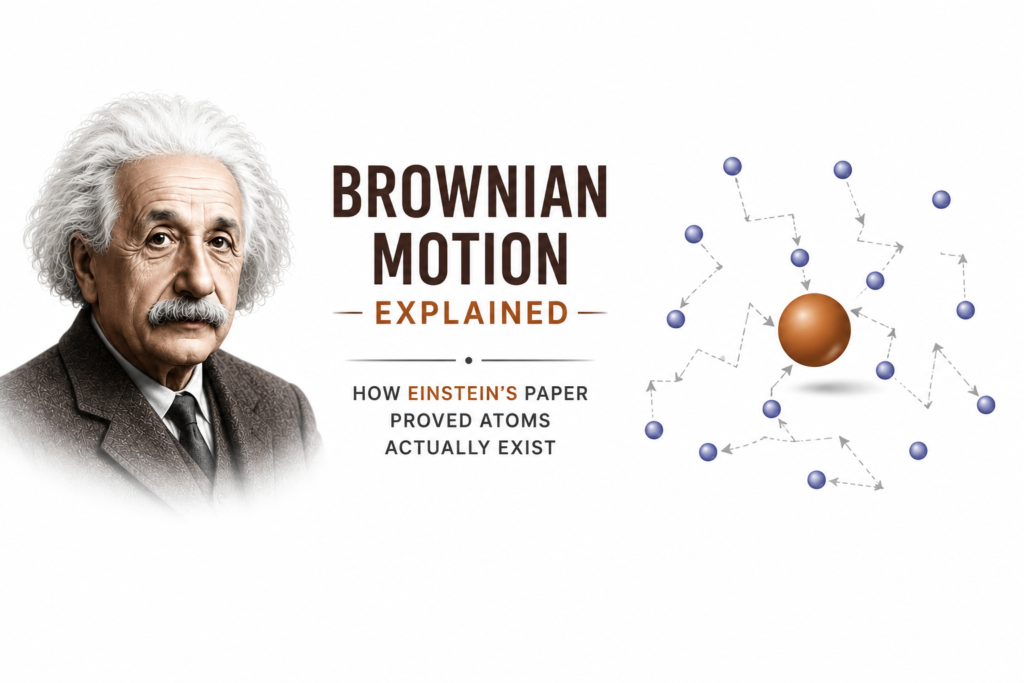
It sounds almost too simple to be revolutionary. Tiny particles suspended in water jitter around randomly, drifting this way and that for no obvious reason. Yet this seemingly trivial observation, first noticed nearly a century earlier, became the subject of one of Albert Einstein’s most important 1905 papers, one that finally settled a scientific debate that had raged for decades. Brownian motion explained through Einstein’s mathematical analysis provided the definitive proof that atoms and molecules genuinely exist, ending centuries of philosophical uncertainty about the fundamental nature of matter itself.
Understanding brownian motion explained means tracing how a curious botanical observation, made long before atomic theory gained scientific acceptance, eventually became the decisive evidence confirming that matter is built from countless invisible, constantly moving particles.
Robert Brown’s Curious Discovery (1827)
The story of brownian motion explained begins in 1827, when Scottish botanist Robert Brown pollen grains research led him to notice something strange while observing pollen particles suspended in water under a microscope. The tiny particles moved in an erratic, unpredictable pattern, jittering constantly despite no obvious external force acting upon them.
Brown initially wondered whether this movement indicated some form of biological life force within the pollen itself. However, further experimentation revealed that even inorganic dust particles exhibited identical erratic movement, ruling out any biological explanation entirely. This mysterious microscopic particle jitter remained scientifically unexplained for nearly eighty years, a puzzling observation without any satisfying theoretical foundation.
The Scientific Debate Over Atoms
Throughout the nineteenth century, physicists remained deeply divided regarding molecular kinetic theory and the fundamental existence of atoms. While chemists increasingly relied on atomic concepts to explain chemical reactions, many prominent physicists remained skeptical, viewing atoms as merely a convenient mathematical tool rather than genuine physical entities.
This atomism physics debate represented one of the most significant unresolved questions in scientific philosophy at the time. Without direct observational evidence, the question of whether matter was truly composed of discrete atoms and molecules, or whether it represented some form of continuous substance, remained genuinely open to serious scientific debate.
Einstein’s Brilliant Insight (1905)
During his remarkable miracle year, alongside groundbreaking work on special relativity explained and the einstein photoelectric effect, Einstein turned his attention toward solving the decades old mystery behind Robert Brown’s observation. His Einstein Brownian motion paper 1905, published within Annalen der Physik, provided a rigorous mathematical framework explaining exactly why microscopic particles exhibited this strange, erratic movement.
Einstein proposed that visible particle jitter resulted directly from countless random fluid particle collision events, occurring as invisible water molecules constantly bombarded the larger, visible particles from all directions. Because these molecular collisions occurred randomly and unevenly at any given moment, the larger particle would experience a net random push in one direction, then another, producing the erratic movement pattern Robert Brown had originally observed.
The Mathematics Behind Brownian Motion
Einstein’s genuine breakthrough involved developing a precise mathematical relationship describing this random thermal motion statistically, even though predicting any single particle’s exact path remained impossible. He derived what became known as the mean square displacement formula, expressed as:
⟨x²⟩ = 2Dt
Here, ⟨x²⟩ represents the average squared displacement of a particle over time, D represents the diffusion coefficient Einstein calculated based on fluid properties, and t represents elapsed time. This elegant equation revealed that particle displacement grows predictably with the square root of time, providing a testable, quantifiable prediction that could be verified experimentally.
Einstein further connected this diffusion coefficient directly to fundamental physical constants through what is now known as the stokes-einstein equation:
D = k_B T / (6πηr)
Here, k_B represents the Boltzmann constant k_B, T represents absolute temperature, η (eta) represents the fluid’s viscosity fluid motion property, and r represents the radius of the suspended particle. This equation elegantly connected microscopic thermal agitation directly to measurable macroscopic properties like temperature and viscosity.
Why This Mathematics Mattered So Much
What made Einstein’s brownian motion explained approach so revolutionary was its predictive power. If matter truly consisted of discrete, countless molecules constantly undergoing random walk mathematics style motion, then Einstein’s equations predicted exactly how quickly and how far suspended particles should drift over any given time period, based purely on measurable physical properties like temperature, viscosity, and particle size.
This transformed an old, purely qualitative observation into a precise, quantitative prediction, one that could be tested directly through careful laboratory experimentation, finally providing physicists a genuine path toward proving molecular existence beyond mere theoretical speculation.
Jean Perrin’s Experimental Confirmation (1908 – 1913)
Einstein’s theoretical predictions received rigorous experimental verification through the painstaking work of French physicist Jean Perrin Brownian motion research conducted between 1908 and 1913. Using extremely precise microscopic observation techniques, Perrin carefully tracked colloidal particle displacement patterns, measuring exactly how far suspended particles drifted over specific time intervals.
Perrin’s meticulous measurements matched Einstein’s mathematical predictions with remarkable precision, providing compelling atomistic worldview confirmation that finally ended lingering scientific skepticism regarding molecular existence. This groundbreaking experimental verification earned Jean Perrin Nobel prize 1926 recognition specifically for his work confirming the discontinuous structure of matter.
Calculating Avogadro’s Number
One of the most remarkable practical outcomes of brownian motion explained involved Avogadro’s number calculation, determining precisely how many molecules exist within a given quantity of substance. By carefully measuring observed particle displacement patterns and applying Einstein’s theoretical framework, Perrin successfully calculated the Avogadro constant calculation N_A with impressive accuracy, providing direct experimental confirmation of a fundamental physical constant previously known only through indirect theoretical estimates.
This achievement represented perhaps the most concrete, tangible proof possible that molecules genuinely exist as discrete, countable physical entities, rather than merely convenient theoretical abstractions used for chemical calculations.
Connecting Brownian Motion to Broader Physics
Einstein’s brownian motion explained work also connected meaningfully to his broader theoretical contributions throughout 1905, including his collaborative intellectual relationship with einstein and planck regarding statistical approaches to physical phenomena. Both breakthroughs relied heavily on statistical mechanics Einstein applied throughout his career, treating physical systems through probability and statistical analysis rather than purely deterministic classical mechanics alone.
This statistical approach would later prove essential to quantum mechanics as well, demonstrating how Einstein’s willingness to embrace probabilistic thinking, at least regarding molecular motion, provided crucial methodological groundwork for later theoretical developments throughout physics.
Why This Discovery Still Matters Today
Beyond settling a centuries old philosophical debate, brownian motion explained through Einstein’s mathematical framework continues influencing modern scientific research. The underlying principles now apply broadly throughout financial mathematics, biological research studying cellular processes, and materials science investigating fluid atom collision behavior within various substances.
This achievement stands among the clearest examples of einstein predictions proven through rigorous experimental verification, alongside his other remarkable 1905 contributions including mass-energy equivalence and special relativity, together representing an extraordinarily productive single year that reshaped multiple branches of physics simultaneously.
The Legacy: Confirming Atomic Reality
The Albert Einstein legacy surrounding brownian motion explained remains foundational to modern physics and chemistry, providing the definitive experimental proof that matter truly consists of countless discrete atoms and molecules, constantly in random thermal motion. This achievement, though often overshadowed by Einstein’s more famous relativity work, represents one of his most practically significant scientific contributions.
Frequently Asked Questions
What is Brownian motion explained simply?
Brownian motion refers to the random, erratic movement of small particles suspended in a fluid, caused by countless collisions with surrounding invisible molecules, as explained mathematically by Einstein in 1905.
Who first observed Brownian motion?
Scottish botanist Robert Brown first observed this phenomenon in 1827 while studying pollen grains suspended in water under a microscope.
How did Einstein’s paper prove atoms exist?
Einstein developed precise mathematical equations predicting particle displacement based on molecular collisions, providing testable predictions that were later experimentally confirmed, proving molecules genuinely exist.
Who experimentally confirmed Einstein’s Brownian motion theory?
French physicist Jean Perrin conducted precise experiments between 1908 and 1913 that confirmed Einstein’s predictions, earning Perrin the Nobel Prize in Physics in 1926.
Why is Brownian motion important in modern science?
Brownian motion principles now apply broadly across financial mathematics, biological research, and materials science, extending far beyond their original application to atomic theory confirmation.
Conclusion
Brownian motion explained through Einstein’s remarkable 1905 paper stands as one of his most practically significant scientific achievements, providing the definitive mathematical proof that atoms and molecules genuinely exist as discrete physical entities. What began as Robert Brown’s curious observation of jittering pollen grains became, through Einstein’s theoretical insight and Jean Perrin’s careful experimental verification, the decisive evidence ending centuries of philosophical debate about the fundamental nature of matter. More than a century later, this elegant solution to a seemingly simple puzzle continues influencing scientific fields far beyond physics, proving that even the smallest observations can lead to humanity’s greatest scientific certainties.