
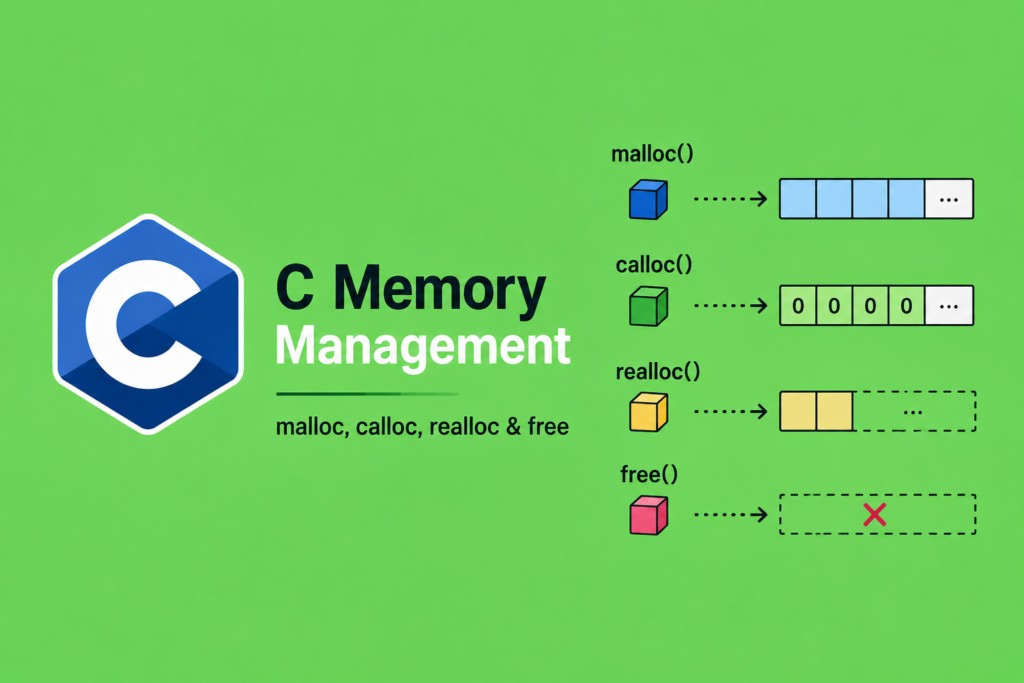
C memory management represents one of the most critical concepts in C programming, yet it remains a source of confusion for many developers. Unlike modern languages with automatic garbage collection, C requires programmers to manually manage memory allocation and deallocation. Understanding c memory management through malloc, calloc, realloc, and free functions is essential for writing efficient, reliable C programs. This comprehensive guide explores each function, provides practical examples, and teaches best practices for preventing common memory errors.
The power of C lies partly in its low-level control, and c memory management exemplifies this principle. When you master dynamic memory allocation in C, you gain unprecedented control over system resources. However, this control comes with responsibility. Poor c memory management leads to memory leaks, segmentation faults, and security vulnerabilities. Whether you’re building embedded systems or large-scale applications, understanding these concepts transforms your programming capability.
Understanding Memory in C Programs
Before exploring c memory management functions, comprehending how memory works in C programs is essential. Every C program has access to two primary memory regions: the stack and the heap. Stack memory is automatically managed and stores local variables, function parameters, and return addresses. Stack memory is fast but limited in size and automatically freed when variables go out of scope.
Heap memory is manually managed and provides unlimited storage capacity within system constraints. The heap allows you to allocate memory at runtime, crucial for handling dynamic data structures like linked lists, trees, and resizable arrays. Understanding the distinction between stack and heap memory forms the foundation of c memory management knowledge.
The <stdlib.h> header file provides all functions necessary for c memory management. This standard library contains malloc, calloc, realloc, and free declarations. Including this header enables access to dynamic memory allocation capabilities fundamental to professional C programming.
Introduction to malloc Function
The malloc function (memory allocate) is the foundation of c memory management in C. It allocates a specified number of bytes on the heap and returns a pointer to the allocated memory. The syntax is straightforward:
c:
void *ptr = malloc(size_in_bytes);malloc takes one parameter: the number of bytes to allocate. It returns a void pointer that you must cast to the appropriate data type. If allocation fails due to insufficient memory, malloc returns NULL.
Here’s a practical example of c memory management using malloc:
c:
#include <stdio.h>
#include <stdlib.h>

int main() {
    // Allocate memory for 5 integers
    int *arr = (int *)malloc(5 * sizeof(int));

    if (arr == NULL) {
        printf("Memory allocation failed!\n");
        return 1;
    }

    // Use the allocated memory
    for (int i = 0; i < 5; i++) {
        arr[i] = i * 10;
        printf("%d ", arr[i]);
    }
    printf("\n");

    // Free the allocated memory
    free(arr);
    arr = NULL;  // Good practice: set pointer to NULL after freeing

    return 0;
}
This program allocates memory for five integers, initializes them, displays them, then frees the memory. Notice the sizeof(int) multiplication. This ensures portable code across different systems where integer sizes might vary. c memory management requires such careful attention to details.
Understanding calloc Function
calloc (contiguous allocate) is another crucial c memory management function that allocates memory and initializes it to zero. This distinction from malloc is significant. While malloc leaves allocated memory uninitialized (containing garbage values), calloc zeroes all allocated bytes. The syntax is:
c:
void *ptr = calloc(num_elements, element_size);calloc takes two parameters: number of elements and size per element. It returns a pointer to the allocated memory or NULL if allocation fails.
Here’s a practical c memory management example using calloc:
c:
#include <stdio.h>
#include <stdlib.h>

typedef struct {
    char name[50];
    int age;
    float salary;
} Employee;

int main() {
    // Allocate memory for 3 employees, initialized to zero
    Employee *employees = (Employee *)calloc(3, sizeof(Employee));

    if (employees == NULL) {
        printf("Memory allocation failed!\n");
        return 1;
    }

    // Initialize employee data
    strcpy(employees[0].name, "Alice");
    employees[0].age = 30;
    employees[0].salary = 50000.0;

    strcpy(employees[1].name, "Bob");
    employees[1].age = 28;
    employees[1].salary = 45000.0;

    // Display employee information
    for (int i = 0; i < 2; i++) {
        printf("Name: %s, Age: %d, Salary: %.2f\n",
               employees[i].name, employees[i].age, employees[i].salary);
    }

    // Free the allocated memory
    free(employees);
    employees = NULL;

    return 0;
}
This example demonstrates c memory management with structures. calloc’s zero-initialization is particularly useful for allocating arrays of structures where you want all fields initialized to zero or NULL by default.
Realloc Function for Memory Resizing
The realloc function (memory reallocation) modifies previously allocated memory size, making it essential for c memory management when data requirements change. You might allocate space for ten integers initially, then need fifty. realloc resizes memory blocks without losing data.
The syntax is:
c:
void *ptr = realloc(old_ptr, new_size);realloc takes an existing pointer and new size. It returns a pointer to resized memory, which might be a different address than the original pointer. If allocation fails, realloc returns NULL, leaving the original memory intact.
Here’s a practical c memory management example demonstrating realloc:
c:
#include <stdio.h>
#include <stdlib.h>

int main() {
    // Allocate initial array of 5 integers
    int *numbers = (int *)malloc(5 * sizeof(int));

    if (numbers == NULL) {
        printf("Memory allocation failed!\n");
        return 1;
    }

    // Fill initial array
    for (int i = 0; i < 5; i++) {
        numbers[i] = i + 1;
    }

    printf("Original array (5 elements): ");
    for (int i = 0; i < 5; i++) {
        printf("%d ", numbers[i]);
    }
    printf("\n");

    // Resize array to 10 elements using realloc
    int *temp = (int *)realloc(numbers, 10 * sizeof(int));

    if (temp == NULL) {
        printf("Memory reallocation failed!\n");
        free(numbers);
        return 1;
    }

    numbers = temp;

    // Initialize new elements
    for (int i = 5; i < 10; i++) {
        numbers[i] = i + 1;
    }

    printf("Resized array (10 elements): ");
    for (int i = 0; i < 10; i++) {
        printf("%d ", numbers[i]);
    }
    printf("\n");

    // Free the allocated memory
    free(numbers);
    numbers = NULL;

    return 0;
}
This example demonstrates c memory management with realloc, showing how to safely resize arrays. Notice using a temporary pointer for realloc; if realloc fails returning NULL, you still have access to original memory to free it properly.
The Free Function and Memory Deallocation
free is perhaps the most critical function in c memory management. It deallocates memory previously allocated by malloc, calloc, or realloc. Failing to free allocated memory causes memory leaks, where memory remains allocated but inaccessible, wasting system resources.
The syntax is simple:
c:
free(pointer);free takes a pointer to previously allocated memory and releases it back to the system. After freeing, the pointer becomes a dangling pointer. Accessing memory through a dangling pointer causes undefined behavior, typically segmentation faults.
Here’s demonstrating proper c memory management with free:
c:
#include <stdio.h>
#include <stdlib.h>

int main() {
    // Allocate memory for a string
    char *message = (char *)malloc(50 * sizeof(char));

    if (message == NULL) {
        printf("Memory allocation failed!\n");
        return 1;
    }

    strcpy(message, "Hello from dynamic memory!");
    printf("%s\n", message);

    // Free the allocated memory
    free(message);
    message = NULL;  // Prevent dangling pointer issues

    // This would cause a segmentation fault if not for NULL assignment
    // printf("%s\n", message);  // WRONG: Accessing freed memory

    return 0;
}
Notice setting the pointer to NULL after freeing. This practice prevents accidental access to freed memory. Some developers check if a pointer is NULL before freeing, though modern practice just calls free(NULL) which safely does nothing.
Common Memory Management Patterns
Effective c memory management follows established patterns that prevent common errors. One essential pattern allocates memory in one function and frees it in another, requiring clear documentation of ownership. Another pattern uses wrapper functions around malloc and calloc that handle error checking automatically.
Here’s a reusable c memory management pattern:
c:
#include <stdio.h>
#include <stdlib.h>

// Safe malloc wrapper
void *safe_malloc(size_t size) {
    void *ptr = malloc(size);
    if (ptr == NULL && size > 0) {
        fprintf(stderr, "Memory allocation of %zu bytes failed!\n", size);
        exit(EXIT_FAILURE);
    }
    return ptr;
}

// Safe calloc wrapper
void *safe_calloc(size_t nmemb, size_t size) {
    void *ptr = calloc(nmemb, size);
    if (ptr == NULL && nmemb > 0 && size > 0) {
        fprintf(stderr, "Memory allocation failed!\n");
        exit(EXIT_FAILURE);
    }
    return ptr;
}

int main() {
    // Using safe wrappers eliminates NULL checking
    int *array = (int *)safe_malloc(10 * sizeof(int));

    // Use array without checking for NULL
    for (int i = 0; i < 10; i++) {
        array[i] = i;
    }

    free(array);
    array = NULL;

    return 0;
}
These wrapper functions implement c memory management best practices by handling allocation failures immediately rather than scattered throughout code.
Avoiding Memory Leaks in C
Memory leaks occur when allocated memory is never freed. This is a critical concern in c memory management. A single memory leak might not matter, but accumulating leaks exhaust system resources, causing programs to crash or perform poorly.
Common c memory management mistakes causing leaks include:
- Allocating memory but never calling free
- Losing pointer references when reassigning pointers
- Forgetting to free memory in error paths
Here’s demonstrating a c memory management mistake:
c:
#include <stdio.h>
#include <stdlib.h>

void leak_example() {
    int *ptr1 = (int *)malloc(10 * sizeof(int));
    int *ptr2 = (int *)malloc(20 * sizeof(int));

    // Oops! This loses the reference to first allocation
    ptr1 = ptr2;  // MEMORY LEAK: first allocation unreachable

    free(ptr1);   // Only frees second allocation
    // First allocation is lost forever!
}

int main() {
    leak_example();  // Memory leak occurs here
    return 0;
}
Understanding this mistake is crucial for c memory management. Always carefully track which pointer references which allocation.
C Programming for Beginners Learning Memory Management
C programming for beginners should include substantial time understanding c memory management. Many beginners initially use stack-allocated arrays exclusively, then struggle when needing dynamic sizing. Learning c memory management early prevents years of difficult debugging later.
Starting with simple programs allocating integers, then progressing to structures and arrays helps build intuition. Practice writing programs that allocate, modify, and free memory repeatedly. This hands-on experience is invaluable.
Understanding Pointers in C Memory Management
C pointers explained becomes crystal clear when studying c memory management. A pointer is simply a variable containing a memory address. malloc returns a pointer to allocated heap memory. Understanding this relationship is fundamental.
When you write int *ptr = malloc(sizeof(int));, you’re creating a pointer variable that holds the address of allocated heap memory. Dereferencing with *ptr accesses the value at that address. This pointer concept is central to everything in c memory management.
Memory Allocation Performance Considerations
malloc versus calloc performance differences matter in c memory management. malloc is typically faster because it doesn’t initialize memory to zero. calloc includes initialization overhead. For applications where initialization happens immediately after allocation, malloc often outperforms calloc.
However, c memory management performance depends on specific use cases. Premature optimization usually matters less than correctness. Write correct code first, optimize later if profiling indicates memory allocation as a bottleneck.
C Programming Legacy in Modern Development
C programming legacy continues influencing modern software despite newer languages’ existence. C’s c memory management model shaped how programmers think about resources and ownership. Operating systems, embedded systems, and performance-critical applications still rely on C.
Understanding c memory management connects you to this rich programming heritage. Techniques and patterns you learn apply beyond C, influencing even memory management in other languages.
C Standard Library and Memory Functions
The <stdlib.h> header contains crucial c memory management functions. Beyond malloc, calloc, realloc, and free, it provides other memory-related utilities. Understanding the standard library functions available for c memory management prevents reinventing the wheel.
Memory functions in <stdlib.h> are implemented efficiently by systems programmers. Using these standard functions ensures portable, well-tested c memory management behavior across platforms.
FAQs About C Memory Management
What’s the difference between malloc and calloc in c memory management?
malloc allocates uninitialized memory containing garbage values. calloc allocates memory initialized to zero. Both are part of c memory management, but calloc’s initialization overhead makes it slower. Choose malloc for performance when you immediately initialize memory, calloc when zero-initialization is valuable.
How do I avoid dangling pointers in c memory management?
Set pointers to NULL immediately after calling free. Before accessing a pointer in c memory management, check that it’s not NULL. Some coding standards forbid accessing pointers after freeing them. Better yet, design code so freed pointers never need accessing.
Can c memory management fail, and how should I handle it?
Yes, malloc, calloc, and realloc can fail returning NULL when insufficient memory exists. In c memory management, always check for NULL after allocation. Modern practice often exits immediately on allocation failure for critical allocations, or handles it gracefully for non-critical allocations.
What’s a memory leak in c memory management?
A memory leak occurs when c memory management allocates memory that’s never freed. The allocated memory becomes inaccessible, wasting system resources. Tracking all allocations and ensuring corresponding free calls prevents leaks. Tools like Valgrind detect memory leaks automatically.
How does c memory management compare to garbage collection?
C requires manual c memory management through explicit free calls. Languages with garbage collection automatically free unreachable memory. This manual approach gives C programmers precise control but requires discipline. Garbage collection reduces bugs but adds overhead.
Conclusion
Mastering c memory management through malloc, calloc, realloc, and free separates competent C programmers from amateurs. These functions provide powerful low-level control over system resources while demanding discipline and attention to detail. The investment in learning c memory management thoroughly pays dividends throughout your programming career.
c memory management isn’t just about memorizing function signatures. It’s about understanding how computers allocate and manage memory, how pointers work, and how careless allocation practices cause bugs. Every program you write using c memory management teaches lessons applicable far beyond C itself.
As you continue developing C expertise, explore C functions and recursion patterns that work well with dynamic allocation, understand C pointers explained deeply, and study advanced C programming techniques for sophisticated memory management strategies. For foundational knowledge,C programming for beginners should emphasize these concepts early. Those interested in c memory management history should explore C programming legacy that established these patterns decades ago, still standard in professional development today.
The discipline you develop learning c memory management makes you a better programmer overall. Whether building systems software, embedded applications, or any performance-critical code, these skills remain essential. Practice these concepts repeatedly, read others’ code demonstrating proper c memory management, and don’t hesitate to use debugging tools. Your dedication to mastering memory management ensures writing robust, efficient, reliable C programs for years to come.