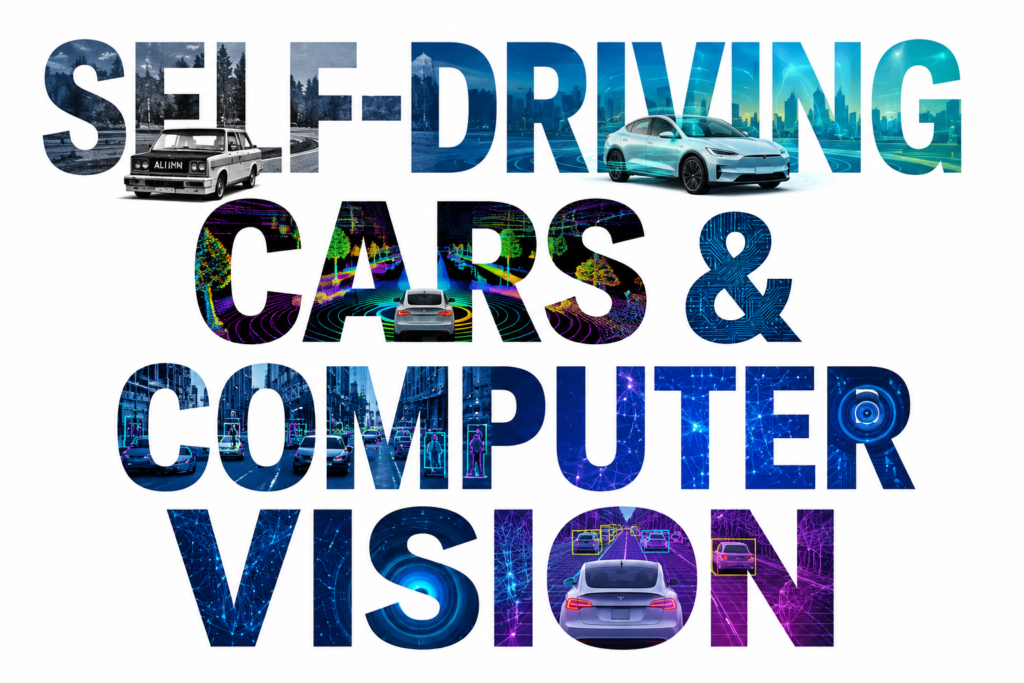
The dream of a car that drives itself is almost as old as the car itself, but for most of automotive history, it remained firmly in the realm of science fiction. The relationship between self-driving cars and computer vision changed that, transforming autonomous driving from a futuristic concept into something that exists, in various forms, on roads around the world today. This article traces that history, from the earliest experimental systems to the camera-based architectures that define many of today’s most advanced driver assistance systems.
Why Computer Vision Became Central to Autonomous Driving
Role of computer vision in autonomous vehicles becomes clear once you consider what driving actually requires. A human driver constantly processes visual information, reading lane markings, identifying other vehicles, recognizing pedestrians, interpreting traffic signals, and judging distances and speeds, all simultaneously and largely without conscious effort.
For a vehicle to drive itself, it needs some way to perform these same tasks. Self driving car camera perception technology emerged as one of the primary approaches to this challenge, since cameras are relatively inexpensive, capture rich visual information similar to what human drivers use, and benefit directly from the broader advances happening across the history of computer vision.
ALVINN: An Early Experiment (1989)
History of camera based autonomous driving systems often begins with ALVINN, the Autonomous Land Vehicle In a Neural Network, developed at Carnegie Mellon University in 1989. ALVINN used a neural network, a relatively simple architecture by modern standards, trained to map camera images directly to steering commands, allowing a vehicle to follow roads based on visual input.
This early work predates the history of AlexNet and the broader deep learning transformed computer vision revolution by more than two decades, relying on much simpler neural network architectures than those used today. Even so, ALVINN demonstrated the core concept that would eventually define much of modern autonomous driving: a neural network could learn to drive based on visual input, without needing explicit rules for every possible road scenario, learning instead from examples of human driving behavior.
The limitations of ALVINN were significant. The neural networks of the late 1980s had nowhere near the capacity needed to handle the enormous variety of real-world driving conditions, and computational power available at the time made running such systems in real time on a moving vehicle extremely challenging. ALVINN operated successfully primarily under controlled conditions, but it proved the concept was viable.
The DARPA Grand Challenges (2004 – 2007)
A significant jump forward in autonomous vehicle research came through a series of competitions organized by the Defense Advanced Research Projects Agency in the mid-2000s. These competitions brought together university teams and companies to build vehicles capable of navigating challenging routes autonomously, first in desert environments and later in urban settings.
Convolutional neural network inference was not yet the dominant approach during this period, since the deep learning transformed computer vision revolution had not yet occurred. Instead, many systems relied heavily on Visual SLAM navigation, simultaneous localization and mapping techniques that combined visual information with other sensors to build maps of the environment and track the vehicle’s position within them, along with rule-based systems for interpreting sensor data and making driving decisions.
These competitions demonstrated that autonomous navigation through complex environments was possible, though the systems involved were generally large, expensive, and far from ready for everyday consumer use. They represented important proof of concept work that would inform the commercial development efforts that followed in subsequent years.
Computer Vision vs LiDAR: Two Philosophies Emerge
Computer vision vs LiDAR in self driving cars represents one of the most significant ongoing debates in the history of autonomous vehicle development. LiDAR, which uses laser pulses to directly measure distances to surrounding objects, provides highly accurate depth information directly, without requiring the kind of inference that camera-based systems need to estimate distance from visual information alone.
Camera-based approaches, by contrast, rely on computer vision techniques to extract spatial information from two-dimensional images. Pseudo-LiDAR depth estimation represents one approach within this camera-based philosophy, using deep learning techniques to estimate depth information from camera images that approximates what LiDAR would provide directly, but using significantly less expensive hardware.
This debate connects to broader themes within computer vision technology where significant research has focused on extracting accurate three-dimensional information from two-dimensional camera images, a capability that becomes increasingly important the more a self-driving system relies on cameras rather than direct depth-sensing hardware like LiDAR.
Mobileye and the Rise of ADAS (2007 – 2015)
Mobileye camera chips history represents a significant chapter in bringing camera-based computer vision to mass-market vehicles, predating fully autonomous driving ambitions. Mobileye developed specialized chips designed to run computer vision algorithms efficiently within vehicles, enabling Advanced Driver Assistance Systems (ADAS) features like lane departure warnings, automatic emergency braking, and adaptive cruise control.
Lane detection computer vision systems history during this period focused on identifying lane markings on roads using classical computer vision techniques related to the history of edge detection, with increasingly sophisticated pattern recognition to handle variations in lighting, road conditions, and marking types.
Pedestrian detection technology in self driving cars also developed significantly during this period, applying object detection techniques to identify pedestrians and estimate their position and movement relative to the vehicle, a critical safety capability for any system operating in environments where pedestrians might be present.
Deep Learning Arrives in Automotive Vision (2015 – 2020)
Object detection algorithms for self driving cars transformed significantly following the broader deep learning transformed computer vision revolution. Architectures descended from the history of r-cnn, the history of yolo, and the single shot detector began to be adapted for automotive applications, offering significant improvements in accuracy and robustness compared to earlier classical computer vision approaches.
Real time semantic segmentation in autonomous vehicles became increasingly important during this period as well. Rather than just identifying bounding boxes around objects, semantic segmentation, related to the broader history of image segmentation, classifies every pixel in an image, distinguishing road surfaces, sidewalks, vehicles, pedestrians, vegetation, and sky at a pixel level, providing much richer scene understanding than bounding boxes alone.
Multi-camera sensor fusion emerged as a common architectural approach during this period, combining input from multiple cameras positioned around a vehicle to build a more complete picture of the surrounding environment than any single camera could provide alone, addressing limitations like blind spots and providing overlapping coverage for redundancy.
Tesla’s Camera-Centric Approach (2019 – 2026)
Tesla Full Self Driving computer vision architecture represents one of the most prominent examples of a heavily camera-based approach to autonomous driving development. Rather than relying primarily on LiDAR, this approach emphasizes extracting as much information as possible from camera inputs using deep learning techniques.
Spatial occupancy networks and Birds-Eye-View (BEV) transformation represent significant architectural concepts within this camera-centric approach. Rather than processing each camera’s images independently, these techniques involve combining information from multiple cameras into a unified representation of the space around the vehicle, often represented as if viewed from above, making it easier for downstream systems to reason about the positions and movements of objects relative to the vehicle regardless of which camera originally captured them.
This approach connects directly to the broader history of multimodal AI and vision transformers, as the architectures used to combine and interpret information from multiple camera feeds increasingly draw on transformer-based approaches originally developed for other domains, reflecting a broader trend across computer vision technology toward unified architectures capable of processing and combining information from multiple sources.
Handling Edge Cases and Continuous Improvement
Edge case road anomalies represent one of the most persistent challenges in the relationship between self-driving cars and computer vision. Unlike many computer vision benchmarks, which involve relatively constrained sets of categories and conditions, real-world driving involves an essentially unlimited variety of situations, unusual vehicles, construction zones, unexpected obstacles, extreme weather, and countless other scenarios that may be rare in training data but still need to be handled safely when encountered.
Over-the-air vision updates have become an important mechanism for addressing this challenge. Rather than requiring physical hardware changes, software updates can improve a vehicle’s computer vision systems based on data collected from vehicles already on the road, allowing systems to be refined and improved continuously as new edge cases are identified and addressed.
Edge computing hardware for autonomous visual AI has also evolved significantly to support these increasingly sophisticated computer vision systems. Running deep learning models for object detection, segmentation, and depth estimation in real time, on hardware that fits within a vehicle and operates within strict power and thermal constraints, represents a significant engineering challenge distinct from, but related to, the algorithmic advances driving the underlying computer vision capabilities.
Frequently Asked Questions
What was the first self-driving car to use computer vision?
ALVINN, developed at Carnegie Mellon University in 1989, is often cited as an early and influential example of using a neural network to map camera images directly to steering commands, an early demonstration of camera-based autonomous driving, though it operated under much more limited conditions than modern systems.
What is the difference between computer vision and LiDAR in self-driving cars?
LiDAR uses laser pulses to directly measure distances to objects, providing accurate depth information without requiring inference. Computer vision approaches use cameras and deep learning techniques to interpret two-dimensional images, including estimating depth through techniques like pseudo-LiDAR. Different companies and systems take different approaches, with some relying primarily on cameras and computer vision, others combining cameras with LiDAR, and others using various combinations of sensors.
How does semantic segmentation help self-driving cars?
Semantic segmentation classifies every pixel in a camera image according to what it represents, such as road, sidewalk, vehicle, or pedestrian. This provides much richer information than simply detecting bounding boxes around objects, helping a self-driving system understand the full layout of its surroundings at a pixel level.
What is Birds-Eye-View transformation?
Birds-Eye-View transformation combines information from multiple cameras positioned around a vehicle into a unified representation of the surrounding space, often visualized as if viewed from above. This makes it easier for autonomous driving systems to reason about the positions and movements of objects relative to the vehicle, regardless of which specific camera originally captured the relevant information.
Why are edge cases such a challenge for self-driving cars?
Edge cases are challenging because real-world driving involves an enormous variety of situations that may be rare or entirely absent from training data, but that still need to be handled safely. Unlike controlled benchmarks with limited categories and conditions, self-driving systems must be robust to unusual vehicles, unexpected obstacles, extreme weather, and countless other scenarios, an ongoing challenge addressed partly through continuous data collection and over-the-air software updates.
Conclusion
The history of self-driving cars and computer vision spans more than three decades, from ALVINN’s early demonstration that a neural network could learn to steer based on camera input, through the DARPA Grand Challenges that proved autonomous navigation through complex environments was possible, to the sophisticated multi-camera, deep learning based systems being developed and deployed today.
Throughout this history, the relationship between self-driving cars and computer vision has been defined by a consistent theme: as computer vision technology has advanced, from classical edge detection and lane finding to deep learning based object detection, semantic segmentation, and unified multi-camera representations, autonomous driving systems have been able to take on increasingly complex driving tasks. Understanding this history means understanding how decades of progress across computer vision research have come together to address one of the most demanding real-world applications of the technology.