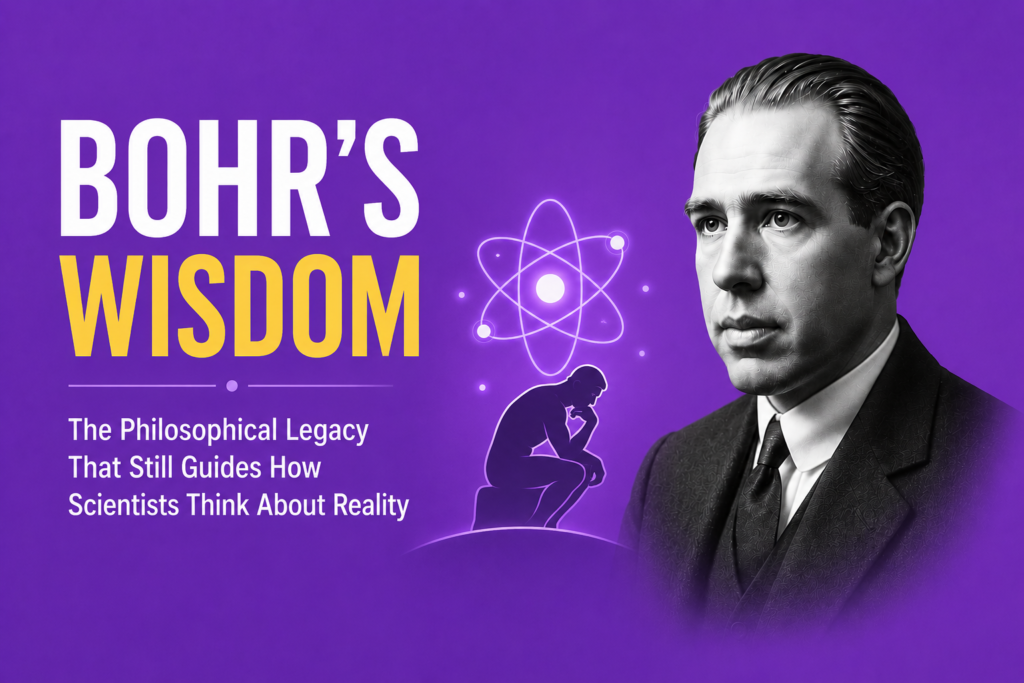
Some scientists change equations. Others change how humanity thinks about truth itself. Niels Bohr belongs firmly in the second category, and bohr’s philosophical legacy extends far beyond the boundaries of physics into some of the deepest questions humans have ever asked about knowledge, reality, and the very limits of what can genuinely be known. Long after his specific equations became standard textbook material, Bohr’s philosophical insights continue quietly shaping how scientists across every discipline approach the fundamental nature of scientific truth.
Understanding bohr’s philosophical legacy means grappling with genuinely uncomfortable questions about objective reality, the limits of human language, and whether science can ever fully capture nature’s deepest truths using concepts originally developed to describe our everyday, macroscopic experience.
Beyond Physics: A New Way of Thinking
While Bohr certainly earned his reputation through groundbreaking physics, including his revolutionary insights regarding electron orbits and energy levels within atoms, his most enduring contribution may ultimately prove to be his broader Bohr philosophy of science. Rather than simply adding new equations to physics textbooks, Bohr fundamentally challenged assumptions about what scientific knowledge actually represents and how confidently humans can claim to understand objective reality.
This philosophical dimension emerged naturally from Bohr’s confrontation with quantum mechanics’ genuinely strange implications. Ordinary human intuition, built entirely upon macroscopic, everyday experience, simply failed when applied to atomic and subatomic phenomena, forcing Bohr toward deeper philosophical reflection regarding the nature of knowledge itself.
The Limits of Classical Language
Central to bohr’s philosophical legacy is his profound insight regarding classical language quantum reality tensions. Bohr recognized that human language itself, including scientific terminology, developed entirely through describing everyday, macroscopic experience. Words like “particle,” “wave,” “position,” and “momentum” all carry inherent classical assumptions baked directly into their meaning.
This created a genuine language boundary physics problem when attempting to describe quantum phenomena. According to Bohr, quantum mechanics revealed aspects of reality that simply could not be adequately captured using classical language alone, since our conceptual vocabulary itself remained fundamentally rooted in macroscopic intuition rather than genuine quantum understanding.
Complementary Truths: A New Kind of Logic
Perhaps Bohr’s most philosophically radical contribution involves his concept of complementary truths, formalized through his complementarity principle. Classical logic assumes that if one statement is true, its direct opposite must necessarily be false. Bohr proposed something genuinely different regarding quantum phenomena, that sometimes two apparently contradictory descriptions could both represent legitimate, necessary aspects of a complete truth.
This concept of deep truth opposite truth reasoning suggested that light could genuinely be both wave and particle, not as some temporary paradox awaiting eventual resolution, but as a permanent, irreducible feature of quantum reality itself. This represented through wave-particle duality a genuinely new epistemological framework, one accepting that certain deep truths might require multiple, seemingly contradictory descriptions rather than a single, unified classical explanation.
Redefining the Observer-Observed Relationship
Bohr’s philosophical framework also fundamentally reshaped understanding regarding the subject observer relationship within scientific measurement. Classical physics assumed a clean, absolute separation between the observer conducting an experiment and the physical system being observed, with measurement simply revealing pre-existing properties without meaningfully influencing them.
Through his development of the copenhagen interpretation, Bohr suggested this classical assumption simply breaks down at the quantum level. The observer and observed system, along with the specific measuring apparatus employed, become inseparably connected within any meaningful description of quantum phenomena. This represents a genuine epistemological shift, challenging centuries of assumed separation between subjective observation and objective physical reality.
What Does “Reality” Actually Mean?
Perhaps most provocatively, bohr’s philosophical legacy raises genuinely difficult questions regarding the definition of reality itself. Does an electron possess definite properties, like precise position and momentum, even when nobody happens to be measuring it? Or does asking this question itself reflect a fundamentally flawed, overly classical assumption about how reality actually operates?
Bohr suggested that certain questions about objective reality, framed using purely classical concepts, might simply lack meaningful answers within the quantum domain. This position represented a genuinely radical departure from centuries of scientific assumption, suggesting that some deep truths about nature might remain forever expressed only through mathematical formalism rather than intuitive, everyday language and concepts.
The Historic Test: Bohr Versus Einstein
Bohr’s philosophical framework faced its most rigorous challenge through the historic Einstein–Bohr debate, spanning nearly three decades of intellectual confrontation. Einstein, deeply committed to more traditional assumptions regarding objective, observer-independent reality, found Bohr’s philosophical framework genuinely unsettling.
This tension crystallized most dramatically through the EPR paradox, where Einstein argued that quantum mechanics, if truly complete, seemed to require accepting spooky action at a distance, an apparent violation of basic causality assumptions Einstein found philosophically unacceptable. Bohr’s reply to Einstein consistently defended his more radical philosophical position, arguing that nature itself, rather than human theoretical incompleteness, genuinely operated according to these strange, non-classical principles.
The ultimate experimental vindication of Bohr’s position through subsequent decades of testing represents far more than a narrow scientific victory within Niels Bohr vs Einstein disagreements. It represents genuine philosophical confirmation that reality itself operates according to principles fundamentally different from classical human intuition.
Epistemological Lessons Beyond Physics
The epistemological lessons of quantum physics that Bohr established extend meaningfully beyond pure physics into broader philosophy of science discussions. His insights regarding the limits of human knowledge physics suggest that scientific understanding, however successful and predictively powerful, may sometimes require accepting genuine limits regarding what human concepts and language can fully capture about ultimate reality.
This represents a significant departure from more traditional scientific philosophy, which historically assumed that sufficiently careful investigation would eventually reveal complete, intuitive understanding of any physical phenomenon. Bohr’s framework suggests instead that some aspects of reality might remain permanently expressible only through abstract mathematical formalism, forever resistant to complete translation into ordinary human language and conceptual frameworks.
Quotes That Continue Resonating
Bohr quotes meaning throughout his career reflected this deep philosophical sophistication. His observation that anyone who isn’t shocked by quantum theory hasn’t properly understood it captures the genuine conceptual difficulty his philosophical framework demanded. Similarly, his insistence that physics concerns not what nature genuinely is, but rather what we can meaningfully say about nature, represents perhaps his most philosophically significant statement, establishing crucial epistemological humility regarding science’s ultimate explanatory limits.
Why This Philosophy Still Matters Today
Bohr’s conceptual framework continues influencing contemporary discussions extending well beyond physics itself, informing broader philosophical debates regarding scientific representation, the nature of objective knowledge, and appropriate epistemological humility when confronting phenomena resistant to intuitive human understanding. This philosophical legacy proves increasingly relevant as modern science continues exploring from Bohr model to modern technology applications built directly upon these once purely theoretical insights.
An Enduring Intellectual Inheritance
Perhaps most remarkably, bohr’s philosophical legacy demonstrates that scientific revolutions sometimes require more than merely developing new equations or experimental techniques. Sometimes genuine scientific progress demands fundamentally reconsidering the very philosophical assumptions underlying how humans conceptualize knowledge, reality, and truth itself, a conceptual framework Bohr pioneered specifically to accommodate the genuinely strange, counterintuitive world quantum mechanics revealed.
Frequently Asked Questions
What is Bohr’s philosophical legacy in simple terms?
Bohr’s philosophical legacy includes his insights regarding the limits of classical language for describing quantum reality, the concept of complementary truths, and the inseparable relationship between observation and physical reality.
Why did Bohr believe classical language couldn’t fully describe quantum mechanics?
Bohr argued that human language and concepts developed entirely through everyday, macroscopic experience, making them fundamentally inadequate for capturing genuinely strange quantum phenomena without contradiction.
What did Bohr mean by complementary truths?
Bohr proposed that seemingly contradictory descriptions, like wave and particle behavior, could both represent legitimate, necessary aspects of a complete quantum truth rather than requiring resolution into a single classical explanation.
How did Bohr’s philosophy differ from Einstein’s views on reality?
Bohr believed certain quantum properties simply didn’t possess definite values until measurement occurred, while Einstein insisted physical reality must have definite properties independent of observation.
Why does Bohr’s philosophical legacy still matter today?
Bohr’s insights continue influencing broader philosophical discussions regarding scientific knowledge, epistemological humility, and the genuine limits of human understanding when confronting counterintuitive natural phenomena.
Conclusion
Bohr’s philosophical legacy represents perhaps his most enduring contribution to human understanding, extending far beyond the specific equations and models that first established his scientific reputation. By challenging fundamental assumptions regarding objective reality, classical language, and the relationship between observer and observed, Bohr established a genuinely new epistemological framework that continues shaping how scientists approach questions resistant to intuitive understanding. More than a century after his groundbreaking insights first emerged, bohr’s philosophical legacy continues reminding us that genuine scientific progress sometimes requires the intellectual courage to accept that reality itself may operate according to principles fundamentally different from our everyday human intuition.