For generations, the mechanism by which physical features passed from parents to children remained a profound biological mystery. Early naturalists observed that certain traits would inexplicably vanish in one generation only to reappear down the line, but they lacked a systematic framework to explain this phenomenon. The prevailing scientific consensus incorrectly assumed that parental traits blended together like milk and coffee, creating a permanent intermediate form. This flawed perspective completely shifted when an analytical monk brought mathematical rigor to his monastery garden. Through systematic observations, he unlocked a universal biological coding mechanism that relies on the interaction of dominant and recessive traits to shape the living world.
By applying quantitative logic to plant breeding, he proved that inheritance is governed by discrete, unyielding units of information. These units do not blend; instead, they operate as distinct genetic factors that can remain completely silent for a generation before emerging intact. Understanding how dominant and recessive traits interact provides humanity with a magnificent roadmap of the genetic code blueprint that determines the physical features of all sexually reproducing organisms. To truly grasp this immortal scientific achievement, we must explore the mechanical reality of gene variant interaction, the elegant mathematical formulas behind trait masking, and the timeless legacy of these fundamental laws of nature.
The Monohybrid Cross and the Discovery of Dominance (1856 – 1860)
The breakthrough began when Gregor Mendel designed a series of meticulously controlled experiments using the garden pea, Pisum sativum. He isolated seven specific visible physical traits, including seed shape, seed color, and plant height, ensuring each had two sharply contrasting variations. To uncover the rules of inheritance, he performed a structured monohybrid cross, mating true-breeding plants that possessed opposing forms of a single characteristic.
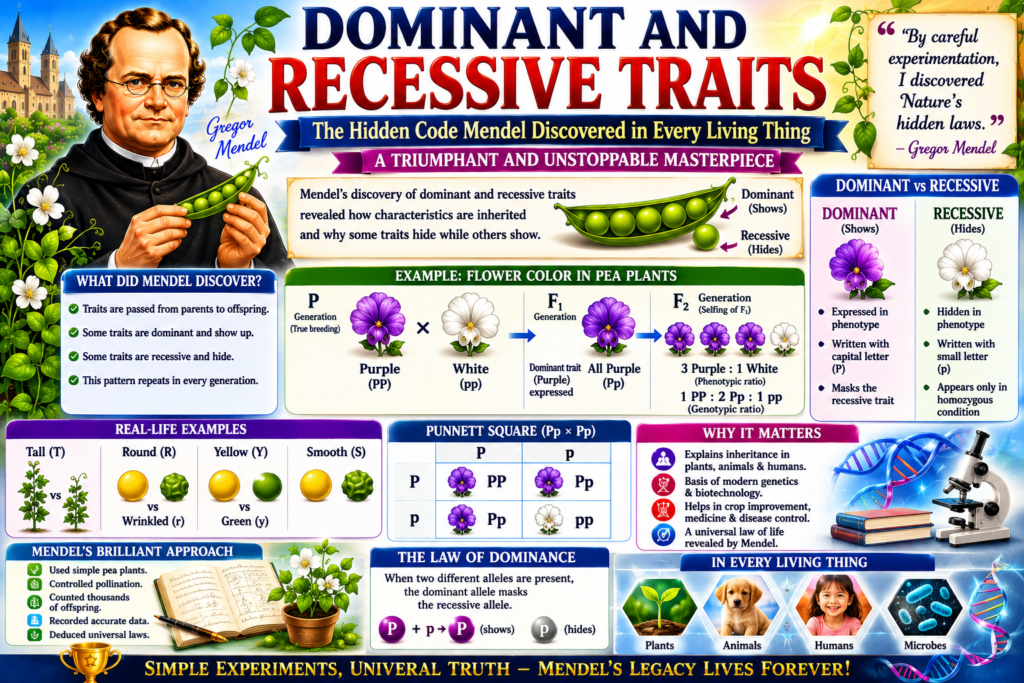
[ P Generation ]  True-Breeding Purple (PP)  x  True-Breeding White (pp)
                                             │
                                             ▼
[ F1 Generation ]                 All Purple Flowers (Pp)
When he crossed a pure purple-flowered plant with a pure white-flowered plant, the blending theory failed instantly. The resulting first filial generation, known as the F1 generation, did not display light pink petals. Instead, every single offspring produced brilliant purple flowers. The white characteristic had been completely suppressed.
Mendel recognized that the purple factor exercised a superior biological influence over the white factor. This profound insight led directly to the formulation of the law of dominance, establishing that when two differing genetic factors are present together, one specific variant will completely mask the expression of the other. The visible, expressed characteristics were labeled dominant, while the hidden, unexpressed characteristics were classified as recessive.
Mendel’s Seven Traits. Source: ttsz / Getty Images
The Hidden Code: Phenotype versus Genotype
To explain how a physical feature could vanish and return later without altering its structure, Mendel introduced a revolutionary conceptual division that modern biology defines as phenotype vs genotype. The phenotype represents the visible physical traits of an organism, such as purple petals or wrinkled seeds. In contrast, the genotype represents the underlying genotypic configuration or the specific combinations of alleles carried within the cellular blueprint.
An organism can possess a dominant phenotype while harboring latent genetic factors for a recessive trait. When a plant inherits identical copies of a gene variant, it is homozygous; if it inherits two different alleles, it is heterozygous. A dominant allele is typically designated by a capital letter, such as P for purple, while the recessive allele is represented by a lowercase letter, such as p for white.
Because the dominant allele acts as a molecular switch that dictates the phenotype, a heterozygous plant (Pp) looks identical to a homozygous dominant plant (PP). This structural reality means that individuals can serve as silent carriers of hidden genetic traits, preserving evolutionary genetics traits within a population without displaying them to the outside world.
The Mathematical Framework of Trait Segregation (1860 – 1863)
Mendel was not content with merely observing the presence of dominant and recessive traits; he demanded mathematical proof to validate his models. He allowed the heterozygous F1 plants (Pp) to undergo self-fertilization naturally, generating a massive F2 generation. When he counted the thousands of offspring, the unexpressed white flower trait returned with absolute predictability.
To decipher the underlying rule of this recovery, he applied the clear logic of the mathematics of heredity. Across thousands of independent trials, he discovered that the visible traits in the second generation always conformed to an exact mathematical distribution. The resulting phenotypic ratio was consistently three dominant individuals to every one recessive individual, famously known as the mendel 3 to 1 ratio.
To demonstrate the structural necessity of this distribution, Mendel utilized an algebraic polynomial expansion. The distribution of male and female gametes during fertilization can be modeled mathematically as the product of two independent genetic probabilities:
(P+p)(P+p)=P2+2Pp+p2
This elegant algebraic equation reveals the precise genotypic distribution hidden beneath the physical surface of the plants:
- 1 part PP (Homozygous Dominant): Visually purple phenotype
- 2 parts Pp (Heterozygous): Visually purple phenotype, acting as silent carriers of the recessive trait
- 1 part pp (Homozygous Recessive Condition): Visually white phenotype
This mathematical harmony proved that the two alleles for a single feature separate, or segregate, cleanly into individual reproductive gametes during cellular formation. This foundational mechanism is defined as the law of segregation, showing that the inheritance of physical features is a game of precise probability rather than random biological blending.
                      Maternal Gametes
                        +-----+-----+
                        |  P  |  p  |
                  +-----+-----+-----+
                  |  P  | PP  | Pp  |
Paternal Gametes  +-----+-----+-----+
                  |  p  | Pp  | pp  |
                  +-----+-----+-----+
The Molecular Basis of Dominance and Recessive Alleles
Modern molecular biology has revealed the exact biochemical reality behind the dominant and recessive traits that Mendel tracked in his garden. Alleles are simply different structural sequences of DNA found at a specific location on a chromosome. A dominant allele typically codes for a fully functional protein, enzyme, or molecular switch that actively drives a specific cellular process, such as producing a vibrant purple pigment molecule.
In contrast, a recessive allele often represents a loss-of-function mutation. This structural alteration alters the DNA sequence so that the resulting protein is either entirely non-functional or completely absent. In a heterozygous individual (Pp), the single dominant allele (P) still produces enough functional enzyme to manufacture the purple pigment, completely masking the defective variant.
The recessive phenotype only becomes visible when the organism inherits a homozygous recessive condition (pp). Lacking a functional copy of the dominant gene, the plant cannot produce the pigment, resulting in a white flower. This biochemical reality forms the foundation of modern medical genetics, explaining the transmission patterns observed in human carriers of recessive diseases.
FAQs
What determines if a genetic trait is dominant or recessive?
Whether a trait is dominant or recessive is determined by how the specific allele behaves at the molecular level. Dominant alleles typically code for a functional protein or enzyme that drives a physical process, whereas recessive alleles often represent a loss-of-function mutation where no functional protein is produced, allowing the dominant partner to control the phenotype.
Can a recessive trait become more common in a population than a dominant trait?
Yes, the dominance of an allele does not dictate how frequently it appears in a population. Allele frequency is driven by evolutionary fitness and natural selection. If a specific homozygous recessive condition provides a distinct advantage for survival, that recessive trait can become highly widespread over time, outcompeting the dominant variant.
What is the difference between complete dominance, incomplete dominance, and codominance?
In complete dominance, the dominant allele completely masks the recessive allele in a heterozygous individual. In incomplete dominance, the alleles blend to create an intermediate phenotype, such as a red and white flower producing pink offspring. In codominance, both alleles are expressed fully and simultaneously, such as a cow displaying both independent red and white patches of fur.
How do carriers pass on genetic vulnerabilities without being affected themselves?
Carriers are heterozygous individuals who possess one dominant allele and one recessive allele for a specific characteristic. Because the dominant allele functions normally, the carrier remains completely unaffected by any negative impacts of the recessive variant. However, if two carriers reproduce, there is a 25% mathematical probability that their offspring will inherit the homozygous recessive condition, displaying the trait fully.
The Triumphant Awakening of Modern Genetics
The revelation that inheritance operates via a digital interaction of dominant and recessive traits shattered old biological dogmas and laid an unbreakable foundation for modern science. Although the naturalists of the nineteenth century completely ignored his work because they lacked the mathematical background to comprehend his probability models, the rediscovery of his research transformed human knowledge forever. It proved that the stunning diversity of life is governed by clean, predictable laws of nature rather than chaotic chance.
From the simple tracking of garden peas to the complex mapping of the human genome, the conceptual division between phenotype and genotype remains an essential tool for medical research, agricultural biotechnology, and evolutionary science. By demonstrating that hidden genetic factors can travel silently through time without losing their structural integrity, Gregor Mendel predicted modern genetics with astonishing accuracy, presenting humanity with an eternal intellectual triumph that continues to unlock the deepest mysteries of the living world.