The internet runs on web applications. Every website you visit, every API you call, every form you submit involves python web development . Python has become one of the most popular languages for building web applications. But beginners face a confusing choice. Which framework should you learn? Three names dominate the conversation. Django, Flask, and FastAPI. Each has different strengths. Each serves different purposes. This excellent guide will explain everything you need to know about python web development with these three frameworks. You will understand their history, their use cases, and exactly when to choose each one. Let me share a fascinating fact from history of python . Guido van Rossum created Python in 1991. But python web development frameworks emerged later. Django was released in 2005. Flask came in 2010. FastAPI arrived in 2018. Each represents a different philosophy. Understanding these philosophies will make you a better developer. The history of programming languages shows that frameworks evolve to solve specific problems. Let me help you choose the right tool for your next project.
Why Python for Web Development
Before comparing frameworks, understand why python web development is so popular. Python is readable, expressive, and has a massive ecosystem. It emphasizes developer happiness and productivity. You can build a working web application in hours, not weeks. Python has excellent database migration tools, authentication libraries, and middleware support. The backend development community in Python is huge and welcoming. Companies using Python for the web include Instagram (Django), Pinterest (Flask), and Netflix (FastAPI). These companies chose Python because it accelerates development without sacrificing scalability. For python for beginners , web frameworks provide structured ways to build real applications. You learn by building. And building websites is motivating. You can show your work to friends instantly. This python web development guide will help you start that journey.
Django The Batteries Included Giant (2005)
Django was released in 2005. It was created by Adrian Holovaty and Simon Willison while working at the Lawrence Journal World newspaper. They needed a framework that could handle rapid deadlines. Django follows the batteries included framework philosophy. It comes with everything you need out of the box. User authentication, database ORM, admin interface, form handling, security features, and much more. This is full stack python development in a single package. Install Django:
pip install django
Create a new project:
django admin startproject mysite
cd mysite
python manage.py runserver
Here is a simple Django view:
# mysite/views.py
from django.http import HttpResponse
from django.shortcuts import render
def home(request):
return HttpResponse("Hello from Django!")
# mysite/urls.py
from django.urls import path
from . import views
urlpatterns = [
path('', views.home, name='home'),
]
Django includes an object relational mapper (ORM) called Django ORM . It lets you work with databases using Python code instead of SQL:
# models.py
from django.db import models
class BlogPost(models.Model):
title = models.CharField(max_length=200)
content = models.TextField()
published_date = models.DateTimeField(auto_now_add=True)
def __str__(self):
return self.title
# Using the ORM
from blog.models import BlogPost
# Create
post = BlogPost(title="My First Post", content="Hello World")
post.save()
# Read
all_posts = BlogPost.objects.all()
specific_post = BlogPost.objects.get(id=1)
# Filter
recent_posts = BlogPost.objects.filter(published_date__year=2024)
Django’s automatic admin interface is legendary. With zero code, you get a full content management system:
# admin.py
from django.contrib import admin
from .models import BlogPost
admin.site.register(BlogPost)
Django also includes Jinja2 templates (though it uses its own template language by default). Templates separate HTML from logic. Django’s MVC architecture (called MVT for Model View Template) keeps code organized. For python web development on large projects with many features, Django is unbeatable. It handles security, sessions, caching, and internationalization automatically.
Flask The Microframework (2010)
Flask was released in 2010 by Armin Ronacher. It started as an April Fool’s joke. But developers loved its simplicity. Flask follows the microframeworks philosophy. It gives you the bare minimum. Routing, request handling, and response generation. Everything else like databases, forms, and authentication comes from extensions. You choose only what you need. This flexibility makes Flask perfect for small projects, microservices, and learning. Install Flask:
pip install flask
Here is a complete Flask application in one file:
from flask import Flask, render_template, request, jsonify
app = Flask(__name__)
@app.route('/')
def home():
return 'Hello from Flask!'
@app.route('/user/<name>')
def user(name):
return f'Hello {name}!'
@app.route('/api/data', methods=['GET', 'POST'])
def api_data():
if request.method == 'GET':
return jsonify({"message": "This is GET"})
else:
data = request.get_json()
return jsonify({"received": data})
if __name__ == '__main__':
app.run(debug=True)
Flask uses Jinja2 templates for HTML rendering. Create a templates/index.html file:
<!DOCTYPE html>
<html>
<head><title>Flask App</title></head>
<body>
<h1>Hello {{ name }}!</h1>
</body>
</html>
Then render it:
@app.route('/welcome/<name>')
def welcome(name):
return render_template('index.html', name=name)
Flask extensions add functionality. Popular extensions include:
# Flask SQLAlchemy for databases
pip install flask sqlalchemy
# Flask Login for authentication
pip install flask login
# Flask WTForms for form handling
pip install flask wtforms
Flask’s minimalism is its superpower. You understand every line of code. There is no magic. For python web development when you need full control or a small API, Flask is perfect. Many developers learn Flask first because the learning curve is gentle. Then they graduate to Django or FastAPI when needed.
FastAPI The Modern High Performance Framework (2018)
FastAPI was released in 2018 by Sebastián Ramírez. It is the newest of the three. FastAPI was built for modern RESTful APIs and high performance APIs . It takes advantage of Python’s async/await features. It is as fast as Node.js and Go. FastAPI automatically generates interactive API documentation using Swagger UI. Install FastAPI with an ASGI server like Uvicorn:
pip install fastapi uvicorn
Here is a simple FastAPI application:
from fastapi import FastAPI
from pydantic import BaseModel
app = FastAPI()
@app.get("/")
def home():
return {"message": "Hello from FastAPI!"}
@app.get("/items/{item_id}")
def read_item(item_id: int, q: str = None):
return {"item_id": item_id, "query": q}
# Automatic data validation with Pydantic
class Item(BaseModel):
name: str
price: float
is_offer: bool = False
@app.post("/items/")
def create_item(item: Item):
return {"item_name": item.name, "item_price": item.price}
Run the server:
uvicorn main:app --reload
Now visit http://localhost:8000/docs. FastAPI automatically generated interactive API documentation. You can test your API directly from the browser. This is a killer feature for python web development .
FastAPI shines with async/await in FastAPI for high concurrency:
import asyncio
@app.get("/slow")
async def slow_endpoint():
await asyncio.sleep(2) # Simulate database or API call
return {"message": "This took 2 seconds"}
@app.get("/fast")
async def fast_endpoint():
return {"message": "Instant response"}
FastAPI includes dependency injection for shared logic:
from fastapi import Depends, Header, HTTPException
def verify_token(authorization: str = Header(...)):
if authorization != "secret-token":
raise HTTPException(status_code=401, detail="Invalid token")
return authorization
@app.get("/protected")
def protected_route(token: str = Depends(verify_token)):
return {"message": "You have access!"}
FastAPI also handles database integration seamlessly. It works great with SQLAlchemy for traditional databases and Beanie for MongoDB. For python web development focused on modern APIs, microservices, or real time applications, FastAPI is the best choice.
Django vs Flask vs FastAPI Comparison Table
Let me break down the key differences when choosing python web development frameworks.
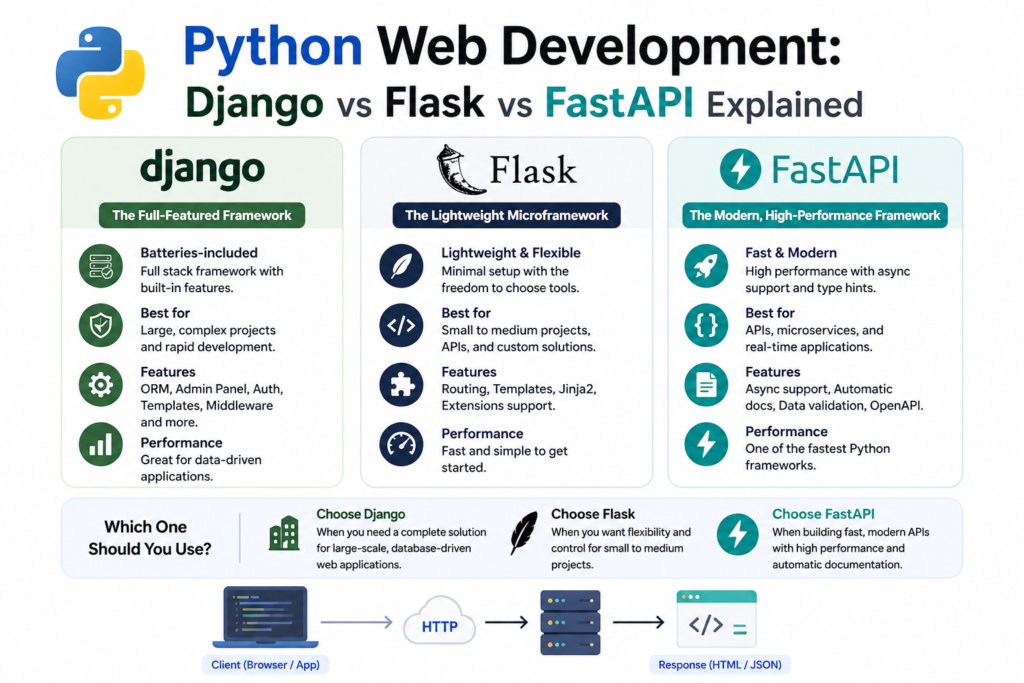
Django Best For:
Large, complex applications with many features. Content management systems. E commerce sites. Social media platforms. Teams that want standardization. Projects where you need everything built in.
Flask Best For:
Small to medium applications. Simple APIs. Prototypes and MVPs. Learning web development. Microservices that are not performance critical. Projects where you want minimal dependencies.
FastAPI Best For:
High performance APIs. Real time applications. Machine learning model serving. Projects requiring async support. Modern RESTful APIs with automatic documentation. Systems needing high concurrency.
Here is a code comparison for the same simple API in all three frameworks.
Django:# views.py
from django.http import JsonResponse
def hello(request, name):
return JsonResponse({"message": f"Hello {name}"})
# urls.py
from django.urls import path
from . import views
urlpatterns = [
path('hello/<str:name>/', views.hello),
]
Flask:from flask import Flask, jsonify
app = Flask(__name__)
@app.route('/hello/<name>')
def hello(name):
return jsonify({"message": f"Hello {name}"})
FastAPI:from fastapi import FastAPI
app = FastAPI()
@app.get('/hello/{name}')
def hello(name: str):
return {"message": f"Hello {name}"}
FastAPI has the most modern feel. Flask is the simplest. Django has the most structure.
ASGI vs WSGI Understanding the Server Layer
To understand python web development frameworks, you need to know about server interfaces. ASGI vs WSGI is a critical distinction. WSGI (Web Server Gateway Interface) is the older standard. It handles one request at a time. Synchronous only. Django and Flask use WSGI by default. ASGI (Asynchronous Server Gateway Interface) is the newer standard. It handles multiple requests concurrently. Supports both sync and async code. FastAPI uses ASGI natively. The web server gateway layer sits between your framework and the web server (like Nginx or Apache). For high performance APIs, ASGI is superior. For traditional websites, WSGI is perfectly fine. The Uvicorn server runs FastAPI. Gunicorn runs Django and Flask. This matters when you need scalability . FastAPI can handle thousands of concurrent connections with fewer resources.
Routing and Middleware Comparison
Routing means mapping URLs to code. All three frameworks handle routing well. But they differ in features. Django uses URL configuration files separate from views. Flask and FastAPI use decorators directly on functions. Middleware is code that runs before or after requests. Django has built in middleware for security, sessions, and authentication. Flask requires extensions for most middleware. FastAPI supports both standard ASGI middleware and its own dependency system. Here is middleware in Flask:
@app.before_request
def before_request():
print("Request received")
@app.after_request
def after_request(response):
print("Request finished")
return response
Here is middleware in FastAPI:
from fastapi import Request
import time
@app.middleware("http")
async def add_process_time_header(request: Request, call_next):
start_time = time.time()
response = await call_next(request)
process_time = time.time() - start_time
response.headers["X-Process-Time"] = str(process_time)
return response
Django middleware is more structured but less flexible. Each approach has tradeoffs.
Frontend Backend Integration
Modern frontend backend integration happens in two main ways. Traditional server side rendering where the backend generates HTML. This is Django and Flask’s strength. They serve complete web pages. Modern single page applications where the backend provides only JSON APIs. The frontend (React, Vue, Angular) consumes those APIs. FastAPI excels at this because of its automatic JSON handling, validation, and documentation. For server side rendering, Django’s templates and Flask with Jinja2 are excellent. For API only backends, FastAPI is superior. Django can also serve APIs using Django REST Framework, but this adds complexity. Many teams use Django for admin interfaces and content management, then FastAPI for public APIs serving mobile apps.
Database and Migration Tools
Database migration means changing your database schema over time without losing data. Django includes built in migrations. One command creates migration files. Another applies them:
python manage.py makemigrations
python manage.py migrate
Flask has no built in database support. You add Flask SQLAlchemy and Flask Migrate (Alembic). This takes more setup but gives flexibility. FastAPI also has no built in database tools. You use SQLAlchemy with Alembic, or use async databases like databases, Tortoise ORM, or Beanie for MongoDB. For python web development beginners, Django’s integrated approach is easiest. For experts who want control, Flask and FastAPI let you choose your database layer.
Authentication and Security
Authentication (logging in) and security are critical for real applications. Django includes comprehensive authentication out of the box. User models, password hashing, login views, session management, and permissions. Flask requires Flask Login extension. Setup takes about 30 minutes. FastAPI requires more manual work. You typically use OAuth2, JWT tokens, or OAuth2 Password Flow. FastAPI has excellent built in tools for OAuth2 and JWT. Here is FastAPI JWT authentication:
from fastapi import Depends, FastAPI, HTTPException
from fastapi.security import OAuth2PasswordBearer
oauth2_scheme = OAuth2PasswordBearer(tokenUrl="token")
@app.get("/users/me")
async def read_users_me(token: str = Depends(oauth2_scheme)):
# Verify token and return user
return {"token": token}
For maximum security, Django is easiest to get right. Flask requires careful extension selection. FastAPI gives you modern standards but requires more code.
Learning Curve and Community Support
The learning curve for python web development varies dramatically. Django has the steepest curve. It has many concepts to learn: ORM, templates, forms, admin, middleware, signals. But once you learn Django, you build incredibly fast. Flask has the gentlest curve. You learn routing, requests, responses, templates. Then you add extensions as needed. FastAPI has a moderate curve. You need to understand type hints, Pydantic models, and async concepts. But the automatic documentation and validation make development joyful. Community support is excellent for all three. Django has the largest community. Flask has the most tutorials. FastAPI has the most modern documentation and fastest growing community. For python for beginners starting web development, Flask is often recommended first. Then Django for large projects. Then FastAPI for APIs.
Frequently Asked Questions (FAQs)
Q1: Which framework is best for beginners in python web development?
Flask is easiest to learn. Then Django. FastAPI is best after you understand basics.
Q2: What is the main difference between Django vs Flask vs FastAPI?
Django is full featured. Flask is minimal. FastAPI is high performance for APIs.
Q3: Which framework is fastest for high performance APIs?
FastAPI is significantly faster than Django and Flask for API workloads.
Q4: Can I use FastAPI for full stack python web development?
FastAPI focuses on APIs. For full stack with HTML templates, Django or Flask are better.
Q5: Is Django still relevant in 2026?
Yes. Django powers Instagram, Pinterest, and thousands of large sites. It is not going away.
Conclusion
You have explored the three pillars of python web development . Django is the batteries included giant perfect for large, feature rich applications. It gives you everything out of the box. Flask is the microframework that values simplicity and flexibility. It lets you build exactly what you need, nothing more. FastAPI is the modern high performance framework for APIs. It delivers speed, automatic documentation, and async support. Your choice depends on your project. Building a content management system or e commerce site? Choose Django. Building a small prototype or learning? Choose Flask. Building a high performance API or microservice? Choose FastAPI. Guido van Rossum gave Python the language. These frameworks gave Python the web. The future of python includes all three. They serve different niches. Learn all of them over time. Start with one that matches your immediate needs. Build something real. Deploy it. Show the world. Your python web development journey starts today.