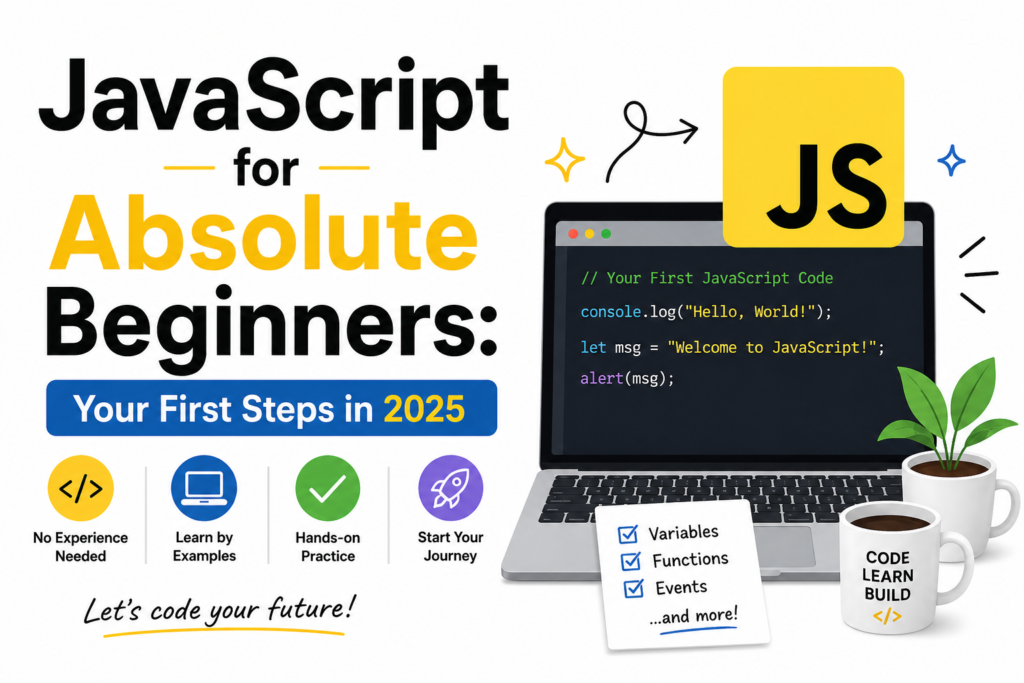
Welcome to the world of programming. You have made an excellent decision. Learning to code will change how you think, solve problems, and build things. Out of all programming languages you could choose, JavaScript is the best starting point for 2025. Why? Because JavaScript runs everywhere. Every single website you visit uses JavaScript. Every interactive button, every animated menu, every form that checks your email before you submit it. That is JavaScript. This javascript beginner guide is designed for people with zero coding experience. I will not assume any prior knowledge. I will not use confusing jargon. I will walk you through everything step by step. By the time you finish reading, you will write your first working programs. You will understand the syntax basics . You will build interactive web pages . And you will have a clear javascript roadmap for continued learning. Let me start with an inspiring fact. Brendan Eich created JavaScript in just 10 days back in 1995. Today, it powers 98% of all websites. That is the power of this language.
Why JavaScript Is the Best First Language for 2025
Before you write your first line of code, understand why JavaScript is perfect for entry-level coding . First, JavaScript runs in your web browser. You do not need to install anything complicated. Every computer has a browser. Every browser understands JavaScript. Second, you see results immediately. Write some code, save the file, refresh the browser. Your program runs. No compilation steps. No waiting. Third, JavaScript is forgiving. It does not crash on small mistakes. It gives helpful error messages. Fourth, the web development for beginners community is enormous. Millions of developers started exactly where you are. They wrote tutorials, recorded videos, and answered questions. You are not alone. Fifth, JavaScript leads directly to a developer career path . Companies cannot hire enough JavaScript developers. Every business needs websites and web applications. Learning JavaScript opens doors to frontend development, backend development with Node.js, and even mobile apps.
What You Need Before Starting
This javascript beginner guide requires almost nothing. You need a computer. Any computer works. Windows, Mac, Linux, even a Chromebook. You need a web browser. Chrome, Firefox, Edge, or Safari all work fine. You need a text editor. Not Microsoft Word. Use something simple like Notepad on Windows or TextEdit on Mac. However, I recommend downloading Visual Studio Code. It is free and designed for coding. That is it. No expensive software. No powerful hardware. No paid courses. Everything you need is free. Open your browser right now. Press F12 or right click anywhere on the page and select “Inspect.” Then click the “Console” tab. You will see a space where you can type JavaScript directly. Try typing console.log("Hello") and press enter. You just ran JavaScript. That is how simple this is. The learning curve for JavaScript is gentle. You can start having fun within minutes.
Your First JavaScript Hello World
Let us write the traditional first program. Open your text editor. Create a new file called hello.html. Type this exact code:
<!DOCTYPE html>
<html>
<head>
<title>My First JavaScript</title>
</head>
<body>
<h1>Hello World</h1>
<script>
console.log("Hello from JavaScript");
alert("Welcome to coding!");
</script>
</body>
</html>
Save the file. Open it in your web browser. You will see a popup alert saying “Welcome to coding!” Press F12 to open developer tools. Click the Console tab. You will see “Hello from JavaScript” printed there. Congratulations. You just wrote your first JavaScript program. The script tags tell the browser where JavaScript lives. The console.log prints messages for developers. The alert shows a popup to users. This simple example teaches you the basic structure. Every JavaScript program runs inside HTML or from a .js file. For learning javascript from scratch , this is your first milestone. Celebrate it.
JavaScript Variables Explained
Variables are containers for storing information. Think of them as labeled boxes. You put a value inside and give it a name. Later you can look inside the box or change what it holds. In JavaScript, you create variables using let, const, or var. Modern JavaScript uses let and const. Here is how javascript variables explained works:
let name = "Alice";
const age = 25;
let isStudent = true;
let score = 99.5;
let colors = ["red", "green", "blue"];
let person = { firstName: "Alice", lastName: "Smith" };
The let keyword creates a variable that can change later. The const keyword creates a variable that cannot change. It is constant. Variable names must follow a few rules. They can contain letters, numbers, underscores, and dollar signs. They cannot start with a number. They are case sensitive. Use descriptive names like userName instead of single letters like x. This makes your code readable. JavaScript is dynamically typed. You do not need to declare that age is a number. JavaScript figures it out automatically from the value you assign. For basic programming concepts , variables are the foundation. You cannot write anything useful without them.
JavaScript Data Types and Operators
Understanding javascript data types and operators is essential. JavaScript has several basic data types. Strings are text inside quotes. "Hello" and 'World' are strings. Numbers are numeric values. 42 and 3.14 are numbers. Booleans are either true or false. Arrays are ordered lists. [1, 2, 3] is an array. Objects are collections of key value pairs. {name: "Alice", age: 25} is an object. Undefined means a variable has no value. Null means intentionally empty.
Operators perform actions on values. Arithmetic operators do math. + adds, - subtracts, * multiplies, / divides, % gives remainder. Assignment operators assign values. = assigns. += adds and assigns. Comparison operators compare values. == checks equality (loose). === checks equality (strict). > greater than, < less than. Logical operators combine conditions. && means AND, || means OR, ! means NOT.
Try this in your browser console:
let x = 10;
let y = 3;
console.log(x + y); // 13
console.log(x * y); // 30
console.log(x > y); // true
console.log(x === 10); // true
Play with these examples. Change the numbers. See what happens. This is how you learn. The online compilers and browser consoles give instant feedback.
JavaScript Functions Explained
Functions are reusable blocks of code. Instead of writing the same code multiple times, you write it once inside a function. Then you call that function whenever needed. This is one of the most important programming fundamentals . Here is javascript functions explained :
function greet(name) {
return "Hello " + name;
}
let message = greet("Alice");
console.log(message); // Hello Alice
The function keyword starts the definition. The name greet is what you call it. The parentheses contain parameters. Parameters are inputs the function expects. The curly braces contain the function body. The return statement sends a value back. You can also create functions without return statements:
function showMessage() {
alert("Button clicked!");
}
Functions can be called from anywhere. You can call a function when a user clicks a button. You can call a function when a page loads. You can call a function inside another function. Functions help you organize code, avoid repetition, and build complex programs from simple pieces. For simple scripts , functions keep everything neat.
Making Decisions with If Statements
Programs need to make decisions. An if statement checks a condition and runs code only when that condition is true. Here is the basic pattern:
let temperature = 30;
if (temperature > 25) {
console.log("It is hot outside");
} else {
console.log("It is not hot today");
}
You can add else if to check multiple conditions:
let score = 85;
if (score >= 90) {
console.log("Grade: A");
} else if (score >= 80) {
console.log("Grade: B");
} else if (score >= 70) {
console.log("Grade: C");
} else {
console.log("Grade: F");
}
The condition inside parentheses must evaluate to true or false. Comparison operators like >, <, ===, !== return booleans. Logical operators combine conditions. This decision making ability transforms static pages into interactive web pages . Your program can respond differently based on user input, time of day, or data from a server.
Repeating Actions with Loops
Loops repeat code multiple times. The for loop is the most common. It runs a block of code a specific number of times. Here is a javascript beginner guide example:
for (let i = 0; i < 5; i++) {
console.log("Count: " + i);
}
This loop prints “Count: 0”, then “Count: 1”, up to “Count: 4”. The three parts inside parentheses are initialization, condition, and increment. The initialization runs once at the start. The condition is checked before each iteration. The increment runs after each iteration. The while loop repeats while a condition remains true:
let count = 0;
while (count < 5) {
console.log("Number: " + count);
count++;
}
Loops are essential for working with arrays. You can loop through every item in a list and do something with each item. Loops also handle repetitive tasks like animating elements or processing data. Practice writing loops with different conditions. Change the starting point, the ending point, and the increment. See what happens. For basic programming concepts , mastering loops is a major milestone.
Interacting with HTML The DOM
JavaScript’s superpower is manipulating web pages. The DOM (Document Object Model) is a tree representation of your HTML. JavaScript can access, change, and delete elements in the DOM. This is javascript DOM manipulation guide territory. Here is a complete example. Create an HTML file:
<!DOCTYPE html>
<html>
<body>
<h1 id="title">Hello World</h1>
<button id="myButton">Click Me</button>
<script>
let button = document.getElementById("myButton");
let title = document.getElementById("title");
button.addEventListener("click", function() {
title.textContent = "You clicked the button!";
title.style.color = "blue";
});
</script>
</body>
</html>
Open this file in your browser. Click the button. The text changes. The color changes. This is the magic of JavaScript. You can select any element on the page and change anything about it. Text, colors, sizes, visibility, position, and even add or remove elements entirely. The web development for beginners community uses these techniques to build everything from simple menus to complex web applications.
Working with User Input
Websites need to collect information from users. The prompt function shows a dialog box asking for input. Here is a simple example:
let userName = prompt("What is your name?");
if (userName) {
alert("Hello " + userName + "! Welcome to JavaScript.");
} else {
alert("Hello stranger!");
}
For more complex input, HTML forms work better. You can read values from text boxes, checkboxes, radio buttons, and dropdowns. Here is a form example:
<input type="text" id="nameInput" placeholder="Enter your name">
<button id="submitBtn">Submit</button>
<p id="output"></p>
<script>
let input = document.getElementById("nameInput");
let button = document.getElementById("submitBtn");
let output = document.getElementById("output");
button.addEventListener("click", function() {
let name = input.value;
output.textContent = "Hello " + name;
});
</script>
User input makes your pages interactive. You can build calculators, quizzes, to do lists, and games. The student resources available online include thousands of examples for handling user input.
Your First Simple Project A Number Guessing Game
Let me walk you through building a real project. This number guessing game uses variables, functions, if statements, loops, and user input. Create an HTML file with this code:
<!DOCTYPE html>
<html>
<body>
<h1>Number Guessing Game</h1>
<p>I am thinking of a number between 1 and 100.</p>
<input type="number" id="guessInput" placeholder="Enter your guess">
<button id="guessBtn">Guess</button>
<p id="message"></p>
<p id="attempts"></p>
<script>
let secretNumber = Math.floor(Math.random() * 100) + 1;
let attempts = 0;
let guessBtn = document.getElementById("guessBtn");
let guessInput = document.getElementById("guessInput");
let message = document.getElementById("message");
let attemptsDisplay = document.getElementById("attempts");
function checkGuess() {
let userGuess = Number(guessInput.value);
attempts++;
attemptsDisplay.textContent = "Attempts: " + attempts;
if (userGuess === secretNumber) {
message.textContent = "Correct! You guessed it in " + attempts + " attempts!";
message.style.color = "green";
guessBtn.disabled = true;
} else if (userGuess > secretNumber) {
message.textContent = "Too high! Try again.";
message.style.color = "red";
} else if (userGuess < secretNumber) {
message.textContent = "Too low! Try again.";
message.style.color = "red";
}
guessInput.value = "";
guessInput.focus();
}
guessBtn.addEventListener("click", checkGuess);
</script>
</body>
</html>
This project uses everything you learned. The computer picks a random number. The user makes guesses. The program gives feedback. When you guess correctly, it shows a success message. Build this project. Test it. Share it with friends. This is your first step toward becoming a JavaScript developer.
JavaScript Roadmap After This Guide
After completing this javascript beginner guide , here is your javascript roadmap . First, master the fundamentals thoroughly. Variables, data types, operators, conditionals, loops, functions, and DOM manipulation. Second, learn javascript ES6 features like arrow functions, template literals, destructuring, spread operator, and modules. Third, understand asynchronous javascript explained concepts like callbacks, promises, and async/await for handling network requests and timers. Fourth, learn the javascript fetch API tutorial for getting data from servers. Fifth, learn a framework. The react vs vue vs angular comparison will help you choose. React is most popular. Vue is easiest to learn. Angular is powerful for large applications. Sixth, learn what is node.js for running JavaScript on servers. This opens backend development. Seventh, study javascript design patterns for writing professional code. Eighth, always stay updated on the future of javascript . The language evolves yearly.
Frequently Asked Questions (FAQs)
Q1: How long does it take to learn JavaScript as a beginner?
With daily practice of 30 to 60 minutes, most people learn fundamentals in 4 to 6 weeks.
Q2: Do I need to know HTML and CSS before JavaScript?
Basic HTML helps because JavaScript manipulates web pages. You can learn HTML alongside JavaScript in one week.
Q3: Can I learn JavaScript on my phone?
Yes. Use apps like SoloLearn or online editors like JSFiddle. But a computer is better for serious learning.
Q4: What is the best first JavaScript project for a beginner?
A number guessing game or a to do list app. Both use variables, functions, events, and DOM manipulation.
Q5: Is JavaScript still worth learning in 2025?
Absolutely. JavaScript is the most used programming language. Demand for JavaScript developers continues growing.
Conclusion
You have completed this javascript beginner guide . You understand why JavaScript is the best first language for 2025. You know how to write variables, functions, if statements, and loops. You can manipulate web pages with DOM. You built a working number guessing game. The future of software engineering depends on JavaScript. Every interactive website uses it. Every web application relies on it. The history of javascript shows incredible growth from a 10 day prototype to the world’s most used language. Now you are part of that story. Open your code editor. Write some code. Make mistakes. Fix them. Build projects. Share your work. The journey from absolute beginner to confident developer is a marathon, not a sprint. But you have taken the first and most important step. Keep going. The world needs your creations.