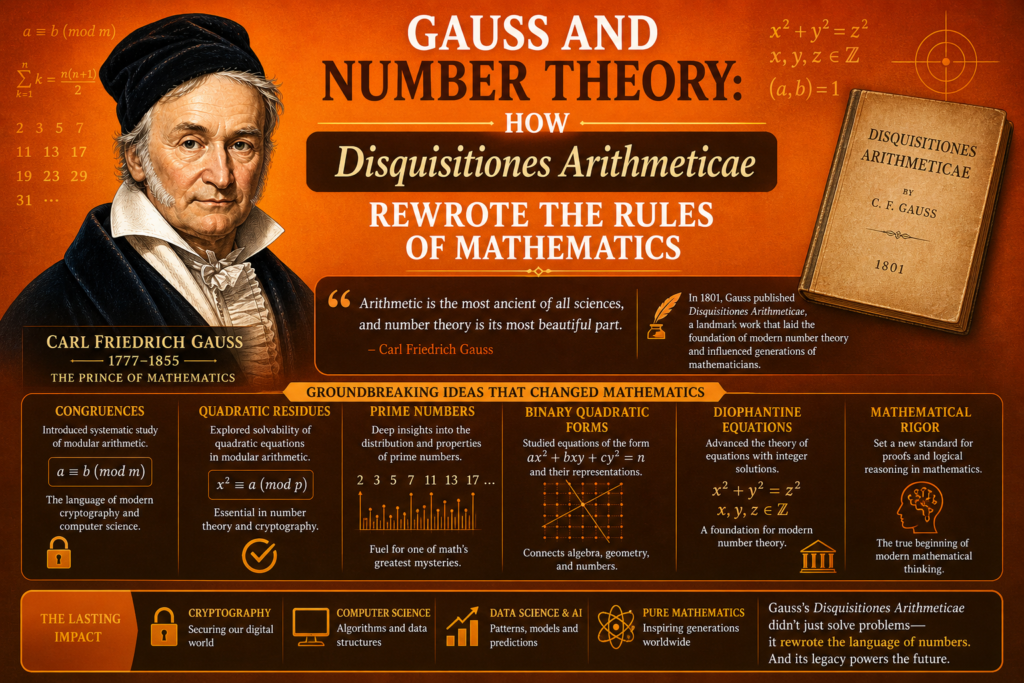
Imagine a world where numbers are just tools for counting. No secrets hidden inside them. No patterns waiting to be unlocked. That was mathematics before 1801. Then a 24 year old genius published a book that shattered that innocent view forever. The book was Disquisitiones Arithmeticae, and it created the entire field of modern gauss number theory. Before Gauss, number theory was a collection of random puzzles, tricks for party games, and isolated theorems from Fermat and Euler. After Gauss, it became a deep, rigorous, and beautiful science. The prince of mathematics did not just add new discoveries; he rebuilt the foundation. He gave us modular arithmetic, the language of clocks and calendars, and the secret code that protects every credit card transaction today. Let us enter the world of gauss number theory and see why this book is considered one of the most influential texts ever written.
The State of Number Theory Before Gauss
To understand the revolution of gauss number theory, you must first see the chaos that came before. For centuries, mathematicians treated number theory as a playground for amateurs. Pierre de Fermat had scribbled his famous Last Theorem in the margin of a book, offering no proof. Leonhard Euler had made brilliant guesses but lacked a systematic method. There was no textbook, no shared language, and no clear direction. The fundamental theorem of arithmetic (that every integer can be uniquely factored into prime numbers) was known, but its consequences were not fully explored. The study of arithmetic properties was fragmented. Gauss looked at this scattered landscape and decided to build a cathedral. His Disquisitiones Arithmeticae (Arithmetical Investigations) organized everything into a logical, beautiful system. It remains the most influential number theory textbook ever written.
The Revolutionary Concept of Congruences
The single most important idea in gauss number theory is the concept of congruences. Before Gauss, mathematicians had to write long, clumsy sentences to describe divisibility. For example, “14 leaves a remainder of 2 when divided by 12.” Gauss compressed this into a elegant notation. He wrote:
This reads: “a is congruent to b modulo m.” It means that is divisible by . This simple notation, introduced in Disquisitiones Arithmeticae, changed everything. Modular arithmetic allowed mathematicians to work with remainders directly, without constantly referring back to the original numbers. It turned divisibility into an algebraic operation. With congruences, Gauss could add, subtract, multiply, and even divide in modular worlds. This is the mathematics behind clocks (where 10 o’clock plus 4 hours is 2 o’clock, because ). Every student of gauss number theory learns this notation on day one, and it remains the universal language of modular arithmetic today.
The Golden Theorem: Quadratic Reciprocity
Within Disquisitiones Arithmeticae, Gauss placed a jewel he called the “Golden Theorem.” This is the law of quadratic reciprocity, one of the most beautiful and surprising results in all of mathematics. The theorem answers a simple question: given an odd prime , which numbers are perfect squares modulo ? For example, modulo 7, the squares are 1, 2, and 4 (because , , , and so on). The reciprocity law connects this question for two different primes and . It states:
Here is the Legendre symbol, which tells you whether is a square modulo . This equation is breathtaking because it shows a deep symmetry between primes. Gauss was so proud of this theorem that he published six different proofs of it during his lifetime. Each proof revealed a different connection: to geometry, to algebra, or to analysis. The law of quadratic reciprocity is the centerpiece of gauss number theory, and it opened the door to the higher reciprocity laws that now form algebraic number theory.
The Structure of Disquisitiones Arithmeticae
The Disquisitiones Arithmeticae is divided into seven sections, each a masterpiece. Section 1 covers congruences in general. Section 2 introduces congruences of the first degree. Section 3 discusses residues of powers, including Fermat’s Little Theorem. Section 4 is the heart of gauss number theory: quadratic reciprocity. Section 5 introduces the theory of binary quadratic forms, a vast subject that Gauss transformed from a collection of tricks into a full algebraic theory. Section 6 explores applications to cyclotomy (the division of circles), where Gauss connected number theory to geometry. Section 7 extends the theory to equations of higher degree. Every section contains original discoveries. The book is written in a dense, terse style. Gauss famously demanded perfection; he removed all traces of how he made his discoveries, presenting only the final, polished proofs. This made the book famously difficult to read. The great mathematician Lagrange reportedly found it “very hard.” But those who persevered found a treasure.
Prime Numbers and the Fundamental Theorem
One of the first topics Gauss addresses in gauss number theory is the fundamental theorem of arithmetic. This theorem states that every integer greater than 1 is either a prime number itself or can be factored into prime numbers in exactly one way (ignoring the order). For example, , and there is no other way to break 30 into primes. This seems obvious, but proving it rigorously is tricky. Gauss provided a clear, logical proof based on divisibility rules and the Euclidean algorithm. He showed that prime numbers are the building blocks of all integers. This theorem is the foundation of integer factorization and modular arithmetic. Without it, much of gauss number theory would crumble. Gauss also studied the distribution of prime numbers, leading him to conjecture the Prime Number Theorem (which was proved almost 100 years later). He counted primes in blocks of 1000 numbers and noticed the pattern that would eventually connect number theory to complex analysis.
Cyclotomy and the 17 Gon Connection
One of the most stunning achievements in gauss number theory is the connection between cyclotomy (the division of circles into equal parts) and the construction of regular polygons. Remember the gauss child prodigy who constructed a regular 17 sided polygon with only a compass and straightedge? That feat appears in Disquisitiones Arithmeticae as an application of his number theory. Gauss proved that a regular polygon with sides can be constructed using only a compass and straightedge if and only if is a power of 2 times a product of distinct Fermat primes (primes of the form ). This result is purely number theoretic. It uses primitive roots and complex numbers (roots of unity) to reduce a geometric problem to an algebraic one. Gauss essentially invented cyclotomy as a branch of gauss number theory. Later mathematicians would extend his ideas to create the theory of algebraic number theory, where ordinary prime numbers factor into “prime ideals” in larger number fields.
Binary Quadratic Forms and Deep Structures
Section 5 of Disquisitiones Arithmeticae is the longest and most technically demanding. It treats binary quadratic forms: expressions of the form , where are integers. Gauss asked: when do two different forms represent the same set of numbers? He introduced the concept of “composition of forms,” a way to combine two forms to get a third. This operation has a structure that modern mathematicians recognize as a group. Gauss did not have group theory (that came later), but he essentially invented it in the context of binary quadratic forms. This work directly led to the development of class field theory and modern algebraic number theory. The binary quadratic forms studied by Gauss are still an active area of research today, with connections to Diophantine equations (equations where we seek integer solutions) and integer factorization algorithms used in cryptography.
The Legacy of Disquisitiones Arithmeticae
The influence of Disquisitiones Arithmeticae cannot be overstated. Every major number theorist of the 19th century studied it cover to cover. Dirichlet, Dedekind, Riemann, and Hilbert all acknowledged their debt to gauss number theory. The book transformed the field from a collection of isolated puzzles into a coherent discipline with deep connections to algebra, analysis, and geometry. Modern cryptography, which secures the internet, relies on the difficulty of integer factorization and the properties of modular arithmetic. The RSA algorithm, which protects your bank transactions, is built on a theorem that appears in Disquisitiones Arithmeticae (Euler’s theorem, a generalization of Fermat’s Little Theorem). Every time you see a padlock icon in your browser, you are seeing a practical application of gauss number theory.
Gauss’s Later Work in Number Theory
Although Disquisitiones Arithmeticae was published in 1801, Gauss never stopped thinking about numbers. He continued to make discoveries in gauss number theory throughout his life, but he published very little of it. His famous mathematical diary, discovered after his death, contains dozens of theorems that he never shared with the world. For example, he discovered the class number formula for imaginary quadratic fields, a deep result connecting prime numbers to geometry. He also made significant progress on the theory of cyclotomy and Gauss sums, which are exponential sums that connect modular arithmetic to complex numbers. These Gauss sums are now essential tools in analytic number theory and in the proof of the Law of Quadratic Reciprocity. Even his unpublished work influenced later mathematicians. The prince of mathematics was so far ahead of his time that his private notes became the research programs of the next century.
Frequently Asked Questions (FAQs)
What is Disquisitiones Arithmeticae and why is it important?
Disquisitiones Arithmeticae is the foundational textbook of modern gauss number theory, published in 1801. It organized centuries of scattered results into a logical system and introduced revolutionary concepts like congruences and modular arithmetic. The book proved the Law of Quadratic Reciprocity, developed the theory of binary quadratic forms, and connected number theory to geometry through cyclotomy. It remains one of the most influential mathematics books ever written.
What are congruences in number theory?
Congruences are Gauss’s elegant notation for working with remainders. We write to mean that and leave the same remainder when divided by , or equivalently that divides . This simple idea is the foundation of modular arithmetic and appears everywhere in gauss number theory, from the laws of prime numbers to the algorithms that power modern cryptography.
How did Gauss prove Quadratic Reciprocity?
Gauss proved the Law of Quadratic Reciprocity using several different methods over his lifetime. His first proof, presented in Disquisitiones Arithmeticae, used a clever induction argument based on Gauss sums (exponential sums involving roots of unity). He later published five additional proofs, each revealing a different aspect of the theorem’s deep structure. The existence of so many distinct proofs shows how central this result was to gauss number theory.
Why is Gauss called the Prince of Mathematics?
He is called the prince of mathematics because of his profound and elegant contributions to nearly every branch of mathematics, including gauss number theory, analysis, geometry, and physics. The title reflects his royal status among mathematicians. Unlike kings who rule through conquest, Gauss ruled through intellectual authority and perfect proofs. His work on gauss number theory alone would have guaranteed his fame, but he also revolutionized statistics, astronomy, and electromagnetism.
How is Gauss’s number theory used in modern cryptography?
Modern cryptographic systems like RSA rely on the difficulty of integer factorization and the properties of modular arithmetic. The RSA algorithm uses the fact that multiplying two large prime numbers is easy, but factoring the product back into those prime numbers is extremely hard. The mathematics behind this comes directly from gauss number theory, specifically from theorems about congruences and Euler’s theorem (a generalization of Fermat’s Little Theorem, which appears in Disquisitiones Arithmeticae).
Conclusion
The publication of Disquisitiones Arithmeticae was a turning point in human intellectual history. Before gauss number theory, the study of integers was a disorganized collection of curiosities. After Gauss, it became a deep, rigorous, and interconnected science. The prince of mathematics gave us the language of modular arithmetic, the beauty of quadratic reciprocity, and the structural power of binary quadratic forms. His work on gauss and ceres and the method of least squares made him famous as an astronomer. His discoveries in gauss normal distribution and gauss non euclidean geometry shaped physics and statistics. But gauss number theory remained his first love, the subject he called the “queen of mathematics.” Every time you check your bank balance online, encrypt a message, or marvel at the patterns of prime numbers, you are standing on the shoulders of this giant. In many ways, how ancient greek scientists changed modern science by creating the foundations of logic and geometry, Carl Friedrich Gauss completed their vision by revealing the hidden arithmetic structures that govern the universe of whole numbers. The queen still reigns, and her crown was polished by Gauss.