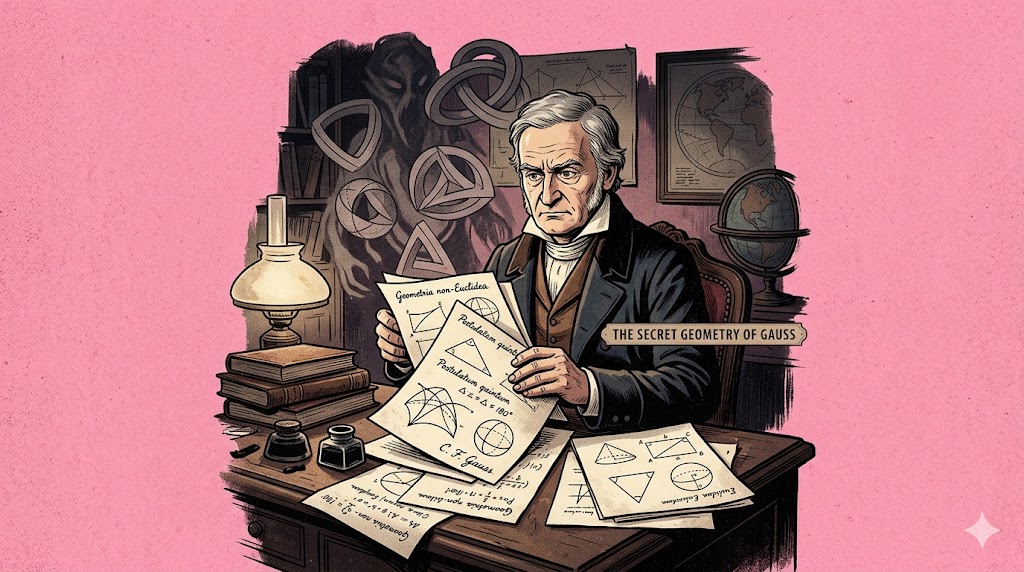
Imagine discovering that the universe is curved, that parallel lines can meet, and that 2000 years of geometry are incomplete. Now imagine keeping that discovery a secret for decades. This is exactly what carl friedrich gauss, the prince of mathematics, did. In the early 19th century, Gauss quietly developed the foundations of gauss non euclidean geometry. He understood that space might not obey the familiar rules of Euclid. He wrote down his insights in private notebooks. He shared them only with trusted friends. But he refused to publish. Why would the greatest mathematician of his age hide a revolutionary idea? Fear. Fear of the “uproar of the Boeotians” (the ignorant masses). Fear of philosophical attacks. Fear of ridicule from the followers of Immanuel Kant, who declared that Euclidean space was the only possible space. This is the dramatic story of gauss non euclidean geometry, the secret that changed science.
The Tyranny of Euclid’s Parallel Postulate
For over 2000 years, Euclid’s Elements was the undisputed bible of geometry. Every schoolboy learned that the angles of a triangle sum to 180 degrees. Every architect trusted that parallel lines never meet. Euclid had five postulates (basic assumptions). The first four were simple and self evident: you can draw a straight line between any two points, you can extend a line, you can draw a circle with any center and radius, and all right angles are equal. But the fifth postulate, the parallel postulate, was different. It was long and complicated. In Euclid’s own words: “If a line segment intersects two straight lines forming two interior angles on the same side that sum to less than two right angles, then the two lines, if extended indefinitely, will meet on that side.” For centuries, mathematicians tried to prove this postulate from the first four. They all failed. The axiom of parallels was a thorn in the side of geometry.
Gauss the Teenage Revolutionary
The young gauss child prodigy was fascinated by the parallel postulate. As a teenager at the University of Göttingen, he began exploring what would happen if the postulate were false. By 1813, he had developed a consistent alternative geometry. He called it “non Euclidean geometry.” In his private notebooks, he wrote, “In the theory of parallels, we are now no further than Euclid. This is a shameful part of mathematics.” He realized that there were at least two alternative geometries: hyperbolic geometry (where parallel lines diverge, and triangles have less than 180 degrees) and elliptic geometry (where parallel lines converge, and triangles have more than 180 degrees). The key to gauss non euclidean geometry was to replace Euclid’s fifth postulate with a different assumption. If you assume that through a point not on a line, there is more than one parallel line, you get hyperbolic geometry. If you assume there are no parallel lines, you get elliptic geometry. Both are logically consistent.
The Mathematics of Hyperbolic Geometry
Let us look at the mathematics behind gauss non euclidean geometry. In hyperbolic geometry, the famous parallel postulate is replaced by the statement: given a line and a point not on that line, there are at least two distinct lines through the point that are parallel to the given line. This seemingly small change has dramatic consequences. The sum of the angles of a triangle is always less than 180 degrees. The area of a triangle is proportional to its “angle deficit” (180 degrees minus the sum of its angles). In fact, for a triangle with angles on a surface of constant gaussian curvature (negative in hyperbolic geometry), the area is:
Furthermore, similar triangles of different sizes are impossible. In Euclidean geometry, you can scale a triangle and keep the same angles. In hyperbolic geometry, the angles determine the size. There is a maximum possible area for a triangle. And parallel lines diverge from each other exponentially fast. Gauss derived many of these relationships in his private notebooks. He even calculated the curvature of space that would be required to make the angles of a large triangle noticeably different from 180 degrees. He found that for any triangle measurable in the 19th century, the deviation would be too small to detect with existing instruments.
Why Gauss Was Terrified
Why did the prince of mathematics hide gauss non euclidean geometry for decades? The answer is fear. In the late 18th and early 19th centuries, the German philosopher Immanuel Kant had famously argued that Euclidean geometry was a synthetic a priori truth: a necessary framework for human experience. Kant declared that space must be Euclidean, and that any alternative geometry was unthinkable. Kant’s followers were powerful and aggressive. Gauss knew that publishing non Euclidean geometry would provoke a storm of philosophical attacks. He wrote to his friend, the astronomer Heinrich Schumacher: “I am becoming more and more convinced that the necessity of our geometry cannot be proven… but the Boeotians (the ignorant) would shout if I published such a view.” Gauss also feared the wrath of theologians who equated Euclidean truth with divine order. He was not a young man seeking fame. He was a middle aged scientist who wanted peace to continue his work on gauss and ceres, gauss geodesy, and gauss electromagnetism. He decided that silence was the safer path.
The Tragic Case of Janos Bolyai
While Gauss kept his secret, others discovered the same ideas. Two men independently developed gauss non euclidean geometry: a Russian named Nikolai Lobachevsky and a Hungarian named Janos Bolyai. Bolyai’s story is heartbreaking. His father, Farkas Bolyai, had been a close friend of Gauss in their youth. Farkas had tried and failed to prove the parallel postulate. He warned his son not to waste time on it. But Janos was obsessed. He succeeded. In 1823, he wrote to his father: “I have created a new, a different world out of nothing.” The proud father sent Janos’s work to Gauss for approval. Gauss replied with a devastating blow. He wrote that he could not praise the work because “to praise it would be to praise myself.” Gauss revealed that he had already discovered gauss non euclidean geometry decades earlier. The young Janos Bolyai was crushed. He never published again. Gauss’s fear of publication had indirectly destroyed another man’s career.
The Bravery of Lobachevsky
Nikolai Lobachevsky, a Russian mathematician at the University of Kazan, had no such fear. He independently discovered hyperbolic geometry and published it in the 1830s. He called it “Imaginary Geometry.” Unlike Gauss, Lobachevsky was not afraid of the Boeotians. He published his results, defended them against critics, and died knowing he had changed mathematics. Today, gauss non euclidean geometry is often called “Lobachevskian geometry” in some textbooks. Gauss privately praised Lobachevsky’s work, calling him a “genuine geometer.” But Gauss never publicly endorsed Lobachevsky. He remained silent. The prince of mathematics watched from the sidelines as others fought the battle he could have led. This is the paradox of Gauss: a man of immense intellectual courage but deep personal caution.
The Theorema Egregium Connection
The secret of gauss non euclidean geometry did not come from nowhere. It grew directly from Gauss’s earlier work on gaussian curvature. In his Theorema Egregium (Remarkable Theorem), Gauss had proved that the curvature of a surface is intrinsic. It can be measured from within the surface. A flat creature living on a sphere can discover that its world is curved without ever leaving it. Gauss realized that this principle applies to three dimensional space as well. We might be living in a curved universe without knowing it. The curvature of space is a measurable quantity. For a space of constant gaussian curvature , the geometry is Euclidean if , spherical (elliptic) if , and hyperbolic if . The gauss non euclidean geometry that Gauss discovered was simply the geometry of spaces with constant negative curvature. His earlier work on gauss geodesy (measuring the Earth’s surface) had given him the tools to think about curved spaces.
The Mathematical Revolution
The eventual publication of gauss non euclidean geometry by Lobachevsky (1829) and Bolyai (1832) triggered a revolution. Mathematicians realized that Euclid was not the only truth. Geometry was not a description of physical space. It was a logical system. Different postulates lead to different, equally valid geometries. This insight freed mathematics from the tyranny of physical intuition. It led directly to the development of Riemannian geometry (by Gauss’s student Bernhard Riemann), then to tensor calculus, and finally to Einstein’s general theory of relativity. When Einstein needed a geometry that could describe a curved, dynamic universe, he reached for gauss non euclidean geometry. The parallel lines that Gauss was too afraid to publish became the paths of light bending around stars. The curved triangles that he drew in his notebook became the fabric of spacetime.
Gauss’s Private Work Revealed
After Gauss died in 1855, his papers and his scientific diary were examined. The world was shocked. Gauss had anticipated almost every major development in gauss non euclidean geometry by decades. His diary contained notes dating back to 1813 describing the consistency of non Euclidean systems. He had calculated formulas for the area of hyperbolic triangles. He had even considered the possibility that physical space might be non Euclidean and suggested experiments to test it (measuring the angles of a large triangle formed by three mountain peaks). The geometric revolution that others took credit for had been fully developed in Gauss’s private notebooks. He simply chose not to share it. This revelation cemented his reputation as the prince of mathematics, but it also raised uncomfortable questions about the responsibility of genius. Should he have published? Would the world have been better off if Gauss had led the charge?
The Philosophical Implications
The story of gauss non euclidean geometry is not just about mathematics. It is about the nature of truth. For 2000 years, humans believed that Euclid’s geometry was the absolute, necessary description of space. Gauss showed that this belief was an accident of history and psychology. The independence of axioms means that we choose our postulates. We can build consistent mathematical worlds that have no physical counterpart. This insight is now fundamental to modern mathematics. It allows us to explore 10 dimensional spaces in string theory, curved spacetimes in relativity, and infinite dimensional spaces in functional analysis. The mathematical philosophy that Gauss pioneered is that mathematics is a creative, human activity, not a passive discovery of pre existing truths. The prince of mathematics gave us permission to imagine impossible geometries.
Frequently Asked Questions (FAQs)
What is non Euclidean geometry?
Non Euclidean geometry is any geometry that does not satisfy Euclid’s parallel postulate. In hyperbolic geometry (a type of gauss non euclidean geometry), given a line and a point not on the line, there are infinitely many lines through the point that are parallel to the given line. The angles of a triangle sum to less than 180 degrees. In elliptic geometry (another type), there are no parallel lines, and triangle angles sum to more than 180 degrees. These geometries are logically consistent and mathematically valid.
Why did Gauss not publish his work on non Euclidean geometry?
Gauss feared the philosophical and religious backlash. The followers of Immanuel Kant believed that Euclidean geometry was the only possible geometry. Publishing gauss non euclidean geometry would have provoked an “uproar of the Boeotians” (the ignorant masses). Gauss valued his peace and quiet. He also feared that the controversy would distract him from his other research. He chose to keep his discovery secret, sharing it only with close friends and in his private notebooks.
How is non Euclidean geometry related to Einstein’s relativity?
Einstein’s general theory of relativity describes gravity as the curvature of space. In the presence of mass and energy, spacetime becomes curved. The geometry of this curved spacetime is non Euclidean. For example, the angles of a large triangle in a gravitational field sum to more or less than 180 degrees. Einstein used the mathematics of Riemannian geometry, which is the direct descendant of gauss non euclidean geometry, to formulate his field equations. Without non Euclidean geometry, there would be no general relativity.
What is the difference between hyperbolic and elliptic geometry?
In hyperbolic geometry (discovered by Gauss, Bolyai, and Lobachevsky), the curvature is negative. Through a point not on a line, there are infinitely many parallels. Triangles have less than 180 degrees. In elliptic geometry (developed by Bernhard Riemann), the curvature is positive. There are no parallel lines (all lines eventually meet). Triangles have more than 180 degrees. The surface of a sphere is a local model of elliptic geometry, but with the complication that lines are great circles.
Did Gauss ever test if physical space is Euclidean?
Yes. As part of his gauss geodesy survey of Hanover, Gauss measured the angles of a large triangle formed by the peaks of Brocken, Inselsberg, and Hohenhagen. He calculated the sum of the angles. Any deviation from 180 degrees would indicate curvature of space. The deviation he found was within the margin of measurement error. He concluded that physical space, over these distances, is effectively flat. However, he left open the possibility that on cosmological scales, space might be curved.
Conclusion
The story of gauss non euclidean geometry is a story of genius, fear, and missed opportunity. Carl friedrich gauss, the prince of mathematics, saw the future. He understood that Euclid was not the last word. He developed a new geometry, a new way of thinking about space, a new language for describing the universe. But he was too afraid to speak. The “uproar of the Boeotians” silenced him. Others, braver or more reckless, took the credit. Janos Bolyai’s life was damaged. Nikolai Lobachevsky fought the battles that Gauss avoided. Yet, when Einstein needed a geometry for his revolution, he turned to the ideas that Gauss had hidden. From the gauss normal distribution to the gauss fast fourier transform, from the gauss-weber telegraph to the method of least squares, from gauss and ceres to gauss electromagnetism, the prince of mathematics shaped our world. But gauss non euclidean geometry is his most daring legacy, the secret that became the shape of the cosmos. In many ways, how ancient greek scientists changed modern science by creating Euclidean geometry as the gold standard of logical proof, Carl Friedrich Gauss shattered that standard and showed that truth comes in many shapes. The universe is curved, and Gauss knew it first. He was just too afraid to tell us.