In 1915, Albert Einstein published a set of equations describing gravity as the curvature of space and time itself. He almost certainly did not expect those same equations to predict something as extreme and terrifying as a region of space where gravity becomes so powerful that not even light can escape. Yet black holes predicted by Einstein’s own mathematics turned out to be one of the strangest, most extreme consequences of his entire theory, an object so bizarre that Einstein himself doubted it could actually exist in nature.
Understanding how black holes predicted through pure mathematics eventually became one of astrophysics’ most thoroughly confirmed phenomena reveals a fascinating story of theoretical courage, mathematical inevitability, and decades of patient scientific verification.
The Theory That Started It All (1915)
The story of black holes predicted begins with Einstein’s publication of general relativity explained, a theory describing gravity not as a traditional force, but as the natural consequence of massive objects curving spacetime itself. According to this framework, gravity is curved spacetime, and objects simply follow the straightest possible paths through this warped geometric fabric.
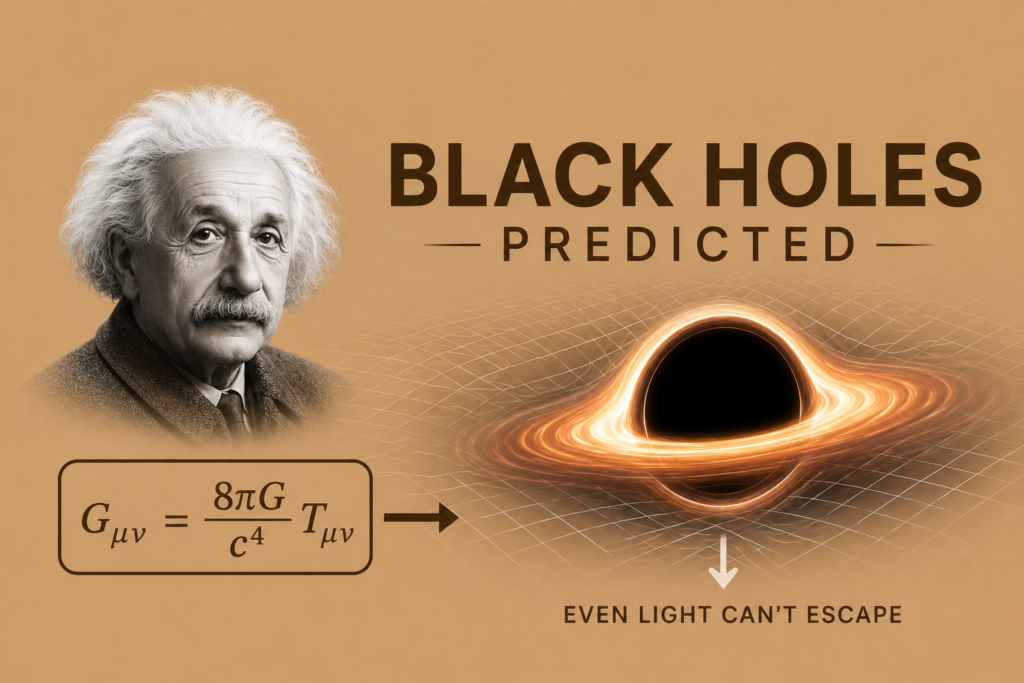
Einstein’s field equations, expressed in simplified tensor notation as:
G_μν = 8πG/c⁴ × T_μν
describe precisely how mass and energy, represented by T_μν, determine spacetime curvature, represented by G_μν, where G is the gravitational constant and c is the speed of light. These equations were remarkably general, meaning they could theoretically be solved for almost any distribution of mass, including situations Einstein himself never anticipated exploring.
Schwarzschild’s Astonishing Solution (1916)
Just months after Einstein published his complete theory, German physicist Karl Schwarzschild, while serving on the Russian front during World War I, found an exact mathematical solution to Einstein’s field equations describing the spacetime surrounding a perfectly spherical, non-rotating mass. This became known as the Schwarzschild solution, and it contained something deeply unsettling.
According to Schwarzschild’s mathematics, if enough mass were compressed into a small enough region of space, the resulting spacetime curvature would become so extreme that a boundary would form, now called an event horizon, beyond which nothing, not even light, could ever escape. This was the first mathematical hint that black holes predicted through general relativity might represent genuine physical objects rather than mere theoretical curiosities.
Even Einstein Was Skeptical
Remarkably, Einstein himself remained deeply skeptical that such extreme objects could actually exist in nature. He viewed the Schwarzschild solution largely as a mathematical curiosity, an interesting but likely unphysical consequence of his equations rather than a genuine astronomical prediction. Many physicists throughout the following decades shared this skepticism, considering black holes predicted by the mathematics to be little more than theoretical oddities unlikely to correspond to anything real in the observable universe.
This hesitation mirrors a broader pattern throughout Einstein’s career, where his own equations sometimes revealed truths he himself struggled to fully accept, a pattern also visible in his skepticism toward certain quantum mechanical implications despite his own earlier contributions through einstein photoelectric effect research.
Building the Physical Picture: Stellar Collapse
The theoretical foundation for taking black holes seriously as physical objects gradually developed through research into stellar evolution. Physicists began understanding that stars generate energy through nuclear fusion, and that once a sufficiently massive star exhausts its nuclear fuel, nothing remains to counteract the star’s own gravitational pull. This connects to broader questions about einstein and nuclear energy processes that govern stellar power production.
When a massive enough star collapses under its own gravity, no known force can halt the collapse, and according to general relativity, the star continues compressing indefinitely, eventually forming exactly the kind of extreme spacetime curvature that Schwarzschild’s mathematics had described decades earlier.
Naming the Phenomenon (1960s)
For decades, the strange objects predicted by Schwarzschild’s solution lacked even a proper name, sometimes described awkwardly as “gravitationally completely collapsed objects.” It was physicist John Wheeler who popularized the term “black hole” during the 1960s, a name that captured the phenomenon’s essential nature perfectly, an object so dense that it appears as a region of complete darkness, swallowing any light that ventures too close.
This period also saw renewed theoretical interest in black holes predicted by relativity, as physicists developed increasingly sophisticated mathematical tools for understanding these extreme objects, building directly upon Einstein’s original framework combined with insights borrowed from special relativity explained regarding the fundamental nature of light and causality.
The Event Horizon: The Point of No Return
Central to understanding black holes predicted through general relativity is the concept of the event horizon, an invisible boundary surrounding a black hole beyond which escape becomes mathematically impossible, even for light traveling at maximum possible speed. This boundary emerges directly from the extreme spacetime curvature predicted by Einstein’s field equations, representing the ultimate consequence of gravity taken to its most extreme mathematical limit.
Interestingly, the physics governing this boundary connects conceptually to the equivalence principle, Einstein’s foundational insight equating gravity with acceleration, since near a black hole’s event horizon, the required acceleration to escape approaches values so extreme that they become physically impossible to achieve.
Time Distortion Near Black Holes
Black holes predicted by relativity also demonstrate extreme time dilation effects, with time itself appearing to slow dramatically for an outside observer watching an object approach the event horizon. From the outside observer’s perspective, an object falling toward a black hole appears to freeze at the horizon, its light stretching toward increasingly longer wavelengths, ultimately fading from view entirely, even though from the falling object’s own perspective, it would cross the boundary without noticing anything unusual at all.
First Observational Evidence (1970s)
Although black holes predicted through pure mathematics remained theoretical for decades, astronomers eventually began finding indirect observational evidence supporting their existence. Throughout the 1970s, scientists identified an X-ray source called Cygnus X-1, where visible starlight appeared to orbit an invisible, extraordinarily massive companion object, providing strong indirect evidence that black holes predicted by Einstein’s mathematics genuinely existed within our own galaxy.
Direct Confirmation: Gravitational Waves and Imaging (2015 – 2019)
The most dramatic confirmation of black holes predicted by relativity arrived in 2015, when scientists directly detected gravitational waves produced by two colliding black holes, ripples in spacetime itself exactly matching predictions Einstein’s equations had made a full century earlier. This discovery represented one of the most significant einstein predictions proven in the entire history of physics.
Just a few years later, in 2019, astronomers captured the first direct image of a black hole’s shadow, using a global network of telescopes to photograph the supermassive black hole at the center of galaxy M87. This unprecedented achievement provided undeniable visual proof that black holes predicted by mathematics developed over a century earlier were genuinely real astronomical objects.
Why This Discovery Still Matters
The confirmation of black holes predicted by Einstein’s equations represents far more than an isolated scientific curiosity. It demonstrates the extraordinary predictive power of mathematical physics, showing how equations developed to solve one problem can reveal entirely unexpected truths about the universe decades or even a century later. The broader Albert Einstein legacy surrounding this discovery continues inspiring ongoing research into black hole physics, gravitational wave astronomy, and the fundamental nature of spacetime itself.
Frequently Asked Questions
How did Einstein’s equations predict black holes?
Karl Schwarzschild found an exact solution to Einstein’s field equations in 1916 showing that sufficiently compressed mass would create an event horizon from which nothing, not even light, could escape.
Did Einstein believe black holes actually existed?
No, Einstein remained skeptical throughout his life that black holes represented genuine physical objects, viewing them largely as an unusual mathematical consequence of his equations.
When were black holes first observationally confirmed?
Indirect evidence emerged during the 1970s through X-ray sources like Cygnus X-1, while direct confirmation came through gravitational wave detection in 2015 and black hole imaging in 2019.
What is an event horizon?
An event horizon is the boundary surrounding a black hole beyond which escape becomes impossible, even for light traveling at its maximum possible speed.
How was the first black hole image captured?
Astronomers used a global network of telescopes called the Event Horizon Telescope to capture the first direct image of a black hole’s shadow in 2019, confirming predictions made over a century earlier.
Conclusion
Black holes predicted by Einstein’s equations stand as one of the most remarkable examples of theoretical physics ahead of its time, mathematics revealing truths about the universe that took over a century of technological advancement to finally confirm directly. From Schwarzschild’s wartime calculations to modern gravitational wave detection and direct imaging, this journey demonstrates the extraordinary power of general relativity to describe reality far beyond what its own creator initially believed possible. More than a century after Einstein first published his equations, black holes remain one of science’s most awe-inspiring confirmations of mathematical prediction meeting observed reality.