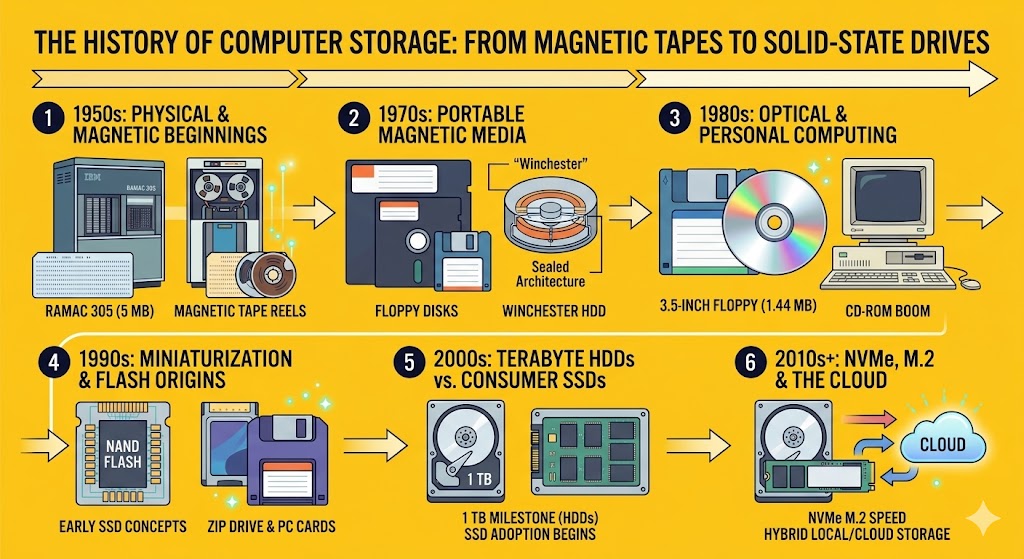
The history of computer storage reveals how digital information has been preserved, accessed, and managed since the early days of computing. From bulky magnetic tapes used in the 1950s to ultra-fast solid-state drives today, storage technology has evolved dramatically.
Modern computing relies heavily on efficient storage systems capable of handling massive datasets. Advances in storage have enabled developments in modern artificial intelligence applications, cloud computing, and large-scale analytics.
The history of computer storage is closely tied to innovations in history of computers, history of computer hardware, and history of databases, which collectively shaped modern computing infrastructure.
Understanding the history of computer storage helps explain how modern systems achieve high performance, reliability, and scalability.
A. The Era of Physical and Magnetic Foundations – 1950–1960
The earliest stage in the history of computer storage relied on magnetic technologies capable of storing digital information on physical media.
These early systems used large mechanical devices equipped with read/write heads to record data on magnetic surfaces.
Storage capacity was limited, but these technologies laid the foundation for the history of magnetic media and future storage systems.
Magnetic Tape (1951)
One of the earliest breakthroughs in the history of computer storage was the development of magnetic tape in 1951.
Magnetic tape allowed computers to store large amounts of sequential data, making it ideal for backups and archival storage.
Although access speeds were slow due to high latency and seek time, tape storage became widely used by early data centers.
The growth of early computing infrastructure described in history of data centers depended heavily on magnetic tape systems.
The First Hard Drive: IBM RAMAC 305 (1956)
In 1956, IBM introduced the RAMAC 305, the first commercial hard disk drive.
This revolutionary system used spinning disks coated with magnetic material and multiple read/write heads to access data.
The RAMAC system demonstrated the potential of random-access storage and played a major role in the evolution of hard disk drives.
However, the machine was enormous and expensive, highlighting the limitations of early storage technologies.
B. The Expansion of Magnetic Media – 1970–1980
During the 1970s and 1980s, the history of computer storage expanded rapidly as magnetic media became more compact and affordable.
Advances in data density and areal density allowed manufacturers to store significantly more data on smaller disks.
These improvements enabled personal computing and enterprise computing systems to adopt disk-based storage solutions.
The Floppy Disk (1971)
In 1971, IBM introduced the floppy disk, which quickly became one of the most important portable storage milestones.
Floppy disks allowed users to transfer files between computers and store software programs.
These disks used flexible magnetic media and relied on read/write heads for data access.
They played a crucial role in the early personal computing era.
The Winchester Drive (1973)
The Winchester drive, introduced in 1973, improved reliability and performance for hard disk drives.
This innovation improved data density and areal density and introduced sealed disk assemblies that protected internal components from contamination.
Later innovations such as perpendicular magnetic recording (pmr) further increased storage capacity and improved disk performance.
C. The Personal Computing and Optical Boom – 1980–1990
The 1980s and 1990s brought a major transformation in the history of computer storage as personal computers became widely available.
Storage devices became smaller, faster, and more affordable, enabling millions of users to store digital files at home.
The 3.5-inch Floppy (1982)
The introduction of the 3.5-inch floppy disk in 1982 improved durability and portability.
Unlike earlier floppy disks, this design included a protective plastic shell that protected the magnetic disk.
The 3.5-inch floppy became a standard storage medium for personal computers throughout the 1980s and early 1990s.
CD-ROM and Optical Storage (1982–1985)
Another important development in the history of computer storage was the emergence of optical storage history technologies such as CD-ROM.
Optical discs used lasers to read data rather than magnetic surfaces.
This technology offered higher storage capacity and improved reliability compared to floppy disks.
Optical media later expanded into DVDs and Blu-ray discs, enabling multimedia storage and distribution.
D. The Miniaturization and Flash Revolution – 1990–2000
The 1990s introduced major innovations that reshaped the history of computer storage.
During this period, engineers developed early flash memory technologies that would later become essential to modern storage devices.
Flash memory relies on nand flash gates to store data electronically rather than magnetically.
These systems are a form of non-volatile memory (nvm), meaning they retain data even when power is removed.
The Rise of SSD Foundations
The development of flash memory laid the groundwork for solid-state drives.
Unlike traditional hard disks, SSDs contain no moving parts, allowing them to deliver much faster data access and improved reliability.
These innovations were crucial to the ssd vs hdd historical development that would shape modern computing.
USB Flash Drives (1999)
In 1999, engineers introduced the first USB flash drives, revolutionizing portable data storage.
These devices offered small form factor (3.5″, 2.5″, m.2) alternatives for carrying digital data.
USB drives quickly became popular due to their durability and convenience.
E. The History of Computer Storage – 2000–2010
The 2000s marked a turning point in the history of computer storage as storage capacity increased dramatically and flash-based technologies became more common.
This period saw the rapid growth of cloud computing infrastructure and digital data creation.
Storage systems became essential for applications discussed in history of big data and large-scale data analytics.
The Terabyte Milestone (2007)
In 2007, hard drives reached the terabyte milestone, enabling users to store enormous amounts of data on a single device.
This breakthrough significantly improved storage affordability and expanded the possibilities of digital media storage.
Consumer SSD Adoption
By the late 2000s, solid-state drives began entering consumer markets.
SSDs delivered superior input/output operations per second (iops) and significantly reduced latency and seek time.
The transition from sata vs nvme interfaces would later improve performance even further.
F. The NVMe and Cloud Integration Era – 2015–2026
Recent years have brought dramatic improvements in storage performance.
NVMe technology allows SSDs to communicate directly with high-speed system buses, dramatically improving data transfer speeds.
These innovations represent a major milestone in the history of computer storage.
NVMe and M.2 (2015–Present)
The introduction of NVMe drives and form factor (3.5″, 2.5″, m.2) standards enabled extremely compact and high-speed storage solutions.
NVMe devices dramatically outperform older SATA drives in terms of speed and efficiency.
These technologies are widely used in cloud computing platforms discussed in history of cloud storage.
The Paradox of Storage
Despite massive improvements in capacity and speed, modern systems face new challenges such as bitrot and data longevity.
Ensuring long-term data preservation has become a critical challenge for large-scale storage infrastructure.
G. The Future: DNA and Atomic Storage – 2026 and Beyond
Looking ahead, researchers are exploring revolutionary technologies that may redefine the history of computer storage.
Experimental storage systems include:
- DNA-based data storage
- atomic-scale storage technologies
- quantum storage systems
These innovations could dramatically increase data density and areal density, enabling computers to store massive datasets in extremely small physical spaces.
Such breakthroughs could transform data storage for future technologies including artificial intelligence and advanced computing.
Frequently Asked Questions (FAQs)
What is computer storage?
Computer storage refers to devices and technologies used to save digital data so it can be accessed later by computer systems.
What was the first hard drive?
The first hard drive was the IBM RAMAC 305, introduced in 1956, which used magnetic disks to store data.
What is the difference between SSD and HDD?
Hard disk drives store data on spinning magnetic disks, while solid-state drives use flash memory, allowing much faster performance and higher reliability.
Why is NVMe faster than SATA?
NVMe connects directly to the system’s high-speed PCIe interface, providing faster input/output operations per second (iops) and reduced latency.
What might replace modern storage in the future?
Future storage technologies may include DNA-based storage, quantum storage, and atomic-scale data storage systems.
Conclusion
The history of computer storage demonstrates how digital storage evolved from large magnetic tapes to ultra-fast solid-state drives. Over the decades, innovations in magnetic media, flash memory, and NVMe technology transformed the way data is stored and accessed.
As digital data continues to grow exponentially, new storage technologies will play a crucial role in supporting cloud computing, artificial intelligence, and future computing systems.